The Importance of Helping Ukraine Defend Itself

The United States is a very strong country, both economically and militarily, and we should be optimistic about the continuation of our leadership role in world affairs.  But we have two strong authoritarian rivals, China and Russia.  China is by far the bigger long-run threat, but we also have to take Russia seriously.

Russian President Vladimir Putin wants to restore the status of the former USSR which was dissolved in 1991.  He is doing this by trying to keep neighboring countries such as Belarus, Ukraine, Georgia and Kyrgyzstan within the Russian orbit.  But Ukraine wants to be free and independent.  Already in 2013 Ukrainians were rallying to express support for joining the European Union.  It is thus no surprise that Ukrainians are now prepared to fight for their freedom from Russia.

The struggle between the United States and Russia is not one of moral equivalence between strong countries.  The U.S. represents and leads the side of freedom and democracy.  Russia is a freedom denying autocracy.  We and our western allies need to do whatever we reasonably can to deter the Russian invasion of Ukraine.

For example:

  • The West needs to arm the likely fierce Ukrainian resistance if a Russian invasion topples the Kyiv government.
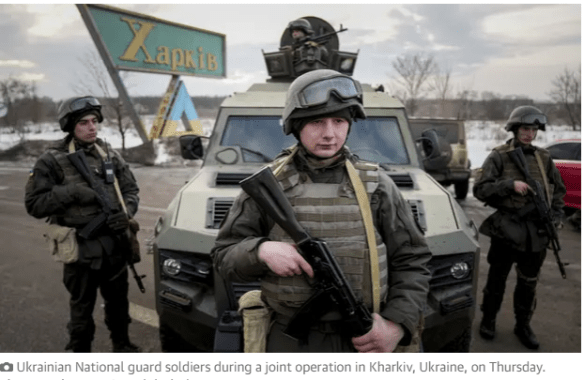
  • Eastern European partners such as Poland, Romania, and the Baltic states need significant upgrades in military hardware and western military forces.
  • NATO membership for Finland and Sweden should become high priority items.
  • Construction of the Nord Stream 2 gas pipeline directly from Russia to Germany should be permanently stopped and alternative supplies for Europe urgently developed.
  • Strict financial sanctions should be imposed including removing Russian banks from the Swift system and seizing all Russian oligarch assets worldwide.
Conclusion.  “The long-term effect of this conflict will hinge on the democratic world’s response. If the U.S. and its allies exact a devastating economic toll on Russia, help Ukraine impose high costs on the invaders, strengthen their military capabilities in Eastern Europe and beyond, and improve the overall cohesion of the democratic community, then this crisis could actually fortify the existing order by showing that efforts to break it will not pay.”

Sign-up for my Email Newsletter
Follow me on Facebook
Follow me on Twitter

Can Inflation be Tamed without a Major Recession?

As of January 2022 inflation is increasing at an annual rate of 7.5%.  The immediate cause is blowout Congressional spending on the pandemic for two years in a row.    Two $3 trillion annual deficits back-to-back was excessive stimulation, even in a pandemic.

The Federal Reserve is now poised to respond by raising interest rates.  There are estimates that short term interest rates will need to rise to between  3% and 4%, from .25% today, to get inflation back to the previous 2% target range.

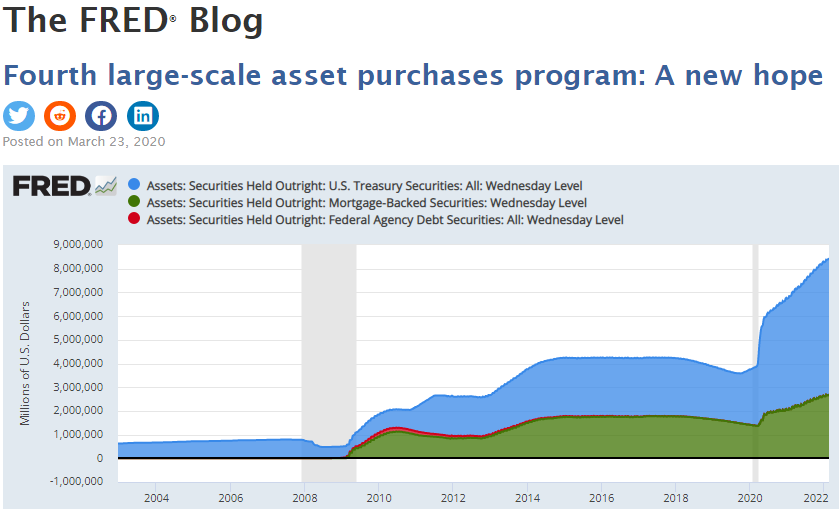
This will force interest rates up all across the economy, from business borrowing to home mortgage rates.  It will create a huge recessionary force which will slow down economic growth.  But, in addition, the Federal Reserve has now built up, through quantitative easing, bond holdings of close to $9 trillion.  As these bonds mature, and are turned over, their interest rates will increase.  This will dramatically raise interest expenses for the bond owners, making recessionary forces even larger.

Last, but not least, our rapidly growing national debt is financed largely by low-interest treasury bonds, as well as equivalent bonds from other countries like China and Japan.  Of course, interest rates will also begin to rise on these debt bonds, which means that interest payments on our debt will begin to rise by hundreds of billions of dollars per year.

Here is my prognosis for inflation, interest rates and debt in the coming months.  The Fed will presumably begin raising interest rates in March and continue doing so until inflation is “tamed.”  If it takes more than just a few months to do this (likely), then a recession will almost surely be kicked off.  The longer the recession lasts, and interest rates continue to rise, the more likely it becomes that a new financial crisis will develop.

Conclusion.  Our close to $30 trillion, and rapidly increasing, national debt is not sustainable indefinitely.  National leaders, including Congress and the President, must get serious about controlling it.  It will require some economic pain for this to happen.  Perhaps the current buildup in inflation will lead to a resolution of this sequence of events: inflation, interest rates, and reduction of the ratio of debt to GDP in the near future.  If so, we will be much better off in the long run.  Hold on to your hats and your wallets!

Sign-up for my Email Newsletter
Follow me on Facebook
Follow me on Twitter
Predicting America’s Political Future

It is easy to predict, with some confidence, a red wave coming in November.   It’s a historical trend, of course.   In addition, the Biden Presidency is struggling and, moreover, inflation will likely still be high in the fall, even if it starts to moderate before then.

But after 2022, things become much murkier.  Who will the Democratic presidential candidate be in 2024?  Will Trump run again?  Lots of things can happen between now and then.

Even though I am an optimist in general about the future of our country, I don’t have any particular insight about how things are going to play out over the coming years.  To have such an insight, in a credible manner, it is necessary to have a framework to base it on.  Here are two individuals who have constructed such frameworks.

  • One of them is Ray Dalio, the successful manager of the hedge fund, Bridgewater Associates.  He predicts that we are likely headed into a new civil war, based on his extensive study of world history.  I am skeptical of this prediction even though it is based on a comprehensive theory that he has constructed. (https://www.wsj.com/articles/principles-for-dealing-with-the-changing-world-order-book-review-ray-dalio-trouble-ahead-as-usual-11637335545)

  • A more compelling framework has been constructed by George Friedman.  He has developed a cyclic theory of American history.  He describes both 80-year institutional cycles and 50-year socio-economic cycles, both of which are coming to a head, i.e. renewing, in the mid to late 2020s. The clashing of these two different cycles, which have renewed separately in the past, is what could cause a storm to occur before the resulting calm.   Of course, things may not happen the way a theory predicts, but still, it’s such an interesting theory that it may have some predictive value.  Mr. Friedman also has a website with frequent postings about ongoing events.

  • My own view. I put value on underlying historical theories in order to construct a framework for predicting the future.  This is why I pay attention to theories like the two I have just outlined above.  But my own prediction is much narrower than theirs.  I think the resolution to our currently divisive and polarized politics will turn out to be more pluralism and decentralization in our political institutions.  In other words, let the blue states and the red states do things their own way (state’s rights) rather than trying to enforce too much national uniformity.  This is already starting to happen.  The red states want to tighten up voting procedures and restrict abortion rights.  Blue states and cities have bigger crime problems and want more restrictions on gun rights.  We should give them more leeway to do as they see fit as long as they are not violating basic constitutional rights.

Conclusion.  The United States has a long and prosperous future to look forward to, but how are broad trends going to play out?  Of course, nobody knows but it still makes sense to try to imagine reasonable courses of action and, then, to do what one can to push things in that direction.

Sign-up for my Email Newsletter
Follow me on Facebook
Follow me on Twitter