Last week I said that the new Fiscal Responsibility Act is a step forward in controlling annual spending deficits and, therefore, getting our national debt under control. It does indeed slow down discretionary spending for the next two years and sets a lower spending baseline for the next decade.

But consider several ominous trends which are making the outlook worse:
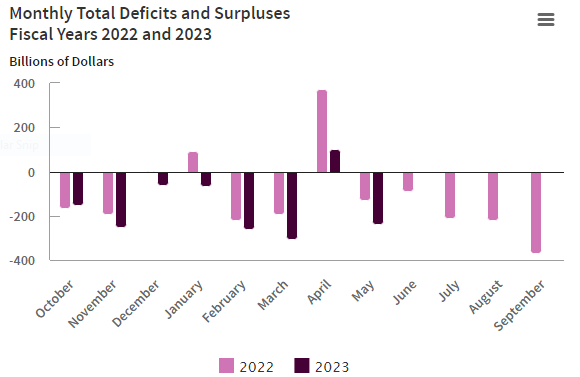
- The Congressional Budget Office reports that the budget deficit for the first eight months of FY 2023 is $1.2 trillion, far more than last year at this time. CBO currently projects a deficit of $1.5 trillion for all of FY 2023 which appears to be very optimistic.

- The Committee for a Responsible Federal Budget reports that the budget deficit totaled $2.1 trillion over the past 12 months through May 2023. As can be seen from the chart below, this is because federal spending is growing rapidly while federal revenue is dropping.

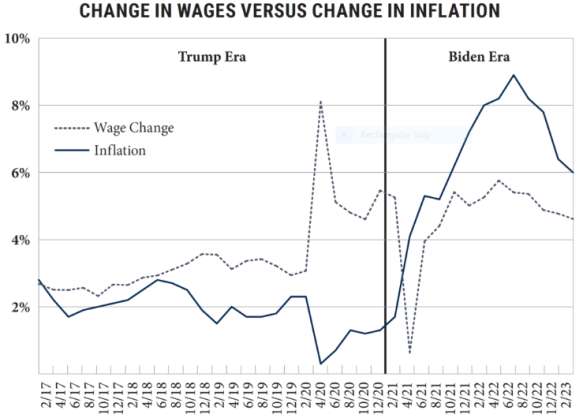
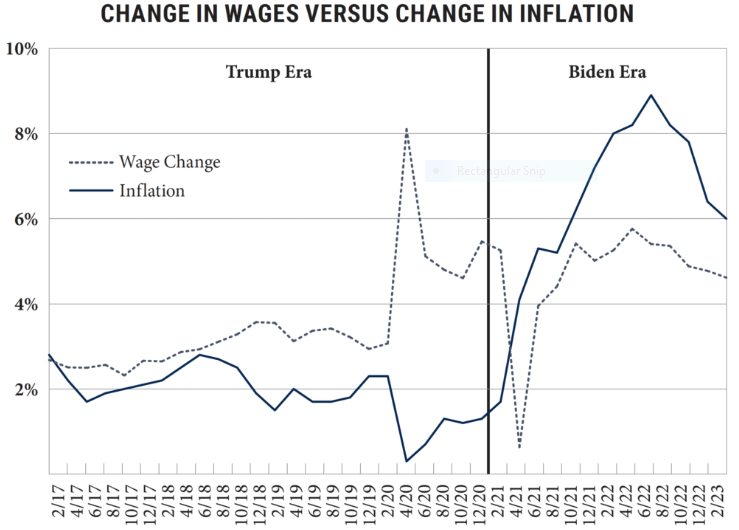
- Inflation, tripped off by the $1.9 trillion American Rescue Plan in March 2021, is far from under control. The liberal economist, Larry Summers, estimates that the three-month Treasury Bill rate is likely to average 4% over the next ten years, much higher than the 2.5% projection by the CBO. Keep in mind that every 1% increase in short-term interest rates raises interest payments by $310 billion per year based on our current (but rapidly growing) debt of $31 trillion.
- At the present time, neither President Biden nor former President (and current candidate) Trump, are willing to support changes to the entitlement programs of Social Security and Medicare. Both need substantial changes to their finances to keep them sustainable for the future. Social Security is conceptually easy (but not politically easy!) to fix (by raising the eligibility age and/or income caps) but Medicare is more expensive than SS and will need more dramatic changes. Entitlement reform is an urgent matter and must soon be addressed by our national leaders.

Conclusion. The recently passed Fiscal Responsibility Act is a plus but much more work needs to be done to put our growing national debt on a sustainable path. The Wall Street Journal calls the need for federal spending restraint “the central issue of our time” and I totally agree!
For my Email Newsletter
Follow me on Facebook
Follow me on Twitter
 It Does Not Add Up