
The last few weeks I have been discussing the budget/debt ceiling debate and how it was resolved in the Fiscal Responsibility Act. Progress was made in controlling spending but it is just a start. Much more needs to be done. Now the action turns to the House and Senate Appropriations Committees where specific sums of money will be allocated for each government agency for FY 2024. This process will be playing out over the next few months.
Looking ahead to the 2024 presidential election, our next president will likewise face some enormous fiscal challenges:
- Record debt levels. Debt held by the public is on track to reach 115% of GDP in 2033 from its current level of 100% of GDP today (see chart below).
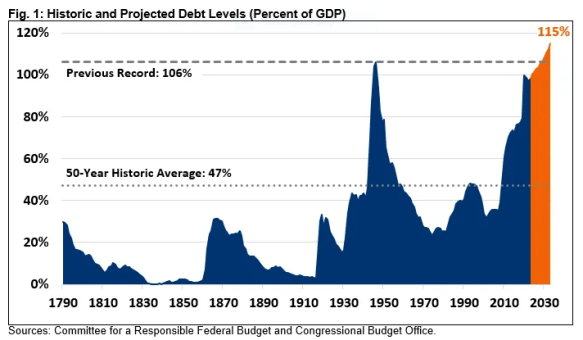
- Growing interest costs. Not only is the national debt itself growing rapidly, but also interest payments on the debt are also growing rapidly because the Fed has been increasing interest rates to control inflation. This, of course, makes the debt grow even faster (see chart below).

- Looming Trust Fund Insolvency. The highway trust fund, the Medicare Hospital Insurance trust fund, and the Social Security trust fund will all soon be depleted (see chart below).

- Major Expirations and the Risk of Costly Extensions. In October 2025 the recently enacted statuary caps on appropriations will expire. By the end of 2025, major provisions in the Tax Cuts and Jobs Act of 2017 and the major expansion of the ACA health insurance subsidies will also expire (see chart below). These expirations must be dealt with in a responsible manner.
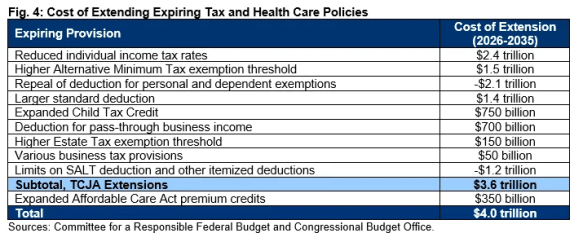


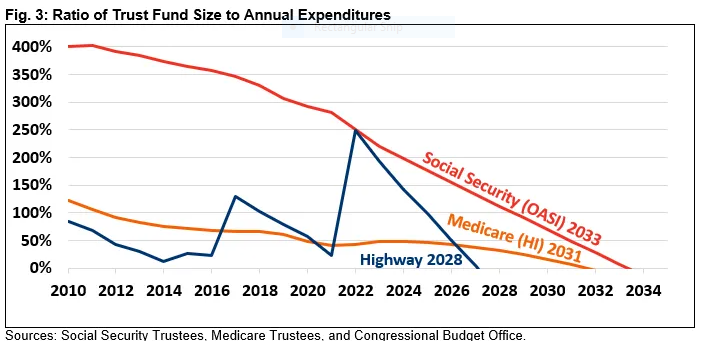

The problem is that neither of the leading candidates for the presidential election in 2024, President Biden nor former President Trump, have a serious commitment to fiscal responsibility. For example, neither one is willing to rein in entitlement spending, the biggest driver of our rapidly exploding debt.
Conclusion. There are many challenges facing the United States, all of which the new president, elected in 2024, will have to deal with. One of these is our rapidly growing national debt. Bringing the debt under control is an urgent problem. Failure to do so puts the United States at great financial risk and therefore becomes a threat to democracy and freedom around the world.
For my Email Newsletter
Follow me on Facebook
Follow me on Twitter
 It Does Not Add Up
It is unlikely that a national fiscal disaster can be prevented, mitigated, or ameliorated by the fragile level of our nation’s social cohesion. Our own example in Nebraska regarding our State’s fiscal responsibility should be nationally promoted, viz., NO indebtedness. We best spend any remaining level of nationally acquired, political capital on the passage of the applicable Constitutional amendment by the States. Our own State should augment this effort by joining it during next year’s Legislative session! Consider it a giant step for rebuilding our State’s level of social cohesion. Just think about our State’s continuing incidence of unacceptable maternal mortality. Shame on us all!
I agree with you that a national fiscal disaster will be very hard, virtually impossible, to avoid by our national political leaders. Nevertheless, we should never give up trying to persuade them to take effective action to put the national debt on a sustainable downward path.