
In a free and open democratic society like ours, there are always challenging problems that need to be addressed. In addition, the entire free world depends on our leadership. Thus the U.S. has a huge responsibility, not only to ourselves but to the entire world as well, to succeed and prosper.
The biggest problem we face at the present time is our huge and rapidly growing national debt. I have devoted several recent posts to the magnitude of this problem, see here and here.


The recent budget/debt ceiling agreement between the House Republicans and President Biden is a small step in the right direction. But far more needs to be done, especially on entitlements, and even more specifically on Medicare. The Manhattan Institute has given an excellent description of the problem and the changes needed, see here and here. Consider:
- The cost of Medicare is expected to double within a decade, rising to $1.9 trillion in 2032, twice the spending on defense. This will be a major contributor to the increase in debt from 98% of GDP in 2022 to the projected increase of debt to 185% of GDP over the next 30 years.
- It is possible to fix this problem without harming beneficiaries. Medicare Trustees estimate that the increase in the program’s cost from price and demographic changes is likely to be less than economic growth over coming decades. That is to say, the cost of delivering existing Medicare services to future retirees is expected to decline as a share of GDP.
- The program’s expected growth is instead driven by the constant addition of new procedures and services to what is covered by Medicare with no legislative oversight to ensure that taxpayers are getting value for their money.
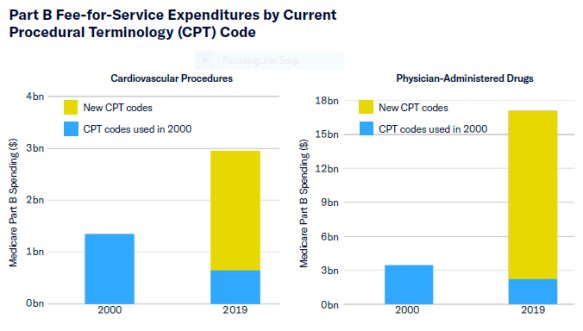
- Between 1997 and 2011, 85% of the increase in real per capita Medicare spending was on newly created procedure codes marking additional medical services. For example, spending on physician-administered drugs surged from $3.4 billion in 2000 to $17.1 billion in 2019, $14.9 billion of which was on codes that didn’t exist in the year 2000.
- At the present time, there is little filtering of whether new additions are cost-effective. Federal law requires that any adjustments, to fees for existing services, have a neutral effect on the federal budget. But no such constraint applies to CMS’s billing-code additions.
- The result is that neither Congress nor the Executive Branch is responsible for considering the cost of adding new services to the basic Medicare benefit package. To close this costly fiscal loophole, Congress should be required to ratify any new deficit-increasing billing codes to Medicare. This would force Congress to stop passing the buck to federal bureaucrats.
- Congressional action to expand basic benefits would still be warranted in the case of high-value new services whose coverage Congress seeks to ensure for all, and which it wishes to be paid for by all taxpayers, rather than just Medicare beneficiaries.

Conclusion. Entitlements in general, and Medicare in particular, are becoming way too expensive to the federal government and must have their costs reined in. Our enormous and rapidly growing national debt cannot be adequately controlled otherwise. The Manhattan Institute has explained how this can be done without burdening existing or future Medicare beneficiaries.
For my Email Newsletter
Follow me on Facebook
Follow me on Twitter
 It Does Not Add Up
In reality, it’s all just another Emporer’s New Clothes scenario a la Hans Christian Anderson fable-fame. That would be a charitable view given that it’s really just another, modern-day Ponzi Scheme. Meanwhile, our nation’s failure to promote the social, political, and economic priorities for assuring that the caring relationships necessary for every child’s early childhood development occur within vibrant, generational families continues to erode our nation’s Population Health and its Primary Healthcare.
Manhattan Institute! Really. We also continue to ignore that the Social Security Trust Fund accounts have not had any investible assets since the Viet Nam conflict. Shame on us all! President Johnson used them to pay for the War “off the books.”
Our national debt is unsustainable on its present course. And the entitlements Social Security and Medicare are its biggest drivers. It is imperative to national survival to rein in their finances in the most effective ways that we can come up with.