
As I often point out, a free and open society like ours always has big problems to address: a huge and rapidly growing national debt, for example. Another problem is how to best relate to our major autocratic rivals, such as China, Russia, and Iran. A third big problem is the extreme political polarization our country faces. But as I also say, I am an optimist about the future of the U.S. One reason for my optimism is the increasing trend of decentralization in American government and society in general

Consider:
- Abortion law. The repeal of Roe vs. Wade by the Supreme Court a year ago was long overdue. Clearly, the U.S. Constitution has no guarantee of abortion rights and, therefore, according to the 10th Amendment, it is an issue that needs to be resolved by the democratic process that, for practical purposes, means at the state level. This is exactly what is now happening.
- Educational choice. Eight states: Arizona, Arkansas, Florida, Indiana, Iowa, Oklahoma, Utah, and West Virginia, have recently adopted universal educational choice at the K-12 level in their states. This has happened because of huge dissatisfaction with the public schools, exacerbated by excessively long school closings during the Covid pandemic. School choice will be especially useful for low-income, often minority children in failing inner-city schools. Better educational achievement is what African/American children most need for faster social and income mobility. This is even more important now that the Supreme Court has struck down racial discrimination in college admissions.

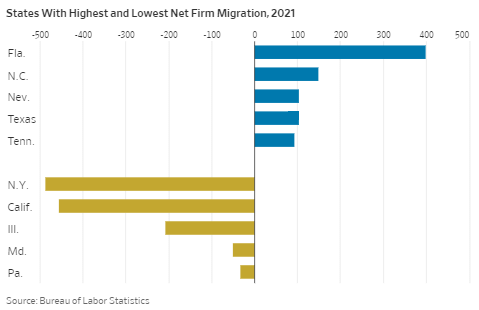
- Migration. After the 2020 census, Texas gained two congressional seats, and Florida and North Carolina each gained one. Also, California, Illinois, and New York each lost one seat. This corresponds to the significant business and personal migration which took place in 2021 because of unnecessary Covid lockdowns as well as much higher tax rates in the out-migration states (see chart below). In other words, more attractive state policies on social and tax issues will draw people from the more oppressive states.
- Fiscal responsibility and debt. The House Republicans are making a huge effort to cut discretionary spending in the FY 2024 budget. Of course, this doesn’t solve our debt problem by itself (entitlement reforms are also badly needed at the federal level), but it could begin a valuable new trend. Shifting major spending categories from the federal government to state governments would reduce federal deficits and save money overall because state governments have balanced budget requirements.
Conclusion. As I have illustrated, there is a major trend developing of sending both social issues (abortion and education) and spending issues back to the states for resolution at the state and local levels. This is a positive movement that could eventually lead to a less divisive resolution of major national issues.
For my Email Newsletter
Follow me on Facebook
Follow me on Twitter
 It Does Not Add Up