The Qualities I Am Looking for in the Next President

As we approach the 2024 Presidential election and the contenders present themselves to the voters, I assess the candidates, just like everyone else.  I have previously stated one essential quality I am looking for in a President: fiscal responsibility.  But, of course, there are other important attributes as well.  Here is my first attempt to describe these essential qualities in a coherent way.  Three of the most important:

  • An optimistic vision for the future of America. We are the strongest and freest country in the world for many reasons.  We aspire to equal opportunity for everyone and work hard to achieve this ambitious goal.  When we fall short, for example, with poor educational outcomes, educational choice springs up in the form of charter schools and/or private school vouchers.  We put a strong emphasis on economic growth and opportunity.  It is no accident that we are a highly innovative society because our economic system encourages growth and development.
  • Fiscal responsibility. One of the major themes on this blog is the urgent need for fiscal responsibility from national leaders.  Our huge and rapidly growing national debt is unsustainable.  The $5 trillion pandemic spending blowout tripped off inflation starting in early 2021, which has forced the Federal Reserve to raise short-term interest rates to 5.25% so far and perhaps higher.  This enormously increases interest payments on the debt that, in turn, makes our deficits and accumulated debt much worse.  The debt problem cannot be fully addressed without major reforms in entitlement spending.
  • A hawkish view of national security. Although we are the strongest nation in the world, we have two major rivals for predominance, China and Russia.  It is critical that we continue to help Ukraine defend itself from the Russian invasion.  It is not only the morally right thing to do but also in our own best interest to defend freedom and democracy around the world.  Our help for Ukraine, for example, will likely deter China from trying to invade Taiwan.
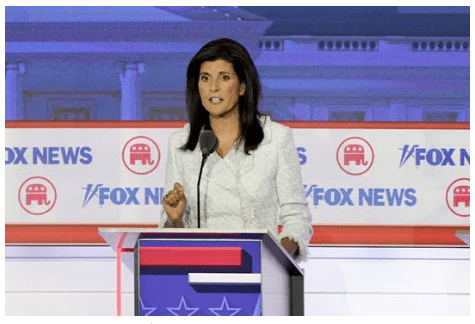
  • Republican presidential candidates. Based on her performance in the first presidential debate, see here and here, Nikki Haley is the only candidate in either party so far who meets all three of the above essential requirements to be President.  She has an inspiring personal story, she understands the seriousness of our debt problem, and she supports our defense of Ukraine.
Conclusion.  Being optimistic about the future of America, understanding the seriousness of our debt problem, and being committed to the strong defense of freedom and democracy around the world, are three very important qualities needed by our next President.  So far, Nikki Haley is the only candidate in either party who has demonstrated these essential qualities.  Much further discussion on this issue will follow as the campaign proceeds!

For my Email Newsletter
Follow me on Facebook
Follow me on Twitter

The Currently Perilous Fiscal Trap We Are In: Strong Economic Growth, Persistent Inflation, Huge Spending Deficits II. More Evidence

My last post pointed out that the currently strong economy, stimulated by huge deficit spending, is likely to keep inflation higher for a longer period of time.  This means higher interest rates which, in turn, means much higher interest payments on our rapidly exploding debt, leading to even higher annual deficits.  This is a vicious trap we have fallen into.  It is critical to take immediate steps to turn this perilous situation around.

Here is the latest data which reinforces this pessimistic view of our current situation.  Consider:

  • Interest rates and the Federal Reserve.  The CPI is up to 3.2% for July, “only” slightly higher than June’s 3.0%.  But core CPI, excluding food and energy prices, is still higher at 4.7%.  And the price of gas has risen significantly in the past few weeks.  In other words,  the Federal Reserve will likely decide to raise interest rates even higher later this year.  And, of course, this is in addition to the damage inflation is already causing by negating wage increases (see chart).

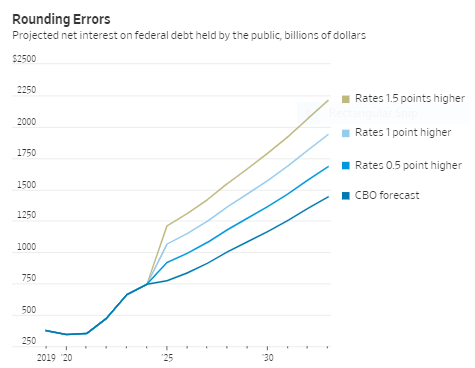
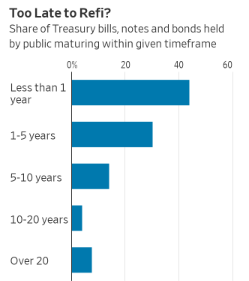
  • The likely rapid increase in interest payments on the debt. This is the scary part.  The first chart shows that over half of the U.S. treasury bonds financing our national debt come due within the next few years.  This means that they will soon be rolled over at much higher interest rates.  Based on the current 5.25% short-term interest rate, CBO projects that interest payments on the debt will reach $1 trillion per year by 2028.  If interest rates rise only .5% more, interest payments will reach $1 trillion by 2026.  And of course, interest payments continue to rise sharply after that.

  • In FY 2023 (this year), interest payments will be almost $700 billion out of a total debt of $1.7 trillion (as estimated by CBO). In other words, deficit spending, without including interest payments, is already hitting $1 trillion annually and rising.  Simple arithmetic shows that our total annual deficit could hit $2 trillion by 2026 as it continues upward.  This is scary!

Conclusion.  Inflation (with concurrent increases in interest rates by the Fed) is making our annual spending deficits grow much faster than otherwise.  This, in turn, overstimulates the economy which is already growing nicely.  Which, in turn, causes inflation to stay higher for longer.  We have created a vicious circle feeding on itself.  We need to break this harmful cycle as quickly as possible.  Significantly lowering annual deficit spending is the only way to do it!

For my Email Newsletter
Follow me on Facebook
Follow me on Twitter
The Currently Perilous Fiscal Trap We Are In: Strong Economy, Persistent Inflation, Huge Spending Deficits

I have long been saying on this blog that our most serious national problem is the huge national debt, now over $32.4 trillion.  And now, persistent inflation, coupled with a strong economy, is exacerbating this debt problem.  Consider:

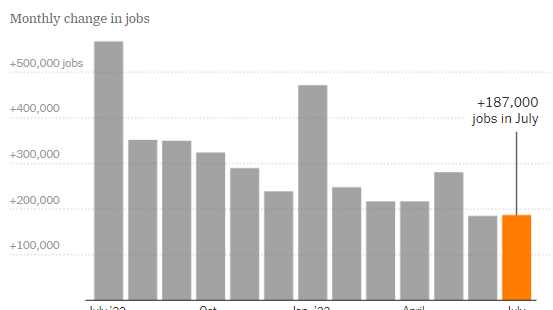
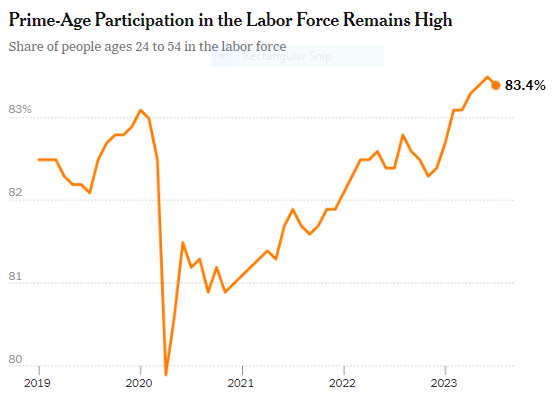
  • Strong Economy.  There were 187,000 new jobs created in July.  Wage gains are finally, after two years, exceeding the increase in inflation.  Job vacancies are high and exceed the number of unemployed.  Labor participation rates are also high.
  • Persistent Inflation.  Although the Consumer Price Index (CPI) grew only 3% in June, core inflation (excluding food and energy) was a significantly higher 4.8%.  And, of course, Fed imposed higher interest rates mean high mortgage rates, badly hurting the housing market.
  • Huge Annual Deficits.  The deficit for FY 2022 was $1.4 trillion.  CBO estimates the 2023 deficit will be $1.7 trillion.  And deficits are projected to keep rising in the future.

The problem in a nutshell.  The $5 trillion Covid pandemic stimulus set off an inflationary spiral, beginning in Spring 2021.  Belatedly the Federal Reserve has raised short-term interest rates to 5.25%.  This has slowed down inflation but not yet back to the desired level of 2%.  Either interest rates must go higher still, or the CPI will linger at a 3% or higher level.  In the meantime, the higher interest rates have raised interest rates on our $32.4+ trillion debt which has massively raised interest payments on the debt.  This greatly increases the annual deficits, which become part of the total debt.  And the increasingly high deficits continue to overstimulate the economy, which, in turn, puts upward pressure on inflation.

The solution is clear.  A strong economy does not need extra fiscal stimulus.  Annual deficit spending must be greatly reduced.  This may slow economic growth somewhat but, in turn, will make it easier for the Fed to bring inflation back down to the 2% level.  In other words, the key to curbing inflation, and getting economic growth back on a sustainable course, is to greatly reduce annual deficit spending.  This can be done if our national leaders are willing to spend the political capital to do it.

Conclusion.  Our current combination of a strong economy, persistent inflation, and high annual fiscal deficits puts our country in a dangerous trap that could easily spiral out of control if not reversed.  The key is to significantly reduce annual deficit spending, as described above.

For my Email Newsletter
Follow me on Facebook
Follow me on Twitter