
The last several posts on this blog have discussed the severity of our debt problem and several different ways to address it. Also addressed is the continuing threat of renewed inflation if annual spending deficits are not significantly reduced.
Even more details on the severity of the problem are presented in today’s post. Consider:
- Hoover Institution scholar, Niall Ferguson, asks the question “Debt has always been the ruination of great powers. Is the U.S. next?” He points out that last year, the U.S. spent $1.107 trillion on defense and $1.104 trillion on debt service. He also points out that America’s expensive welfare system will only become more costly as the population ages, making it harder to reduce the national debt.
|

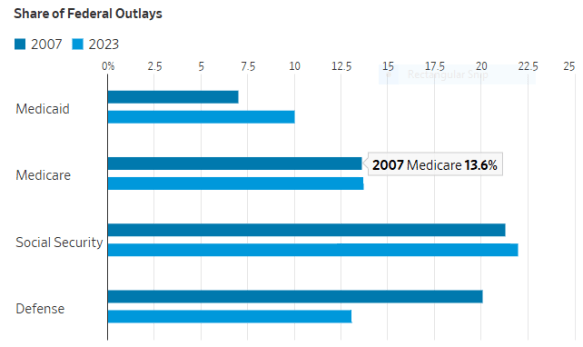
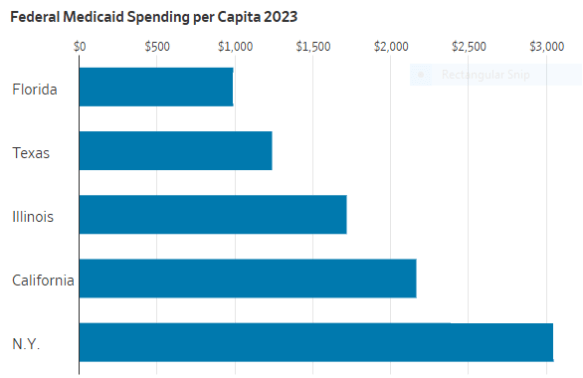
- The Wall Street Journal points out that Medicaid was established to help the needy – poor children, pregnant women, the elderly, and the disabled. Democrats have since expanded it by degrees into a far broader entitlement for able-bodied, working-age adults with lower incomes. Republicans could frame their budget reform as improving the entitlement for the truly vulnerable while putting it on a fiscally sustainable trajectory. Reforms like state block grants and per-capita caps on spending growth would do his while returning flexibility and political accountability to states for how Medicaid dollars are spent.
- Wisconsin Senator Ron Johnson says that fiscal sanity is possible this year. In FY 2019, federal outlays totaled $4.447 trillion. In FY 2020, federal outlays jumped to $6.554 trillion because of the pandemic. From March 2020 to March 2022, the federal government spent $5.2 trillion on Covid relief. There was no justification for maintaining that level of spending once the pandemic was over. Yet this is what we did, spending $6.6 trillion, $6.8 trillion, $6.3 trillion, $6.1 trillion, and $6.8 trillion in FY 2020, 2021, 2022, 2023, and 2024 respectively. President Biden’s 2025 budget proposed spending $7.3 trillion, 63.3% higher than 2019 spending.
Using FY 1998 as a base (the first year since 1969 with a budget surplus), adjusting for inflation and population growth, and using Biden’s 2025 figures for S.S. and Medicare, established a total budget for 2025 of $5.5 trillion, which coincides with Biden’s 2025 revenue projection, thereby producing a balanced budget!

Conclusion. The above analysis demonstrates that the lack of fiscal restraint could be the ruination of our country. It also demonstrates how to achieve fiscal restraint by making some common-sense spending reforms.
For my Email Newsletter
Follow me on Facebook
Follow me on Twitter
 It Does Not Add Up