
On this blog, I discuss a variety of important national problems, often centered around fiscal and economic issues. Today, I talk about political polarization, which is considered a major issue by many people.
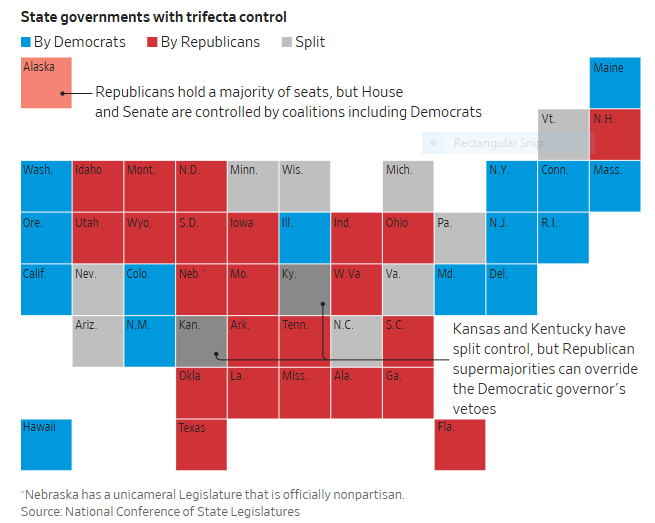
State level polarization. We know that our national politics is highly polarized between the two parties. It so happens that politics at the state level is also highly polarized. Looking at the map below, one can see that 25 states are completely controlled by Republicans, either by holding both legislative branches and the governorship, or else both legislative branches with supermajorities, with 15 states being controlled by Democrats in the same way. This means that issues like abortion and gun control can be dealt with on a completely partisan basis by one party alone in 40 out of 50 states.
School choice. School choice is booming in the red states. In Florida, for example, 51% of K-12 students are now attending a school of their choice, beyond the neighborhood school they are assigned to. School choice in the U.S. is the tipping edge of much-needed education reform.
Congressional redistricting. Congressional redistricting is required every 10 years after a new census in order to equalize population between districts. This process is controlled by state legislatures. But occasionally, such as at the present time, some states will try to redistrict mid-census. Republican Texas and Democratic California and Illinois are considering this right now.
But regardless of how this plays out, the chart below shows that, based on current population trends, Democratic states are likely to lose 12 Congressional seats after the 2030 census, with Republican states gaining 12 seats. This will be a big blow to Democratic prospects for control of the U.S. House of Representatives. The more one party dominates Congress, the more powerful polarization becomes.

Conclusion. Both our national government and our state governments are highly polarized at present and are likely to become more so in the near future. There is at least one benefit of state-level polarization. It is allowing red states to establish school choice. This is the tipping edge of education reform. As school choice improves K-12 educational outcomes, as it surely will, hopefully blue states will recognize this and get on board.
Follow me on Twitter: https://twitter.com/jack_heidel
Follow me on Facebook: https://www.facebook.com/jack.heidel.3
 It Does Not Add Up