
On this blog, I discuss important national issues, often connected with fiscal and economic policy. Lately, I have spent a lot of time discussing the policies, pro and con, of President Donald Trump.
My last post discussed the possibility of a wealth tax, as opposed to an income tax, and why that is not a good idea. Today, I discuss a related issue, how to address poverty in the United States.
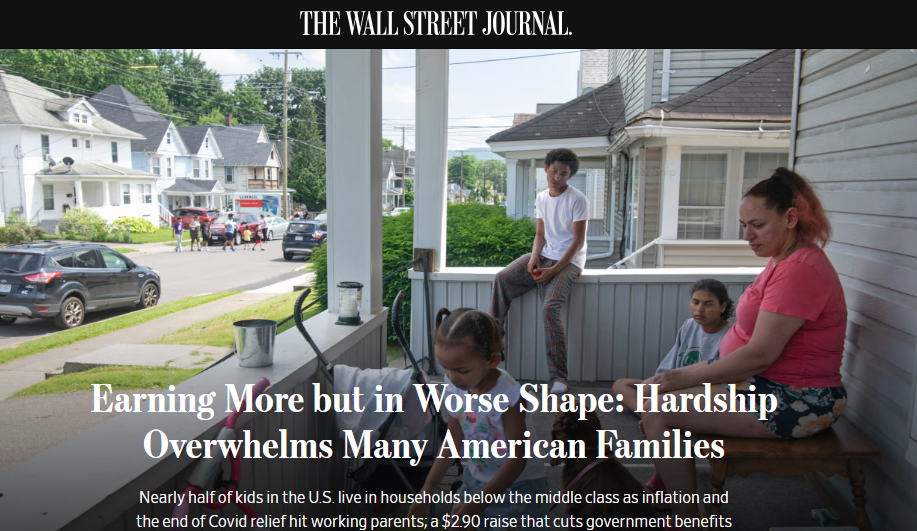
Consider:
- The definition of poverty. In 2024 the official poverty rate in the U.S. was 10.6% for a total of 35.9 million people. For example, the poverty threshold for a family of four (two adults, two children) was $31,200. For a single individual, it was $15,060.
- How can poverty be reduced? The customary advice for anyone to avoid poverty is to 1) graduate from high school, 2) get and hold a full-time job, and 3) don’t have children before getting married. What society in general can do to reduce poverty is to provide a strong educational system at all levels, ensure access to affordable and basic healthcare, and create a dynamic economic system to make sure that there are well-paying jobs at different income levels.
- Ameliorating the poverty that does exist. While attempting to move people up the income scale, society should also try to lessen its negative effects on the poverty that does exist. This can be done with temporary assistance for needy families (TANF), food stamps (SNAP), temporary housing vouchers, and additional income for working adults (EITC).
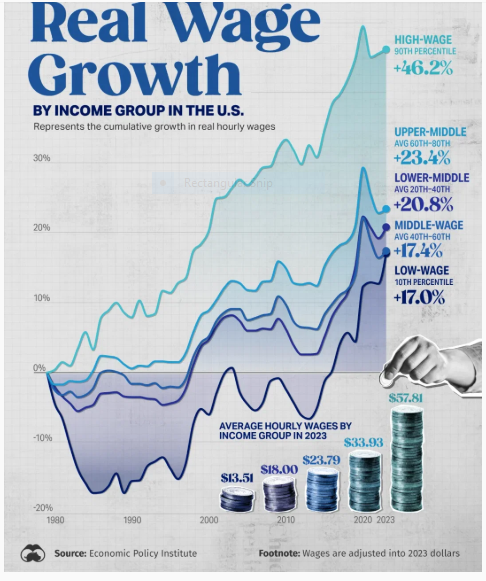
- What won’t help: reducing inequality between different income groups. It is a simple fact of life that real median incomes for different groups won’t grow at the same rates over any extended period of time. This is clearly evident in the attached chart. In this chart, the lowest several income groups have grown much more slowly than the highest income group. This does not contribute to the poverty that exists in the lowest group. Society should try to raise up the people on the bottom, rather than trying to reduce incomes for people higher up on the income ladder.
Conclusion. Society should take all reasonable steps to reduce the national poverty rate as well as ameliorate the effects of poverty on those who are unfortunate enough to be poor. But attempting to reduce income (or wealth) inequality amongst the general population, is not only a bad idea in general, it won’t help one bit to reduce the overall poverty level.
 It Does Not Add Up