Which U.S. ‘Problems’ Should We Be Most Concerned About?

I am mostly an optimist about the future of the United States.  But, according to press reports, we have a lot of pessimists in our midst.  Our country certainly has challenges to deal with, and many people wonder if we will be able to address them all successfully.  I understand their concern, but, with one possible exception, I believe we will meet all the major challenges we face without major repercussions. 

Consider:

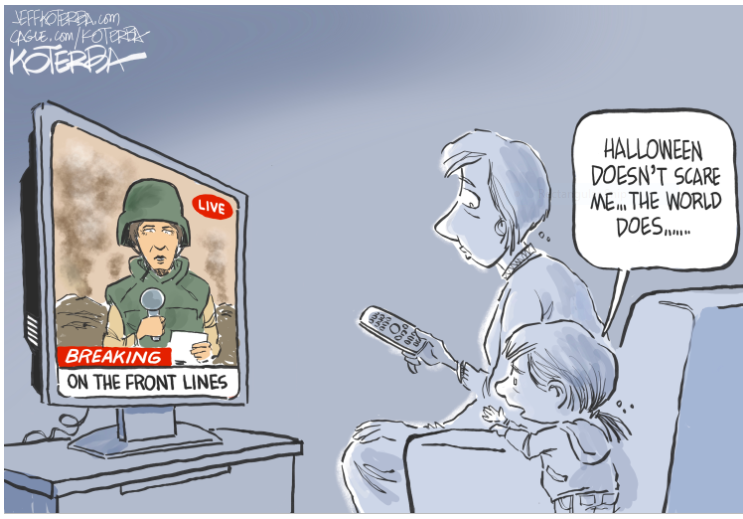
  • The world in disarray. There are now major conflagrations occurring in Ukraine and the Middle East.  Russia invaded Ukraine almost two years ago and Hamas surprised Israel with an attack on October 7.  Both are serious regional wars in which the U.S. is heavily involved.  The U.S. and its allies are helping Ukraine defend itself.  Ukraine wants to expel Russia from all occupied territory, but, it may have to instead negotiate a compromise settlement.  At any rate, it is unlikely that this war will spread beyond the Ukraine/Russia border area.
    In the Middle East, the Israel/Hamas Gaza war is likely to end soon in a cease-fire with some sort of international presence involved to finally achieve justice for Palestinians in Gaza and the West Bank.  I do not think that the current situation will spill out into a larger war in the Middle East because the U.S. and the local powers, Egypt, and Saudi Arabia, do not want this to happen.
  • U.S./China rivalry. China is challenging the U.S.-created world order (Pax Americana) established at the end of WWII.  However, China benefits enormously from international trade with the West and is unlikely to attempt to capture Taiwan by force.  Furthermore, China currently has its own big internal problems to address. In other words, our (economic) competition with China will continue but will unlikely lead to a military confrontation.
  • U.S. political polarization. The progressive left and the conservative right despise each other, and this creates much internal division.  Nationally, it means that a partisan split in Congress makes it difficult to pass bipartisan legislation.  At the state level, only Pennsylvania has a partisan split in the control of its legislative chambers.  I consider our current political polarization as democracy in action and not a sign of national distress.  Eventually, this unpleasant situation will resolve itself politically in a peaceful manner.
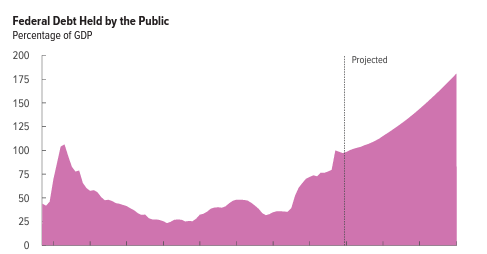
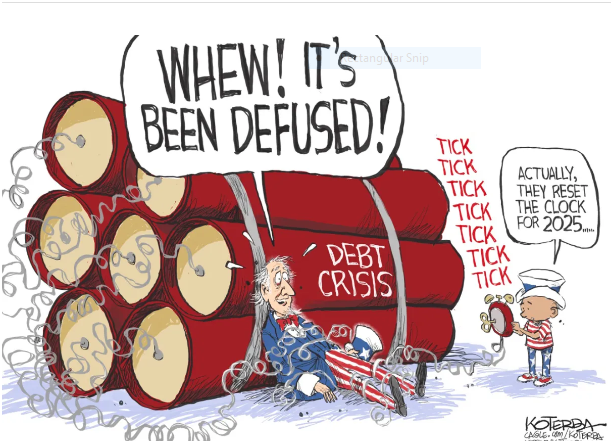
  • National Debt. This is a very serious problem that must be addressed soon to avoid a financial crisis much worse than the one that occurred in 2008.  The only way to effectively do this is with entitlement reform, which, unfortunately, elected national leaders are loath to address.  The debt problem can be solved but, so far, the political will to do it does not exist.

Conclusion.  At the present time, there is an untidy world order with lots of regional stress.  Furthermore, the U.S. is almost equally divided between left and right political factions, and this generates great animosity.  These situations, as unpleasant as they are, will fade away over time in a relatively peaceful manner.  Unfortunately, the U.S. national debt is rapidly getting worse.  If not addressed soon by the President and Congress, a huge new financial crisis will develop that will cause great damage both to the U.S. itself and the rules-based world order that it has created and led since the end of WWII.

For my Email Newsletter
Follow me on Facebook
Follow me on Twitter

The United States – A Country in Constant Transition

Lately, on this blog, I have been discussing the need for continued U.S. world leadership.  We are the strongest country in the world, economically and militarily.  We are the leader of the free (democratic) world.  We do, of course, have autocratic adversaries nipping at our heels.  But it is our responsibility to continue promoting the free, democratic world order we created after WWII and have supported and defended ever since.

Is the U.S. capable of continuing to fulfill this critical role?  What is involved?

  • First of all, we have enormous strengths as a nation.  By stretching across the entire North American continent, from the Pacific Ocean to the Atlantic Ocean, and with friendly northern and southern neighbors, we are difficult to conquer. We have a brilliant, long-lasting, constitutional form of government which has made us, and keeps us, free and prosperous.  We continue to have a dynamic, entrepreneurial economy of rugged individualists that leads the world in developing new products and technologies.
  • We are making steady social progress. Slavery ended in 1865.  Jim Crow racism ended in the 1960s civil rights era. Black poverty declined dramatically from 1940 to 1960, and significantly from 1960 to 1970.  This decline still continues, but more slowly.  In addition, child poverty was lower than ever in 2022.  As another example, school choice is expanding dramatically.
  • In recent years, a new problem has arisen: political polarization. The left denounces the evil of what it claims the country has always been: racist, oppressive, toxically male, transphobic. The right rages against the evil of what the country has become: perverse, perverted, Marxist, elitist, woke.   The two sides don’t trust each other.  A deeper fear is that this nightmare is just getting started.  Artificial Intelligence might magnify our differences by generating and spreading even more misinformation on its own.
  • In the midst of our domestic political strife, humanity overall is making much progress.  Global child mortality is decreasing. One hundred thousand people are emerging from extreme poverty per day.  On the world health front, polio and Guinea worm disease are near eradication. In the U.S., CRISPR gene-editing techniques are starting to be used for sickle cell disease and other ailments.

Conclusion.  On the one hand, the U.S. is a strong, prosperous country that has been very successful in creating a stable and relatively peaceful world order since the end of WWII. Furthermore, great progress is being made worldwide in reducing poverty and improving health.  On the other hand, the U.S. is in the midst of great political strife.  How will our internal divisions play out in the end?  We likely won’t know the outcome for some time.  But I, personally, am optimistic that we, the “indispensable” nation, will be able to resolve our political differences in such a way that our world leadership role will continue unabated for many years to come.

For my Email Newsletter
Follow me on Facebook
Follow me on Twitter

How Is the U.S. Doing as the New Year Approaches?

My recent posts have discussed the role of the U.S. in the world and how it could be improved.  Ever since the end of WWII, the U.S. has been the leader of the free (democratic) world.   Since the end of the Cold War in the late 1980s, the U.S. has been the dominant power in the world.  Our economic and military strength has given us the clout to maintain stability and order worldwide.

How does the U.S. stand today, both domestically and internationally? First of all, we have several very serious domestic problems:

  • As a result of $5 trillion in covid pandemic stimulus spending, inflation flared up starting in Spring 2021 and is still, at 3.1% in November 2023, at a high level. The Federal Reserve has indicated that it doesn’t expect to raise short-term interest rates any higher than the current level of 5.25%, but how soon will it be able to lower this rate substantially? In the meantime, home mortgage rates are very high which greatly retards the housing market.

  • With ever-larger annual spending deficits ($1.7 trillion in FY 2023), our national debt is ballooning. This creates a huge fiscal trap for the future, all the more urgent because higher interest rates mean higher interest payments on our current massive debt of $34 trillion.

  • Our southern border is now virtually out of control, with 10,000 or more illegal immigrants entering the country every day. It will be difficult for Congress and the President to get this very serious problem back under control.

In addition to these domestic problems, the U.S.-led international rules-based order is becoming more unstable.

  • First of all, in August 2021, was our disastrous withdrawal from Afghanistan. Biden’s own military advisors recommended keeping a small residual U.S. force to support the Afghan army but this did not happen.  Consequently, our hasty withdrawal left a chaotic situation on the ground and the Taliban took control immediately.
  • In February 2022, Russia invaded Ukraine. The Ukrainian people are valiantly resisting the invasion with much material support from the U.S. and its European allies.  Russia is supported by military supplies from both Iran and North Korea.  It will be difficult for the much smaller Ukrainian army to push the Russians out.

  • Just two months ago, on October 7, the Hamas forces in Gaza attacked Israel across the border, killing 1200 people. Now, there is a war raging in Gaza as Israel attempts to drive Hamas out.

Conclusion.  Presently, we are facing big domestic problems (inflation, massive debt, open southern border) at the same time as the stable U.S.-led world order is being challenged by several of our autocratic adversaries.  In other words, the U.S. has big domestic and international problems to deal with simultaneously.  Can our national leaders rise to the task of meeting these big challenges?

For my Email Newsletter
Follow me on Facebook
Follow me on Twitter

Maintaining the U.S.-Created International World Order

Lately, on this blog, I have been discussing the continued need for U.S. world leadership.  We have been providing such leadership since the end of WWII and our leadership has been the main factor in preserving the stability and relative peace that has prevailed in the world since then.

But now the U.S. needs a new strategy, that understands that it remains a formidable power but operates in a far less quiescent world.  Our challenge is to run fast but not scared.  The analyst, Fareed Zakaria, has described how the U.S. can step up and achieve an enhanced role in world affairs.  Consider:

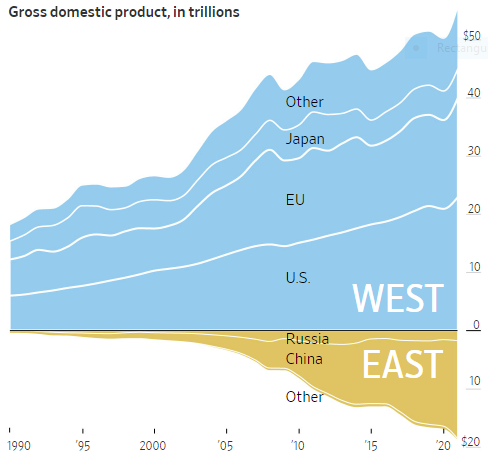
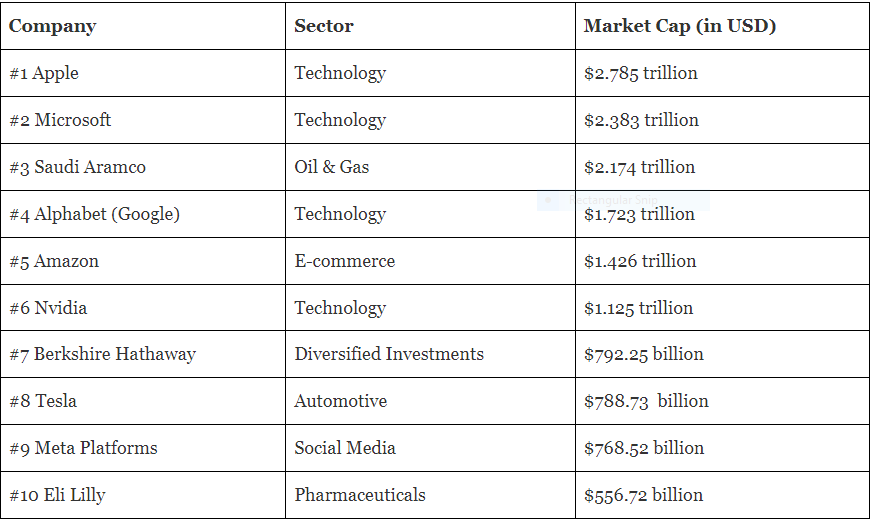
  • The U.S. is now stronger than ever. In 2008, the American and eurozone economies were roughly the same size.  Now the U.S. economy is nearly twice as large as the eurozone.  Of the ten most valuable companies in the world in 1989, only four were American, and the other six were Japanese.  Today, nine of the top ten are American.  Today, the U.S. is the world’s largest producer of oil and gas, larger even than Russia or Saudi Arabia.  The dollar remains the currency used in almost 90% of international transactions.  The country has a high debt load and rising deficits.  But its total tax burden is low compared with those of other rich countries.

  • Between worlds. Despite its strength, the U.S. does not now preside over a unipolar world.  Today, the U.S. faces a world with real competitors and many more countries vigorously asserting their own interests.  But the U.S. remains the single strongest country when adding up all hard-power metrics.  China is our main competitor but its power has limits, beyond shrinking demographics.  It has just one treaty ally, North Korea, and a handful of informal allies, such as Russia and Pakistan.  The U.S. has dozens of allies.
  • The new disorder: the invasion of Ukraine and the Israel-Hamas war. In attempting to conquer Ukraine, Putin miscalculated, but it was not a crazy move since his previous incursions had met with little resistance.  Iran has now spread its influence into Iraq and Syria, and supported Hamas in its war with Israel.   But this, in turn, has brought Saudi Arabia and Egypt closer to Israel.  Saudi Arabia is also becoming closer to China, its largest oil customer.
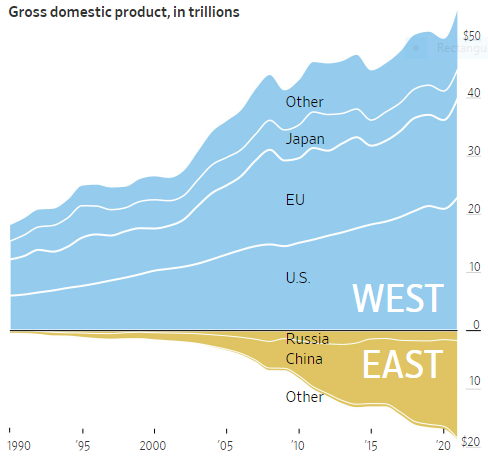
  • Staying Power. The international order that the U.S. built and sustained since WWII is being challenged on many fronts.  But the U.S. is still the most powerful player in that order.  The “free world” coalition that fought and won the Cold War has now expanded into the coalition supporting Ukraine’s military or enforcing sanctions against Russia, which includes almost every country in Europe, as well as a smattering of other states.  Overall, this “West Plus” encompasses about 60% of the world’s GDP and 65% of global military spending.  The challenge from China is a different one.  China is now a superpower.  But China is not a spoiler state like Russia.  It has grown rich and powerful within the international system and is uneasy about overturning this system.  China is searching for a way to expand its power.  The U.S. should accommodate legitimate efforts in this respect.

  • The danger of declinism. Washington’s alliances in Asia and elsewhere act as a bulwark against its adversaries.  For that reality to continue, the United States must make shoring up its alliances the centerpiece of its foreign policy.  The greatest flaw in Trump’s and Biden’s approaches to foreign policy derives from their similarly pessimistic outlooks.  Both assume that the U.S. has been the victim of the international economic system that it created, and that the U.S. cannot compete in a world of open markets and free trade.
  • Keep the Faith. But the GATT system created right after WWII was designed to let poor countries grow rich and powerful, making it less attractive to wage war and to try to conquer territory.  Much of the appeal of the U.S. has been that we have never been an imperial power on the scale of the UK or France.  The world order created was good for the U.S. but also good for the whole world.  It sought to help other nations rise to greater wealth, confidence, and dignity.  That remains the United States’ greatest strength.  The most worrying challenge to the rules-based international order does not come from China, Russia, or Iran.  It comes from the U.S. itself.

Conclusion.  If the U.S. truly turned inward, it would mark a retreat for the forces of order and progress.  Washington can still set the agenda, build alliances, help solve global problems, and deter aggression, even while using limited resources, well below the level it spent during the Cold War.  For all of its internal difficulties, the U.S. above all remains uniquely capable and positioned to play the central role in sustaining this international system.

For my Email Newsletter
Follow me on Facebook
Follow me on Twitter
How the U.S. Can Improve Its International Leadership

My last few posts discuss the need for U.S. leadership in world affairs. We are the strongest country in the world, economically and militarily, and we should step up and take this responsibility more seriously.  No other country can do it nearly as well as we can.

How are we lacking, and what do we need to do differently?  The AEI scholar, Kori Schake, gives the answer in a recent issue of Foreign Affairs.  We should always:

  • Promote American security and economic power while supporting the expansion of democracy around the world. This means maintaining a strong military, cooperating with allies to advance shared interests, and advocating free trade while ensuring fair international competition for U.S. companies.
  • The world is growing more dangerous, and foreign policy bears directly on the state of our domestic economy. The Biden administration works from the theory that U.S. foreign policy has failed the middle class and needs to be repaired through market protections and government subsidies.  This approach has stoked inflation, distorted markets, stunted trade, and frustrated U.S. allies.
  • A majority of Americans, in both political parties, believe their country should provide better leadership, invest in military power, promote international trade, support freedom and democracy, and stand with Ukraine until it wins its war against Russian aggression. Americans are reluctant internationalists, but internationalists all the same.
  • The guiding principle of U.S. policy toward China should be to force or motivate it to become a more responsible economic and geopolitical stakeholder – to play by international rules. Washington should long ago have tightened restrictions on U.S. funding for Chinese military technologies.
  • The problem with U.S. strategy toward globalization in the past 20 years has not been that Washington allowed too much trade but that it permitted trade that did not establish reciprocity – trade that did not create a level playing field. Trade deficits with China cost the U.S. 3.7 million jobs between 2001, when China was admitted to the WTO, and 2018.  Three-fourths of these lost jobs – 2.8 million – were in manufacturing.
  • Little unites Americans more strongly than the belief that the U.S. military should be strong. More adequate funding for defense will necessarily require entitlement reform, especially for Social Security and Medicare.  Entitlements now constitute 63% of federal spending, up from 19% in 1970.  The federal debt stands at $34 trillion.  By 2025 or 2026, interest payments on that debt will exceed defense spending.
  • The failure to protect the U.S. southern border and therefore, to properly regulate immigration, is leading the U.S. to neglect its current biggest geopolitical opportunity: consolidating North American cooperation. U.S. politicians do not worry enough about the downside of Mexico sinking into criminality, especially with unregulated trade in illegal drugs.

Conclusion.  Rejoining the Trans-Pacific Partnership, negotiating and securing the ratification of other trade treaties, increasing defense spending while reforming entitlements and reducing the national debt, securing the U.S. – Mexican border, and aiding countries fighting to preserve their liberty: these are the major goals we should strive for in foreign policy.  Americans support a strong role for the U.S. as world leader, both for the country’s sake and for their own individual safety and prosperity.

For my Email Newsletter
Follow me on Facebook
Follow me on Twitter

Why the U.S. Is Such a Strong and Indispensable Nation

My last few posts have discussed the current great need for leadership in the world and why only the U.S. can provide it.  Wars, inflation, political uncertainty, the rapid growth of technology, all of these major events create a complicated and chaotic environment.  The reason why it is so critical for the U.S. to step up to the moment is because we are the strongest country in the world by far, and thus, only we can provide the leadership that is needed so badly.

Consider:

  • We are the oldest democracy in the world, our brilliant constitution being ratified in 1787, with only 27 amendments having been passed in the last 236 years. The U.S. is an “invented” nation (as opposed to an evolved nation), established less than 200 years after the first settlers arrived in the early 1600s.  With a population of over 330 million, we are the third largest country in the world, behind only India and China.
  • We have natural geographical advantages, such as stretching across the entire North American continent, with friendly neighbors, Canada and Mexico, on our borders. This makes the U.S. much easier to defend.
  • As a nation of immigrants, we are descended from rugged individualists willing to risk their lives and livelihoods to travel across the ocean and establish themselves on a new continent.
  • By the mid-1800s, as the nation began to fill up and industrialize, a system of universal public K-12 education developed so that all citizens would have an opportunity to become literate and acquire useful skills. At the present time, with public K-12 education floundering, especially in the larger cities, school choice alternatives are springing up across the country.
  • Our free enterprise economic system provides maximum opportunity for individuals to thrive by developing their natural talents into productive careers. In fact, our amazing entrepreneurial business culture has now led to nine of the top ten companies in the world being American.

  • Economic growth leads to social advancement. There are plenty of naysayers about the American economy, but it is still the best there is. We have achieved huge economic and social advancement in recent years and continue to do so.

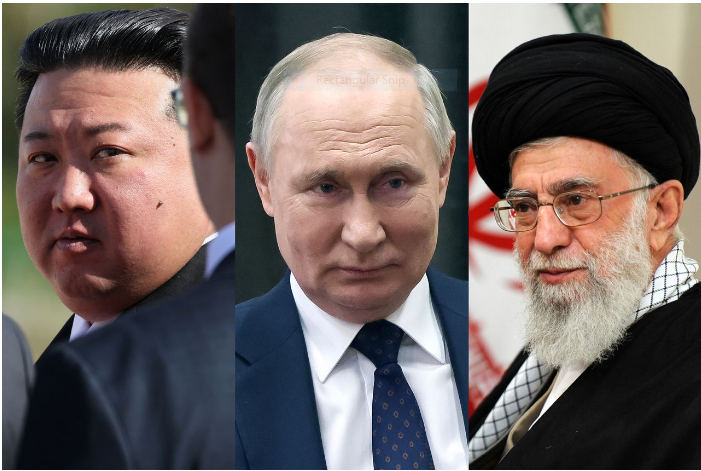
  • As the top power in the world, the U.S. has adversaries such as China, Russia, Iran, and North Korea, who envy our elevated status and want to bring us down.  But we also have many strong democratic allies around the world.  Democracies seldom go to war with each other.  Together with our allies, we have far greater economic and military strength than our adversaries.

Conclusion.  The U.S. has many strengths as a nation that we should clearly recognize but never take for granted.  We are the one indispensable nation in the world and should accept the responsibility to assume a strong leadership role.  It is in our own best interest to do this because the world will then be much better off as a result.

For my Email Newsletter
Follow me on Facebook
Follow me on Twitter

The World Now Needs U.S. Leadership More Than Ever V. Bidenomics is Unsustainable

The outbreak of war in Gaza between Israel and Palestine has created a tense atmosphere around the world, which can only be mitigated by U.S. leadership.   Republicans can help by acting in a responsible manner, but the Democrats are largely in charge under President Biden.

The problem is that Bidenomics, the economic policy of the Biden Administration, is unsustainable.  Consider:

  • The main problem with Bidenomics is that it relies far too much on deficit financing which drives us the national debt.  The deficit for FY 2023 is $1.7 trillion, up from $1.4 trillion in FY 2022.  Such huge deficits greatly overstimulate the economy and, therefore, make inflation worse than otherwise and much harder for the Federal Reserve to control.
  • The Inflation Reduction Act’s manufacturing tax credits include “prevailing wage” requirements, which force firms that take the money to meet or exceed the average minimum wage for that type of work. The requirements prevent firms from competing to reduce labor costs and effectively make unions wage setters.  Forcing nonunionized employers to pay the same wages as unionized ones is unionization by other means.
  • Census Bureau data exposes the true cost of Bidenomics. Median real (inflation- adjusted) income has decreased each year since 2019 (see chart).
  • The following chart shows even more dramatically the comparison between wage growth and inflation between the Trump years and the Biden years. Wage gains exceeded inflation during the Trump years but started to fall behind shortly after Biden took office in January 2021.  Only in the last few months has that trend reversed itself.
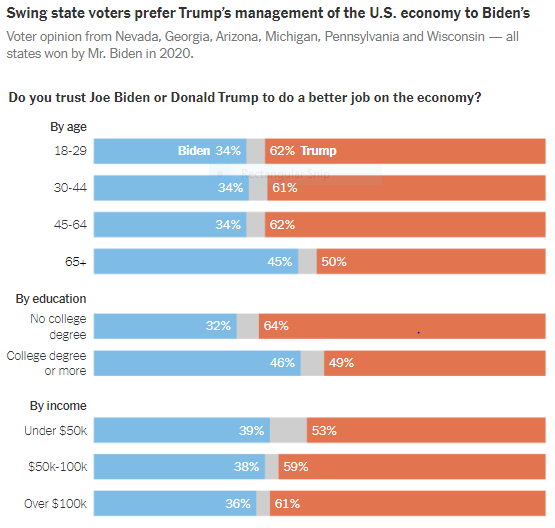
  • Swing state voters, according to age, education, or income, all think that Donald Trump’s management of the economy is preferable to Joe Biden’s.

Conclusion.  The world now needs U.S. leadership more than ever.  The U.S. can’t continue to provide strong leadership without a strong economy.  Bidenomics does not provide a strong economy in the long run.  This is a huge problem going forward, with  implications for the U.S. presidential elections next year.

For my Email Newsletter
Follow me on Facebook
Follow me on Twitter

The World Now Needs U.S. leadership More than Ever IV. What Should the Republicans Do?

My last several posts have been on the role of U.S. leadership in the world.  Since the end of WWII, it has been U.S. strength and leadership that have led to relative peace in the world (no more world wars).  Now China, Russia, and Iran are working together to challenge U.S. supremacy. It is critical that the U.S. meet this challenge head-on, to deter this new axis of autocratic powers lined up against us.  For the time being, Joe Biden is in charge, and we must hope that he is capable of providing the necessary leadership to prevail over our adversaries.  In the meantime, it is critical for Republicans to act in a responsible manner by addressing our most basic problems.  Consider:

  • Our biggest domestic problem by far is the rapidly growing national debt. The Republican House of Representatives can provide major leadership on this problem by insisting that Congress return to “regular order” in setting annual budgets. This means that the House and Senate each pass their own version of the twelve basic appropriation bills, and then meet in conference to negotiate any differences.  This will lead to a close look at each federal agency by “experts,” and only as much money being appropriated as is actually needed to operate the agency.  Regular order has the potential to save hundreds of billions of dollars each year by eliminating wasteful and unnecessary spending.
    In addition, it is a good idea to set up an independent fiscal commission to propose reforms of other expensive government programs such as entitlements.

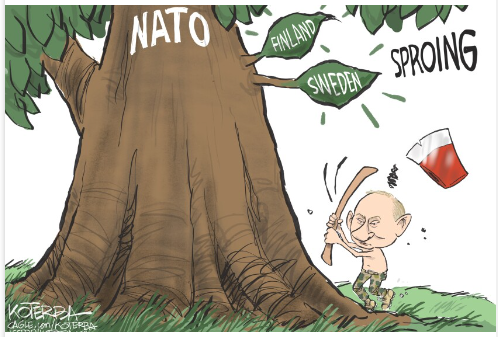
  • Republicans need to abandon isolationism and continue to financially support our strong allies, Ukraine and Israel, in their efforts to resist aggression from Russia and Iran’s proxy, Hamas.  Only by defending democracy where it is threatened, can the autocratic powers lined up against us be held in check.  In particular, the best way to deter China from invading Taiwan is to continue to help Ukraine.  If Russia is not stopped in Ukraine, it will eventually decide to invade a NATO country, and then the U.S. will be drawn into an even bigger war.
  • I personally will not vote for a Presidential candidate who might abandon Ukraine. Right now, of the three leading Republican candidates, Trump, Haley, and DeSantis, only Haley is unequivocal in her support of Ukraine.

Conclusion.  In today’s dangerous world, the U.S. simply cannot afford to appear weak.  The Republican House can show strength by maintaining sufficient unity to insist on “regular order” in establishing the budget for FY 2024.  It also needs to continue support for threatened democratic allies such as Ukraine, Israel, and Taiwan.  Let us hope that the eventual Republican nominee for President in 2024 will also pledge to continue support for Ukraine.

For my Email Newsletter
Follow me on Facebook
Follow me on Twitter

The World Now Needs U.S. Leadership More Than Ever III. Our Major Challenges Going Forward

My last few posts have been concerned with how badly the world needs U.S. leadership at the present time.  We are the strongest country in the world, both economically and militarily, and no other country can come close to providing the effective leadership role that we can.

Consider:

  • The Middle East Situation. Israel does not want to occupy Gaza after Hamas is destroyed.  It is critical to work with our autocratic, but nevertheless valuable, Muslim allies Egypt and Saudi Arabia to solve the Palestinian problem.  One key to a viable solution is deterring the active involvement of Iran and its proxies.
  • It is also critical to continue helping Ukraine defend itself from the Russian It is not only the right thing to do but is also in our best interest.  Russian success in Ukraine will encourage China to become more belligerent toward Taiwan.  Russia and Iran have formed a military axis to oppose the U.S.  In other words, the Ukraine/Russian war and the Israeli/Hamas war are linked.  Success on one front helps us on the other.
  • As much as China wants to take over Taiwan, it is not likely to attempt this by military force, as long as the U.S. has the military strength and will to help Taiwan defend itself.
  • Restoring public support for global leadership is an urgent need and should be a high priority.  First, we have to go beyond pivoting to Asia. We need a strategy for dealing with the entire world. Second, we must employ all the instruments of national power, such as trade agreements as well as security agreements.  Thirdly, we need a stronger nuclear deterrence and a bigger navy in the face of a Chinese-Russian alliance.  Finally, Congress needs to act more quickly and efficiently in approving annual defense budgets.

Conclusion. Israel appears to be on track to destroy Hamas in Gaza.  Only by continuing to work with Egypt and Saudi Arabia to deter Iranian support of terrorism can we establish a lasting peace in the Middle East.  We must continue to help Ukraine in defending itself against the Russian invasion.  We will have peace with China as long as we are strong both economically and militarily.  Restoring public support for global leadership should be a very high priority.

For my Email Newsletter
Follow me on Facebook
Follow me on Twitter
The World Now Needs U.S. Leadership More Than Ever II. The Middle East Situation

Last week, I wrote that the world needs U.S. leadership more than ever.  This has now become urgent!  What should the U.S. do with respect to the Israel/Hamas conflict?  Writing in the Wall Street Journal, Richard Haass says that the goal for U.S. diplomacy with Israel should be to achieve “first calm, then peace.”

In more detail:

  • First, punish Hamas for the October 7 attacks and limit its ability to carry out additional terrorism. The proper role of the U.S. is not to try to prevent a significant military action, which is inevitable, but to shape its scale and duration. Israel needs to minimize civilian casualties by limiting military actions to precision strikes.  Furthermore, get as many hostages out of Gaza as quickly as possible.  In addition, Israel should not try to occupy Gaza.

  • Secondly, once the situation is stabilized, begin a renewed effort to normalize ties between Israel and Saudi Arabia and between Israel and those Palestinians willing to eschew terrorism. Bringing about a degree of calm and stability would make it possible to deal with core Israeli-Palestinian issues, which must be resolved if what happened this month is not to occur again and again.  Hamas would play no role in negotiations about the Palestinian future.  The focus should be on developing a Palestinian partner in the West Bank, one willing to renounce violence, live alongside Israel, and hopefully eventually lead to a viable state.
  • Saudi Arabia is an important potential partner in this endeavor. The Saudi leadership is interested in obtaining a civilian nuclear energy program from the U.S., as well as a Senate-approved security pact.  The Saudis could demand restraint on settlements and greater interim Palestinian self-governance.

  • Deterrence of Iran is also required.  America’s core problem in the Middle East is the march of an unappeasable Iran toward regional power, regardless of moral or human cost.  The U.S. is losing its power to deter.  Putin’s 2022 invasion of Ukraine, in defiance of direct American warnings, was a major step.  Iran’s support for Hamas’s strike on Israel is an even bolder attack on the American order.  If the President’s response to Hamas and its patron, Iran, fails to restore respect for American power, and will, our enemies everywhere will draw conclusions and take steps that we and our allies won’t like.

Conclusion.  President Biden has a huge challenge as well as a unique opportunity to assert American leadership.  His response to the Hamas terrorist attack on Israel must, simultaneously, support Israel’s right to respond forcefully, restrain Israel from over-retaliating, and clearly deter Iran from further destabilizing the explosive situation that now exists.  This is a critical test of his ability to lead the free world against our autocratic rivals.

For my Email Newsletter
Follow me on Facebook
Follow me on Twitter