Cutting Spending in Trump 2.0 II. The Inflation Threat

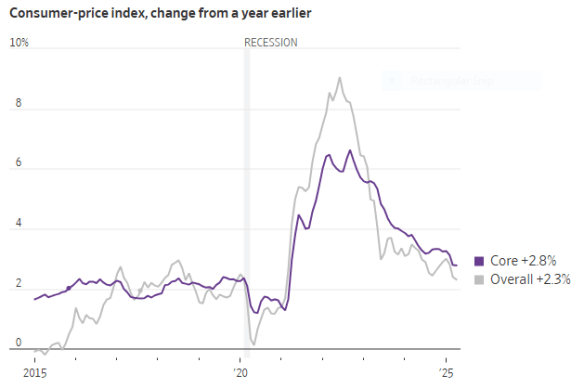
Several weeks ago, I stated on this blog that Trump’s biggest challenge is to keep inflation under control.  This is an even bigger challenge today.  Consider:

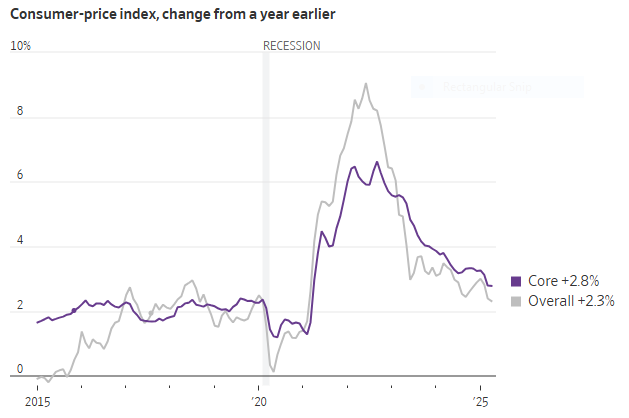
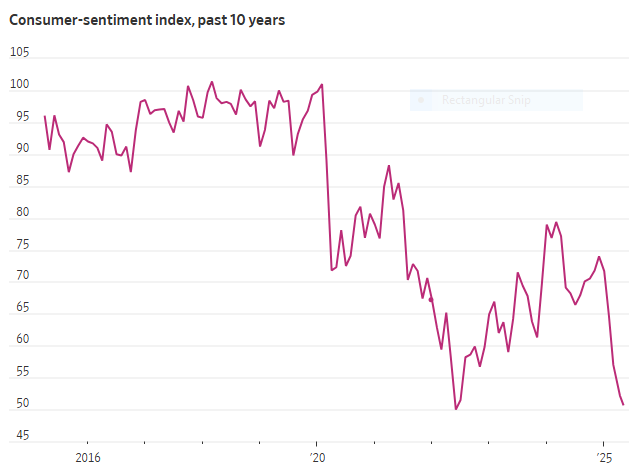
  • As of January 2025, inflation (the consumer price index, CPI) is back up to 3%, way above the Fed’s desired level of 2%. This means that the Fed will not be cutting interest rates any time soon and may even have to raise them again.

  • If such a high inflation rate continues, and maybe even goes higher, Trump won’t keep his current 53% job approval rating for long.  Furthermore, his tariff plans could push inflation higher than it is already.
  • A recent Government Accountability Office (GAO) report states that the Federal Government loses between $233 billion and $521 billion annually to fraud. This is what Elon Musk and his DOGE team are trying to eliminate.

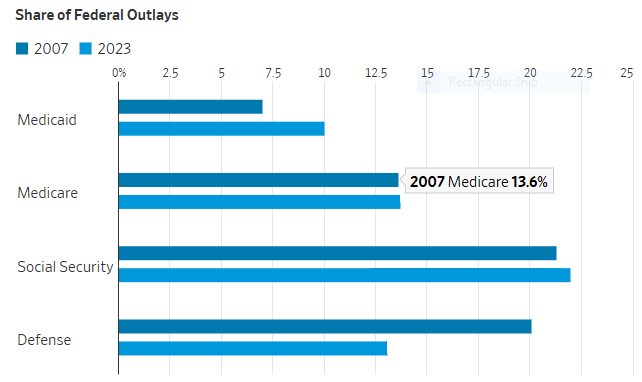
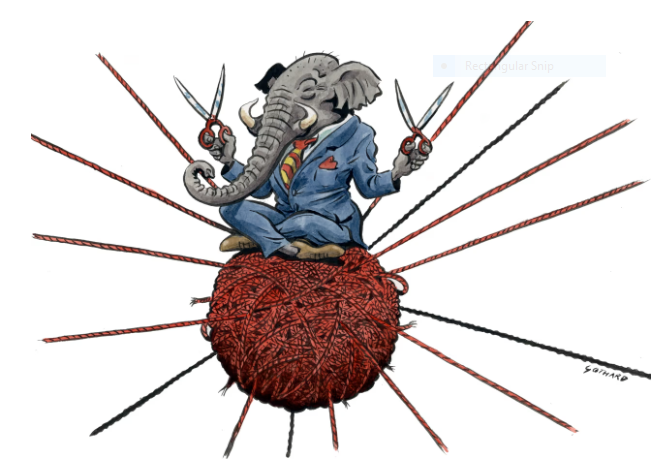
  • House Republicans last week advanced a blueprint that directs committees to find $2 trillion in savings to offset planned $4.5 trillion in tax cuts or new spending. This obligates House Republicans to shrink bloated programs like Medicaid and food stamps so that they can spend more on defense and the border.

Conclusion.  The Fed cannot control inflation by itself, just by raising interest rates.  It needs fiscal restraint from Congress and the President as well.  Congress is doing its part by setting a $2 trillion (ten-year) goal for cutting spending.  The President is doing his part by recruiting Elon Musk and DOGE to eliminate waste, fraud, and inefficiency in government spending.  In other words, the Republicans now in charge of the Federal Government are off to a good start in doing what is necessary to help the Fed bring inflation down to the desired 2% level.  This is critical for the success of President Trump’s second term.

For my Email Newsletter
Follow me on Facebook
Follow me on Twitter

Cutting Spending in Trump 2.0

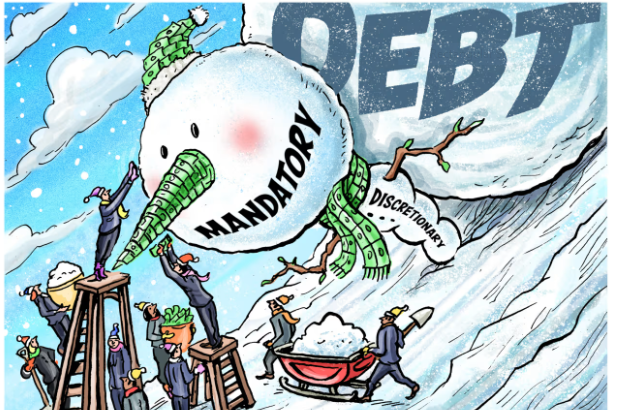
On this blog, It Does Not Add Up, I discuss various issues such as the strength of U.S. and world democracy, the U.S. economy, and other major concerns.  The biggest problem our country faces by far is our enormous national debt, now exceeding $36 trillion, and our rapidly growing annual spending deficits, most recently $1.85 trillion for FY2024.  In a recent post, I discussed several general ways of reducing the annual deficit, such as closing tax loopholes, requiring able-bodied welfare recipients to work, and encouraging federal employee layoffs.

Now, as Donald Trump begins his second term, the budget situation has become more focused:

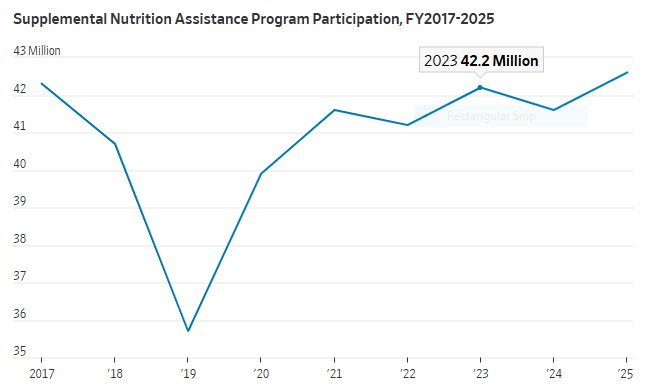
  • Even though the unemployment rate has now shrunk to 4.1%, 42.6 million Americans still receive food stamps, similar to January 2021, at the height of Covid. This number is clearly excessive.

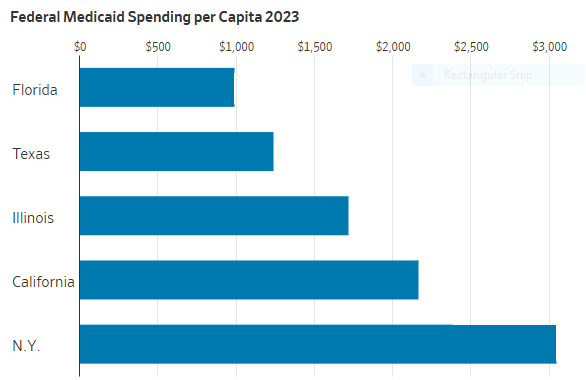
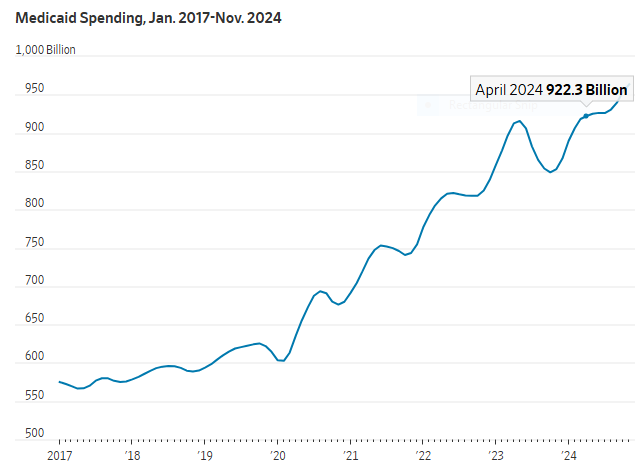
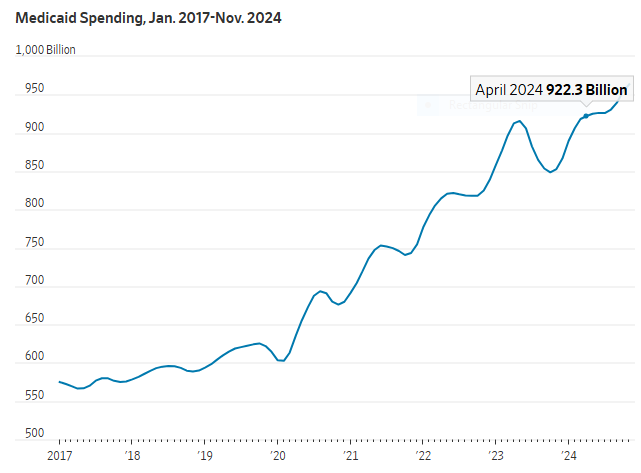
  • There are now 84.6 million Americans enrolled in Medicaid, the same number as when President Biden entered office. Simply returning to pre-pandemic Medicaid spending levels would generate a savings of $1.4 trillion over a decade.

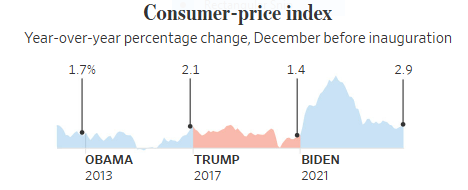
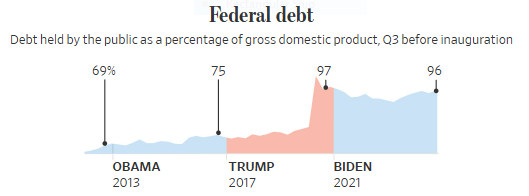
  • Both the consumer-price index and the federal debt rose dramatically under President Biden. These are closely related very serious long-term problems.

  • Federal workers have now been ordered to return to the office or accept an eight-month buyout by February 6.  It is estimated that at least 10% of federal employees, approximately 200,000, will accept the buyout.
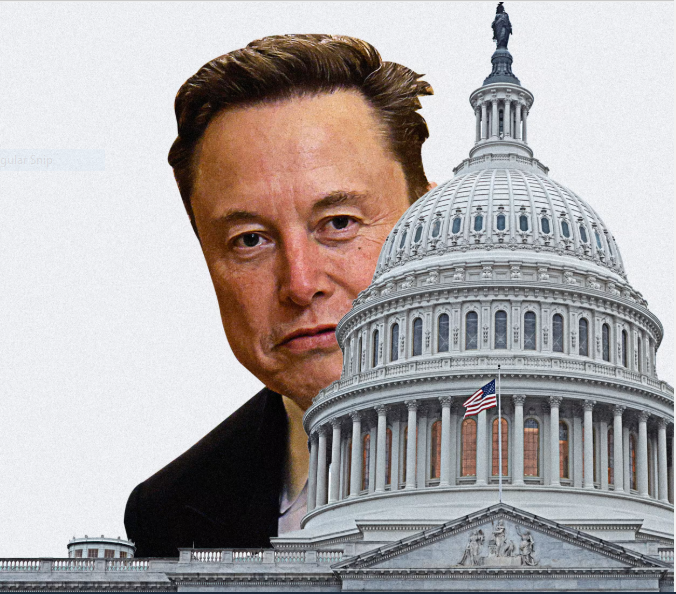
  • Elon Musk, the head of DOGE (Department of Government Efficiency), says that he can cut $4 billion a day from the federal budget between now and the end of September 2025, and by a total of $1 trillion for FY2026, which begins October 1, 2025.

Conclusion.  Thanks especially to tech entrepreneur Elon Musk, we can look forward to big cuts in federal spending over the next year.  This is critical for getting our national debt under control.  It is also needed to help the Federal Reserve get inflation back down to the desired 2% level. This cannot be done without the major fiscal restraint that Elon Musk is determined to bring about.

For my Email Newsletter
Follow me on Facebook
Follow me on Twitter
The incredible strength of the American economy

On this blog, It Does Not Add Up, I discuss major issues affecting our country.  For example, in my last post, I discussed the strength of democracy around the world.

Today, I write about the incredible strength of the American economy, following Michael Beckley of the American Enterprise Institute.

Consider:

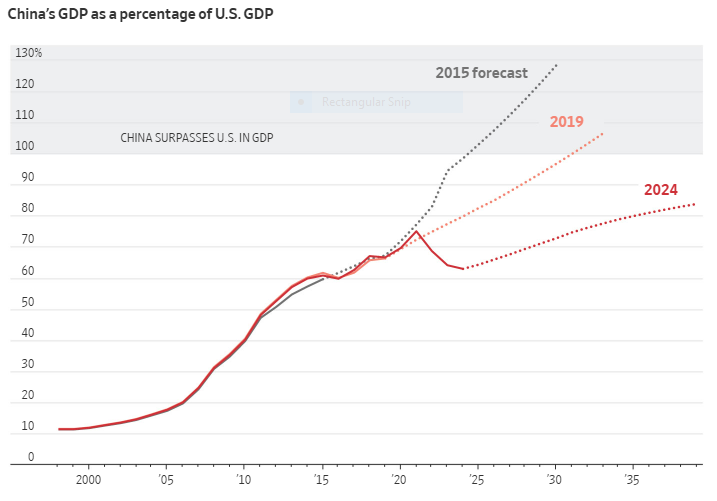
  • The United States is an economic powerhouse, accounting for 26% of global GDP, the same as during the unipolar moment of the early 1990s. Even the Chinese economy is shrinking relative to that of the U.S. in current dollar terms.  In reality, China’s economy is smaller than the Communist Party claims, and it is barely growing.  From 2021 to 2024, Chinese citizens illicitly moved hundreds of billions of dollars out of China, and became the fastest growing migrant group crossing the U.S. southern border.
  • From 1990 to 2019, U.S. median household income rose 55% after taxes, transfers, and adjusting for inflation, with income in the bottom fifth seeing a 74% gain. Since 2019, wages for the lowest-paid decile have grown nearly four times as fast as for middle earners and over ten times as fast as top earners.
  • Consider the dollar. The currency now accounts for nearly 60% of global central bank reserves. It is used in roughly 70% of both cross-border banking liabilities and foreign currency debt issuance and almost 90% of global foreign exchange transactions.

  • Once the world’s largest energy importer, the U.S. is now the leading producer of oil and natural gas, surpassing both Russia and Saudi Arabia. European companies currently pay two to three times as much for electricity and four to five times as much for natural gas, prompting some foreign manufacturers to relocate to the U.S. Meanwhile, the huge American consumer market, equivalent to China’s and the Eurozone’s combined, pressures foreign companies and governments to align with U.S. trade policies to maintain access to the world’s most lucrative revenue source.
  • The U.S. lead in global innovation further strengthens its structural power. S. firms generate over 50% of the world’s high-tech profits, whereas China captures only 6%.
  • The U.S. also attracts human capital, drawing thousands of scientists, engineers, and entrepreneurs from around the world each year. Coupled with higher birthrates, the average annual influx of over a million immigrants makes the U.S. the only great power whose prime working-age population is projected to grow throughout the century.
  • The decentralized U.S. system also excels at adopting and scaling innovations across industries, a capability more crucial for long-term growth than invention alone. American localities – like American businesses – face fewer constraints from central government red tape.  As a result, successful ideas tend to spread quickly.  This diffusion advantage is reinforced by the U.S. deep venture capital markets, which account for about half of the global total.
  • China’s subsidy-driven, authoritarian model creates isolated pockets of innovation without enhancing productivity across the economy. China prioritizes what it thinks of as internationally important sectors, such as the electric vehicle and renewable energy industries.  But these two industries make up only 3.5% of the Chinese economy, too little to offset declines in the bloated property and construction sectors, which account for roughly 30% of GDP and have erased $18 trillion in household wealth since 2021.

Conclusion.  The U.S. economy is enormously productive, totally surpassing any other country in the world, friend or foe alike.  This creates the responsibility, and opportunity, for the U.S. to provide enlightened leadership to help other countries increase their own economic growth.  This will be the topic of a future post.

For my Email Newsletter
Follow me on Facebook
Follow me on Twitter
 

2024: A Good Year for Democracy

Lately, on this blog, I have concentrated on what I consider to be our country’s biggest problem: enormous (($1.85 trillion in FY 2024) annual spending deficits and a rapidly growing national debt. This is unsustainable and will lead to a weaker U.S. if not brought under control soon.

But there is also much good news from around the world in 2024.  Democracy is thriving!  Consider:

  • Voters in over 60 countries went to the polls last year. The elections were peaceful and the results were accepted by all parties without violence and civil division.  The largest democracy in the world, India, reelected Narendra Modi as president even though his party, BJP, underperformed expectations and denied Modi the supermajority he had anticipated.   The world’s oldest continuous democracy in the world, the United States, reelected Donald Trump in an orderly, peaceful, fashion.
  • It was a bad year for autocracies.  Most dramatically, Bashar al-Assad’s dictatorship in Syria was overthrown by rebels.  Russia’s invasion of Ukraine is draining its economic and military resources.  Iran’s Middle Eastern proxies Hamas in Gaza, Hezbollah in Lebanon, and the Houthis in Yemen are coming under increasing pressure from Israel.

  • The world’s largest autocracy, China, has huge, self-inflicted, demographic and economic problems. Its recently ended one-child policy is leading not only to dramatic population decline, but also a major worker shortage.  It has an estimated 80 million empty apartment units, creating a huge financial drain.  It is unlikely to catch up with the U.S. in GDP anytime soon.

Conclusion.  The world is largely free and getting freer all the time.  Yes, there are autocracies (unfree countries) but they have major problems to deal with.  The U.S. and its democratic allies largely predominate both economically and militarily.  Free and open societies like ours will always have problems to deal with, but they are not the severe problems facing our autocratic adversaries.  We can never become complacent, of course, but we should be confident that democracy is ascendent and that our future is bright (if we can fix our debt problem).

For my Email Newsletter
Follow me on Facebook
Follow me on Twitter

There Are Several Practical Ways to Fix Our Annual Federal Spending Deficit

I have stated many times on this blog, It Does Not Add Up, that our biggest national problem by far is the exploding national debt, now sitting at $36 trillion, and growing at the rate of almost $2 trillion per year ( $1.85 trillion for FY 2024).

My last post stated that President Trump’s greatest challenge will be keeping inflation under control.  The Federal Reserve is doing its part by keeping short-term interest rates elevated.  But large spending deficits put upward pressure on inflation, and only the President and Congress can reduce federal spending.

Here are several major ways in which to shrink our annual deficits:

  • Implementing DOGE (Department of Government Efficiency).  Setting Elon Musk and Vivek Ramaswamy loose on the inefficiencies of the federal government will help a lot. For example, simply requiring federal employees to work in the office will likely lead to hundreds of thousands of resignations, thus saving tens of billions of dollars per year.  Brian Riedl, of the Manhattan Institute, thinks that several hundred billion dollars per year can be saved with increased efficiency.
  • Requiring welfare recipients to work. Requiring all able-bodied welfare recipients (and without dependents) to work would also save tens of billions of dollars per year.

  • Reducing tax expenditures. https://www.wsj.com/opinion/gop-takes-control-headed-for-a-fiscal-cliff-policy-economy-550653a5  Consider tax expenditures, which consist of various exclusions, deductions, credits, and preferences, otherwise known as tax loopholes.  According to the Joint Committee on Taxation, these expenditures annually cost $1.8 trillion in lost revenue and have grown in number from 53 in 1970 to more than 200 today.  Many need to be eliminated.

  • Entitlement reform. Of course, reforming both Social Security and Medicare is badly needed. These are valuable programs for  retired people and need to become fiscally sustainable to survive for the long run.  The federal government is subsidizing them at the rate of $600 billion a year (and rising), which cannot last much longer.

Conclusion.  There are several ways in which big savings can be achieved in the federal budget.  The important thing is to get started doing this soon, with either one or a combination of these methods.  The survival of our great nation depends on it.

For my Email Newsletter
Follow me on Facebook
Follow me on Twitter
Trump’s Biggest Challenge: Controlling Inflation

Kamala Harris was defeated, and Donald Trump won, primarily because of the failure of Bidenomics.  Of course, there were other issues, such as an open southern border, weak foreign policy, and woke culture, but inflation is the main reason for Trump’s victory. The working class, Trump’s main supporters, have been badly hurt by the rapid rise of inflation that has exceeded wage gains since it took off right after Biden took office in January, 2021. The consumer price index (CPI) is now down to 2.6% (October 2024), but this is not good enough, and inflation has not yet been licked. The problem, of course, is continuing huge federal deficit spending, which reached $1.8 trillion for FY 2024 just ended.

The Federal Reserve can’t control inflation by itself.  Its only tool is raising short-term interest rates which are already quite high.  Trump is apparently unwilling to reform the entitlements, Social Security and Medicare, where big savings could be found.  Furthermore, he is threatening to raise tariffs around the world, which, of course, means raising the prices that Americans pay for many basic commodities.

Inflation will not be subdued, in a sustainable way, until federal deficit spending is greatly reduced.  Trump and Republicans, in general, want to keep taxes low, and, in particular, renew the 2017 major tax reform from Trump’s first term.  This is a good idea because it will stimulate the economy and make it grow faster, thereby boosting employment and wages.  But this means that the only way to reduce the deficit is to cut federal spending.

This is where DOGE (Department of Government Efficiency), to be headed by Elon Musk and Vivek Ramaswamy, comes in:

  • Simply ending remote work for the federal workforce’s 2,000,000 employees could make a big difference. 17 federal agencies had less than 25% utilization of their headquarters buildings in 2023.  Requiring all federal employees to work full-time in their assigned offices would likely lead to a huge number of resignations, saving hundreds of billions of dollars every year.
  • Repealing the grossly misnamed Inflation Reduction Act would save $100 billion a year for many years to come.  Of course, it would also repeal one of Biden’s worst attempts at implementing a harmful industrial policy.

Conclusion.  To be a successful President, Donald Trump must keep inflation subdued which can only be accomplished by slashing federal spending.  His best chance of doing this is by unleashing his DOGE team, Musk and Ramaswamy, on the federal bureaucracy.  There are hundreds of billions of dollars to be saved in this way if DOGE is effective.

For my Email Newsletter
Follow me on Facebook
Follow me on Twitter
What Trump 2.0 Can Reasonably Expect to Accomplish

My last post, Donald Trump’s Mandate, stated that Trump’s basic mandate is to undo the Biden Administration’s biggest blunders: inflation, open southern border, and weak foreign policy.  The American people want a solution to these major problems.  That’s why Trump was elected, for all his personality flaws, instead of Harris.  How should he deal with these problems?  Consider:

  • Department of Government Efficiency (DOGE). Trump has asked the two billionaire entrepreneurs, Elon Musk and Vivek Ramaswamy, to lead a massive effort to eliminate waste and inefficiency in the Federal Government.  The Manhattan Institute scholar, Brian Riedl, says that they should be able to trim several hundred billion dollars a year in such if they are serious about it.  This would make a serious dent in U.S. annual deficit spending now approaching $2 trillion. Shrinking our annual spending deficits is critical for a sustainable solution to the inflation problem.

  • Closing the Southern Border. The first thing the Trump Administration will do is close the border to all new illegal entrants and require asylum applicants to remain in Mexico until their asylum request has been approved.  This will cut way down on attempts at illegal entry.  The other immediate action will be to expel all existing illegals with a criminal record.  Since the U.S. has a huge labor shortage overall, a program should be worked out for law-abiding illegal immigrants to stay in the U.S. indefinitely, perhaps with a temporary guest worker visa.  It would be economically disruptive to try to round up all illegals and deport them en masse.

  • Identity politics and polarization.  The main cause of political polarization is the identity politics practiced by the Democratic Party. Trump did quite well among nonwhite voters this year.  For example, he won more than 20% of Black men and more than half of Hispanic men. This doesn’t mean the end of identity politics but it might be the beginning of the end.  After all, minorities care about the same quality of life issues (e.g. inflation, housing availability, crime) as everyone else.
  • Foreign Policy. It is not clear what specific policies Trump will adopt in foreign policy but we can assume that he will be much tougher on our primary autocratic adversaries: China, Russia, Iran, and North Korea.

Conclusion.  President Biden’s major policy mistakes (inflation, open border, weak foreign policy) led to Trump’s election and give him a huge opportunity to achieve a positive change in direction for our country.  Let’s hope he adopts the right policies to accomplish this.

For my Email Newsletter
Follow me on Facebook
Follow me on Twitter
Donald Trump’s Mandate

Now that the election is over and Donald Trump has won not only the electoral vote but the popular vote as well, it is time to think about what he may do and should do in his second term.  It seems to me that he should forcefully address the issues where the Biden/Harris Administration was especially weak and which led to Trump’s massive victory.  What are these issues?

  • Inflation, deficit spending, and the economy. It is now widely accepted that it was the excessive Covid stimulus spending that tripped off inflation in Spring 2021; especially Biden’s $1.9 trillion American Rescue Plan, passed by the Democratic Congress in March 2021.  Our spending deficit for FY 2024, which just ended September 30, was over $1.8 trillion, which is way too high for a growing economy and puts upward pressure on the consumer price index.  The solution is to massively cut federal spending and Elon Musk has agreed to help Trump do this.  Hopefully, this will become a major priority for the new administration.

  • Border Security. Another huge weakness of Biden/Harris was to greatly relax security at our southern border with Mexico.  We are already taking in a million new immigrants legally each year and we need even more to meet our large labor shortage.  But letting undocumented immigrants pour over the border without restraint is not the way to get this done.  Let’s increase worker visa programs as well as new categories for legal immigration.  This shouldn’t be that hard to accomplish.

  • Weak Foreign Policy. Starting with Biden’s disastrous withdrawal from Afghanistan in August 2021, his response to international crises has been weak.  Putin was encouraged to invade Ukraine in February 2022 for this reason.  Hopefully, Trump will get much tougher with Russia.  Also, letting the Houthis disrupt shipping in the Red Sea is another disaster.  We need to continue working with our democratic allies in Asia (Japan, South Korea, and Australia) to deter China’s military buildup, but China is unlikely to invade Taiwan anytime soon.  The resulting sanctions from the US and our allies would do great damage to the already precarious Chinese economy.

Conclusion.  The new Trump Administration has a clear mandate to strongly address these three issues which are the primary reasons Trump defeated Harris so handily.  A Republican Senate and likely Republican House will surely support sensible policies to fix these three problems.

For my Email Newsletter
Follow me on Facebook
Follow me on Twitter

Is Donald Trump a Fascist?

As our November 5 election draws closer and closer, Americans are more and more focused on the issues involved.  My blog is now almost exclusively devoted to discussing these issues.  The charge has now been made repeatedly in the mainstream press that Donald Trump is a fascist.  To respond to this charge we need to have at least a working definition of what fascism is.

Consider a description of fascism provided by Heather Cox Richardson:

  • What is fascism?
    Fascism, the U.S. government document explained, “is government by the few and for the few. The objective is seizure and control of the economic, political, social, and cultural life of the state.” “The people run democratic governments, but fascist governments run the people.”“The basic principles of democracy stand in the way of their desires; hence—democracy must go! Anyone who is not a member of their inner gang has to do what he’s told. They permit no civil liberties, no equality before the law.” “Fascism treats women as mere breeders. ‘Children, kitchen, and the church,’ was the Nazi slogan for women,” the pamphlet said.

    Fascists “make their own rules and change them when they choose…. They maintain themselves in power by use of force combined with propaganda based on primitive ideas of ‘blood’ and ‘race,’ by skillful manipulation of fear and hate, and by false promise of security. The propaganda glorifies war and insists it is smart and ‘realistic’ to be pitiless and violent.”

    Fascists understood that “the fundamental principle of democracy—faith in the common sense of the common people—was the direct opposite of the fascist principle of rule by the elite few,” it explained, “[s]o they fought democracy…. They played political, religious, social, and economic groups against each other and seized power while these groups struggled.”

  • Is Donald Trump a fascist? According to Ms. Richardson above, fascism can only exist if democracy is subverted and overthrown or at least weakened.  Trump tried to overturn the 2020 election, but had no success in doing so.  His campaign filed over 60 lawsuits around the country but not a single one had any success.  The mob riot at the Capitol on January 6, 2021 did not succeed in changing the outcome of the election.  If Trump is reelected this year, he will serve four more years and will be ineligible to run for reelection in 2028.  If Trump is defeated for reelection this year, he will remain a private citizen as he is now.The U.S. Constitution was ratified in 1787, and has now helm firm for 237 years.  Democracy is thriving in the U.S. today.  It has persevered under previous crises such as the Civil War and the great depression.  It will surely survive the disruptive presidency of Donald Trump, whether he ends up serving two terms or only one.

Conclusion.  Fascism does not now exist in the U.S. nor can it appear unless and until our fundamental democratic institutions are greatly weakened.  Of course, we should never be complacent, but this is unlikely to happen anytime soon.

For my Email Newsletter
Follow me on Facebook
Follow me on Twitter

Who Will Be Better for Economic Policy: Harris or Trump?

Neither presidential candidate for President, Kamala Harris nor Donald Trump, has expressed concern about our enormous national debt of $35 trillion, nor our annual deficit spending now approaching $2 trillion per year and growing. This, of course, is a dereliction of duty on a grand scale by both candidates.  This being the case, voters will have to try to figure out as best they can who will be the best steward of the economy for the next four years.  It is assumed below that Harris’s economic policies are likely to be a continuation of Biden’s.

Consider:

  • Deficit spending. Deficits under Trump (fiscal years, 2017 – 2020) totaled $5.5 trillion while under Biden (fiscal years 2021 – 2024) they have totaled $7.6 trillion. And this includes a major Covid spending year for each, 2020 for Trump and 2021 for Biden.  Score one more point for Trump.
  • Inflation. There was little inflation under Trump and the CPI (consumer price index) was 1.4% when Biden took office in January 2021.  The new Democratic Congress then passed the $1.9 trillion American Rescue Plan, signed by Biden, and inflation immediately started rising and reached over 9% in 2022.  It has now dropped back to 2.4% for September 2024.  Even though excessive quantitative easing by the Federal Reserve made inflation more likely, it is still correct to say the Biden Administration tripped off our current round of inflation.  Score one more point for Trump.
  • Tariffs. Trump’s proposed major increase in tariffs would be anti-growth, but would not be inflationary. Tariffs increase relative prices in specific goods or industries but do not increase general price levels (which is the cause of inflation).  Trump’s first-term tariffs hurt economic growth but were not inflationary.  Score ½ point for Harris who will probably keep the existing (lower-level) Biden tariffs.
  • Taxation. Trump has proposed several tax cuts (on tip income, social security income, overtime pay income, increasing SALT deductions, and deducting interest on car loans) none of which have good economic motivation and are unlikely to be approved by Congress.    Harris wants to rate the corporate tax rate from 21% to 28%, which is a bad idea.  Trump will approve extending the present 21% corporate tax, a good idea.  Declare a draw on tax policy and spending.

Conclusion.  Trump is likely to have better economic policies than Harris.  His deficit spending should be less which means a smaller chance of reigniting inflation.  His unilateral and universal tariff proposals are a bad idea.  Hopefully, they will serve primarily as a bargaining tool to encourage lower tariffs from our democratic allies.

For my Email Newsletter
Follow me on Facebook
Follow me on Twitter