Does Either Political Party Take Our National Debt Seriously?

America is a blessed country.  We have the strongest economy and military in the world.  We have many democratic allies around the world with whom we work closely on our many common interests.  We are one of the most prosperous countries in the world with a constantly growing and expanding middle class.

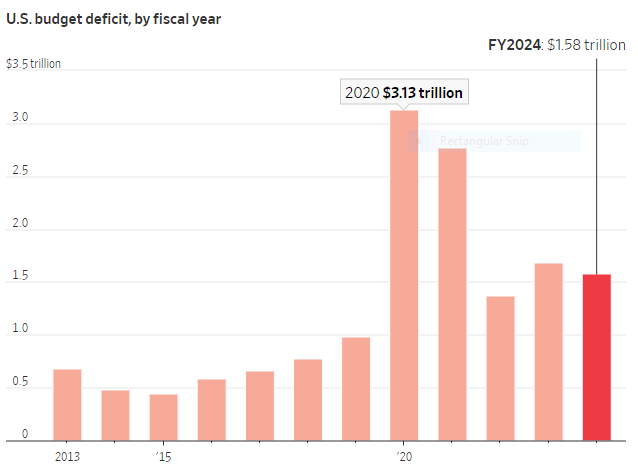
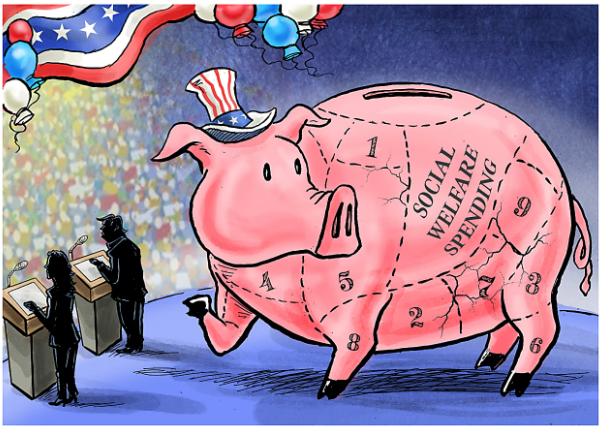
We do, however, have one huge problem that is not being adequately addressed by our national leaders.  It is our national debt, now $35 trillion, and growing at the rate of $2 trillion per year.  Two things could be done to drastically reduce our annual deficits: 1) reform the entitlements Social Security and Medicare to make them self-sustaining for the long term and 2) require welfare recipients (who are able-bodied and without dependents) to work in return for their benefits.

Neither presidential candidate is willing to touch entitlements for obvious political reasons.  Furthermore

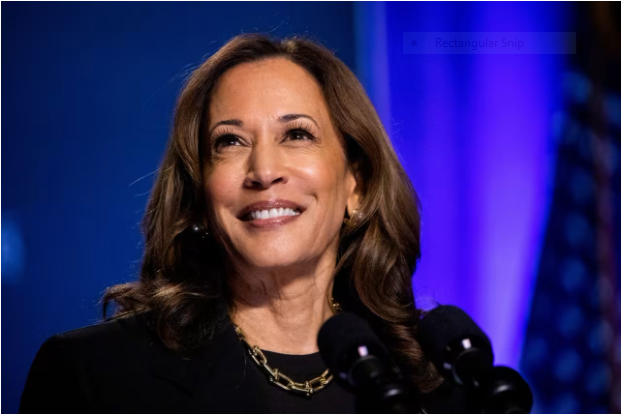
  • Kamala Harris wants to dramatically increase federal spending.  For example, she wants new entitlements for childcare, preschool, long-term healthcare and paid leave. She wants restoration of Covid’s $3600 child tax credit and a new $6000 tax credit for families with newborns, and tripling the earned income tax credit for childless adults.  She wants $25,000 grants for first-time homebuyers, more student loan forgiveness, and sweetened Obamacare subsidies. She wants more subsidies for solar panels and EVs on top of the $1.2 trillion already in the IRA pipeline.
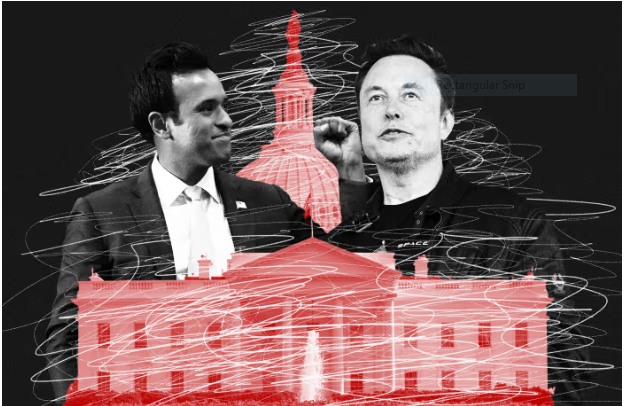
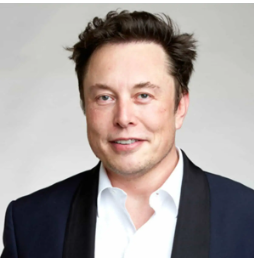
  • Donald Trump wants to stop taxing tip income, stop taxing social security benefits, and raise the SALT (state and local tax) deductions from its current $10,000 per household level. All such tax cuts would increase the deficit without having any redeeming economic value. However, he also says he would ask Elon Musk to head up a Commission on Government Efficiency. This could lead to dramatic federal budget savings.

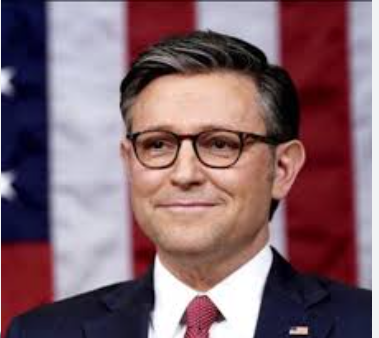
But, on the otherhand, House Speaker Mike Johnson takes fiscal responsibility very seriously. (https://www.speaker.gov/) He understands that Congress has a moral and constitutional duty to resolve the fiscal crisis, reform and modernize entitlement programs, and eliminate waste fraud and abuse across the federal government.  Also, he thinks that the workforce should be cut, eliminating non-essential jobs across the federal bureaucracy.

Conclusion.  Kamala Harris apparently has no concern about our $2 trillion annual spending deficit and no plans to address this horrendous problem.  Donald Trump says he won’t touch entitlements but he will ask Elon Musk to identify possible spending cuts.  House Speaker Mike Johnson is very serious about our debt problem and will try hard to lead the House to make extensive spending cuts.  In other words, the Republican House takes our national debt very seriously.

For my Email Newsletter
Follow me on Facebook
Follow me on Twitter

Suggestions for Staffing a New Trump Administration

As I have been saying recently on this blog, our country’s biggest problem by far is the exploding national debt, with annual deficits now rising to $2 trillion.  Furthermore, there are some conceptionally easy (even though not politically easy) ways to effectively address the debt problem, see here, and here.

Neither presidential candidate, Kamela Harris nor Donald Trump, has been willing to publicly address the debt problem.  To address this problem effectively, I make the following suggestions for staffing a Trump Administration:

  • Elon Musk to head a Government Efficiency Commission. There is enormous waste and inefficiency in the federal government and Mr. Musk has the credibility and clout to ferret out and shine a spotlight on the hundreds if not thousands of ways that substantial savings can be saved in federal government operations.

  • Mitch Daniels for Secretary of the Treasury. Mr. Daniels is a former federal budget director, governor of Indiana, and President of Purdue University.  He clearly understands the need for drastically cutting federal spending.  He would be an excellent choice for watchdog of the federal treasury.

  • Mike Pompeo for Secretary of State. Pompeo served in this capacity in the first Trump Administration.  He has recently outlined a plan to resolve the Russia/Ukraine conflict without capitulation to Russia.  This involves unleashing America’s energy potential, working with Saudi Arabia to squeeze Russia out of global energy markets, and imposing real sanctions on Russia.  The idea here is to support Ukraine both militarily and economically at minimal expense to the U.S.

Conclusion.  Of course, getting the federal budget under control is a difficult political problem because every program has supporters who don’t want spending cutbacks.  However, it is essential to drastically reduce federal spending overall.  Otherwise, we will soon have a new financial crisis much worse than anything we have seen so far.  If elected, Trump will need highly qualified people in key leadership positions to have a successful presidency.  Here are three specific individuals who could serve in such roles.

For my Email Newsletter
Follow me on Facebook
Follow me on Twitter
An Additional Approach to Fixing Our Debt Problem.

My recent post presented a plan by Brian Riedl at the Manhattan Institute to fix our national debt problem.  Mr. Riedl outlines how it can be done primarily by reining in spending on Social Security and Medicare.  He has an excellent plan to do just this.

But now comes another approach from the American Enterprise Institute describing the enormous drain on the federal budget from huge increases in means-tested social welfare spending – Medicaid, food stamps, refundable tax credits, Supplemental Security Income, Temporary Assistance for Needy Families, federal housing subsidies, and many other programs whose eligibility is limited to those below an income threshold.

Consider:

  • Social Security and Medicare are a drain on general revenue and will become a big fiscal problem if not reformed. In 2023 SS payroll taxes funded 88.9% of benefits, at a net federal cost of $88.1 billion.  Medicare payroll taxes and premiums funded 49.7% of Medicare expenditures, at a net federal cost of $509 billion.
  • On the contrary, means-tested social welfare spending totaled $1.6 trillion in 2023.
  • Since funding for the war on poverty ramped up in 1967, welfare payments received by the average work-age household in the bottom quintile of income recipients has risen from $7,352 (in inflation-adjusted 2022 dollars) to $64,700 in 2022. This 780% increase was 9.2 times the rise in income earned by the average American household.
  • The U.S. today redistributes a larger share of its GDP, 29.4%, through transfers and taxes, than any developed country in the world except France with 30.1%.
  • After counting all transfer payments as income to the recipients and taxes as income lost by taxpayers, and adjusting for household size, the average households in the bottom, second, and middle quintiles, all have roughly the same incomes despite dramatic differences in work effort. The portion of prime work-age persons in the bottom quintile who work has fallen to 36% from 68%.  In the second quintile, households with a work-age adult who works, have declined to 85% from 90%.  The percentage of middle-income households with a prime work-age person who works, has risen to 92% from 86%.
  • Americans overwhelmingly support an effective mandatory work requirement for able-bodied adults receiving welfare benefits. The bipartisan effort to reform Aid to Families with Dependent Children during the Clinton Administration was a success.  When all transfer payments are counted as income, 80% of those who are today counted as being poor are no longer poor, and almost half have incomes equivalent to American middle-income earners.
  • A mandatory welfare work requirement for able-bodied adults receiving welfare benefits, a requirement that the Census Bureau count all transfer payments as income, and a mandate that all federal agencies use the same income measure when determining eligibility for welfare, would be major steps towards righting the nation’s finances.
  • But it would also do much more than this. It would bring people back into the economy, the source of prosperity and economic independence.  A job is the best nutrition, housing, healthcare, education, childcare, and general welfare program there is.

Conclusion.  Yes, the entitlement programs Social Security and Medicare need to be reformed to become fiscally sustainable.  But much more than this can be done to drastically reduce our now $2 trillion, and rapidly growing, annual deficits.  Adding a work requirement to means-tested welfare spending would save hundreds of billions of dollars every year.

For my Email Newsletter
Follow me on Facebook
Follow me on Twitter


The Challenge of Fixing Our Debt Problem

My last post, described a plan by Brian Riedl at the Manhattan Institute to fix our debt problem in a bipartisan manner.  It won’t be easy, of course, but he shows how it can be done.  Today I highlight another article by Mr. Riedl, explaining why it is such an enormous political problem to get there.

Consider:

  • The faster government escalates towards an inevitable debt crisis, the less politicians and voters seem to care. In the 1980s and 1990s, more modest deficits prompted six major deficit reduction deals that even balanced the budget from 1998 through 2001.
  • In the past eight years, Presidents Trump and Biden enacted $12 trillion in deficit- expanding legislation, even as Social Security and Medicare shortfalls drove baseline deficits even higher. When even liberal economists warned that the post-pandemic economy faced a modest degree of rising inflation, Congress responded by enacting the $2 trillion American Rescue Plan.  When inflation and mortgage rates resultantly surged to 9.1% and %7.8%, respectively, lawmakers continued the inflationary spending spree.
  • We have apparently convinced ourselves that 1) deficits do not matter, 2) deficits have become a weapon to be politicized rather than a problem to be solved, and 3) few are willing to face the unpopular reality that the problem cannot be solved without fundamentally reforming Social Security, Medicare and middle-class taxes. We cannot grandfather out of reform the 74 million baby boomers whose retirement costs are driving the enormous shortfall.
  • Up through the mid-1990s, Republicans and Democrats – despite public bickering – often collaborated well behind the scenes. Currently, we have 24/7 partisan warfare.  The last attempt at reform, from former House Speaker Paul Ryan, earned him bipartisan hatred from voters and an attack ad portraying him murdering a senior citizen.
  • There are simply no easy solutions. Demanding a balanced budget amendment to fix $2 trillion annual deficits is absurd.  Proposing that taxing the rich will eliminate the problem is equally absurd.  Defense spending has already fallen from 6% of GDP in the 1980s to currently 3% of GDP and can’t realistically go much lower.  Medicare for All is not a serious savings proposal and would only shift private healthcare expenses from the private sector to the public, making deficits even worse.
  • The painful reality for the Republicans: the long-term debt cannot be stabilized with tax revenues remaining at 18% of GDP. The most conservative, but plausible, proposal would limit long-term spending to 23% of GDP, which would require revenues of 20% of GDP to stabilize the debt (taking economic growth into account).
  • The painful reality for Democrats: you cannot chase spending heading to 32% of GDP by increasing taxes on the rich or even the non-rich.
  • The reality for both parties: you have to work together.  The political model is the 1983 Social Security reforms where both parties worked together and were overwhelmingly reelected.
  • The most important reform variable is the voters. Lawmakers will not act as long as they fear that even discussing deficit-reduction proposals will provoke a furious backlash.

Conclusion.  Brian Riedl has outlined a workable deficit reduction proposal, but it cannot be implemented without an honest effort by both parties to work together.  Furthermore, the voters have to be brought along so that members of Congress will not be penalized by cooperating on this critical and urgent task.

For my Email Newsletter
Follow me on Facebook
Follow me on Twitter

A Bipartisan Proposal to Fix Our Debt Problem

I discuss many different national issues on this blog.  But, I do believe that the biggest long-term problem our country faces is the uncontrolled growth of the national debt. Thus, I am highly intrigued by a proposal from Brian Riedl of the Manhattan Institute to stabilize our debt over the next thirty years at no more than 100% of GDP.

First, the rationale for his plan:

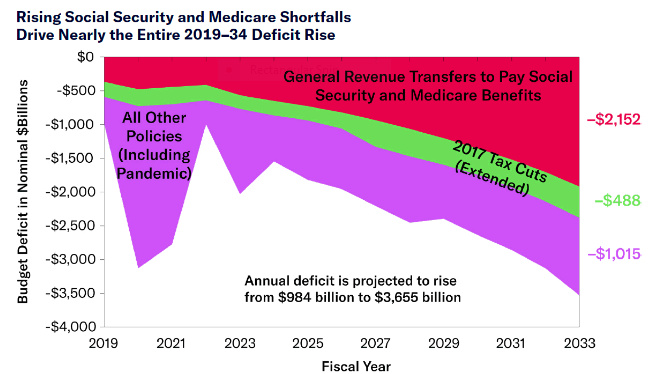
Annual budget deficits are already approaching $2 trillion annually and are headed toward $3 trillion per year just 10 years from now (see chart below).  There is a way to avert our looming debt crisis without broad-based tax increases or significant cuts to antipoverty and social spending.  However, this involves acting quickly to reform both Social Security and Medicare, as every year four million more baby boomers retire into these programs.  The fiscal consolidation in this report calls for some SS and Medicare benefits for upper-income recipients to be trimmed.

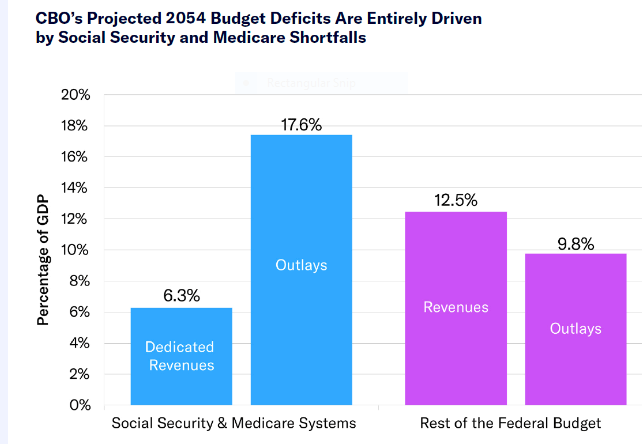
The debt problem is not caused by falling tax revenues.  Federal tax revenues have averaged 17.4% of GDP since 1960 and are projected by CBO to be 17.9% of GDP by 2054.  Instead, the entire increase in long-term debt will come from surging SS, Medicare, and other government healthcare spending (see chart below).

This demographic challenge is worsened by rising healthcare costs and repeated benefit expansions.  Today’s typical retiring couple has paid $214,000 into Medicare and will receive $635,000 in benefits because Medicare’s physician (Part B) and drug (Part D) benefits are not prefunded with payroll taxes and are only partially funded by retiree premiums.  A similar discrepancy applies to SS.

This year SS and Medicare will collect $1,701 billion in payroll taxes and premiums and pay out $2,349 billion in benefits.  Add in $21 billion in interest payments on this shortfall and SS and Medicare will contribute $651 billion to the FY 2024 deficit.  In just 10 years from now, this entitlement deficit will increase to $2.2 trillion (see chart below).

Keep in mind that most seniors are not poor.  Senior incomes have grown 60% (faster than inflation) since 1980, compared with 15% for the average worker.  Simplistic solutions to our debt problem must be rejected.  For example, Medicare-for-all.  There is no evidence that single-payer healthcare could reduce American healthcare expenditures.  A single-payer system would simply shift $32 trillion in private health expenditures over the next decade to the federal government.

The Riedl Plan achieves most of its savings from mandatory programs as follows:

  • SS early and normal eligibility ages (currently 62 and rising to 67) are raised by 3 months per year, beginning in 2030, until they reach 64 and 69 in 2037.
  • Canceling SS annual cost-of-living adjustments for seniors whose incomes in the previous year exceed $100,000 per individual or $200,000 per couple.
  • Make Medicare more efficient by implementing a premium support system for Parts A (hospitals) and B (physicians). This creates a healthcare market where insurers must compete for retirees.
  • Raise total senior premiums to cover 50% of Medicare Part B costs and 30% of Medicare Part D. Monthly premiums would rise on a sliding scale based on current, post-retirement income.
  • Medicare eligibility age remains 65. The Medicare payroll tax, currently 2.9%, would increase by 1% to contribute to Medicare’s huge cash shortfall, including the overall gradual increase in the cost of healthcare.
  • Medicaid reimbursements to the states would be capped at an annual per-capita increase in costs, rather than reimbursing a preset percentage of overall state Medicaid costs.

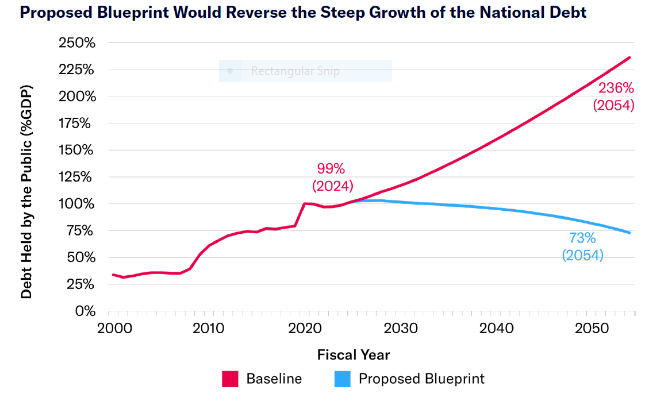
Conclusion.  The Riedl Plan caps our national debt at its current level of 100% of GDP and gradually reduces the debt to 73% of GDP by 2054 (see chart).  Well-off retirees would shoulder most of the costs of bringing SS and Medicare finances, which comprise most of our debt problem, to a sustainable level.  The Riedl Plan shows that our debt problem can be solved mostly with relatively modest changes in entitlement programs.

For my Email Newsletter
Follow me on Facebook
Follow me on Twitter

Biden’s Biggest Blunder: Economics Policy

On this blog, I write about important national issues, and, of course, this includes politics.  Recently, I have said that both major presidential candidates have huge liabilities, see here and here.  Overall, I think that Biden’s biggest hurdle to reelection is his misguided economic policies, i.e. Bidenomics.

Consider:

  • Debt and deficits. CBO has just increased its deficit estimate for FY 2024 from $1.5 trillion to $1.9 trillion.  Adding up the deficits from Biden’s four years, from FY 2021 to FY 2024, produces a total four-year deficit of $7.9 trillion, which represents Biden’s contribution to the total national debt of approximately $35 trillion.  As the debt goes up, interest payments on the debt also go up, compounding the problem.

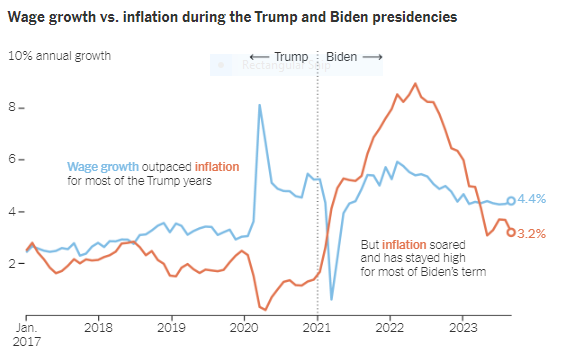
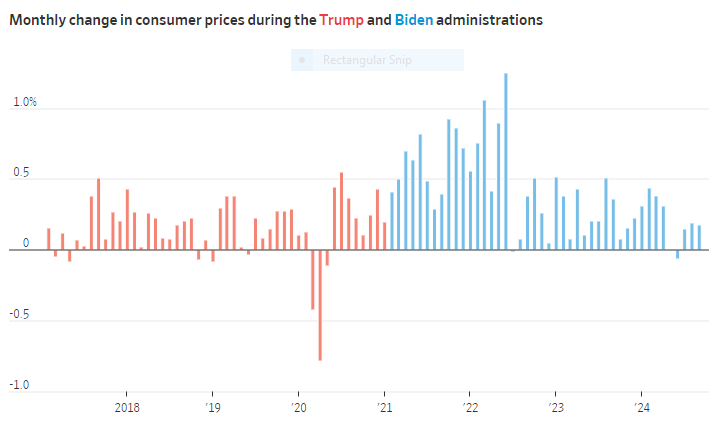
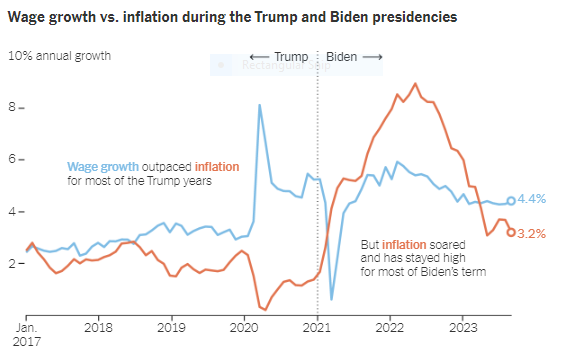
  • It is well understood that excessive government spending, especially the $5 trillion in Covid stimulus spending, is the immediate cause of our current round of inflation which took off in March 2021, shortly after Biden signed the so-called American Rescue Plan of $1.9 trillion.  Although inflation has dropped to 3.3% as of May 2024, prices have now risen almost 20% since Biden took office and are still going up.

  • High interest rates. The Federal Reserve has only one tool to bring the consumer price index down to the desired level of 2%, namely by increasing short-term interest rates to try to slow down the economy.  High interest rates not only make our debt that much worse, but cause other problems as well, such as raising mortgage rates.  This tightens the housing market, both for new home purchases, as well as for rentals.

  • Treating the symptoms rather than the underlying problem.  The Biden Administration is responding to inflation, not by cutting federal spending, but by, for example, forgiving student debt and proposing to forgive medical debt.  This does not reduce inflationary forces but rather increases moral hazard: just borrow more money for college or skip adequate health insurance.

Conclusion:   Biden’s careless economic policy of reckless deficit spending has not only made our national debt problem much worse than before but has also tripped off a new round of inflation that makes life more difficult for millions of people.  His Administration badly needs some competent economic help.

For my Email Newsletter
Follow me on Facebook
Follow me on Twitter
Our Presidential Choice in 2024: Bad Policy (Biden) or Bad Behavior (Trump)

This blog, It Does Not Add Up, discusses many different national issues, both domestic and international, including political aspects.  I have already started to devote attention to the upcoming Presidential election, and will continue to do so even more as November approaches.  Of course, Trump’s felony conviction in New York creates a huge new issue.  We will soon know, from new polling, how much impact it is likely to have.

Nevertheless, the general outline is clear:  the election is likely to come down to President Biden’s bad policies versus former President Trump’s bad behavior.

Biden’s bad policies:

  • The attached chart from Axios, shows that inflation was minimal in January 2021 when Biden took office.  It reached a high of 9% in June of 2022 and has now come back down to 3.4% in April 2024.  This is what economists talk about.  But, the Consumer Price Index (CPI) has risen almost 20% since Biden took office.  This is what people (i.e. the voters) actually experience.  Furthermore, it was the last $1.9 trillion under Biden, of the total $5 trillion in Covid stimulus spending, which tripped off the recent inflation surge.

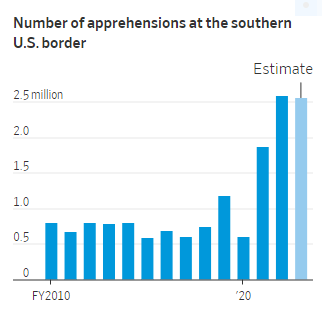
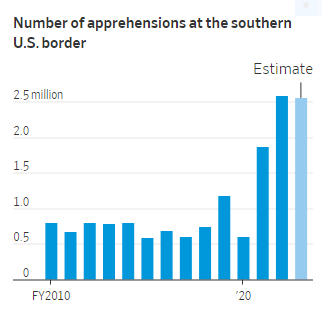
  • Open southern border. The attached chart from the Economist, shows that illegal southern border crossings have jumped way up under Biden.  Of course, we need comprehensive immigration reform, but until Congress gets this done, it is the President’s responsibility to enforce the asylum regulations we already have.

  • Worsening world situation.  Starting with Biden’s disastrous withdrawal from Afghanistan in August 2021, two regional wars (in Ukraine and Gaza) have now broken out.  Does Biden have a plan to deter our adversaries from steps that undermine our security?  If so, what is it?

Trump’s bad behavior:

  • Election denial in 2020. Trump filed over 60 lawsuits to try to overturn the 2020 election, without any success.  He also incited a riot at the Capitol on January 6, 2020, to protest the election results.  Although there were well-documented, pandemic-related, mail-in voting irregularities in several states, widespread voting fraud almost certainly did not occur.
  • Felony conviction.  His conviction in New York, even though it is likely to be overturned on appeal, demonstrates his often sleazy behavior towards women and others.

Conclusion.  An estimated 70% of voters don’t like either major party candidate.  They will have to decide in November who they think is the least bad candidate between the two.

For my Email Newsletter
Follow me on Facebook
Follow me on Twitter

Why Biden is Behind in the Polls: Swing is King

Most of the time on this website, I discuss national issues independently of the personalities and political dynamics involved.  But, as we draw closer to the 2024 presidential election in November, it is impossible to avoid talking about President Biden and former President Trump.

The Democratic Party pollster, Mark Penn, has recently explained why Trump is now leading Biden in the polls. Consider:

  • Biden is being dragged to the left by his policy advisors. He is not reaching out to moderate swing voters with policy ideas.  These voters look for fiscal restraint without tax increases, climate policies that still give people a choice of cars and fuels, and immigration policies that are compassionate to those who are here but close the borders.  The balanced budget remains one of the single strongest measures that swing and other voters want.
  • Biden is pushing the Haley voters to Trump. Eighty-four percent of independents surveyed said they supported Israel more than Hamas in the conflict, and 63% said they believed a cease-fire should occur only after the hostages have been released.
  • Biden needs to give a serious speech on the issues of crime and immigration and what they are doing to our inner cities. He has to combine policies of fair policing and treatment of DACA recipients with tougher crime and immigration policies.
  • Seventy-eight percent of independents polled said they wanted the Biden Administration to make it tougher to get into the United States illegally, but 63% said they ultimately wanted compromise legislation that strengthens the border while giving DACA recipients a path to citizenship.
  • Eighty-three percent of voters said they wanted shoplifting laws to be enforced strictly, and 69% said they supported Justice Department intervention against city district attorneys who are pulling back prosecution of violent offenders.
  • Biden’s energy policies, especially his push for more electric vehicles, are not popular, either. Fifty-nine percent of Americans said they opposed the mandate that half of cars sold in the United States by 2030 be electric.  In Michigan, Trump has identified a potentially killer strategy by going around telling autoworkers that electric vehicles will destroy their jobs.  Threats concerning the loss of auto industry jobs could directly affect hundreds of thousands of voters in Michigan.

Conclusion.  The 2024 election is a rematch, but Biden should not assume he will get the same result as he did in 2020 in Michigan, Pennsylvania, Wisconsin, and other swing states. This time, he is older, and the assessment of the job he has done is in negative territory.  He could move more to the center and vacuum up swing voters who want to reject Trump.
He has to push back against his base rather than pandering to it and remember that “swing is king.”

For my Email Newsletter
Follow me on Facebook
Follow me on Twitter

How Would Trump Address Major Issues in a Second Term?

As we get closer to the November 2024 election, I will be discussing major political issues more and more on this website. I have already pointed out that both Biden and Trump have huge political liabilities:  Biden is a big spender and therefore weak on inflation.  He also has made our open southern border problem much worse.  Trump appears to be an isolationist on foreign policy.  He has also mired himself in untenable election denial claims from 2020.

But let’s look at several big national issues with respect to Trump’s likely policies more carefully. Consider:

  • Inflation. Many economists understand that excessive fiscal stimulus makes inflation worse. In particular, Covid pandemic stimulus spending of $5 trillion, especially the last $1.9 trillion under President Biden, was excessive.  How would Trump address inflation in a second term?  According to his campaign website, he would “slash the deficit” by “crushing the deep state.”  I agree that shifting some responsibilities from the federal to the state level would be more fiscally sound, because states spend money more efficiently than the federal government.
  • Ukraine. Although I have criticized Trump for being too isolationist, he did not oppose House Speaker Mike Johnson’s recent successful effort to pass additional funding for Ukraine (as well as Israel and Taiwan).  It is critical to continue to help Ukraine defend itself against the Russian invasion.  The U.S must firmly support freedom and democracy around the world when these fundamental values are threatened by our autocratic adversaries.
  • Abortion. Roe vs Wade was (is) clearly unconstitutional and it was the Trump- nominated Supreme Court justices who helped accomplished its overthrow.  Even though the national consensus on abortion is for an approximately 15-week cutoff, it is highly unlikely that Congress would be able to enact such a measure.  Democrats want less restrictive regulation while Republicans want it more restrictive.  Thus, the most viable course of action is for each state to pass its own abortion regulations.  This is the approach that Trump has now endorsed.

  • Open Border. We can rest assured that Trump will return to much more effective control of the southern border, just as he did in his first term.

Conclusion.  At least on the above four major issues: inflation, Ukraine, abortion and border control, Trump has taken sound policy positions.  Whether such policies consist of careful thought on his part, or (more likely) on good advice he is getting, it is reassuring that he’ll have sound positions on these major issues if he is reelected.

For my Email Newsletter
Follow me on Facebook
Follow me on Twitter

Envisioning the Future of America: the Rise of the Cyber City

On this website, It Does Not Add Up,I mostly talk about the major problems facing the United States and how I usually think things will work out well for us.  In other words, I am an optimist about our future.

Of course, we do have problems to be concerned about.  Our national debt is huge and out of control.  We have several autocratic adversaries (China, Russia, Iran, North Korea) who want to diminish us.  We currently have monetary inflation that is causing substantial misery for many people.  In a sense, these are all pesky details of national life to be attended to.

But, a major change is taking place at the present time that will transform American society.  As the social analyst, Walter Mead, has described, society is right now undergoing a huge realignment, from the “car city” to the “cyber city.”  Up until about 1920 the “rail city” predominated.  It was then replaced by the car city and is now being replaced by the cyber city.

Until recently, most people thought that the car city was the highest form of urban living and that the Great (car) Migration would dominate our lives forever.  But since the pandemic started in 2020, work-from-home (WFH), has opened the door to a new kind of urban living and the shift from the car city to the cyber city appears to be a major upgrade.

Cities emerge from the interplay of geography and technology.  To start with, railroads allowed cities to reach an unprecedented level of concentration, drawing many millions of people from the hinterlands into urban life by commute.  But then, car cities replaced rail cities in the early twentieth century.  Suburban living and single-family home ownership increased greatly because workers could commute from a much wider area.

The post-WWII flight to the suburbs helped create a new kind of American city as the descendants of ethnic immigrants moved to the suburbs and intermarried.  Many leading trends in American politics are rooted in the contest between the old rail cities and the postwar proliferation of car cities.  The center cities remain more hospitable to left-wing politics today than most suburbs.  The right, by contrast, remains instinctively pro-car and pro-suburb.

Now, tens of millions of American commuters are discovering that they can work from home (WFH).  This happened during the pandemic!  As of March 2024, more than 35 million Americans, close to one in four workers overall, were teleworking all or part of the time.  The rise of WFH threatens a massive dislocation in the life of the American city, a shift that is likely to be more far-reaching than the previous shift between rail and car cities.

WFH and the technologies that power it aren’t just breaking up the Great Migration.  They are opening the doors to a new era of middle-class prosperity that will make the zoomers rich. The real issue is geography as car cities approach their natural limits.   Density proponents want to address the resulting shortage of affordable housing by allowing denser building in existing neighborhoods.   WFH offers a much better path.

As happened after 1945, the wave of new infrastructure construction and new housing that WFH will unleash won’t just help the families who can move into new homes.  It will create millions of new jobs, enabling more workers to join the growing ranks of a rejuvenated American middle class.

Conclusion.  “America is one of a handful of countries well-positioned to lead the transition to a new kind of humane urbanism.  We have the space to expand, we have the growing population, and we have both the ingenuity and the energy to reimagine our cities and upgrade our society.  The age of American opportunity is not drawing toward a close.  It is moving toward renewal.”

For my Email Newsletter
Follow me on Facebook
Follow me on Twitter