A Sensible and Comprehensive Plan for Reducing Debt and Inflation

As I have been saying for many weeks on this blog, see here, here, and here, the closely related problems of inflation and national debt are by far the biggest and most urgent problems facing our country.

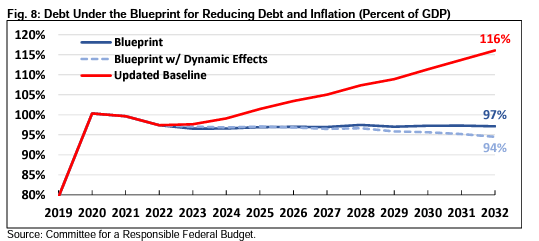
Finally, there is a sensible and comprehensive plan to address these problems put together by the Committee for a Responsible Federal Budget (CRFB).  It should be looked at carefully by everyone who realizes how dangerous our current fiscal situation now is.  The Plan is actually modest in that it doesn’t expect miracles.  But even to stabilize our current public debt (the $24 trillion on which we pay interest) at 98% of GDP over the next decade will require roughly $7 trillion in budget savings!

The Plan is a combination of revenue and spending changes – with savings from health care, tax reform, discretionary spending caps, energy reforms, and Social Security solvency, among other things.  Without major reforms such as these, our public debt will grow from 98% of GDP in Fiscal Year 2022 to 116% of GDP by FY 2032.  Here is a rough outline (to begin with!) of the CRFB Blueprint:

  • Stabilize and reduce the debt as a share of the economy. Failing to do so means leaving us at increased risk of higher interest rates and slower growth with fewer tools to address future needs and crises.  A comprehensive plan should prevent debt from rising as a share of the economy.
  • Support the Federal Reserve’s efforts to fight inflation. While the Fed is charged with fighting inflation, also using fiscal policy to help the Fed ensures that all policy is moving in the same direction, spreading the impact of inflation reduction across the economy, and reducing the likelihood and/or severity of recession.
  • Secure the major trust funds to prevent insolvency. The major trust funds, Social Security, Medicare Hospital Insurance (Part A), and the Highway Trust Fund are all headed for insolvency within the next 12 years, which would require abrupt cuts in benefit spending.  A budget plan should restore long-term solvency to these funds.
  • Promote long-term economic and income growth. Lower debt can help to grow the economy and specific policy reforms can further support work, promote investment, and reduce distortions.
  • Support fairness and efficiency throughout the tax code and budget. A budget plan should consider how to structure the budget and tax code more efficiently to better target resources where they are needed and can do the most good.
The above-outlined fiscal policies help to fight inflation by tempering demand, boosting supply, and lowering prices. 

Conclusion.  We now have a very serious inflation problem and our national debt is growing rapidly.  These two problems are intimately related.  While the Federal Reserve has the primary responsibility of fixing inflation, Congress and the President can help immensely by implementing serious fiscal restraint.  That’s what the CRFB blueprint plan, as described above, is proposing. More details will follow soon!

for my Email Newsletter
Follow me on Facebook
Follow me on Twitter

How Do We Solve Our Inflation Problem?

By far the biggest problem in our country right now is inflation, which reached an annual rate of 9.3% in June and is now at 8.2%.  I have been devoting a lot of time with this blog in discussing various aspects of this problem, see here, here, and here.

Let’s summarize the fundamentals of inflation, and how to fix it, as explained by the economist John Cochrane in the Wall Street Journal.  They are:

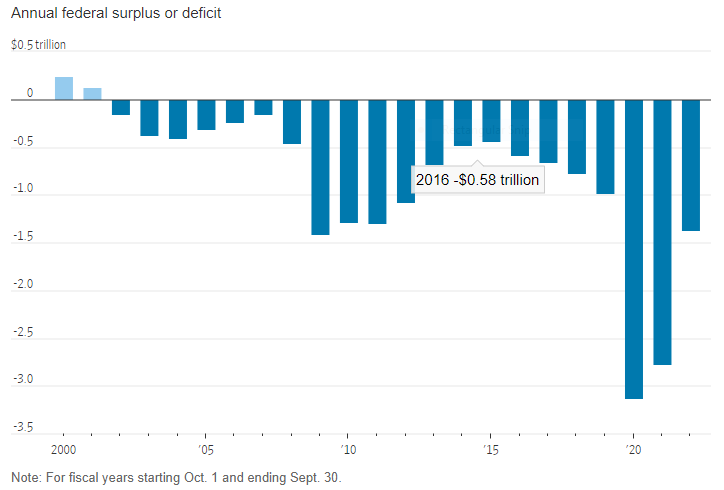
  • Loose Fiscal Policy is the proximate cause of inflation, i.e. the most immediate cause. The government spent $5 trillion on Covid relief stimulus during 2020 and 2021 and thereby created huge spending deficits in those years (see chart).  These huge deficits created far more demand in the economy than could be quickly met and so prices started to increase.

  • The Federal Reserve has only a blunt tool to reduce inflation, namely raising interest rates to slow down the economy which, of course, risks causing a recession. So far, the Fed has raised short-term interest rates by 3% and will almost certainly continue raising rates for many months to come, to get inflation back down to the desired rate of 2%.
  • Interest Payments on our enormous $30 trillion accumulated debt have already started to increase rapidly because of the higher interest rates. This will, of course, make our already high annual deficits just that much worse.

  • The Federal Government will be tempted to spend even more money to help people pay their bills during the recession which may have already started. This will, of course, just make deficit spending that much worse.
  • Economic Growth is required for a favorable long-term outcome. This is what happened in the 1980s after the inflation of the 1970s.  Economic growth increases taxable income, and therefore taxes collected, which can be used to shrink annual deficit spending.  Along with economic growth is needed spending restraint, especially in the form of entitlement reform.
  • The Good News is that our inflation problem can be solved by fiscal (congressional), monetary (Federal Reserve), and regulatory (Presidential) policy working together, if these three branches of government are committed to working together.

Conclusion.  We are now faced with a very serious inflation problem.  It can only be solved by the Federal Reserve, Congress, and the President working together, as described above.  We can be confident that the Fed will do its part.  Are President Biden and Congress up to doing their own parts?  Only time will tell if we come out of our current predicament in a relatively comfortable way (with only minor economic pain), or whether we have new, and much worse, fiscal and debt crises to deal with along the way.

for my Email Newsletter
Follow me on Facebook
Follow me on Twitter
The Biden Contradiction: Where He’s Right and Where He’s Very Wrong

My two favorite topics recently on this blog are 1) our fundamental strengths as a nation, and 2) my great concern about the damaging effects of high inflation.  In short, we’re doing a good job of providing leadership in the free world, but poorly in letting high inflation get such a strong grip on our economy.

More specifically, our current President Joe Biden is doing a good job on foreign policy but a very poor job on the economy.  Consider:

  • World Leadership. The Biden Administration’s new National Security Strategy Plan clearly identifies the challenges and opportunities facing the U.S. in dealing with our principal adversaries around the world: China, Russia, Iran, and North Korea.  In fact, the U.S. has many strengths to build on in dealing with these rogue countries.  U.S. companies are now, for example, responding to government incentives to withdraw from the Chinese Chip market.  In short, the Biden Administration is defending and further building on our strong record of supporting democracy and freedom around the world.
  • The U.S. Economy. Here the situation is the reverse of the above.  When President Biden took office in January 2021, the U.S. inflation rate was 1.4% and the economy was already recovering strongly from the Covid lockdowns and their consequent unemployment.  Nevertheless, despite strong warnings from many prominent economists, including Larry Summers, Congress passed, and President Biden signed, the $1.9 trillion American Rescue Plan in March 2021.  Inflation immediately took off, reaching a high of 9.3% in June 2022 and now sitting at 8.2% for September 2022.  Based on our experience in the 1970s and 1980s, the Federal Reserve will have to keep raising interest rates for many months to come, in order to force inflation back to the desired 2% level.  In the meantime, inflation has spread around the world, and hundreds of millions of people will be feeling the pain of higher prices and slowing economies.  Understanding that there are many contributing factors to inflation, see here and here, by tripping off the current inflationary spiral, the Biden Administration and fellow Democrats are largely responsible for inflicting this pain, not only on the U.S., but on the rest of the world as well.

Conclusion.  Giving credit where credit is due, President Biden is strongly supporting U.S. interests, broadly construed, around the world.  But his economic policies have been disastrous, tripping off a huge surge of inflation at home and abroad.  The answer is to elect a Republican Congress next month to put the brakes on excessive federal spending, in order to help the Fed bring the inflation rate back down to normal levels.

for my Email Newsletter
Follow me on Facebook
Follow me on Twitter

The U.S. Has Huge Strengths in the Struggle for World Leadership

In recent posts, I have written that I am optimistic about the future of the U.S., but I am also quite concerned about the effects of the high inflation we are now experiencing.  In other words, we’re in overall good shape but there is going to be pain involved in getting inflation under control.  But compare our own strengths with the weaknesses of our main adversaries.

  • U.S. strengths. Our fundamental strength is a free and open society and a democratic form of government.   A free society like ours will always have urgent problems to address.  But our democratic form of government assures that the people will ultimately decide, with free and fair elections, how to resolve our differences and move forward.  Another huge strength is the superiority of a free enterprise economy (see chart) which will always out-compete the socialist alternative.  Yet another enormous strength is our good relations with the many other democracies around the world.  Stable democracies work out their differences peacefully rather than through war.

  • China’s weaknesses. China is basically a socialist country even though it has aspects of a free market.  It is not really free because the government arbitrarily controls its tech sector as well as its overbuilt real estate market.  And its zero-Covid policy is now creating huge economic problems at the same time as our own (democratic) decentralized response to Covid has pulled us out of the two-year pandemic.  China also has a huge demographic problem (its working-age population is shrinking) because of its previous one-child-per-woman policy.
  • Russia’s weaknesses. Russia’s President, Vladimir Putin, has been a worldwide trouble maker for many years, and has now made the huge mistake of invading Ukraine.  With the help of the U.S. and its European allies, Ukraine is defending itself heroically and even starting to repel the Russian forces.  There is growing opposition to the Ukraine invasion and to Putin, himself, even within Russia.  However the Ukrainian war plays out in the end, Russia has been diminished as a superpower.

  • Iran’s weakness. Starting with a young woman’s arrest and death over a head scarf, Iranians are protesting in droves fueled by middle-class anger over the country’s collapsing economy.  The mullahs running Iran are unwilling to enter a “longer and stronger” agreement with the U.S. to assure that Iran does not develop nuclear weapons.  Iran is now suffering from severe economic sanctions imposed by the West.

  • North Korea. North Korea is a threat to the U.S. because it has nuclear missiles.  The best defense for the U.S. against North Korea is to keep improving our missile defense capabilities.

Conclusion.  The United States has huge underlying strengths in the struggle for world supremacy against our main adversaries of China, Russia, Iran, and North Korea.  We have a far superior economic and political system than our rivals.  We also outclass them in military strength.  We should be confident in our ability to remain the world’s leading power for many years to come.  At the same time, we should never become complacent about our advantages and let our guard down.  Especially right now, we must take very seriously our high rate of inflation, and exercise the necessary fiscal restraint needed to bring the inflation rate back down to the desired 2% level.

for my Email Newsletter
Follow me on Facebook
Follow me on Twitter

The Harmful Effects of High Inflation

As readers of this blog know, I am optimistic about the long-term future of our country,  because of our many fundamental strengths.  But I am also quite concerned about the effects of the high rate of inflation we are now experiencing, which is, first of all, driving up the cost of everyday living.

In the near term, the next few years, inflation is going to cause even more pain for millions of Americans.  Consider:

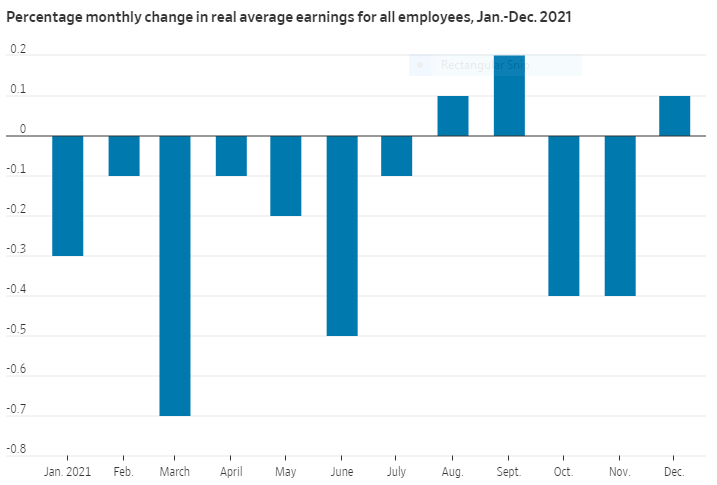
  • What inflation costs workers.  In 2021 inflation reduced real wage gains by 2.4% (see chart).

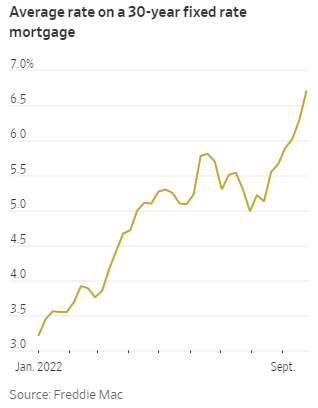
  • Mortgage rates surge.  The average mortgage rate is now 6.7%, the highest level since July 2007 (see chart). This adds pressure to the already cooling U.S. housing market.  Many would-be home buyers have given up, while many existing homeowners have become reluctant to sell.

  • Likelihood of recession. According to the economist Larry Summers, there is a very substantial likelihood of a recession over the next two years.  This is suggested by the current inflation rate of 8.3%, along with the current low unemployment rate of 3.7%, and the clearly stated goal of Federal Reserve Chair Jerome Powell to raise interest rates as high as necessary to bring the inflation level back down to the desired 2% level.

  • Interest payments on the national debt.  Rising interest rates are already dramatically increasing interest payments on our public debt of $24 trillion.  They hit $63 billion in August 2022 which computes to $756 billion on an annual basis.  Soon interest payments on the debt will exceed $1 trillion per year from the current level (in Fiscal 2022) of $400 billion per year.  Because of inflation, social security payouts will increase from $1.2 trillion per year to $1.3 trillion.  Federal healthcare costs (Medicare, Medicaid, etc.) which amounted to $915 billion in fiscal 2022, will grow by $163 billion next year.  If we do fall into a serious recession, federal tax revenue will erode.

Conclusion.   Workers falling further and further behind in the cost of living, prospective home buyers unable to afford to buy a house, a serious recession substantially raising the unemployment rate, and finally, huge increases in financing our growing debt coupled with recession-induced shrinking tax revenue, all these events will be very harmful to the economy.  Will this likely combined scenario put us into a “doom loop” of decline or “just” mire us in stagflation, draining growth potential from the national economy?  Either way, the whole process will be painful for tens of millions of Americans.

for my Email Newsletter
Follow me on Facebook
Follow me on Twitter