
Many things are going well in the U.S. We are a free and open democratic society. Our two major political parties compete vigorously for votes. We are the strongest country in the world, both economically and militarily. Together with our many democratic allies, we are helping Ukraine defend itself against Russian aggression.
But we have a huge problem on the horizon that we are handling poorly: the national debt. It is now over $32 trillion and growing rapidly. The annual deficits, that collectively make up the debt, are now over $1.5 trillion each year and growing. Let’s look at the big picture on our debt situation.

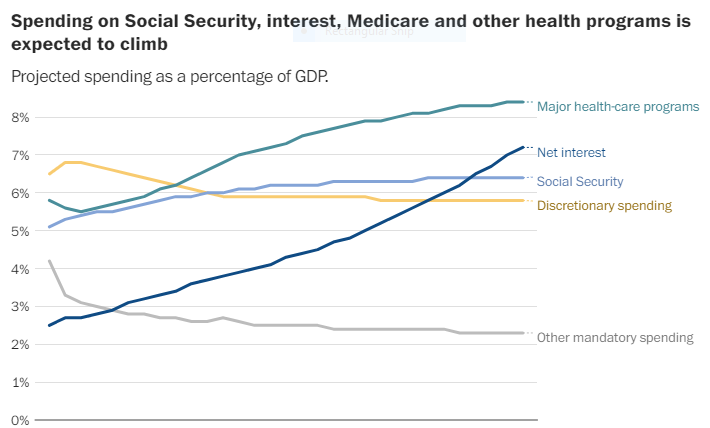
Consider:
- Major healthcare programs are the largest single item in the federal budget at 24%. They are also the fastest-growing category of the federal budget (along with net interest). The Washington Post has shown that it is possible to save almost $100 billion per year in Medicare costs alone by more effective management of the program. The largest single component of this savings, $40 billion, comes from making Medicare Advantage more cost-effective. Other big savings for Medicare would come from the more careful addition of new procedures. Medicare is an important social program but must be reformed to remain sustainable.

- Social Security. SS makes up 22% of federal spending and its spending is not growing as fast as healthcare programs. Nevertheless, it also needs some relatively small tweaks to remain sustainable, such as raising the eligibility age, and making means adjustments for benefits (down for the wealthy but also up for low-income recipients).

- Non-defense discretionary spending. This is only 15% of the total budget but still offers opportunities for big savings. This is precisely what the House Republicans focus on in the current discussions about the FY 2024 budget. As you can see from the attached chart, there is a $119 billion discrepancy between what the House Appropriations subcommittees have allocated for next year and what the corresponding Senate subcommittees have allocated. These differences will be resolved in joint meetings between the House and the Senate. Clearly, there is potential for large savings compared to what was enacted for FY 2023.


Conclusion. We simply cannot continue our current path of annual spending deficits of $1.5 trillion and higher. There is more and more public awareness of this simple arithmetic fact. The current trend toward governmental decentralization will help. But we also need major spending restraint at the federal level.
For my Email Newsletter
Follow me on Facebook
Follow me on Twitter
 It Does Not Add Up
Thank-you Jack. Just keep up with the constant reminders!
Hopefully, we will have the political option to get started in about 18 months. My totally uneducated intuition is that the Stock Market will be up 50% by then as well. Amazingly, it seems as if our economy is doing amazingly well in spite of all the strikes against it during the last 2-3 years.
Paul
Thanks for your continued support. Yes, our economy is doing well but this is partly due to the stimulus of huge annual deficits that are also the primary cause of inflation. I also expect the stock market to do well in the near term especially as a hedge against our persistent inflation.