
I am mostly an optimist about the future of the United States. But, according to press reports, we have a lot of pessimists in our midst. Our country certainly has challenges to deal with, and many people wonder if we will be able to address them all successfully. I understand their concern, but, with one possible exception, I believe we will meet all the major challenges we face without major repercussions.
Consider:
- The world in disarray. There are now major conflagrations occurring in Ukraine and the Middle East. Russia invaded Ukraine almost two years ago and Hamas surprised Israel with an attack on October 7. Both are serious regional wars in which the U.S. is heavily involved. The U.S. and its allies are helping Ukraine defend itself. Ukraine wants to expel Russia from all occupied territory, but, it may have to instead negotiate a compromise settlement. At any rate, it is unlikely that this war will spread beyond the Ukraine/Russia border area.
In the Middle East, the Israel/Hamas Gaza war is likely to end soon in a cease-fire with some sort of international presence involved to finally achieve justice for Palestinians in Gaza and the West Bank. I do not think that the current situation will spill out into a larger war in the Middle East because the U.S. and the local powers, Egypt, and Saudi Arabia, do not want this to happen. - U.S./China rivalry. China is challenging the U.S.-created world order (Pax Americana) established at the end of WWII. However, China benefits enormously from international trade with the West and is unlikely to attempt to capture Taiwan by force. Furthermore, China currently has its own big internal problems to address. In other words, our (economic) competition with China will continue but will unlikely lead to a military confrontation.
- U.S. political polarization. The progressive left and the conservative right despise each other, and this creates much internal division. Nationally, it means that a partisan split in Congress makes it difficult to pass bipartisan legislation. At the state level, only Pennsylvania has a partisan split in the control of its legislative chambers. I consider our current political polarization as democracy in action and not a sign of national distress. Eventually, this unpleasant situation will resolve itself politically in a peaceful manner.

- National Debt. This is a very serious problem that must be addressed soon to avoid a financial crisis much worse than the one that occurred in 2008. The only way to effectively do this is with entitlement reform, which, unfortunately, elected national leaders are loath to address. The debt problem can be solved but, so far, the political will to do it does not exist.
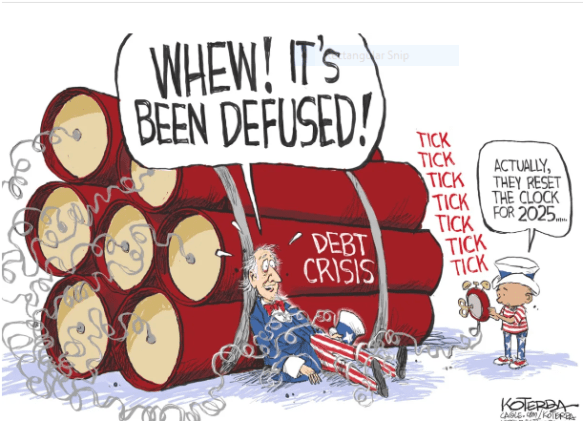

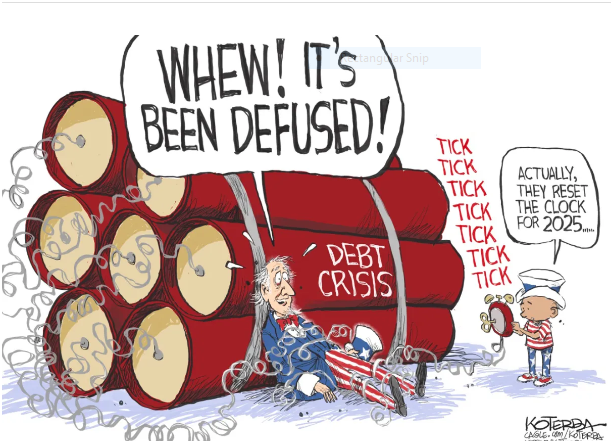
Conclusion. At the present time, there is an untidy world order with lots of regional stress. Furthermore, the U.S. is almost equally divided between left and right political factions, and this generates great animosity. These situations, as unpleasant as they are, will fade away over time in a relatively peaceful manner. Unfortunately, the U.S. national debt is rapidly getting worse. If not addressed soon by the President and Congress, a huge new financial crisis will develop that will cause great damage both to the U.S. itself and the rules-based world order that it has created and led since the end of WWII.
For my Email Newsletter
Follow me on Facebook
Follow me on Twitter
 It Does Not Add Up
I vote for two additional Federal, Constitutional Amendments:
BALANCED BUDGET
CONGRESSIONAL TERM LIMITS
Paul Nelson
I agree with you but, realistically, neither such amendments have virtually no chance of being approved by Congress, or even ratified by 38 states if they were.
I am under the impression that 35 states have already approved a version of the Balanced-budget Amendment. Its remotely possible that a Republican perfect-wave is in the immediate future!
Paul
I hope you’re right, I’d love to see it.