On this blog, I discuss important national issues, often about fiscal and economic matters. Most recently, I made the case that the U.S. is a very strong country for a variety of reasons: constitutionally, economically, and militarily.
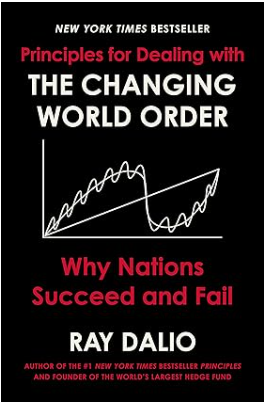 Today, I take a step back and look at the U.S. from the view of Ray Dalio’s Cyclic Theory of History, which explores how empires form, grow, and decline over long periods of time. According to Dalio, there are three different factors (orders) that cause these cycles to occur: the monetary order, the domestic political order, and the international world order. Let’s take each in turn:
- The Monetary Order. The U.S. now has a national debt of $39 trillion. It is collecting approximately $5 trillion a year in taxes and spending $7 trillion a year, thus adding $2 trillion a year to an already excessively large debt. This is a huge problem of fiscal irresponsibility and cannot continue much longer without tripping off a new, and very serious, financial crisis. The only way to rein in this excessive federal spending is to make major reforms to entitlement programs such as Social Security, Medicare, and Medicaid. This is very hard to do for members of Congress who have to run for reelection.
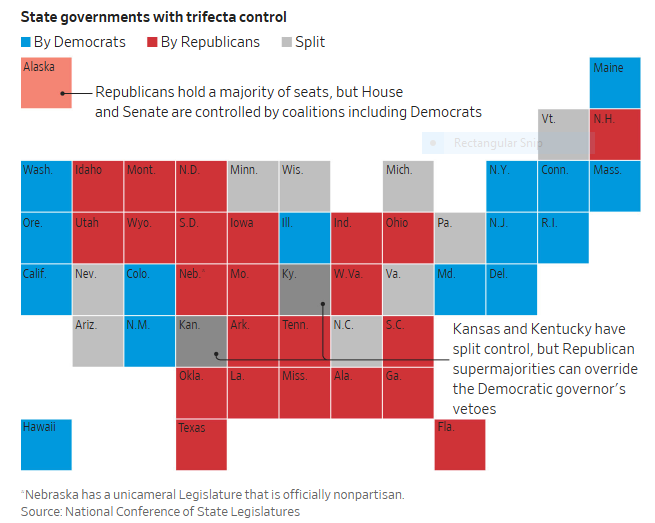
- The Domestic Political Order. The U.S. is highly polarized politically, not only in Congress but at the state level as well. There are currently 25 (red) states in which Republicans have control of both legislative branches with either large supermajorities or else hold the governorship as well, and 15 (blue) states controlled by the Democrats in this way (see chart below). This means that in 40 out of 50 states, one party can enact controversial policies largely on its own. Note, furthermore, that the red states are gaining population overall while the blue states are losing population. This will likely have a big effect on redistricting after the 2030 census. I view this polarization as unfortunate but not necessarily destabilizing for the U.S.

- The International World Order. The U.S. is much stronger than its autocratic adversaries: China, Russia, Iran, and North Korea. China has an export-dependent economy and needs a favorable trade arrangement with the U.S. to prosper. Russia is in economic decline because of its disastrous invasion of Ukraine. Iran will have to reach a deal soon with the U.S. to avoid the collapse of its oil-based export economy. North Korea is a nuisance but not a serious threat to our national security. In other words, the international world order is favorable to the U.S. for the foreseeable future.
Conclusion. Of Ray Dalio’s three major controlling orders, the first one, the monetary order, looks bad for the U.S., the second one, the domestic political order, is disturbing but not really a crisis, and the third one, the international world order, leans in our favor, for the foreseeable future. We may have to deal with a new financial crisis over our massive and rapidly growing debt in the near future. This will be painful for many Americans, but will probably not significantly affect our overall national strength.
 It Does Not Add Up
You need to listen to a real economist like Robert Reich.
Robert Reich has no credibility. He is far too left wing.