What Is the Best Way to Cope with Climate Change?


The Intergovernmental Panel on Climate Change has just issued it’s latest and most definitive assessment about the extent of global warming.  The earth’s average temperature has increased by .85 degrees centigrade since 1880 and is on track to increase to 2 degrees centigrade in a relatively short time span.  Such a major climate change will have severe repercussions for human life.
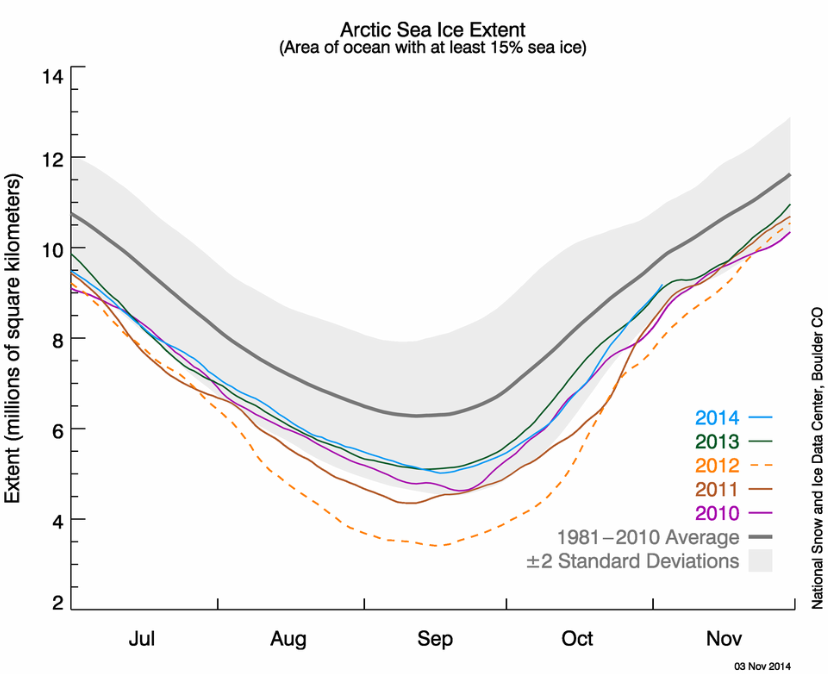
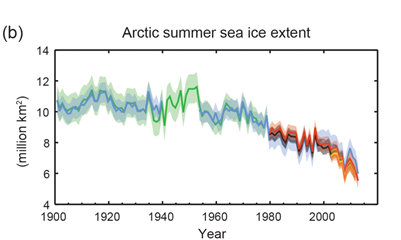
CaptureThere is much evidence for the IPCC’s gloomy prognosis.  Most convincing for me is that the extent of the summer artic ice cap is steadily shrinking, as demonstrated in the above chart.
The Environmental Protection Agency is attempting to decrease carbon emissions by regulation but there is a limit to what can be accomplished in this way:

  • The EPA’s goal is a 30% reduction in carbon emissions from 2005 levels by 2030. But the only way that this can possibly be achieved is by substituting the use of natural gas for coal, which reduces carbon emissions by 50%
  • The current low cost of natural gas is making nuclear power less economically viable even though nuclear power has no carbon footprint at all.
  • In addition to creating such constraints, this approach also has led the EPA to set complicated and arbitrary goals on carbon emissions for each state individually.

In other words, by employing onerous regulations the EPA will only, at best, be able to achieve a 30% reduction in carbon emissions by 2030. Of course, this is better than nothing but it is not nearly enough to significantly slow down global warming.  Even if European countries succeed in meeting similar targets as the ones set for the U.S., this leaves out the largest carbon emitter of all, namely China, as well as the rest of the developing world. Since it is impractical to eliminate the use of fossil fuels altogether, or even come close to doing so, the emphasis should be on limiting carbon emissions.  In other words, we should create incentives for carbon “sequestration,” i.e. the capture and storage of carbon when burning fossil fuels.   The way to do this is with a tax on the release of carbon into the atmosphere.  Such a carbon tax would provide a huge incentive for energy and power companies to develop the best possible sequestration techniques. With an economic incentive to do so, U.S. technological ingenuity will quickly develop effective methods for carbon sequestration.  Once discovered and perfected, their use would rapidly spread around the world. Climate change is real and we need an effective way to address it.  A carbon tax is the best way to get the job done.
What the EPA Is Doing about Climate Change


My last post, “The Latest Scientific Report on Climate Change,” summarizes a new report from the Intergovernmental Panel on Climate Change. It makes a very strong case that global warming is real and that it will badly disrupt human civilization before the end of the twenty-first century if not substantially mitigated.
What are we doing about it? The Environmental Protection Agency reports on its many actions as follows: “What EPA is doing about Climate Change

  • Inventorying of U.S. Greenhouse Gas Emissions and Sinks has been tracking all GHG emissions since 1990.
  • Developing “Common Sense” Regulatory Initiatives. For example, EPA’s vehicle greenhouse gas rules will eliminate 6 billion metric tons of GHG pollution by 2025. EPA is developing carbon pollution standards for the power sector which will cut carbon emissions 30% below 2005 levels.
  • Partnering with the Private Sector. EPAs partners reduced over 345 million metric tons of GHG in 2010 alone.
  • Advancing the Science. EPA works with the IPCC to understand the environmental and health impacts of climate change.


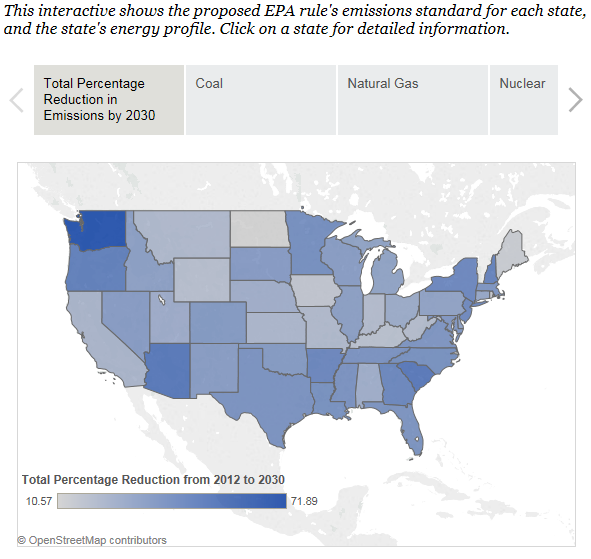
Here is how the Washington Post describes another EPA activity, the recently announced Clean Power Plan. “The rule provides every state with a target carbon-emissions intensity for its power plants, with preliminary standards kicking in by 2020 and full goals to be achieved by 2030.  As the map (below) shows, the rule generally asks the least from the states with the worst carbon-intensity at present – those that are very dependent on coal generation, such as West Virginia, Kentucky and North Dakota.  While cross-state variations in the intensity of pollution controls are a standard feature of regulation under the Clean Air Act, they usually have a compelling justification: the negative effects of emissions are local, and so areas suffering from pollution problems must be more stringent.  But greenhouse gas concentrations are uniform globally, making it somewhat awkward to subject identical emitters to divergent standards simply because their home states’ power mix is more or less carbon-intensive.”
CaptureThe purpose of this whole discussion is to illustrate how complicated it already is and will continue to be to achieve a significant reduction in GHG carbon emissions by regulation alone, even the relatively modest 30% reduction which the EPA is trying to accomplish.
Fortunately there is a better way of achieving an even bigger reduction in carbon emissions.  Stay tuned for my next post!

The Latest Scientific Report on Climate Change


The Intergovernmental Panel on Climate Change has just issued its Fifth Assessment Report summarizing the best scientific information about global warming that is available in 2014.
Capture1CaptureKey findings are:

  • It is extremely likely that humans are the dominant cause of warming since the mid-20th century.
  • Each of the past three decades has been successively warmer than the preceding decades since 1850.
  • Oceans absorb more than 90% of the heat.
  • Land temperatures remain at historic highs while ocean temperatures continue to climb.
  • Oceans will continue to warm during the 21st century.
  • Global mean sea level will continue to rise during the 21st century.
  • It is very likely that the Artic sea ice cover will continue to shrink and thin as global mean surface temperature rises.
  • Some of the changes in extreme weather and climate events observed since about 1950 have been linked to human influence.
  • The globally averaged temperature shows a warming of .85 degrees centigrade over the period 1880 – 2012. And 65% of the carbon budget compatible with limiting future temperature to an overall 2 degrees C increase has already been used.
  • Energy production remains the primary driver of greenhouse gas emissions.
  • Measures exist to achieve the substantial emissions reductions required to limit likely warming to 2 degrees C.
  • Delaying mitigation will substantially increase the challenges associated with limiting warming to 2 degrees C.

I consider the above information from the IPCC report to be noncontroversial and providing overwhelmingly strong evidence that global warming is taking place. Next question:  What do we do about it?  This will be the subject of my next post!

Why We Need a Carbon Tax VI. Because of China!


Over the past two months I have posted several blogs about the seriousness of global warming and demonstrated that the best way to address it is with a carbon tax of about $20 per ton of CO2 released into the atmosphere.  Here is a summary of my argument:

  • The reality of global warming can hardly be questioned. For example, the extent of summer ice in the arctic ocean is shrinking rapidly.
  • Expecting the Environmental Protection Agency to be able to administer an effective program by giving each state a target for CO2 emissions reductions is cumbersome and arbitrary.
  • The current EPA program of trying to reduce carbon emissions by 30% over the next 15 years will set up an economic incentive to substitute natural gas for coal and slow down the further development of nuclear energy and renewable energy sources such as wind and solar power. This is because natural gas is plentiful and inexpensive. But the burning of natural gas still releases half as much CO2 as coal and so will continue to contribute to global warming.

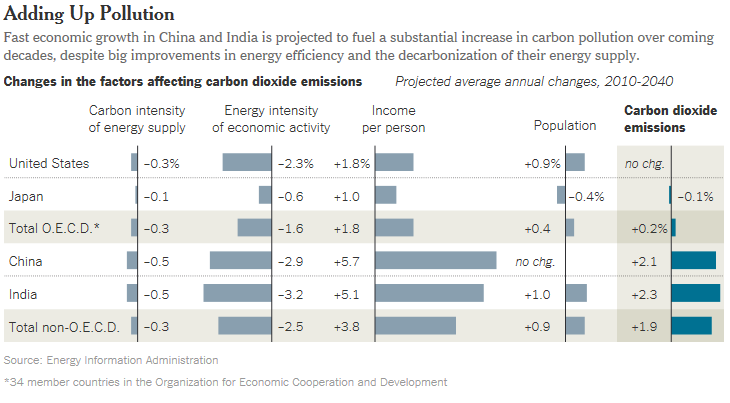
CaptureIn yesterday’s New York Times, the reporter Eduardo Porter in “China’s Hurdle to Fast Action on Carbon” calculates that even under conservative growth assumptions, China will almost double its carbon emissions between now and 2040.  And this doesn’t even consider all of the other developing nations which also will increase their use of inexpensive energy sources in order to increase their standards of living.
In other words, even if the EPA is able to force a big switch from coal to natural gas in the U.S., any such reduction in carbon emissions will be dwarfed by increases from other countries.
A carbon tax on CO2 emissions will not only give a big boost to all non-fossil fuels, it will also unleash American ingenuity to figure out how to accomplish carbon sequestration in the use of fossil fuels.  This will enable the U.S. to achieve a much greater reduction than 30% in carbon emissions over the next 15 years and beyond.  Furthermore the new technology which we develop to do this will be immediately available for use around the world.
With such a program the U.S. would actually be demonstrating how to effectively attack global warming instead of just advocating for it!

Why We Need a Carbon Tax V. We’re Playing with Matches!


“Risk is like fire: If controlled it will help you; if uncontrolled it will rise up and destroy you.”                                                                            Theodore Roosevelt,   1858 – 1919

Just a few days ago I featured an Op Ed column in the New York Times “The Coming Climate Crash” by Henry Paulson, the former Secretary of the Treasury.  He discusses global warming as an economic issue.  The increasing number of severe storms, deeper droughts, longer fire seasons and rising sea levels it will cause will wreak tremendous economic damage on our country and the whole world as well.
CaptureA new report, “Risky Business” produced by the Risky Business Project, elaborates much further on this theme.  “The American economy is already beginning to feel the effects of climate change.  These impacts will likely grow materially over the next 5 to 25 years and affect the future performance of today’s business and investment decisions in the following areas: coastal property and infrastructure (damaged by storm surges and higher sea levels); agriculture (disrupted by higher temperatures); energy (costs will go up to provide more cooling).”
In addition to the large scale economic effects referred to above, global warming will affect each of us in a very direct way.  For example, in Omaha NE where I live, in just a few short years the current average of about 10 days per summer with a temperature over 95 degrees F, will increase to about 25 such summer days.
All of these effects are assuming that we continue on our present course of rapidly increasing CO2 build up in the atmosphere.  We do have a choice in this matter.  We can cut back but it will take a big effort to accomplish this.  The whole world needs to cut back and it is up to the U.S. to lead the way.
Republicans need to step forward on global warming.  It is highly irresponsible to say that any anti-carbon measures we take will just hurt our economy and ignore all of the harmful effects of proceeding on our present course.  It is also irresponsible to say that we can’t act unless everyone else does too.  If we are exceptional, and I agree that we are, then it is up to us to set an example for the whole world.
We need fiscal conservatives in office to address our very serious deficit and debt problems.  But fiscal conservative have to win the trust of a wider group of voters to show that they are deserving of broader support.

Why We Need a Carbon Tax IV. The Economic Risks of Climate Change


I have now posted more than 200 entries on my blog.  I have discussed a wide variety of fiscal and economic issues in the last year and one-half.  But there are really, in my opinion, just a fairly small number of basic themes in my posts, such as:

  • Eliminating deficit spending so that we can shrink our national debt over time to a substantially lower level than the current 73% of GDP.
  • Boosting our economy in order to put more people back to work as well as bringing in more tax revenue.
  • Maintaining an activist foreign policy including a sufficiently strong military force to protect our free and democratic way of life.
  • Maintaining high citizen morale by addressing other critical domestic issues such as economic mobility and increasing income inequality.
  • Addressing natural threats to our way of life such as global warming.

Capture Today’s New York Times has an excellent article on global warming “The Coming Climate Crash” from a surprising source, former Secretary of the Treasury, Henry Paulson.  He was in office when the credit bubble burst in 2008 and is therefore an expert on crisis management.  His argument is that global warming presents a strong economic threat as well as an environmental threat.  It therefore should be addressed by an effective economic policy, such as a carbon tax.  He points out that:

  • Global warming is a far more intractable problem than a credit bubble, not at all amenable to a relatively quick fix by government action.
  • A threat from nature like global warming is not an ideological issue because it affects all of us in the same way, conservatives and liberals alike.
  • A future with more severe storms, deeper droughts, longer fire seasons and rising sea levels creates huge economic risks which we ignore at our great peril.
  • A carbon tax doesn’t outlaw the use of fossil fuels but rather creates a huge economic incentive for developing carbon sequestration when fossil fuels are burned.

Government regulation of fossil fuels by the Environmental Protection Agency represents a timid and arbitrary half measure that won’t have nearly the impact of a sound economic incentive like a carbon tax.  Let’s get serious and do things the right way!

Why We Need a Carbon Tax III. Natural Gas Is Not a Real Solution


Most people agree that global warming is for real and that it is caused by a buildup of greenhouse gases in the atmosphere, mostly from carbon dioxide.  We need to respond to this existential threat and the U.S. should lead the way.  The Environmental Protection Agency’s new regulations call for a 30% reduction in carbon emissions, from 2005 levels, by 2030.  Since fracking has led to a natural gas boom in the U.S. and the burning of natural gas only emits half as much carbon as the burning of coal, it is very likely that the new EPA rules will lead to a major replacement of coal by natural gas in U.S. energy production.
CaptureBut there is a downside to this approach as pointed out in yesterday’s New York Times, “The Potential Downside of Natural Gas,” as follows:

  • Natural gas is starting to replace nuclear power which has no carbon footprint. Last year five reactors announced that they would close because of the low cost of natural gas. This will increase CO2 in the atmosphere.
  • Fracking for oil produces natural gas as a side product which may not be easily marketable. This excess natural gas is either burned off or escapes unburned releasing methane which causes even more damage than CO2.
  • The low cost of natural gas is also slowing down the development of renewable energy sources such as wind and solar power.

A far more efficient system of reducing carbon dioxide in the atmosphere would be to tax its emission from any fuel source.  The most commonly mentioned amount is $20 per ton which would raise the price of gasoline by about 10 cents per gallon.   This way the use of all forms of fuel, including coal, oil and gas, would be taxed equally based on how much carbon they emit.  This would create a huge economic incentive for developing carbon capture in fuel combustion, which is the ultimate solution to eliminating CO2 emissions.
In other words, we have a huge problem on our hands which needs an effective solution.  Half measures will not get the job done and will just cause lots of confusion and political controversy in the meantime.  It’s time for some real leadership!

Why We Need a Carbon Tax II. The Scientific Evidence Is Very Strong


A few days ago I made the argument that “we need a carbon tax” because global warming is real and our response to it should not be defaulted to regulatory action by the EPA and individual states acting on their own.  Just two days ago the U.S. Global Change Research Program released a voluminous new report, the “Third National Climate Assessment”, giving many examples of how dramatically global warming is already affecting life in the United States as well as all over the world.
CapturePerhaps the most direct effect in the U.S. is an increase in average temperatures of almost 2 degrees Fahrenheit since 1900.  This means that summers are longer and hotter and that winters are shorter and warmer, on average.  Hotter temperatures mean that there is more moisture in the atmosphere and rain comes in heavier downpours.
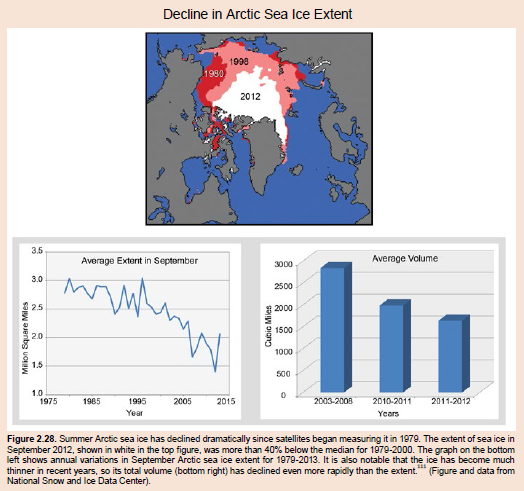
Capture1It is going to be harder and harder for doubters to deny the accumulating evidence.  Global average temperatures have also increased by almost 2 degrees F in the past century.  The most dramatic, and visible, evidence worldwide for climate change is the shrinking of the artic polar icecap measured each year in September.  Although the ice extent fluctuates from one year to another, the pattern of decline, as shown below, is clearly evident.
Capture2A worldwide response is urgently needed and the wealthiest country in the world should step up to the plate and lead the way.  A carbon tax does not mean an end to using to using fossil fuels but simply provides a strong incentive, without government picking winners and losers, to cut back on carbon emissions.  We can be confident that, with a strong economic incentive, American technology will figure out how to remove carbon from fossil fuels during combustion.
The sooner we begin a program along these lines, the better off we will all be in the very near future as the world continues to get warmer.

Why We Need a Carbon Tax


The Los Angeles Times recently ran the article “U.S. electricity prices may be going up for good” (reprinted in today’s Omaha World Herald), stating that “Experts warn of a growing fragility as coal-fired plants are shut down, nuclear power is reduced and consumers switch to renewable energy.”
CaptureThe article goes on to say that “the problems confronting the electrical system are the result of a wide range of forces: new federal regulations on toxic emissions, rules on greenhouse gases, state mandates for renewable power, technical problems at nuclear power plants and unpredictable price trends for natural gas.”
“New emissions rules on mercury, acid gases and other toxics by the Environmental Protection Agency are expected to result in significant losses of the nation’s coal generated power, historically the largest and cheapest source of electricity.  Already two dozen coal generating units are scheduled for decommissioning.”
“At the same time, 30 states have mandates for renewable energy that will require the use of more expensive wind and solar energy.  Since these sources depend on the weather, they require backup generation – a hidden factor that can add significantly to the overall cost to consumers.”
Here is what we should do instead:

  • First, we agree that global warming is for real. For me, the clearest and most irrefutable evidence is the rapidly diminishing extent of the artic polar icecap each summer. There is much evidence that cause of global warming is the use of fossil fuels, coal, oil and gas, which releases carbon dioxide into the atmosphere.
  • Secondly, even though the problem is worldwide, and China emits more CO2 than the U.S., nevertheless the U.S. has a responsibility to provide the leadership of which only it is capable.
  • The problem is, as the LA Times article makes very clear, our disorganized and inefficient response to the problem. Separate and haphazard responses by individual states are not nearly enough, rather we need a coherent national response.
  • A national carbon tax of perhaps $20 per ton of CO2 emitted would provide a uniform market mechanism to encourage the reduction of carbon emissions from fossil fuels or their replacement by alternate sources of energy. Coal power plants, for example, would not be forced to shut down but would have to figure out how to emit less carbon in order to remain economically viable.

This would be a big improvement over our current situation!

Global Warming Is For Real II. How Do We Move Forward?


The Intergovernmental Panel on Climate Change has just issued a new report, reported in yesterday’s New York Times, “Climate Efforts Falling Short, U.N. Panel Says”. The IPCC is saying that an intensive effort is needed in the next 15 years to prevent the global average temperature from rising more than 3.6 degrees Fahrenheit (2 degrees Celsius) above the preindustrial level. Since the U.S. and China are the biggest emitters of carbon, it is critical for the U.S. to show leadership on this issue.
CaptureOne dramatic piece of evidence that global warming is real is the rapidly shrinking size of the artic polar ice cap measured at the end of each summer. In a previous post last December 8, I took note that at least 29 U.S. companies “are incorporating a price on carbon into their long range plans.” I also noted a report from the Congressional Budget Office which estimates that a tax on energy companies of $20 to emit a ton of CO2 would raise $120 billion a year and raise the cost of gasoline by 10 to 15 cents per gallon.
The scene is clearly set. There is a serious threat to life on earth. We have a good estimate of what it will take to meet the threat and a specific time window for responding. We also know the approximate cost of a sensible plan for doing so. Can our democratic political system be moved to action?
A large energy tax like this will take a bite out of the economy. An attractive way of building support would be to make it part of broad based tax reform designed to stimulate the economy with lower individual and corporate rates offset by closing loopholes and eliminating deductions. In fact a carefully assembled package might be able to reduce carbon emissions, stimulate the economy (with lower tax rates) and raise revenue to pay down the deficit, all at the same time!
Is this too much to hope for?