Why Our Debt Is Such a Serious Problem

My last several posts have discussed some of our society’s biggest problems in terms of their relative seriousness and how likely we are to make progress in solving them in the near future.  For example:

  • Global Warming. The evidence for man-made global warming is overwhelming (shrinking arctic sea ice, rising sea levels, more intense hurricanes, more devastating forest fires, etc.).  But a growing number of Americans (now 70%) agree that urgent action is needed to address global warming and our political system is already responding on a state and local level.  The Republican Party is already starting to get the message.
  • Stagnant Middle Class Incomes. How to boost incomes for the working class is now a hot political issue.  Do we need faster economic growth or more redistribution or a combination of the two?  My own answer is to push for more inclusive economic growth by enhancing the Earned Income Tax Credit with a Wage Subsidy to give a bigger boost to all working people at the lower end of the income scale.  The EITC already subsidizes wages to some extent and there is bipartisan support for expanding this program.

But our national debt is continuing to get worse and worse with no plausible solution in sight.  The public debt (on which we pay interest) now stands at $16.6 trillion or 78% of GDP and is projected by the Congressional Budget Office to keep growing rapidly until serious reforms are undertaken.  The longer we wait the more difficult the necessary corrective actions become.
Capture1

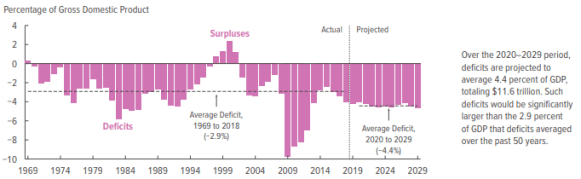
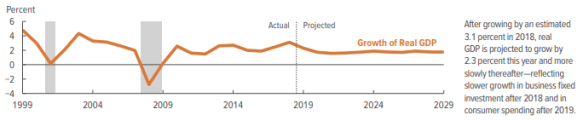
For example, CBO predicts that our annual deficits will settle down to an average of about 4.4% of GDP from 2019-2029 (see chart). At the same time GDP from 2020-2029 may only average 1.7%, much too low to keep up with the larger deficit levels.  In addition the net interest rate on the debt will likely increase to 3% by 2029. (see chart).

Capture2

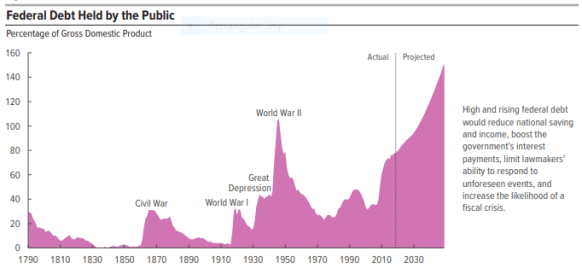
All of this adds up to a spectacular debt increase over the next 30 years (see chart) which will almost certainly produce a severe fiscal crisis long before we reach the end of this time period.

Capture3

What makes this problem so difficult is that neither political party wants to address it seriously because it can only be done by raising taxes broadly or curtailing entitlement spending.  Both alternatives require sacrifice on a large scale which is difficult to accomplish politically.
Stay tuned for more details on what to do!

Follow me on Twitter 
Follow me on Facebook 
An Economy That Works for Everyone

As I remind my readers, I am a non-ideological fiscal conservative and social moderate.  I am a strong supporter of economic growth as measured by GDP.  GDP growth hit 3% in 2018 for the first year time since 2005, helped out by both recent deregulation and the tax reform which lowered our top corporate rate to an internationally competitive 21%.

Capture41.PNG

But it is well understood that blue collar workers have not benefitted from recent economic growth as much as the most highly educated.  Many less skilled workers have been hurt by both globalization and the increasing automation of industry. The economic and social pain they are suffering has been especially well chronicled by the social scientist, Charles Murray, in his book, Coming Apart.

Globalization and automation are desirable trends in general because they are economically efficient ways of raising living standards worldwide. The question then is: what should the U.S. do to help those workers who have been left behind in the present job market?

The best existing program to do this is the so-called Earned Income Tax Credit.  It subsidizes low-income working families at an overall cost to the federal government of about $70 billion per year.  But is has several weaknesses.  It only applies to families with children so that many millions of individual workers are left out.  Furthermore it is only paid out once a year, at tax time, and therefore does not provide a steady stream of extra income.  Finally, the tax credit starts declining at an income of $19,000 for a married couple with two children, for example, and disappears entirely at $50,000.

A better plan has been proposed by Oren Cass in his recent book, The Once and Future Worker.  It is called a wage subsidy and applies to every worker who makes less than a target wage of, say $16 per hour.  It pays half of the difference between the actual wage and the target wage.  For example, if a worker makes $10 per hour, then his employer pays him/her an extra $3 per hour and deducts the $3 from his tax payment to the federal government.  This approach ties redistribution directly to productive employment and therefore is superior to other types of such programs.

It would cost the federal government $200 billion per year, much more than the current EITC program costs.  The additional $130 billion cost could be transferred from the $1 trillion per year now spent on federal welfare programs without hurting the poor.

Mr. Cass’s proposal is founded on the principle that “a labor market in which workers can support strong families and communities is the central determinant of long-term prosperity and should be the central focus of public policy.”

The wage subsidy program would be a giant step in this direction.

Follow me on Twitter 
Follow me on Facebook 
Global Warming vs Economic Growth

As I have discussed in a recent post, two of America’s biggest problems, in my opinion, are slow economic growth and the increasingly serious threat of global warming.   We don’t know yet the official GDP growth figure for 2018, but it will likely be 3% or more, the economy’s best performance since 2005.

capture36

Unfortunately, U.S. carbon emissions also rose in 2018 for the first time in several years (see first chart), even though they are still significantly down from their high point in 2005.  In fact, the U.S. is still largely on track to meet its target from the 2015 Paris Accords (see second chart) as long as the 2018 increase is an aberration and carbon emissions resume their downward track in the coming years.

capture37

This presents a dilemma.  We want economic growth to increase, in order to create more and better paying jobs, but we also need to keep carbon emissions on a significant downward track in order to lessen the effects of global warming.  Last year GDP grew smartly but carbon emissions also went up.  Can we do better?

There is new technology for carbon capture and storage but it is expensive to implement.  An economic incentive is needed for industry to employ it widely.

There is a way to create such an incentive, putting a price on carbon, but unfortunately it does not have nearly enough political support at the present time.  Specifically carbon emissions would be taxed, let’s say at $20 per ton, and the revenue returned to the people in some suitable manner.  This would raise the cost of gasoline, for example, by 18 cents per gallon.

The only way to address global warming is to reduce the carbon in the atmosphere.  An incentive such as a carbon tax is the most efficient way to do it.  At the present time roughly 60% of Americans agree that global warming is caused by human activity.  As the evidence for global warming becomes more and more obvious, eventually there surely will be enough political support to take effective action.

Follow me on Twitter 
Follow me on Facebook 
America’s Best Defense against a More Powerful China

In my last post I pointed out that we are likely to win the current trade war with China because their consumer economy is hurting which makes them more dependent on trade with the U.S.

But the Chinese economy is growing much faster than ours and their population is four times as large.  How do we protect ourselves from China’s looming world economic dominance?

capture34

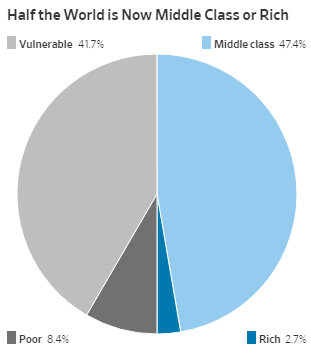
One of our best weapons is a circumstance that is not widely understood and appreciated:  The world is quietly getting better!   In fact, half of the entire world’s 7.6 billion people are now either wealthy or middle class (see chart).  A detailed discussion of the enormous human progress steadily taking place around the world is given by Steven Pinker in his recent work, Enlightenment Now.

The struggle for supremacy between the United States and China is a struggle between freedom and tyranny.  Even though freedom has taken a few setbacks in recent years,  there are still far more free countries than not-free countries around the world. (see second chart)   Democracies seldom go to war with each other; rather they work out their problems peacefully.  Even when China does surpass the U.S. economically, because the U.S. is a democracy, it will continue to have far more allies than China.

capture35

Furthermore, as prosperity continues to grow and spread more widely around the world, as it most likely will, freedom and democracy will also continue to flourish and spread more widely.  This means that the U.S. should gain even more allies in the years ahead.

The U.S. cannot stop China from growing economically nor should it try to.  After all, the wealthier China becomes the better off its people will be, and a more prosperous population will insist on more personal freedom.

But regardless, as a democracy, the U.S. has inherent strengths which should enable it to continue to lead the free world more many years to come.

Follow me on Twitter 
Follow me on Facebook 
Is China a Long Term Threat to the United States?

There cannot be two suns in the sky, nor two emperors on the earth,”                     Confucius, 551-479 BC

Our current trade war with China will probably be resolved soon because the Chinese economy is slowing down (see chart) and the current $250 billion in tariffs on Chinese exports to the U.S. are a major contributor to this.  There is a good chance of achieving our two main goals of obtaining greater access to Chinese markets and ending intellectual property theft.

Chinese Economic Growth
capture33

But the Chinese economy is growing much faster than ours and China’s population is four times as large.  China does have some very serious long term economic problems  but it would be shortsighted for the U.S. to expect the Chines economy to collapse any time soon.  In other words, the U.S. needs to prepare for the likelihood that the size of the Chinese economy will greatly exceed ours in the near future.

Anyone who is concerned about this should read the book, “The Hundred-Year Marathon: China’s secret strategy to replace America as the global superpower,”  by Michael Pillsbury, a longtime U.S. China expert who speaks fluent mandarin.

The People’s Republic of China was founded by Mao Zedong in 1949.  No later than 2049 China will almost surely be strong enough to challenge the U.S. dominated economic and geopolitical world order founded at the end of WWII.

The hundred year marathon strategy suggests that China should, for example:

  • Induce complacency to avoid alerting the opponent
  • Be patient – for decades or longer – to achieve victory
  • Steal the opponent’s ideas and technology for strategic purposes
  • Recognize that the hegemon will take extreme action to retain its dominant position
  • Always be vigilant to avoid being encircled or deceived by others

Mr. Pillsbury has performed a great service by spelling out in detail the immense challenge the U.S. will have in containing China’s growing power and influence around the world.  How should the U.S. deal with this huge threat to its current world dominance?  Stay tuned!

Follow me on Twitter
Follow me on Facebook 
How is Donald Trump Doing as President?

I describe myself as a non-ideological fiscal conservative and social moderate.  I try to discuss political issues in an objective, rational manner and avoid personalities as much as possible.  But it is hard to avoid expressing opinions about the most important political actor of all, the President of the United States.

Mr. Trump is a highly polarizing figure.  Most people either strongly approve of how he is handling the office or else loathe him.  I am in the middle.  I recognize that he is crude, mentally clumsy and divisive but I also think that he is handling several difficult issues quite adroitly.  For example:

  1. The economy. Economic growth is much improved since Mr. Trump became President, hitting 3% in 2018 and likely to continue strong for at least another year or two.  Faster growth means lower unemployment which, in turn, means more jobs and better paying jobs.  This is a big boost especially for hourly workers.  The economy was already picking up steam (because of deregulation) before the December 2017 tax cuts which were a big mistake because they badly increase the national debt.
  2. Trade imbalance with China. Trump is tightening the screws on China’s unfair trade practices which is likely to lead soon to major improvements in how China interacts economically with the free world.                                                                            

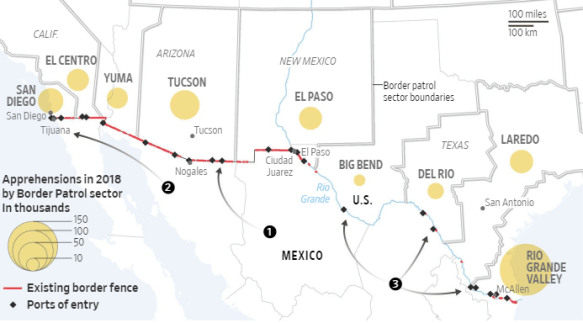
                                             Our Current Wall on the Mexican Border                                

    Capture32

  3. Immigration policy and the Wall. With roughly 12 million foreigners illegally residing in the U.S., current immigration policy is a big mess.  Whether or not more wall is needed (see map), border security needs to be greatly enhanced.  Mr. Trump rightly insists on getting this done.
  4. Foreign policy. Trump is not an isolationist.  How to handle the Middle East is our biggest foreign policy challenge.  Withdrawing 2000 troops from the Kurdish area of Syria represents a possible shift away from Saudi Arabia and towards Turkey.  Pulling Turkey away from the Russia-Iran axis could be a smart move.
  5. Global warming. The evidence for man-made global warming is overwhelming.  Carbon emissions are declining in the U.S. (because coal is being replaced by less expensive and cleaner natural gas) but still continuing to increase worldwide, in spite of the 2015 Paris Accords, because of massive increases in the use of coal by developing countries such as China and India.  Trump is not doing anything to address this problem, but neither is he making it worse (as he is often accused of doing).

The above are a few of the areas where the Trump Administration is moving in the right direction, or at least avoiding the wrong direction, on difficult issues.  Credit should be given where credit is due.

Follow me on Twitter
Follow me on Facebook 

America’s Biggest Problems

In my last post I stated that the U.S. has several big problems which must be successfully addressed in order to avoid national decline.  They are:

  1. National Debt
  2. Slow Economic Growth
  3. Trade Imbalance with China
  4. Global Warming

But which of these problems is the biggest threat?  I now argue that some of these problems are less serious than others.
Capture30

First of all, I am optimistic that global warming, as serious as it is, will be successfully kept under control by all nations working together to reduce carbon emissions.  Already 60% of Americans, for example, agree that global warming exists and is man-made.  As its’ effects, such as rising sea levels and more intense hurricanes, become more and more evident, the general public will strongly insist that effective action be taken to combat it and our elected representatives will respond accordingly.  Further, as Chinese air becomes more and more polluted by the burning of coal, the Chinese government will also decide that strong measures must be taken.  This will eventually lead to American-Chinese cooperation to set up worldwide standards to drastically shrink carbon emissions from fossil fuels and perhaps even to remove carbon from the atmosphere.

I am also optimistic that our trade imbalance with China will be successfully addressed in the near future.  There is strong bipartisan support in Congress to deal with Chinese theft of intellectual property and excessive restrictions on American exports to China.  It is a top priority of the Trump Administration to resolve this problem.  Significant progress is therefore likely to occur.

Again, addressing slow economic growth is a major focus of the Trump Administration.  Faster growth mean less unemployment, which in turn means more jobs and better paying jobs for American workers.  Faster economic growth will likely remain a top priority for both political parties.

I am thus reasonably optimistic that three of our four biggest problems are politically solvable at least in the sense that significant progress can and will be made.  How about the debt problem?  This is much more difficult.  Stay tuned!

Follow me on Twitter
Follow me on Facebook

Avoiding American Decline

I started this blog, It Does Not Add Up, in November 2012, right after the national elections, because I was so concerned about our exploding national debt.  Of course, in the meantime it has been getting worse and worse.
A year ago I decided to put my money where my mouth is, so to speak, and enter the May 2018 Nebraska Republican Primary for the U.S. Senate seat held by Deb Fischer who had just voted for the 2017 tax bill which will raise our debt by a trillion dollars over a decade, even after allowing for increased economic growth.  Fischer went on to win the Primary and then to win reelection to a second six year term last month.
I was so discouraged by my ineffectiveness on the debt issue that I stopped writing new entries for the blog after the May 2018 Primary.
Capture29
But now I am back and we’ll see what happens.  My intention is to continue dealing with the debt problem but in a wider context.  I will be discussing other urgent problems as well.  Mostly I will be focused on the following issues:

  1. The National Debt now stands at 78% (for the public part on which we pay interest) of GDP and our huge annual deficits are continuously making it worse. As interest rates rise, interest payments on our huge debt will increase precipitously.  This will lead to a new fiscal crisis if stern measures to fix the debt problem are not taken soon.
  2. Slow Economic Growth. Faster GDP growth means a lower unemployment rate which, in turn, means more jobs and better paying jobs.  This is exactly what is needed to give a boost to the middle- and lower-income workers who are suffering from economic insecurity.
  3. Trade Imbalance with China. China has four times as many people as the U.S. and its economy is growing faster than ours.  Soon the size of the Chinese economy will exceed ours.  We can’t stop Chinese growth but we can insist that China play fair and stop stealing our intellectual property.
  4. Global Warming. The evidence for man-made global warming is overwhelming. Carbon emissions in the U.S. are steadily decreasing because natural gas is less expensive and cleaner than coal.  But this is not good enough because carbon emissions are increasing worldwide, especially in China and India.  Working together, the U.S. and China have the clout to implement a plan to drastically reduce carbon emissions worldwide.
  5. The Consequences of American Decline.  These are the biggest problems our country faces because together they threaten our prosperity as well as our status as the world’s leading superpower.  A multi-polar world replacing the U.S. dominated uni-polar world is likely to endanger the relative peace and stability we have enjoyed for so long.

Follow me on Twitter:
Follow me on Facebook:

Nebraska Voters, We Are Nearing a National Crisis …


Our debt is growing so fast that we will soon be bankrupt if we don’t change what we are doing. We have simply got to figure out how to fix the debt. I am Jack Heidel, a retired UNO math professor and not looking for a new career.  I am confident that I can make a difference in one six year term in the U.S. Senate. Please vote for me on May 15 in the Republican Primary.

This is the text of a TV commercial which begins running this weekend in the Omaha and Lincoln areas. It attempts to summarize in one short statement what I have been saying for a long time:

  • Our debt (the public part on which we pay interest) is now 78% of GDP and predicted by the Congressional Budget Office to reach almost 100% in the next ten years. Annual deficits are growing rapidly and will be back to almost $1 trillion by next year.
  • The incumbent Deb Fischer is totally ignoring the debt and has actually voted twice recently to make it worse than it already is. The new tax law, for all of its good individual features, will increase the debt by $1 trillion over ten years, even after new growth is taken into account. The new two year budget, also voted for by Fischer, increases the debt by another $1 trillion.
  • Fixing the debt doesn’t mean paying it off but rather shrinking annual deficits way down so that they are less than the rate of growth of GDP. Then the debt will begin to shrink as a percentage of GDP just as it did after WWII.
  • Entitlement reform and, in particular, the high cost of American healthcare, is the only practical way to deal with the debt problem. All of us, as healthcare consumers, must have more personal responsibility for holding down the cost of our own healthcare.

Conclusion. I am so alarmed by our enormous and out-of-control debt that I am challenging an incumbent U.S. Senator in a primary election. If you live in Nebraska I would appreciate your support!

Why We So Badly Need New People in Congress


I am a candidate for the U.S. Senate in the May 15 Republican Primary against the incumbent Deb Fischer because she is ignoring our enormous and out-of-control national debt. In fact she has voted twice recently to make our debt even worse than it already is.  I am referring to both the new tax law which, in spite of its good individual features, raises our debt by $1 trillion over the next decade and also the 2018 budget agreement which increases the debt by a similar amount.
The nonpartisan Congressional Budget Office estimates that this year’s budget deficit will be over $800 billion and next year’s at $981 billion, almost back to the trillion dollar level seen for four years after the Great Recession.
The likewise nonpartisan think tank, the Committee for a Responsible Federal Budget, concludes that over half of next year’s huge deficit is the direct result of legislation passed since 2015 and signed by President’s Obama and Trump, as shown in the chart.


In more detail:

  • The largest contribution to next year’s deficit, $230 billion, is from the December 2017 tax bill.
  • The next largest contribution is $190 billion from the 2018 Bipartisan Budget Act.
  • But the 2015 doc fix and tax extender bills also add $100 billion to the 2019 deficit.

As CRFB says, “It is no longer enough for Congress to ‘do no harm’ in the near term and ensure solvency of entitlement programs over the long term. Fixing our debt will now require reversing the harm which has already been done with tax cuts and spending increases.”

Conclusion. Historically the Republicans have been the party of fiscal responsibility. But now the GOP is completely in charge and annual deficits are increasing rapidly.  Is it not very clear that big changes are needed in who represents us in Washington?