Ending the Tariff Wars

Some analysts are complaining that the Trump Administration is endangering free trade around the world by picking trade fights with, for example, China, Japan, Mexico, Canada and Europe.  Even some of President Trump’s strongest supporters complain that the U.S. is bearing down too hard on our own allies and thereby likely to hurt the overall world economy.

Capture32

But there is another way to look at the worldwide trade situation.   According to Peter Navarro, Director of the Office of Trade and Manufacturing Policy, “American exporters face systematically higher tariffs in the markets of more than 100 U.S. trading partners.”  Consider:

  • The U.S. tariff rate on automobiles is 2.5%. The European Union’s tariff is 10% and the EU exports more than three times as many autos to the U.S. as the U.S. exports to the EU.
  • India applies higher tariffs 90% of the time and China 85%, thereby blocking many American exporters from selling goods to these countries at competitive prices.
  • The World Trade Organization requires member states to apply the lowest tariffs it applies to the products of any one country to the products of every other country. WTO members may, however, charge higher tariffs if they apply those nonreciprocal tariffs to all countries.
  • President Trump has asked Congress to pass the U.S. Reciprocal Trade Act which would allow the President to bring to the negotiating table any trading partner that applies higher nonreciprocal tariffs. If such partner refuses to lower its tariffs, the President would have the power to impose reciprocal duties on that country.
  • Just because the U.S. is the strongest and wealthiest nation in the world, it cannot be expected to sacrifice the welfare of its own citizens with trade practices which treat them unfairly.

Summary.  Free trade among nations enhances overall prosperity because countries are able to specialize in what they do best.  But free trade should also be fair trade so that all parties have the opportunity to benefit from the increased exchange.

Follow me on Twitter 
Follow me on Facebook 

Faster Economic Growth Is Likely to Continue

The U.S. unemployment rate is down to 3.6%.  Economic growth was 2.9% in 2018.  This is very good news but how long will it last?

Capture22

According to Nancy Lazar, the CEO of Cornerstone Macro, the good news is likely to continue indefinitely.  Here is why:

  • Manufacturing started to shift back to the U.S. from China in 2010 due to higher construction costs in China. Investment in the U.S. started to pick up in 2016 and then gained strength in 2017 and 2018 due to the cut in the corporate tax rate.
  • Year over year productivity accelerated to 2.4% in the first quarter of 2019, the strongest in over eight years. For example, productivity growth averaged only .6% from 2011 – 2014.  During the 1990s, productivity growth grew from zero in 1993 to 4% in 1999.
  • Today with roughly 2% productivity growth and 1% labor force growth, maximum potential GDP growth is 3%. Ms. Lazar expects 2.8% growth in 2019.
  • Long term, interest rates will likely stay lower for two reasons: 1) inflation is going to be lower for a longer period, and 2) expectations for the lack of Federal Reserve tightening will hold down long term yields.
  • How long can the good news last? A deterioration in productivity growth started in 2002 as companies shifted investment away from the U.S., with a 40% tax rate which was one of the highest in the world.  All of this has now been reversed.
  • Income inequality is a serious problem. But real median family income is up 15% since 2011 and is now a record high.  Consumer income expectations are now at the same record high levels as in the 1990s.

Summary.  Our current economic expansion is robust and is therefore likely to continue indefinitely.

Follow me on Twitter 
Follow me on Facebook 

Is Democracy in Decline?

Many scholars are claiming that democracy worldwide is in decline and that the U.S. is presently making matters worse by, for example, neglecting allies, befriending dictators and embracing nativist politics.  I believe that this view is unfair to the current administration.

Capture31

But first of all let’s look at the facts.  Freedom House is the best source.  According to the latest information from FH (see chart) democracy has greatly expanded around the world in the past thirty years, is currently in very good shape, and has had only a few setbacks in recent years.

capture35

But let’s look at several hot spots around the world in terms of how the Trump Administration is responding to the challenges.  For example:

  • China is a threat to democracy because it is big and powerful and is throwing its weight around by engaging in unfair trading practices with many other nations. President Trump is the first U.S. President to attack this problem head on and is making much progress in forcing China to play by internationally accepted rules of trade.
  • Venezuela is a failed state and the U.S. is slowly tightening the screws to try to force regime change so that democratic elements in Venezuela can begin the hard work of restoring the economy. The U.S. has not intervened militarily as has Russia and Cuba but rather is working with other democracies to bring about positive change.
  • Iran is feeling the heat from the new U.S. sanctions which are gradually being tightened. The problem is that the 2015 JCPA sunsets in 2030 and the U.S. now rightly insists that Iran give up nuclear weapons permanently. The U.S. stands ready to begin renegotiations with Iran at any time.
  • North Korea signed an agreement with the U.S. to permanently denuclearize the Korean peninsula. The U.S. insists that major progress must be made in denuclearization before any sanctions will be lifted.  Hopefully North Korea will eventually decide that President Trump means what he says and start to fulfill its part of the bargain.
  • The U.S. southern border. The flood of immigrants from Central America is causing a crisis on the border.  Both sides are digging in and so this crisis most likely will not be resolved until after the 2020 Presidential election.  What is needed is comprehensive immigration reform so that illegal immigrants somehow become legal guest workers.

Summary.  The U.S. is actively working with many other countries around the world to resolve complicated international problems.  This is democracy in action and the U.S. is leading the way.

Follow me on Twitter 
Follow me on Facebook 

The Cure for Inequality in the U.S.

As stated by the Hoover Institute’s Edward Lazear, “In rich countries around the world, the top half of the income distribution has been pulling away from the bottom half.  Productivity growth among high-wage workers, driven by technological change, is the reason.”

Many people think that American capitalism is broken.  They say that there is too much inequality, too much wealth for too few and too much greed.  Some CEOs say that there should be less emphasis on short term profits and more emphasis on treating employees better.
Capture30

Right now our economy is growing at a rapid clip and unemployment is at a 50 year low of 3.6%.  Not only does this mean more choices for job seekers and higher wages for most workers, it also means many new opportunities for under-served populations such as women and minorities.

Worker productivity rose 2.4% in the first quarter of 2019, compared to a year ago.  This is the fastest year-over-year growth since 2010.   There is now a huge shortage of high skill workers in the U.S., along with excellent pay for entry level jobs.

Capture29

Some people worry that the development and spread of artificial intelligence will eliminate jobs for many workers.  But it sure hasn’t happened yet.  Right now labor markets are getting tighter, not slacker.  Obviously what our economy needs is more skilled workers at all levels, whether it be with high school degrees, associate degrees, bachelor’s degrees or postgraduate degrees.

Summary.  There is indeed increasing income inequality in the U.S. and around the world.  The reason for this growing inequality is a combination of globalization and the advance of technology.  The people with the most education and the highest skill levels are pulling away from the rest.  The best way to fix it is not to pull down the wealthy but to raise up the non-wealthy.  To accomplish this we need better and more relevant education at all levels.

Follow me on Twitter 
Follow me on Facebook 

The Many Benefits of Faster Economic Growth

Economic growth is picking up speed in the U.S. which, in turn, pushes down the unemployment rate now at a fifty year low of 3.6%.  This is not only bringing more people into the job market but also raising wages more quickly especially at the lower end of the pay scale.
Of course there are a few negative consequences of faster growth, such as an increase in carbon emissions which cause global warming, but the overall effects are highly beneficial to American society in many different ways.
For example:

  • Blue Collar Workers. Another important factor is that there are many good job opportunities for blue collar workers in the interior of the country, away from the crowded coasts.  These are in thriving cities especially in the midlands which have a much lower cost of living as well.

Capture25

  • Women.  One huge benefit is the opening up of many new employment opportunities for women in the blue collar jobs long dominated by men (see first chart).  For example, 9% of over-the-road truck drivers are women as are 5% of welders.

Capture27

  • Black unemployment is steadily dropping and is now as low as it has been for fifty years (see second chart).
  • Trade flexibility. As the U.S. and China close in on an historic trade agreement, President Trump has more flexibility to insist that trade abuses such as intellectual theft and restrictive business practices be sharply curtailed.

Summary.  Faster economic growth, along with the lower unemployment rate it engenders, has many, many benefits for Americans.  It means jobs for more people, higher wages for all, new employment opportunities for those who are ambitious and especially for women and minorities.  Everyone benefits when the American economy is humming.

Follow me on Twitter 
Follow me on Facebook 

Economic Growth Is Critical Even With Side Effects

I often write on this blog about the importance of economic growth.  We have just learned that U.S. GDP growth is continuing to soar, increasing at 3.2% in the first quarter of 2019 (see chart).  Growth is so important because it keeps the unemployment rate, now at 3.8%, very low, which in turn is responsible for creating better paying jobs.  Ultimately it is better paying jobs for the American worker which will reduce inequality in American society.

Capture22

But faster economic growth may cause problems of its own which need to be dealt with as separate issues.  For example:

  • Global warming. Although U.S. carbon emissions are dropping overall in line with the 2015 Paris Accord standards, they did rise in 2018 which was a year of faster (2.9%) GDP growth.  This makes it all the more important to take the threat of global warming seriously.  In fact, we should adopt the most economically sound and efficient way of doing this, namely a (refundable) carbon tax.
  • Residential diversity. The New York Times has pointed out that suburban areas of many big cities are growing more diverse as minorities are more and more capable of affording houses in these areas.  On the other hand, minorities are being displaced in poor inner city neighborhoods as middle class whites are able to pay higher prices for available houses and vacant lots.  In other words, increasing prosperity is leading to more residential integration even though it happens differently in different parts of town.  The economic progress and increasing diversity should be celebrated rather than constantly focusing on racial inequality.
    Capture23.PNG
  • Two wage earner families are becoming more unequal.  As two professional wage earner families want to have children, it is usually the wife who takes a leave of absence or goes part time, rather than the husband.  Our vibrant economy puts a premium on the willingness to work long hours and it is more likely the man than the woman who is willing to do this.  This is a small sacrifice for couples to have to make compared to the rewards of being part of a dynamic economy.

Summary.  Americans are incredibly fortunate to live in a dynamic society with so many opportunities for advancement.  There are costs to pay for such a satisfying environment but they are well worth it.

Follow me on Twitter 
Follow me on Facebook 

Is “Medicare for All” a Good Idea?

I am not a socialist.  I am not a supporter of Bernie Sanders for President.  But “Medicare for All” has one very attractive feature.  It will substantially lower the cost of healthcare in the U.S.

As I repeat many times on this website, our country’s biggest long term problem by far is the rapidly growing, out-of-control, and unsustainable national debt.  The driving force of our debt problem is the rapidly increasing cost of entitlements.  And the cost of entitlement spending is primarily driven by the cost of healthcare: Medicare, Medicaid and private healthcare in that order (since Social Security insolvency is a conceptually easy fix).

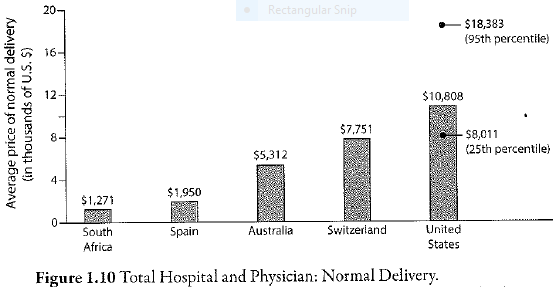
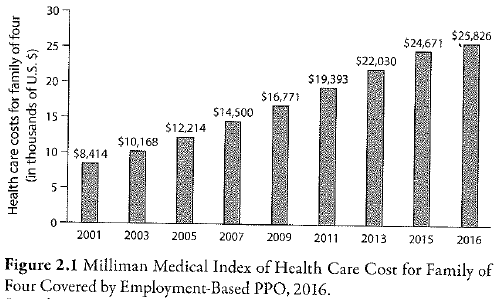
We have excellent healthcare in the U.S. but we pay too much for it, in fact 18% of GDP for all of healthcare, public and private.  This is almost double what any other developed country pays.  The federal government subsidizes the cost of U.S. healthcare (i.e. for Medicare, Medicaid and private) at over $1 trillion per year.  This exceeds even our increasing annual budget deficits.

Capture21

“On average, the government (i.e. Medicare and Medicaid) pays the government 87 cents for every dollar of their costs compared with private insurers that pay $1.45.”   In other words, a government run “Medicare for All” program would force hospitals to operate much more efficiently and thereby lower overall hospital costs by an estimated 40%.  This is the plus side of “Medicare for All.”

The negative side of a single payer system like “Medicare for All” is its likely negative effect on innovation.  According to the economist Tyler Cowan, “The American healthcare system, high expenditures and all, is driving innovation for the entire world.”

Summary.  The sixty four thousand dollar question is: “How do we dramatically lower healthcare costs in the U.S., which are burgeoning out of control, without losing the cutting edge medical advancements produced by the U.S. healthcare system?”

Follow me on Twitter 
Follow me on Facebook 

How to “End Economic Inequality, Grow the Middle Class, and Heal the Nation”

“Solving inequality in earnest will require dramatic changes. … It will take vision, wisdom, creativity, patience, courage, and will to fully change our current inequalities.  But we can start with urgency in the business arena.  We can change the dynamic of our precarious current state.  We can change the dialogue and turn the crisis into a discussion of constructive possibilities.  With caring and compassion our attitudes will shift.  The good people will multiply and their efforts will be transformational.  Progress and success will beget more of the same.” 

These are the closing words of retired CEO Peter Georgescu in his new book, “Capitalists, ARISE: end economic inequality, grow the middle class, heal the nation.”  According to Mr. Georgescu, this can all happen if business CEOs will stop worrying so much about the return on investment to their stockholders and instead give more concern to the welfare of their employees.

Capture20

But it is not necessary for CEOs to act altruistically for these good things to happen.  In 2018 our economy grew at a rate of almost 3% and the unemployment rate is now down to 3.8%.  Such a low unemployment rate means we have a nationwide labor shortage!

In fact wages are now rising at a fairly rapid clip, faster than 3% per year (see second chart).    Many big companies, such as Amazon, Home Depot and Walmart, are individually raising their minimum wages in order to be able to attract the large numbers of workers they need to operate their businesses.

Capture19

Summary.  In other words, the best way to achieve Mr. Georescu’s laudable goals, is to keep the unemployment rate as low as possible, at least under the 4% benchmark.  This will accomplish far more economic good for the average worker than acts of altruism by individual or groups of CEOs.  And by and large it is faster economic growth which lowers the unemployment rate.

Follow me on Twitter 
Follow me on Facebook 

The Stupidity of Modern Monetary Theory

Modern Monetary Theory says that deficits don’t matter, unless inflation increases a lot, because the U.S. can always just print new money to pay off its debts.  The idea being that if inflation does increase then the Federal Reserve would respond by increasing interest rates which would in turn drive up interest payments on the debt.
Capture16
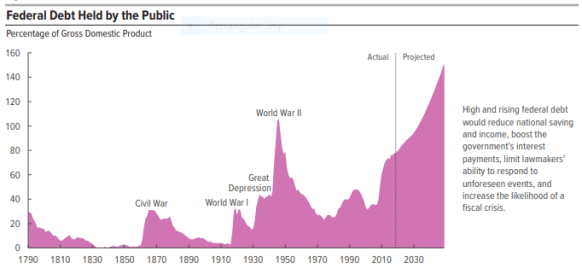
Another way to say it is that we are okay with huge deficits, adding each year to our already large debt, as long as inflation remains low.  Yes, it is true that that right now, interest rates are so low that our huge almost $22 trillion debt is almost free money, costing us “only” about $300 billion per year in interest payments.

The problem is, of course, that this currently happy low inflation era will eventually end and the Federal Reserve will be forced to raise interest rates, perhaps dramatically.  The longer this takes to occur, the more our debt will have accumulated in the meantime.  Right now debt is 78% of GDP (for the public part on which we pay interest), and is predicted by the Congressional Budget Office to keep growing steadily worse without major changes in policy.

I find it shocking that many financially experienced people take MMT seriously.  They should know better.  The very simple logic that inflation, and therefore interest rates and interest payments on the debt, will significantly increase, sooner or later, should be easy to understand.  The longer this takes to happen, the more severe will be the eventual problem and therefore the more traumatic will be the necessary fiscal adjustments to make at that time.

Summary.   It is depressing to clearly foresee the awful fiscal hole that our nation is gradually sinking into and be unable to do anything to stop it.

Follow me on Twitter 
Follow me on Facebook 

Tax Policy and the Wealthy

Most of the Democratic candidates for President want to raise tax revenue to pay for new programs of various sorts.  Senator Elizabeth Warren of Massachusetts has in fact suggested creating a new wealth tax, 2% annually on wealth over $50 million and an additional 1% on wealth over $1 billion.
Capture15

Is a wealth tax a good idea?

Normally I am skeptical of the economic ideas of Harvard University’s Larry Summers.  He has stated many times that slow economic growth may be the new normal.  He has also said quite recently that we should stop worrying about trillion dollar budget deficits.  These are both very dangerous ideas. (here and here)

But he has two recent columns in the Boston Globe about wealth taxes which make a lot of sense.  First of all, he points out the many problems in trying to tax wealth rather than income.  Secondly, he identifies several ways to broaden the income tax base and close loopholes which would raise significant amounts of new money.
For example:

  • Auditing the tax returns of even just 25% of million dollar earners could greatly increase the compliance rate and likely raise $400 billion over ten years.
  • Closing corporate tax shelters would raise $360 billion over ten years.
  • Closing individual tax shelters would raise $420 billion over ten years.
  • Eliminating the stepped up basis for unrealized capital gains on inheritances would raise $250 billion over ten years.

Just these four tax revenue enhancements alone would more than pay for the $1 trillion cost of the Trump tax cuts passed in December 2017.

Summary.  The Democrats want a variety of new government programs which will have to be paid for.  And the trillion dollar annual deficits already projected for the future are totally unacceptable and need to be greatly decreased.  Broadening the tax base and closing loopholes, as suggested by Larry Summers, will meet both of these needs.

Follow me on Twitter 
Follow me on Facebook