Why Free Trade Is So Important


My blog “It Does Not Add Up” addresses our country’s two major problems:

  • Slow Economic Growth, only 2.1% annually for the past seven years and
  • Massive Debt, now 74% of GDP, the highest it has been since the end of WWII.

These two problems are, of course, closely related.  Faster growth would bring in more tax revenue and reduce our annual deficits.  Shrinking the debt, as a percentage of GDP, will demonstrate that the world’s strongest economy will not falter when interest rates inevitably return to more normal (and higher) levels.
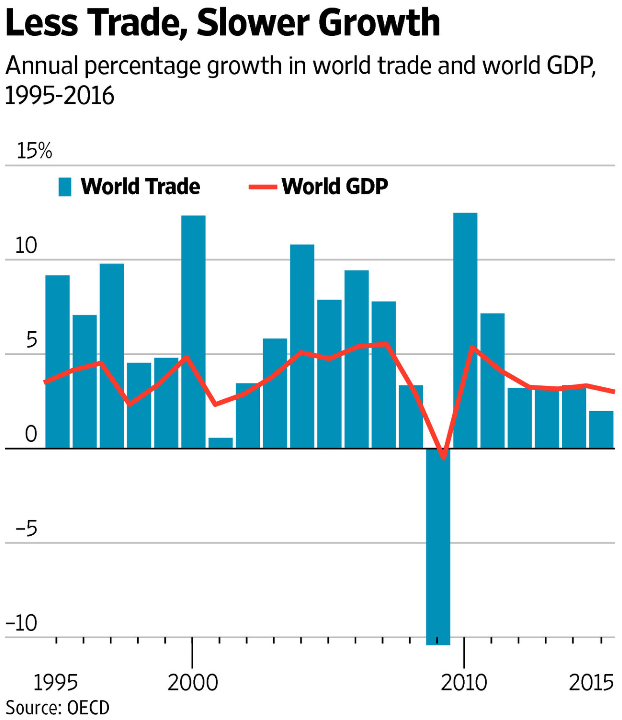
Capture5There is a strong correlation between trade and world-wide economic growth as shown in the above chart.  A recent Gallop poll found that 58% of Americans consider foreign trade an opportunity for economic growth and only 34% view it as a threat.  Not surprisingly, the opponents are lower-income, blue-collar workers who are the most vulnerable to economic change.  Consider:

  • It is technology, not trade, which is behind the loss of manufacturing jobs. Between 2000 and 2010, employment in manufacturing fell by 5.6 million. But productivity growth accounted for 85% of the job loss. Only 13% resulted from trade.
  • Since trade is not the underlying cause of job loss, protectionism is not the solution. If, for example, the U.S. imposes 45% tariffs on imports from China, production would merely shift to other low-wage developing countries in Asia. Pretty soon we’d have a massive trade war.
  • Trade Adjustment Assistance consists of extended unemployment compensation as well as retraining programs. This program misses the millions more who are unemployed due to technological change. Furthermore, extended unemployment compensation leads to deterioration of work skills. A better way to help displaced workers is to expand the Earned Income Tax Credit which supplements all low-income work.
  • NAFTA is a huge economic and foreign policy success. Trade between the U.S. and Mexico has greatly increased sine 1994 and 40% of the value of imports from Mexico consists of content originally made in the U.S. Furthermore NAFTA has promoted the growth of a large middle class in Mexico.
  • Starting in 2001 when China became a WTO member, U.S. companies became more interested in foreign investment in China and other countries and offshoring has proliferated since then. Substantially reducing the corporate tax rate would bring many of these foreign operations back to the U.S.

Trade is win-win for everyone except the production workers who lose their jobs to foreign competition. We can clearly do much more to help them maintain their standard of living.

Follow me on Twitter
Follow me on Facebook


More Trade, Faster Economic Growth


My last post discusses the fact that both worldwide, and in the U.S., employment is growing robustly, while productivity is declining.  In the U.S., for example, the economy is producing lots of new (low-productivity) service jobs and fewer (high-productivity) manufacturing jobs.
CaptureAs I have pointed out previously, there is a high degree of correlation between the growth of world trade and the growth of world GDP.  Unfortunately, many Americans, especially blue collar workers, blame their own economic stagnation on the competition from foreign trade.  This has caused several presidential candidates to declare opposition to the recently negotiated Trans Pacific Trade Pact.
A very informative article by Scott Lincicome in the current issue of the National Review, “The Truth about Trade” points out the fallacy in this way of thinking.
According to Mr. Lincicome:

  • The U.S. is the world’s second largest manufacturer (17.2% of global output) and third largest exporter. America remains the world’s top destination for foreign direct investment ($384 billion in 2015). Much of this investment goes to U.S. manufacturing assets.
  • The U.S. manufacturing “decline” has been limited to employment losses primarily caused by productivity gains, not trade. Import competition explains only ¼ of the contemporaneous aggregate decline in U.S. manufacturing employment.
  • Past global trade liberalization has generated between $2800 and $5000 in additional income for the average American. Almost 90% of these gains accrue to America’s poor and middle class, because of more heavily traded sectors such as food and clothing.
  • More than half of all imports are inputs and capital goods consumed by other American manufacturers to make globally competitive products.
  • Protective tariffs force American families and businesses to subsidize the small share of U.S. manufacturers and workers who compete directly with the imports at issue.
  • We do not have a good set of policies for helping workers adjust to trade or any kind of technological change. For example:
  • The federal tax code’s business deduction for work-related education only applies to one’s current job and not a possible new job.
  • Trade Adjustment Assistance and federal job training programs are notoriously inefficient and ineffective.

Conclusion: It would be a shame if presidential politics leads to a retrenchment of our involvement and leadership in foreign trade which has so many positive benefits for the American economy.

Follow me on Twitter: https://twitter.com/jack_heidel
Follow me on Facebook: https://www.facebook.com/jack.heidel.3

Reviving the Working Class Without Building Walls


The strangest aspect of the current presidential campaign is the staying power of the highly unconventional and controversial candidate Donald Trump. There is wide agreement that the secret of his success is his strong appeal to the members of the white working class whose incomes have been in decline for many years.
The plight of the working class is often viewed in the context of the overall increase in income inequality in the U.S.  My last two posts, here and here, are part of that discussion.
Mr. Trump appeals to these disaffected voters by vowing to wall off Mexico and cut back on foreign trade.  But it may be possible to “Revive the Working Class Without Building Walls” as Eduardo Porter suggests in the New York Times.  According to Mr. Porter, what are needed are new government programs such as wage insurance or direct government employment.
CaptureAlternatively we could meet the illegal immigration and trade protectionism problems in a much more growth oriented way as follows:

  • Immigration Reform. Set up an adequate Guest Worker program to serve only those businesses and industries which can demonstrate that they are unable to recruit enough local workers to meet their employment needs. Once the Guest Worker program is functioning properly, eVerify would be enforced to weed out unauthorized illegal workers and deport them back to their home countries. At the same time the number of H1-B visas would be expanded in order to retain more of the highly skilled foreigners getting advanced degrees in the U.S.
  • Foreign Trade. As the above chart shows, there is a close connection between world trade and world economic growth. And clearly the U.S. economy benefits from world-wide economic growth. The way to balance off job losses caused by foreign trade is with more effective trade-adjustment assistance and job retraining programs.

Whether or not Mr. Trump receives the Republican presidential nomination or is elected to be president in November, we should address the real grievances of his supporters in ways that benefit the entire economy.

Follow me on Twitter: https://twitter.com/jack_heidel
Follow me on Facebook: https://www.facebook.com/jack.heidel.3