
The House Budget vs the President’s Budget: Another Reason for a Balanced Budget Amendment


In January I had several posts advocating in favor of a Balanced Budget Amendment to the U.S. Constitution.  Briefly, the argument runs as follows:

  • Our public debt (on which we pay interest) is now at 74% of GDP, the highest it has been since the end of WWII.
  • Democrats want to raise taxes and increase spending; Republicans want to cut taxes and decrease spending. The only way to satisfy both parties simultaneously is to run huge annual deficits which is exactly what has happened ever since the end of the Great Recession in 2009.

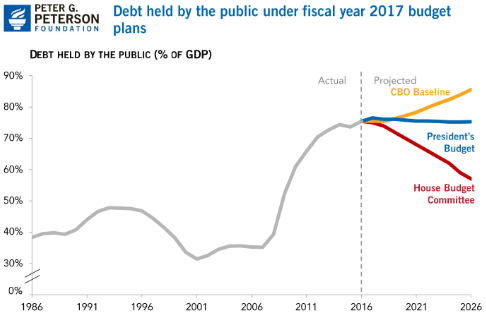
Current planning for the next budget year beginning October 1, 2016 has now begun. Both the House Budget Committee and the President have budget proposals for next year. As reported by the Peterson Foundation, these two budgets differ substantially:
Capture0

  • The President’s budget would hold the public debt at about 75% of GDP over the next ten years by both raising taxes and increasing spending on a variety of programs.
  • The House Budget Committee plan keeps revenues steady at 18.2% of GDP over the next ten years and achieves a balanced budget after ten years. By 2026 the debt held by the public would fall to 57% of GDP from its current 74% level.

Here are two significantly different ten year budget plans. What is likely to happen is a complete standoff without any bipartisan agreement.  This means that no appropriations bills for individual government agencies will be enacted by October 1.  Finally, as usual, an omnibus spending bill will be put together by Congressional leaders and forced through at the last minute to avoid a government shutdown.
A BBA would make both sides compromise and come up with an overall plan.  It would likely contain both spending restraint and new sources of revenue.  Then the various Congressional committees would hammer out the spending details for individual agencies and department.  It would be a far more sensible and transparent process than the way things are done now.
Congress and the President have to be forced to act in such a reasonable manner.  A Balance Budget Amendment is perhaps the only way to make this happen.

Follow me on Twitter: https://twitter.com/jack_heidel
Follow me on Facebook: https://www.facebook.com/jack.heidel.3
It’s Time to Bite the Bullet and Set up a Balanced Budget Plan

As a result of the 2014 elections, both the U.S. House of Representatives and the Senate are controlled by Republicans.  The House Budget Committee and the Senate Budget Committee are now gearing up to produce plans to balance our federal budget over the next ten years.  Accomplishing this goal will be a formidable challenge.
CaptureMaya MacGuineas, President of the Committee for a Responsible Federal Budget, has recently testified before Congress as to how hard it will be to get this job done.  The gist of her testimony:

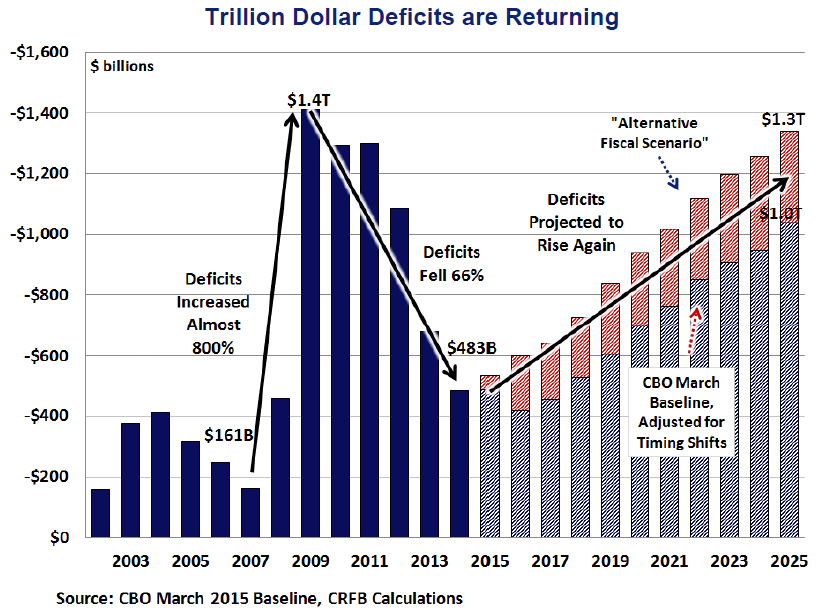
  • Even though the deficit has dropped by two-thirds since the 2009 peak, our deficit and debt problems are far from solved, as indicated in the above chart.
  • CBO estimates that under current law the deficit will rise from $485 billion in 2014 (2.7% of GDP) to more than $1 trillion (3.8% of GDP) by 2025.
  • If nothing is done to slow down these runaway deficits, annual interest payments on the debt will rise from $230 billion this year to $810 billion in 2025. Even with a balanced budget by 2025, interest payments will take up $630 billion in that year.

Capture1

  • As the chart above shows, it will require a ten year savings of $5.5 trillion to bring the budget into balance by 2025. Even to reduce the debt to 60% of GDP by 2025 (compared to 74% today), will take a ten year savings of $4.7 trillion.
  • As if this isn’t hard enough by itself, there will be additional “speed bumps” along the way, whose additional one-year costs alone are $210 billion. See chart below.

Capture2Clearly it will require much pain and shared sacrifice to find trillions of dollars in budget savings over a ten year period as well as avoiding additional costly speed bumps.  But the longer we wait to get started the harder it’s going to be to get the job done.  We need to stop delaying and get started on a budget recovery program this year!

Trash Talk from the New York Times


The Budget Committee of the House of Representatives has just issued a report “The War on Poverty: 50 Years Later”, providing an excellent summary of federal antipoverty programs and their cost at the present time (budget year 2012).  Highlights are:

  • The federal government spent $799 billion on 92 different programs to combat poverty
  • Over $100 billion was spent for 15 different food aid programs
  • Over $200 billion was spent on cash aid
  • Over $90 billion spent on education and job training (over 20 programs)
  • Nearly $300 billion spent on healthcare
  • Almost $50 billion spent on housing assistance

The report also points out that many low-income households face very high effective marginal tax rates, approaching 100%, if any members are employed, because making more money means losing welfare benefits.  This discourages low-income individuals from working at a time when the labor-force participation rate has fallen to a 36-year low of 62.8%.
CaptureHere’s the situation: we have a rapidly growing federal budget with huge deficit spending (see above chart), a stalled economy with low labor-force participation, and an inefficient welfare system which encourages people not to work. Surely our goal should be to motivate welfare recipients to become productive citizens by returning to the workforce.  So doesn’t it make sense to revamp our welfare system to be more efficient as well as to create more incentives for recipients to get and hold a job?
Apparently this does not make sense to the New York Times.  Two days ago they ran an editorial “Mr. Ryan’s Small Ideas on Poverty”, castigating Paul Ryan for “providing polished intellectual cover for his party to mow down as many antipoverty programs as it can see.”  The editorial goes on to say that “it’s easy to find flaws or waste in any government program, but the proper response is to fix those flaws, not throw entire programs away as Mr. Ryan and his Party have repeatedly proposed. . . . For all their glossy reports, Republicans have shown no interest in making these or any other social programs work better.”
Putting it as charitably as possible, the NYT is being unhelpful.  It is a beacon of progressive thought for millions of Americans.  But it is apparently unwilling to give any credence to a sincere effort by fiscal conservatives to reform a major government program to make it operate more efficiently and effectively.