
The Republicans are Making a Huge Mistake with the Current Tax Plan by Appearing to be Fiscally Irresponsible


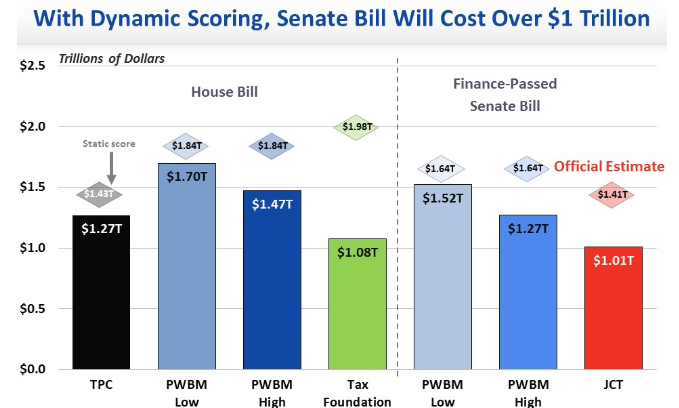
The House and Senate have now each passed their own similar tax bills and a conference will come up with a single unified plan. Each of the individual bills has been scored to add $1 trillion to the national debt over a ten year period and so the final plan will almost surely have this same feature.
With our public (on which interest is paid) debt now 77% of GDP, the highest since right after WWII, and already growing rapidly, this is an extremely unattractive, and even dangerous, feature of the tax plan.
One of our most cherished principles in the U.S. is “liberty and justice for all.”  But consider the normally perceived philosophical differences between the two political parties:

  • The Republicans are the party of liberty concentrating on providing maximum opportunity for people to succeed in life by realizing their full potential. This means fostering strong economic growth in order to have lots of opportunities for self-betterment. It also means keeping government at all levels as lean and efficient as possible, so as to minimize interference with private initiative. Excessive public debt is a particular anathema by creating a huge public burden, especially on future generations.

  • The Democrats are the party of justice concentrating on helping to provide the less fortunate members of society with the necessities of life by means of public support programs. This also means working to oppose all forms of prejudicial behavior based on race, gender, sexual orientation, etc. In addition it means trying to alleviate the inevitable income inequalities which arise in a free and dynamic society like ours, primarily with redistribution of tax revenues.

Conclusion. Both parties have fundamentally important principles. They gain and keep adherents by fighting for what they believe in. If the national Republican Party becomes lackadaisical about our huge national debt, as it appears to be right now, it risks losing its reputation for fiscal responsibility.  This will do it great damage.
Follow me on Twitter 
Follow me on Facebook 

What Ever Happened to Fiscally Responsible Tax Reform?


“I think this level of national debt is dangerous and unacceptable. My preference on tax reform is that it be revenue neutral.  What I’m hoping we will avoid is a trillion dollar stimulus.  Take you back to 2009.  We borrowed $1 trillion and nobody could find that it did much of anything.  So we need to do this carefully and correctly, and the issue of how to pay for it needs to be dealt with responsibly”

Senator Mitch McConnell (R, KY), 2016

Here is where we are today:

  • The world has seen remarkable human progress over the past 200 years. What has brought this about is specialization and trade, i.e. economic growth.
  • Since the end of the Great Recession in June 2009, economic growth in the U.S. has averaged just 2.1%, a remarkably slow recovery by historical standards. This has led to stagnant wage growth especially for blue collar workers. Finally growth is up over 3% for the past two quarters and wage growth is surging.
  • The U.S. corporate tax rate at 35% is not internationally competitive and encourages multinational corporations to move their operations overseas. A lower rate of 20% or so would encourage U.S. multinationals to bring their profits home and also encourage foreign companies to set up shop in the U.S.
  • What all of this means is that we still need tax reform (i.e. lower tax rates) but not fiscal stimulus.
  • The Republican tax plan now moving through Congress will increase our already outrageously excessive debt by $1 trillion over ten years, according to the Joint Committee on Taxation, the official scorekeeper for the U.S. Senate.
  • The Republican Congress will be making a huge mistake by implementing the current plan which has now passed both the House and the Senate. The GOP will no longer be able to make a credible case that it is the party of fiscal responsibility.

Conclusion. With a (public, on which we pay interest) debt of $15 trillion, and growing rapidly, the U.S. is approaching fiscal insolvency. The Republican tax plan will add an additional $1 trillion to this debt over the next ten years.  This is unconscionable behavior.

Follow me on Twitter 
Follow me on Facebook