Getting Spending Under Control II. The Limit, Save, Grow Act

The U.S. is now in a rough patch with out-of-control spending leading to growing annual deficits, massive debt, and stubbornly high inflation.  Furthermore, President Biden is virtually clueless on basic economic and fiscal policy, while the leading GOP presidential candidate for 2024, former president Donald Trump, is under one criminal indictment with more expected.

Although it is clear in a general sense what is needed to get back on track, how do we get started in the right direction?

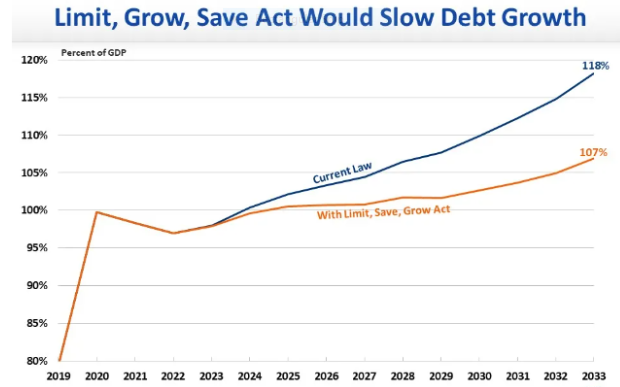
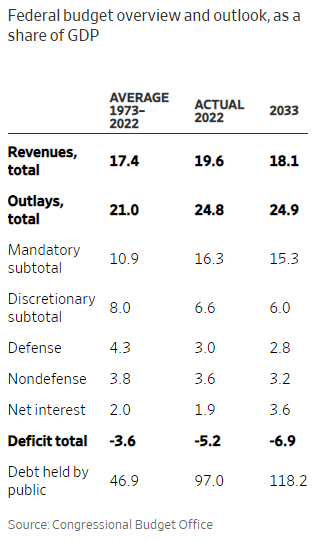
The budget bill introduced by the House Republicans, the Limit, Save, Grow Act, is an excellent way to start.  It would produce savings of $4.5 trillion over ten years and improve our fiscal trajectory going forward (see charts below).  The main features are:
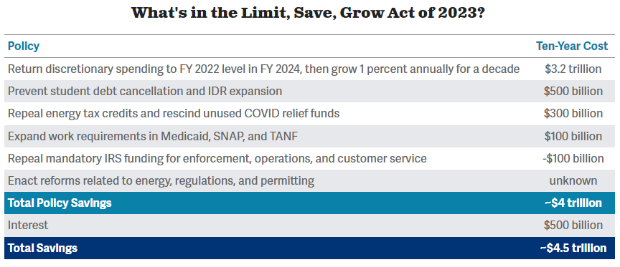

  • Return domestic spending to the level of FY 2022 and then limit growth to 1% per year for the next ten years.
  • Establish a 20-hour-per-week work requirement for all able-bodied adults, between ages 18 and 59, without dependents, who receive food stamps or Medicaid. There are an estimated 40 million Americans on food stamps and 55 million on Medicaid, roughly 10% of whom would now be required to work for their welfare benefits.
  • Returning all unspent Covid funds to the Treasury since the pandemic emergency is over. Additionally, stopping the forgiveness of college loan debt for students from wealthy families will save hundreds of billions of dollars.
  • Raising the debt limit by $1.5 trillion or until March 31, 2024, whichever comes first. This reflects the approximately $300 billion saving under the House plan for 2024 compared to what is in President Biden’s proposed 2024 budget. The 2024 Biden budget proposal produces a deficit of $1.8 trillion next year compared to $1.5 trillion under the House plan.
  • Default on the debt should not be a big concern.  Enough tax revenue continuously flows into the Treasury to pay interest on the debt and also pay priorities like Social Security.  Other parts of the government might have to operate briefly at reduced capacity, but this has happened before.

Conclusion.  It is imperative to get federal spending under much better control to avoid a new and much worse financial crisis in the near future.  The House Republican plan represents an excellent place to begin budget and debt ceiling negotiations between the House, the Senate, and the Biden Administration.

For my Email Newsletter
Follow me on Facebook
Follow me on Twitter
How Do We Chart a Course Back to Sound Money and Long-term Prosperity? II. Immediate Steps

The U.S. is in a rough patch at the present time.  The long-term steps needed to restore sound money and prosperity are clear.  But how do we get started?

  • First, reduce inflation. Yes, inflation dropped to 5% annually in March 2023 from 6% in February.  That is progress but the Federal Reserve’s remaining job will be difficult.  If it continues raising short-term interest rates, it risks causing more bank failures.  If it stops raising interest rates, inflation will subside much more slowly.
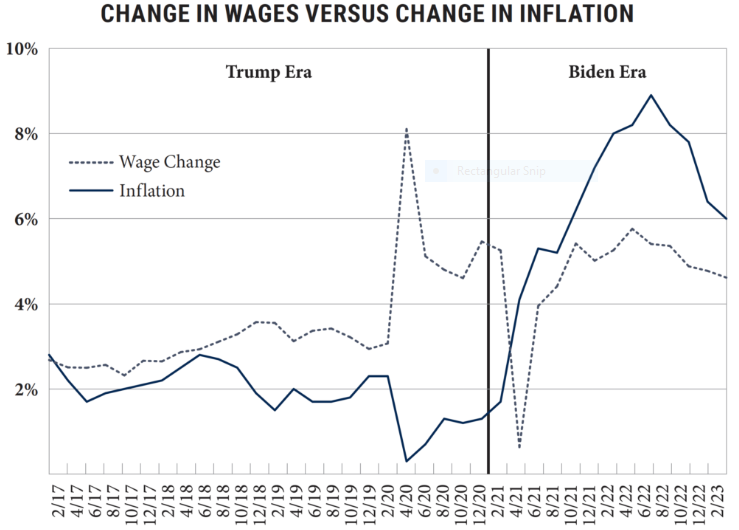
  • The analyst Andrew Puzder has a good discussion of what it will take to get back to strong economic growth.  Most basically, coming out of the pandemic, two things were clear. First, we knew that people had accumulated a lot of money.  The federal government handed out over $5 trillion during the pandemic and people had little opportunity to spend.  The second thing we knew was that fewer people were working.  These two factors combined to produce excess demand and less supply than normal.  In fact, the $1.9 trillion American Rescue Plan of March 2021 tripped off the ensuing inflation (see chart below).
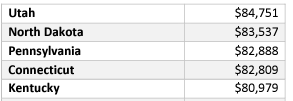
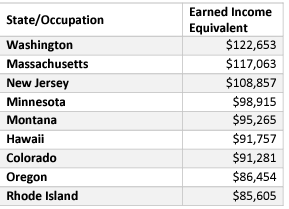
  • Believe it or not, we are still paying too many Americans not to work. A study from December 2022 shows that in 24 states unemployment benefits and ACA subsidies for a family of four with both parents not working are still the annualized equivalent of at least the national median household income.  Moreover, in 14 states (shown below), unemployment benefits and ACA subsidies are equivalent to a head of household earning $80,000 or more in salary, plus health insurance benefits.             

Conclusion.  The Federal Reserve has more work to do to bring down inflation to the desired 2% level.  And the recent banking crisis is making its job harder.  But the current labor shortage, which contributes to inflation by reducing supply, is unnecessarily worsened by paying too many people not to return to work.

For my Email Newsletter
Follow me on Facebook

How Do We Chart a Course Back Toward Sound Money and Long-term Prosperity?

Last week I discussed the rough patch that our country is now in with still 6% inflation, out-of-control national debt, and fraught presidential politics.  But it is possible to turn things around; this has been done so far in American history.  Consider:

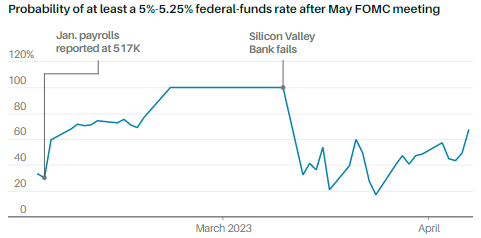
  • Where we are right now.  Nonfarm payrolls increased by 236,000 in March and the unemployment rate dropped from 3.6% to 3.5%. There are still almost 10,000,000 job vacancies nationally.  Such a tight jobs market means that the March CPI (inflation) index is likely to be only slightly lower than February’s 6%.  Therefore the Fed will likely raise rates again when it meets in early May.  In other words, bringing inflation down to the desired 2% level will take longer than anticipated.  (Added on April 13: since the  latest inflation number,5%, is lower than I expected, I now expect that the Fed is less likely to raise rates in May.  This means that inflation may linger longer).
  • How do we get back to sound money and long-term prosperity? Paul Singer, the founder of Elliot Management and one of the world’s most successful hedge-fund proprietors, has predicted all of the financial crises in the last 15 years.  He warned about the dangers of subprime mortgages, the excesses of the Dodd-Frank Act of 2010, and the expansive monetary policy ever since.
    He is afraid that short-term declines in inflation will deceive policymakers and that they’ll quickly go back to their easy money playbook.  If so, inflation will likely come roaring back, and interest rates will have to go higher for longer.
    He worries that the current market trouble is only the beginning.  Likely is an extended time period of jagged moves as people come to grips with the excesses in the financial system.
    His optimistic scenario going forward “would entail pro-growth reforms across the board, including tax reductions, entitlement reforms, regulatory streamlining, encouraging energy development including hydrocarbons … cutting federal spending, and selling the asset holdings on central bank balance sheets.”
    In other words, let us assume that Jerome Powel’s Federal Reserve can get inflation subdued soon as Paul Volcker’s did in the 1970s and 1980s.  Then we will still need a president like Ronald Reagan to implement the pro-growth reforms referred to by Mr. Singer above.  This is what happened in the 1980s and, with some luck, it will happen again.

Conclusion.   We are in a rough patch, a fiscal, economic, and political mess.  Mr. Singer is right on track for how to turn things around.  If we are fortunate, American exceptionalism will assert itself and lead us back to the promised land of sound money and long-term prosperity.

For my Email Newsletter
Follow me on Facebook
Follow me on Twitter
We’ve Hit a Rough Patch but I’m Still Optimistic about Our Future

As I have said many times on this blog, I am optimistic about the long-term future of the U.S.  The U.S. is not only the strongest country in the world economically and militarily, but the strength of the U.S. and its democratic allies together far surpasses the combined strength of our major adversaries: China, Russia, Iran, and North Korea.

But we have now clearly hit a rough patch. Consider:

  • Inflation is still high at 6% (as of February 2023). The Federal Reserve is determined to bring it down by continuing to raise interest rates as high as necessary.  But now bank failure has become a problem precisely as a result of the rapid rise of interest rates.  If the Fed slows up on raising interest rates to save more banks, inflation will take much longer to subdue.
  • The national debt has reached $31.4 trillion and the House Republicans (rightly) insist on big budget cuts in return for agreeing to raise the debt ceiling.  Hopefully, the Biden Administration will come to agree that a strong emphasis on fiscal restraint is imperative in the fight against inflation.

  • Donald Trump has now been indicted for campaign finance violations dating back to 2016.  Since he is an announced candidate for reelection in 2024, this throws a wrench into the Republican primary process leading up to November 2024.  His indictment will probably unite Democrats and divide Republicans.  It makes Trump more likely to be nominated in 2024 and therefore more likely that President Biden will be reelected.
  • Joe Biden is a disaster for the economy, with his strong support of massive new, deficit-financed, spending initiatives in the past two years.  His reelection in 2024 would likely continue this reckless spending blowout and put the U.S. at risk for financial default.

  • Donald Trump and Joe Biden are both very poor choices for president. Trump had some policy victories in his previous term as president but he is too erratic and narcissistic to be a good choice for reelection.  Even though Joe Biden is doing a good job on Ukraine, he is economically incompetent and his reelection could easily lead to a new, and much worse, financial crisis.

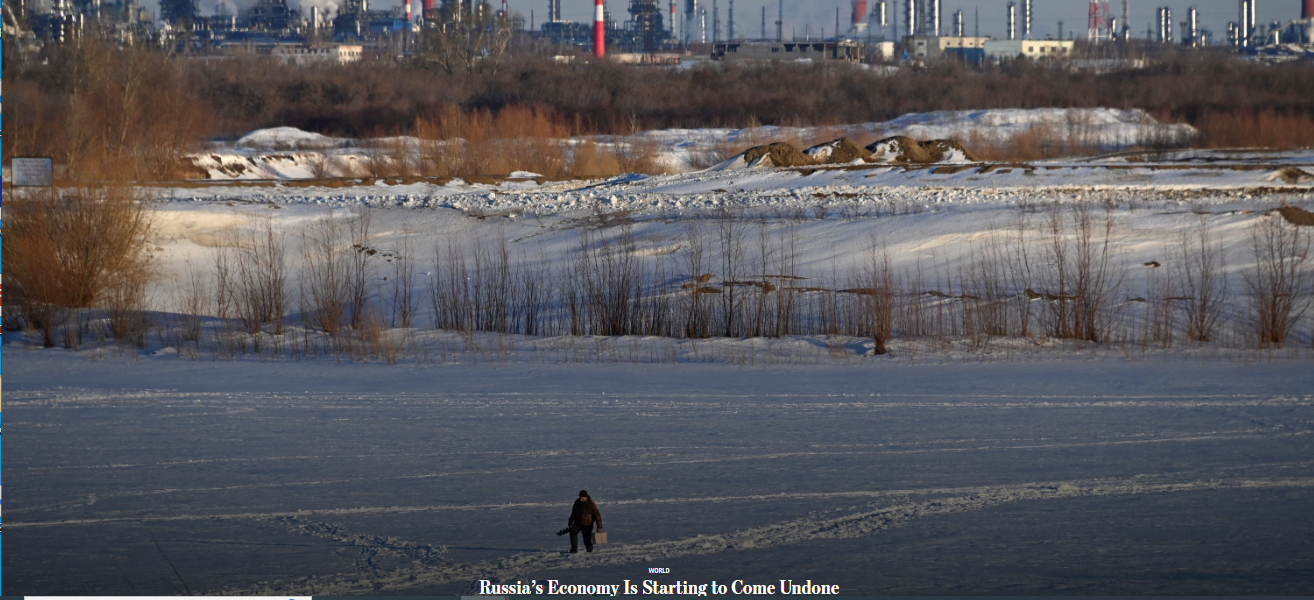
  • The one major event which is going well for the democratic world right now is the war in Ukraine. Russia’s invasion of Ukraine in February 2022 was a major miscalculation and is badly damaging the Russian economy.  Saving Ukraine from Russian domination would be a major victory for the free world.  It will make it far less likely that China will invade Taiwan anytime soon.

Conclusion.  Right now the U.S. is undergoing a rough period with the increased danger of prolonged inflation, a spending blowout by the Biden Administration and a more volatile U.S. presidential campaign in the offing.  But the U.S. and its democratic allies are very strong economically and militarily, which should enable us to ride out the current rough patch and continue to thrive for many years to come.  It would greatly help if neither Trump nor Biden is reelected in 2024.

For my Email Newsletter
Follow me on Facebook
Follow me on Twitter