We Need a Balanced Budget Amendment to the Constitution!


“The Congress, … , on the application of the legislatures of two thirds of the several states, shall call a convention for proposing amendments, which shall be valid to all intents and purposes, as part of this Constitution, when ratified by the legislatures of three fourths of the several states, or by conventions in three fourths thereof  …”
Article V, The U.S. Constitution

As I pointed out in my last post, under the current 2016 federal budget, just adopted by Congress and signed by the President, our public debt (on which we pay interest) is now projected by the Congressional Budget Office to increase from 74% of GDP today to 175% of GDP in 2040, just 25 years from now.
Of course, a new, and more severe, financial crisis is likely to occur long before we hit such a high level of debt but this serves to emphasize the extreme seriousness of our present situation and the need to address it without delay.
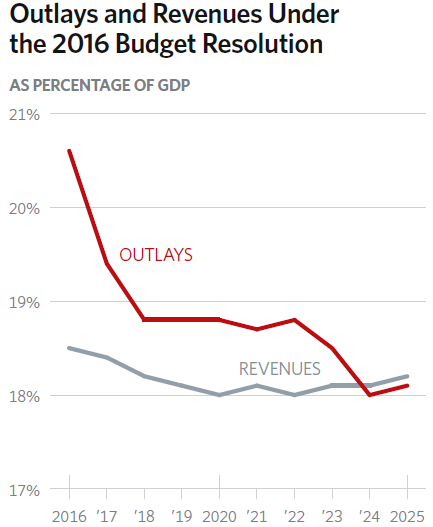
The best and simplest way to do this is for Congress to act on its own accord to pass balanced budgets.  In fact, the current Congress passed a multi-year budget plan last Spring which leads to a balanced budget in ten years, by 2025.  But the budget just passed last week for 2016 totally ignores this plan and actually increases the deficit for 2016 by $158 billion.
In other words, Congress on its own accord appears incapable of acting in a fiscally responsible manner.
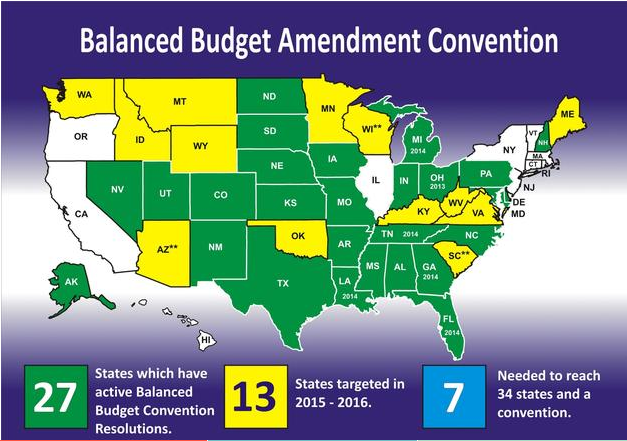
Capture0As shown above, our founding fathers foresaw the possibility of congressional stalemate and provided for an alternative route to force Congress to act on critical issues.  As reported by the Balanced Budget Amendment Taskforce, 27 states have already called for a Constitutional Convention out of the 34 needed to force congressional action.
In my next post I will discuss in detail the ramifications of holding a constitutional convention, pro and con.
Merry Christmas!

Follow me on Twitter: https://twitter.com/jack_heidel
Follow me on Facebook: https://www.facebook.com/jack.heidel.3
The Budget Deal: A Win for the Big Spenders


A tentative budget deal has just been reached by Congress and the President to 1) suspend the debt limit until March 2017, and 2) loosen the budget sequester caps by $112 billion over the next two years.  $80 billion of the increased spending will be balanced by spending cuts elsewhere in the budget with details to be worked out later by various appropriations committees.  Specifically:

  • The current debt ceiling of $18.1 trillion will be lifted until March 2017, after a new president takes office. This will allow an expected increase in the debt of about $900 billion to take place over the next 1½ years.
  • Both military and discretionary non-military spending will increase by $40 billion each over the next 2 years with the military receiving an additional $32 billion for Overseas Contingency Operations.

The problem is that such a deal essentially just maintains the budget status-quo. It does nothing to begin shrinking annual deficits in order to put our accumulated national debt on a downward path as a percentage of GDP.  Our current debt of 74% of GDP is very high by historical standards and simply must be brought down significantly in the near term.
Capture1As I explained in my last post, Congressional Republicans, with majorities in both the House and the Senate, should be able to apply much more leverage than was used in the deal just reached, as follows:

  • Yes, extend the debt ceiling for two years. We need to pay our debts. But insist on spending discipline from now on.
  • Allow only brief temporary budget extensions at current levels until a plan is adopted to put deficits and debt on a downward path. The Republican ten year plan for a balanced budget would be a good place to start.

It’s time for fiscal conservatives to stand up and be counted!

Follow me on Twitter: https://twitter.com/jack_heidel
                       Follow me on Facebook: https://www.facebook.com/jack.heidel.3

Fix It Now: the Political Philosophy of Chip Maxwell


I have just recently come across the book, “Fix It Now: Rediscover the Constitution and Get America Out of Its Fiscal Death Spiral” by Chip Maxwell, a candidate for Congress in Nebraska’s Second District May 2016 Republican Primary.
Chip lays out his political philosophy very clearly.  It is to:

  • Adopt a Balanced Budget Amendment to the U.S. Constitution, phased-in over ten years.
  • Phase out Social Security and Medicare for those under age 55.
  • Dismantle over the next decade the rest of the federal welfare/entitlement system.
  • Provide social services at the state or local level.
  • Launch a national effort to build a majority in Congress of crusaders for limited government.
    Capture1There are some attractive features to Chip’s program but overall I think it is too radical to have much chance at implementation.
    I am very much in favor of a balanced budget amendment and a ten year phase-in period is quite reasonable. Furthermore, providing social services at the state and local level would be much more efficient than what we are currently doing and, even with federal support, would be a big help in balancing the budget.
    Social Security and Medicare are lifelines for tens of millions of people. We can and should strengthen these programs in order to make them more financially viable for future retirees. They are now part of our national fabric and are here to stay.
    Chip’s last principle, promoting limited government, has much appeal but I think is not practical in this day and age. From my perspective, simply passing a Balanced Budget Amendment is sufficient to do what is needed. A BBA will force Congress to set spending priorities and eliminate inferior programs.
    Chip Maxwell is to be commended in running for Congress. If elected, he would move the needle in the right direction, even though some of his ideas wont work.

The Republican Budgets Focus on Entitlement Savings


Last week, both the House and the Senate passed ten year budget plans which would bring the federal budget into balance by 2025.  I have devoted several recent blog posts to discussing these budget proposals and how they address our very serious debt and deficit problems.
CaptureThere are several important points to make:

  • Under both of these Republican plans, overall spending will continue to increase by an average of 3.3% per year, from $3.8 trillion in 2016 to just over $5 trillion in 2015. The President’s budget would increase spending to $6.17 trillion by 2025 and would achieve no balance between spending and revenue.
  • Most of the savings in the Republican budgets, as indicated in the above chart, come from the mandatory (entitlement) programs of Social Security, Medicare and Medicaid. Medicare would be transformed into a subsidy program along the lines of the exchanges set up under the Affordable Care Act. Medicaid would be turned into a block grant program administered by the states. Social Security would be studied by a bipartisan commission to recommend operating efficiencies.
  • Other social welfare programs would be affected to a much smaller extent. For example, the Supplemental Nutrition Assistance Program (SNAP), or Food Stamps, has seen a growth of recipients of 69% between 2008 and 2013 while the poverty rate increased by just 16.5% during the same period. The Republican budgets would block grant Food Stamps to the states in order to achieve operating efficiencies.
  • It is true that both the House and Senate budgets would increase military spending by about 10%. But so would the President’s budget and we live in a very dangerous world. Military defense is one of the most very basic functions of our federal government.

Our country is in dire fiscal condition with large annual deficits projected indefinitely into the future, contributing to an exploding national debt.  It is heartening that our political system is responding to this threat to our future security and prosperity.  Let’s hope that House and Senate majorities continue to keep a sharp focus on the urgent task of fiscal restraint.

Status Quo on the Budget Is Not Good Enough!


As I like to remind readers, I am a non-ideological fiscal conservative.  I am not hard core anything.  I just want to find practical, workable solutions for difficult and complicated problems.  There is basically only one exception to my generally moderate outlook.  I detest huge amounts of deficit spending except for unusual circumstances.  Most of the time we should be willing to either raise taxes and/or cut spending to do what needs to be done and to live within our means.
This is why the current efforts by the Budget Committees of both the House and the Senate to devise a plan to balance the budget, i.e. eliminate deficit spending, over a ten year period is so exciting to me.
An analysis in today’s New York Times suggests that Congress should be content to just extend the so-called Ryan-Murray Budget from 2014-2015.  “Ryan-Murray didn’t decisively move the needle one way or the other, which is why it was able to attract bipartisan support.  Rather it preserved the status quo.  In a world of divided government and polarized politics, keeping the government running without a lot of brinkmanship and high drama may be the best we can hope for.”
CaptureAs I pointed out in my last post, current policy will raise government spending by 5.1% annually over the next ten years.  The President wants to increase spending by an additional $1 trillion over this time period.  The Republican budgets, which lead to balance in ten years, still allow spending to increase by 3.3% annually.  The difference between the two plans is illustrated in the above chart from last Sunday’s Omaha World Herald.
Congress is finally in a position this year to start digging us out of the deep fiscal hole we have fallen into.  Let’s hope that too much “bipartisan” status quo thinking doesn’t get in the way of progress!

It’s Time to Bite the Bullet and Set up a Balanced Budget Plan

As a result of the 2014 elections, both the U.S. House of Representatives and the Senate are controlled by Republicans.  The House Budget Committee and the Senate Budget Committee are now gearing up to produce plans to balance our federal budget over the next ten years.  Accomplishing this goal will be a formidable challenge.
CaptureMaya MacGuineas, President of the Committee for a Responsible Federal Budget, has recently testified before Congress as to how hard it will be to get this job done.  The gist of her testimony:

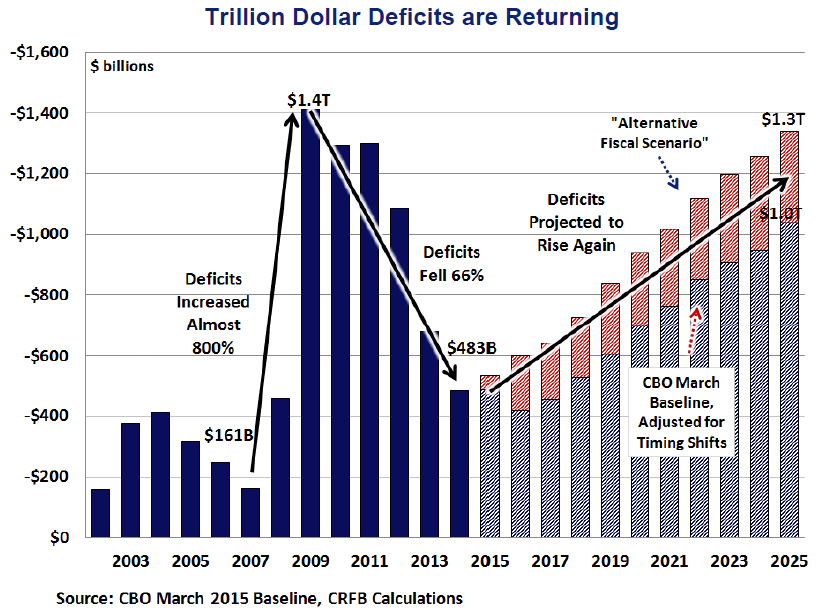
  • Even though the deficit has dropped by two-thirds since the 2009 peak, our deficit and debt problems are far from solved, as indicated in the above chart.
  • CBO estimates that under current law the deficit will rise from $485 billion in 2014 (2.7% of GDP) to more than $1 trillion (3.8% of GDP) by 2025.
  • If nothing is done to slow down these runaway deficits, annual interest payments on the debt will rise from $230 billion this year to $810 billion in 2025. Even with a balanced budget by 2025, interest payments will take up $630 billion in that year.

Capture1

  • As the chart above shows, it will require a ten year savings of $5.5 trillion to bring the budget into balance by 2025. Even to reduce the debt to 60% of GDP by 2025 (compared to 74% today), will take a ten year savings of $4.7 trillion.
  • As if this isn’t hard enough by itself, there will be additional “speed bumps” along the way, whose additional one-year costs alone are $210 billion. See chart below.

Capture2Clearly it will require much pain and shared sacrifice to find trillions of dollars in budget savings over a ten year period as well as avoiding additional costly speed bumps.  But the longer we wait to get started the harder it’s going to be to get the job done.  We need to stop delaying and get started on a budget recovery program this year!