
More Trade, Faster Economic Growth


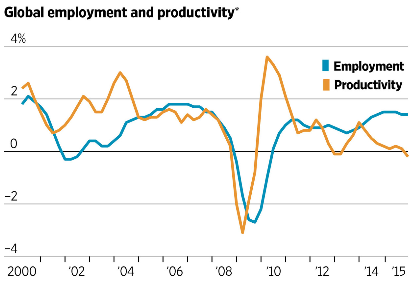
My last post discusses the fact that both worldwide, and in the U.S., employment is growing robustly, while productivity is declining.  In the U.S., for example, the economy is producing lots of new (low-productivity) service jobs and fewer (high-productivity) manufacturing jobs.
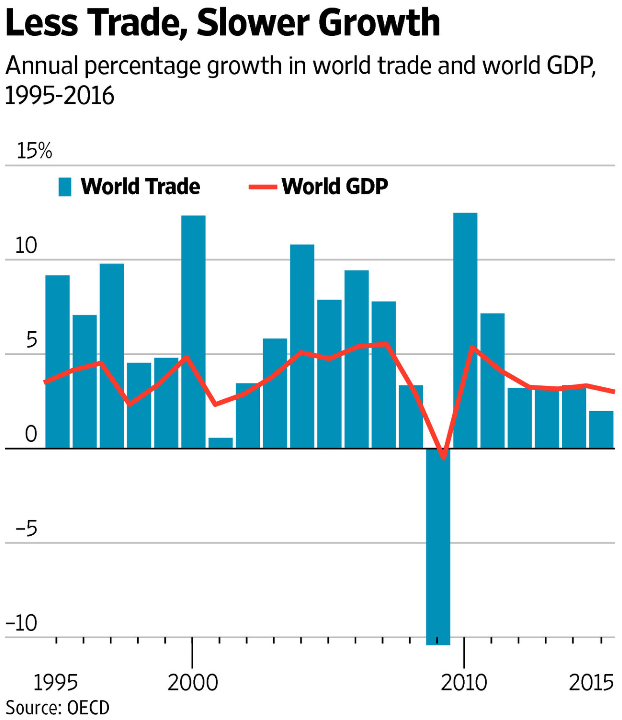
CaptureAs I have pointed out previously, there is a high degree of correlation between the growth of world trade and the growth of world GDP.  Unfortunately, many Americans, especially blue collar workers, blame their own economic stagnation on the competition from foreign trade.  This has caused several presidential candidates to declare opposition to the recently negotiated Trans Pacific Trade Pact.
A very informative article by Scott Lincicome in the current issue of the National Review, “The Truth about Trade” points out the fallacy in this way of thinking.
According to Mr. Lincicome:

  • The U.S. is the world’s second largest manufacturer (17.2% of global output) and third largest exporter. America remains the world’s top destination for foreign direct investment ($384 billion in 2015). Much of this investment goes to U.S. manufacturing assets.
  • The U.S. manufacturing “decline” has been limited to employment losses primarily caused by productivity gains, not trade. Import competition explains only ¼ of the contemporaneous aggregate decline in U.S. manufacturing employment.
  • Past global trade liberalization has generated between $2800 and $5000 in additional income for the average American. Almost 90% of these gains accrue to America’s poor and middle class, because of more heavily traded sectors such as food and clothing.
  • More than half of all imports are inputs and capital goods consumed by other American manufacturers to make globally competitive products.
  • Protective tariffs force American families and businesses to subsidize the small share of U.S. manufacturers and workers who compete directly with the imports at issue.
  • We do not have a good set of policies for helping workers adjust to trade or any kind of technological change. For example:
  • The federal tax code’s business deduction for work-related education only applies to one’s current job and not a possible new job.
  • Trade Adjustment Assistance and federal job training programs are notoriously inefficient and ineffective.

Conclusion: It would be a shame if presidential politics leads to a retrenchment of our involvement and leadership in foreign trade which has so many positive benefits for the American economy.

Follow me on Twitter: https://twitter.com/jack_heidel
Follow me on Facebook: https://www.facebook.com/jack.heidel.3
Growing Employment, Shrinking Productivity: What Does It Mean?


I know that I occasionally repeat myself, but I can’t help it! In my opinion there are two major problems facing our country:

  • Slow economic growth which has averaged only an anemic 2.1% since the end of the Great Recession seven years ago.
  • Exploding national debt, now the highest it has been since the end of WWII. Unless we can quickly shrink our annual deficits down to zero, and therefore stop adding to the debt, interest payments on the debt will eventually rise to horrendous levels.


Two recent newspaper articles address the slow growth problem. Greg Ip, writing in the Wall Street Journal, points out that (worldwide) employment growth is up while productivity growth is down (see chart below).
Capture0Neil Irwin, writing in the New York Times, explains this dichotomy by pointing out that most job growth in the last decade has been in (low productivity) services rather than (high productivity) manufacturing. In other words, the U.S. economy is now producing lots of new temporary and contract jobs which do not add very much to the overall economic growth which produces higher wages and overall prosperity.
The economist John Cochrane has clearly described  why productivity growth, and therefore overall economic growth, has stagnated in recent years.  Here is a short summary:

  • Over-regulation. The Dodd-Frank Act and Affordable Care Act, for example, are hampering growth by strangling the financial and healthcare sectors of the economy.
  • Inefficient Taxation. Growth oriented taxation would have the lowest possible marginal rates paid for by shrinking deductions. Taxing consumption rather than income and savings would be even better.
  • Illegal Immigration. Solving our immigration problem would turn millions of illegals into productive citizens. An adequate Guest Worker program and e-Verify enforcement would solve this problem without the need for amnesty.

Conclusion: There are solutions to the severe economic problems facing our country. Does our political system have the flexibility to adopt these workable policies?

Follow me on Twitter: https://twitter.com/jack_heidel
Follow me on Facebook: https://www.facebook.com/jack.heidel.3
 

Another Way to View the Presidential Candidates

As regular readers of this blog well know, I constantly advocate for two major changes in government policy:

  • Speeding up economic growth, which has averaged an anemic 2.1% per year since the end of the Great Recession in June 2009. This will create the new and higher paying jobs that country so badly needs.
  • Shrinking annual deficits, ideally down to zero, so that our huge public debt (on which we pay interest) will begin to decrease as a percentage of GDP over time.

My last post compared the President’s proposed budget for 2017 with a proposal from the House Budget Committee. Basically the President’s budget increases both taxes and spending while the House budget keeps revenues at a steady 18.2% and leads to a balanced budget after ten years.
Capture2The non-partisan Committee for a Responsible Federal Budget has just produced an interesting report, ”How Much More Would Government Spend Under the Next President?” It compares the spending plans of the remaining five presidential candidates from both parties.  It finds that:

  • Only John Kasich would actually decrease spending over the next decade from 22.1% of GDP (under current law) to 21.5%.
  • The other four candidates would all increase spending: Hillary Clinton (to 22.5%), Donald Trump (to 22.7%), Ted Cruz (to 23.4) and Bernie Sanders (to 29.5%).

Mr. Kasich’s spending restraint would amount to a 2% decrease over current law while Ms. Clinton, for example, would increase spending by 2%.
As I showed a year ago,  reining in spending by 2% per year over current law is a major achievement and will lead to a balanced budget in ten years. In other words, Mr. Kasich’s spending plans are in sync with the latest House Budget Committee proposal.  Perhaps this should not be surprising since Mr. Kasich served as Chair of this House Committee in the 1990s!
Easy question: Which presidential candidate and which chamber of Congress are acting in the most fiscally responsible manner?

Follow me on Twitter: https://twitter.com/jack_heidel
Follow me on Facebook: https://www.facebook.com/jack.heidel.3

The House Budget vs the President’s Budget: Another Reason for a Balanced Budget Amendment


In January I had several posts advocating in favor of a Balanced Budget Amendment to the U.S. Constitution.  Briefly, the argument runs as follows:

  • Our public debt (on which we pay interest) is now at 74% of GDP, the highest it has been since the end of WWII.
  • Democrats want to raise taxes and increase spending; Republicans want to cut taxes and decrease spending. The only way to satisfy both parties simultaneously is to run huge annual deficits which is exactly what has happened ever since the end of the Great Recession in 2009.

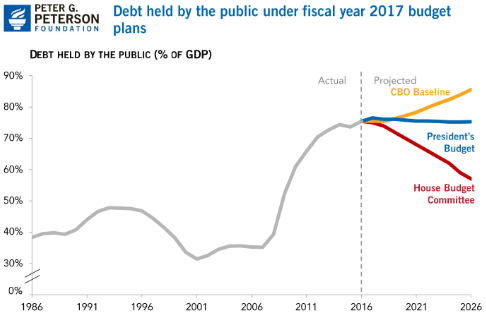
Current planning for the next budget year beginning October 1, 2016 has now begun. Both the House Budget Committee and the President have budget proposals for next year. As reported by the Peterson Foundation, these two budgets differ substantially:
Capture0

  • The President’s budget would hold the public debt at about 75% of GDP over the next ten years by both raising taxes and increasing spending on a variety of programs.
  • The House Budget Committee plan keeps revenues steady at 18.2% of GDP over the next ten years and achieves a balanced budget after ten years. By 2026 the debt held by the public would fall to 57% of GDP from its current 74% level.

Here are two significantly different ten year budget plans. What is likely to happen is a complete standoff without any bipartisan agreement.  This means that no appropriations bills for individual government agencies will be enacted by October 1.  Finally, as usual, an omnibus spending bill will be put together by Congressional leaders and forced through at the last minute to avoid a government shutdown.
A BBA would make both sides compromise and come up with an overall plan.  It would likely contain both spending restraint and new sources of revenue.  Then the various Congressional committees would hammer out the spending details for individual agencies and department.  It would be a far more sensible and transparent process than the way things are done now.
Congress and the President have to be forced to act in such a reasonable manner.  A Balance Budget Amendment is perhaps the only way to make this happen.

Follow me on Twitter: https://twitter.com/jack_heidel
Follow me on Facebook: https://www.facebook.com/jack.heidel.3

The Urgency of Defeating ISIS


After the terrorist attack in Paris I asked, “Does the U.S. Care about Europe?” Now, after the Brussels attack, it is time to repeat this warning. As the New York Time’s Roger Cohen points out:
Capture0

  • Over 1 million refugees entered Europe in 2015 alone. Another 136,000 have arrived so far in 2016. This creates a huge financial burden as well as a cultural challenge for a Europe which is already weakened by huge debt and slow economic growth.
  • It will bolster those campaigning to take Britain out of the European Union in the upcoming June referendum. A British departure from the EU will dramatically weaken it and might encourage other countries to leave as well.
  • Islamic State terror plays into the hands of populist demagogues such as presidential candidate Donald Trump and right wing French leader Marine Le Pen.
  • To allow ISIS to have its own territory, and capital city Raqqa in Syria, is a very high risk strategy. It allows the Islamic State to spread its evil not only around the immediate area but all over the world.
  • The question raised most urgently by the Brussels attacks, so soon after Paris, is whether and why Raqqa can be tolerated when Al Qaeda’s Tora Bora sanctuary in Afghanistan was not. Today, the West’s ponderous wait-them-out approach looks like capitulation.

The fundamental question is whether or not the U.S. can refrain from immersing itself in the crises of the Middle East and still maintain its status as the world’s indispensable super power. “George Bush will be remembered harshly for what he did in the Middle East. Barack Obama is gambling that he will be judged well for the things he didn’t do.”  The stakes are very high indeed for both the United States and our European allies.

Follow me on Twitter: https://twitter.com/jack_heidel
Follow me on Facebook: https://www.facebook.com/jack.heidel.3
Solving America’s Most Basic Problems


My last two posts, here and here, argue that America’s two most critical problems are:

  • Speeding up economic growth in order to create more jobs and better paying jobs, especially for middle- and lower-income workers whose wages have been stagnant for the past 15 years.
  • Getting our large and rapidly growing national debt under control by shrinking annual deficit spending. This will put our debt on a downward path as a percentage of GDP.

Many Facebook comments on these posts inquire about how these goals will be accomplished. If tax reform is the best way to increase economic growth, how can this be done in a way that is fair to the non-wealthy. If spending cuts are necessary to balance the budget, what cuts should be made?  Here is a summary of my views on these questions:

  • Growing the economy with tax reform. The best way to spur investment and business expansion is with the lowest possible tax rates on owners and investors. Broad-based tax reform, with lower tax rates for all, paid for (i.e. in a revenue neutral way) by closing loopholes and shrinking deductions, will accomplish this. The 64% of taxpayers who do not itemize deductions will increase their income with tax rate cuts. Lower tax rates for the affluent will be offset by shrinking deductions and closing loopholes.
  • The corporate tax rate should also be cut to internationally competitive levels, again paid for by drastically shrinking, if not totally eliminating, all deductions. This way all corporations (including GE!) would pay the same tax rate. And American companies would have much less incentive to move overseas.
    Capture0
  • Reducing our national debt. We have got to drastically shrink our annual deficits (now running about $500 billion per year) in order to put our national debt on a downward course, as a percentage of GDP. The House Budget Committee has recently passed a plan to balance the budget within ten years. Not everyone will agree with the details, but at least it’s a starting point. An alternative approach is to adopt a Balanced Budget Amendment to the U.S. Constitution. This would require Congress to make tradeoffs annually between either restraining spending or raising taxes.  A BBA will force them to do what they should be doing anyway!

Follow me on Twitter: https://twitter.com/jack_heidel
Follow me on Facebook: https://www.facebook.com/jack.heidel.3

Why I Lean Republican II. Priorities for the Next President


In my last post, “Why I Lean Republican,” I endorse the ten year budget plan just released by the House Budget Committee which will lead to a balanced budget within ten years.  It represents an excellent starting point towards addressing one of our country’s most serious problems, our huge and rapidly growing national debt.
Capture1
Jim Vanderholm responded to this post by giving his own top priorities for the next President. They are:

  • Job Formation. All sorts of other problems would be addressed in the process. Record high numbers of unemployed and underemployed. Record numbers of people on 85 different welfare programs at a cost of over $1 trillion per year.
  • Highly targeted education/training of the workforce to fill the newly created jobs with American citizens.
  • Reducing annual deficits. Growing the economy by putting more people back to work will bring in more tax revenue. Along with slowing the growth of spending this will lead to lower annual deficits. Once the deficit is reduced by half or more of its current value (about $500 billion), then the debt as a percentage of GDP will begin to shrink.
  • Reduced focus on divisive social issues. The basic structural problems referred to above will not be solved by more gun control, higher carbon tax, shuttering the coal industry, free pre-school and college education, or discontinuing tax-payer funding to Planned Parenthood.

In other words, we need a new President who will focus on basic economic and fiscal issues and not be distracted by divisive social issues. In fact, an ideal division of labor would be for the House Budget Committee to take the lead in getting spending under control while the new President attempts to implement policies to get the economy growing faster. This would lead to real progress on both fronts!

Follow me on Twitter: https://twitter.com/jack_heidel
Follow me on Facebook: https://www.facebook.com/jack.heidel.3
Why I Lean Republican


In the midst of a tumultuous presidential campaign season, it iscommon for partisans of the left and the right to question the integrity, motives and values of those on the other side of the political divide. For example, the rise of Donald Trump in the Republican primaries has led some observers to declare that the Republican Party has lost its way and no longer has any sort of basic, coherent and broadly acceptable political philosophy.
On the contrary, I think that Republicans do by and large share the following two general attitudes towards government which are favorite topics of discussion on this blog:

  • Economic growth in recent years has been much too slow and it should be a major goal of government to substantially speed it up.
  • Our national debt is much too high and Congress and the President should be making serious efforts to balance the budget on an annual basis.

The House Budget Committee has just made a big contribution towards the second goal with, “A Balanced Budget for a Stronger America. Fiscal Year 2017 Budget Resolution.”
Capture0Here are its basic components:

  • The federal budget will be brought into balance over a ten year period.
  • Devolving power back to the states.
  • Prioritizing the responsibilities of the federal government and concentrating on the most important.
  • Strengthening government functions that are critical to the health, retirement and economic security of millions of Americans.

Such a budget plan as this could make an excellent first step towards an eventual bipartisan agreement that would address some of our country’s biggest problems. Instead it is likely to be ridiculed or dismissed by the Democratic Party as mere political posturing by the Republican majority in Congress. What could be a beginning to real progress on urgent issues will probably just be washed down the drain.

Follow me on Twitter: https://twitter.com/jack_heidel
Follow me on Facebook: https://www.facebook.com/jack.heidel.3

Reviving the Working Class Without Building Walls


The strangest aspect of the current presidential campaign is the staying power of the highly unconventional and controversial candidate Donald Trump. There is wide agreement that the secret of his success is his strong appeal to the members of the white working class whose incomes have been in decline for many years.
The plight of the working class is often viewed in the context of the overall increase in income inequality in the U.S.  My last two posts, here and here, are part of that discussion.
Mr. Trump appeals to these disaffected voters by vowing to wall off Mexico and cut back on foreign trade.  But it may be possible to “Revive the Working Class Without Building Walls” as Eduardo Porter suggests in the New York Times.  According to Mr. Porter, what are needed are new government programs such as wage insurance or direct government employment.
CaptureAlternatively we could meet the illegal immigration and trade protectionism problems in a much more growth oriented way as follows:

  • Immigration Reform. Set up an adequate Guest Worker program to serve only those businesses and industries which can demonstrate that they are unable to recruit enough local workers to meet their employment needs. Once the Guest Worker program is functioning properly, eVerify would be enforced to weed out unauthorized illegal workers and deport them back to their home countries. At the same time the number of H1-B visas would be expanded in order to retain more of the highly skilled foreigners getting advanced degrees in the U.S.
  • Foreign Trade. As the above chart shows, there is a close connection between world trade and world economic growth. And clearly the U.S. economy benefits from world-wide economic growth. The way to balance off job losses caused by foreign trade is with more effective trade-adjustment assistance and job retraining programs.

Whether or not Mr. Trump receives the Republican presidential nomination or is elected to be president in November, we should address the real grievances of his supporters in ways that benefit the entire economy.

Follow me on Twitter: https://twitter.com/jack_heidel
Follow me on Facebook: https://www.facebook.com/jack.heidel.3


How to Lower Income Inequality


My last post provides evidence that income inequality has increased more under recent Democratic presidents than under Republican presidents.  Here is a brief summary of the argument:

  • Cheap money is of greatest value to those who have access to it.
  • The effects of the Bush housing bubble (in the 2000s) were more evenly distributed than for the Clinton stock market bubble (in the 1990s) or the Obama credit bubble.
  • Two earner households are the backbone of the American middle class.
  • During the first six years of the Obama presidency, the number of two-earner households declined, the number of single-earner households rose by 2.6 million and the number of no-earner households rose by 5 million. In other words, two-thirds of the increase in the number of households under Obama is accounted for by households with no-one working. This largely accounts for the shrinking middle class and the increase in inequality.
    Capture

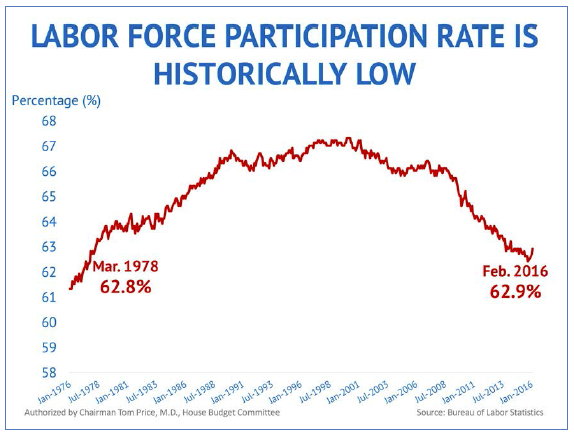
Another way to consider this situation is to look at the labor force participation rate which has been steadily decreasing since the year 2000.  As the above chart shows, this trend is expected to continue indefinitely in the same downward direction.  Along with a slowing increase in the productivity rate, this constrains the U.S. economy’s capacity to expand. Clearly what is needed is faster economic growth in order to create more jobs and better paying jobs.  The way to accomplish this is with:

  • Tax Reform. Lower individual and corporate tax rates for all paid for by shrinking deductions and closing loopholes. More money in the hands of the middle class will stimulate demand. More money in the hands of small business will stimulate supply.
  • Expanded Earned Income Tax Credit. Putting more money in the pockets of low-income and marginally employed workers will encourage more of them to find work and stay in the workforce.

With all the headwinds holding the economy back, our national leaders (and would be leaders!) ought to be focusing much more attention on taking specific actions which would speed up economic growth.

Follow me on Twitter: https://twitter.com/jack_heidel
Follow me on Facebook: https://www.facebook.com/jack.heidel.3