Poverty and inequality are getting worse in the United States. The question is what to do about it. One proposal is to raise the minimum wage from its current value of $7.25 per hour to $10.10 per hour. The Congressional Budget Office has studied the tradeoffs in doing this. Approximately 16 million people, at the bottom end of the wage scale, would see their incomes go up. But 500,000 people would see their incomes go down because they’d lose their jobs! Does the positive outweigh the negative? It’s not clear!
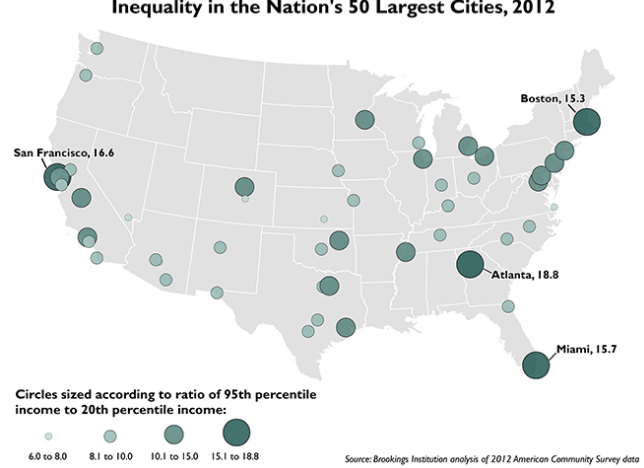 But here is another aspect of the problem. The Brookings Institution has just published a new study “All Cities Are Not Created Unequal”, pointing out that the 50 largest cities in the U.S. have higher rates of inequality than does the country as a whole. Brookings looks at the so-called 95/20 ratio between the 95th percentile of wage earners compared to the 20th percentile. The national average for this ratio is 9.1 with the 95th percentile earning (in 2012) $191,770 and the 20th percentile earning $20,968. But many large cities such as San Francisco (16.6), Boston (15.3) and New York City (13.2) have much higher ratios. The midsized city of Omaha has a ratio of 8.2 which is below the national average.
In other words the problems of poverty and inequality are much worse in some parts of the country than in others. This suggests that at least part of the solution to addressing this problem should come at the state and local level. It makes sense for California, Massachusetts and New York, for example, or at least San Francisco, Boston and New York City, to establish their own higher minimum wages.
This is not to say that a higher minimum wage at the national level is not also needed (more coming). But the whole country cannot be expected to bail out a few major cities where the problem is much worse than elsewhere.

 It Does Not Add Up