What Trump Is Doing Well, Mediocre, and Poorly

On this blog, I discuss important national issues.  Lately, I have mostly been discussing how President Trump has been dealing on these issues.  For example, my last post, pointed out that Trump is following a Jacksonian foreign policy, in the sense that the most important priority of his government is the security and well-being of the American people.

Today, I summarize what I think Trump is doing well, poorly, or in between.

First of all, what Trump is doing well:

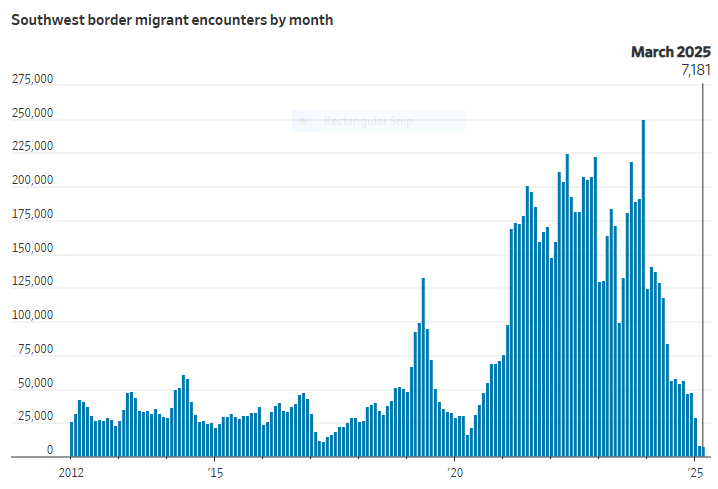
  • He has closed our southern border. The number of illegal border crossings has slowed to a trickle (see chart below).

  • He has severely set back Iran’s attempt to develop nuclear weapons. Iran is a terrorist state, and so this is clearly in America’s best interest.
  • He has strongly and successfully supported Congress in extending the 2017 tax reform law passed at the beginning of his first term.

Secondly, where Trump is floundering and needs to change course:

  • His tariff program, aimed at creating a more efficient international trading system, is overbearing and keeps trading partners guessing at what he really wants. It also risks reigniting inflation, which is what sank Biden’s presidency, and will also hurt Trump badly if it does reignite.

Finally, where Trump is doing poorly:

  • He has shown little, if any, concern about our annual deficit spending, now approaching $2 trillion per year. Not only do these very large deficits make our national debt, now over $36 trillion, grow much too fast, but they also put upward pressure on inflation, which needs to be lowered to the Federal Reserve’s target of 2% annually.  The key to shrinking our annual deficit spending is to cut federal spending significantly.

  • He is not putting nearly enough pressure on Russian President Putin to end the war in Ukraine. Granted, one can argue that what happens to Ukraine doesn’t matter to the U.S.  But this is shortsighted.  If Putin succeeds in subjugating Ukraine, he is then likely to undermine other eastern European countries and create a big problem for our NATO allies.

Conclusion.  Trump is doing well on several important problems, such as border control, resisting nuclear proliferation, and maintaining business tax incentives.  He is floundering on tariff policy and doing poorly on fiscal responsibility and supporting Ukraine in its war against Russian invasion.

For my Email Newsletter
Follow me on Facebook
Follow me on Twitter

Donald Trump’s Foreign Policy is Jacksonian

On this blog, I write about important national issues, mostly economic and fiscal.  But today the topic is foreign policy, especially for our current President, Donald Trump.  An excellent analysis of different types of foreign policy has been given by Walter Russell Mead in the WSJ.

According to Mead, there are four main approaches to American foreign policy:

  • Regard a strong alliance between government and big business “as the key to effective action abroad.”  (Hamiltonian)
  • Believe that the U.S. has both “a moral obligation and an important national interest” in spreading democratic values throughout the world.  (Wilsonian)
  • Believe the most important priority of the U.S. government in both foreign and domestic policy is the security and well-being of the American people.  (Jacksonian)
  • Would “avoid all foreign entanglements.”  (Jeffersonian)

Here are some recent examples:

  • Ronald Reagan was an effective blend of the Hamiltonian and Wilsonian. “Power grows from the barrel of a gun and a gun grows from a good economy.”
  • Barack Obama was “a decadent Wilsonian, to whom being on the good side of something was more important than achieving some power goal.”
  • George W. Bush started as a Jacksonian by trying to stop terrorists from having weapons of mass destruction. But then he became a Wilsonian by trying to bring democracy to Iraq.

Turning now to Donald Trump: 

  • The air strikes on Iran are “a very Jacksonian action” because Iran’s development of nuclear weapons is a threat to the U.S.

  • There is a group of Jeffersonian isolationists within the MAGA movement. Trump nodded to them by imposing a ceasefire on Israel/Iran after the American bombs were dropped.
  • Trump broadcasts bellicosity but does not want to start a war. Jacksonians don’t want to make the world more like America.  They just don’t want other countries threatening our legitimate interests.

Will the U.S. defend Taiwan from attack by China, if necessary?  Chinese control of Taiwan is a major threat to the U.S. according to Mr. Mead.  It would push back U.S. sea power hundreds if not thousands of miles.  This would force Japan and South Korea to reach an agreement with China because China could block their trade.  It would also force other Western allies, such as Australia, Indonesia, and India, to redefine their relations with China to China’s advantage.

Conclusion.  “America First” is a Jacksonian approach to foreign and domestic policy.  Denying nuclear weapons to Iran is clearly in America’s own best interest.  A big question: will Trump, if necessary, help Taiwan defend itself?  This is also in America’s own best interest.

For my Email Newsletter
Follow me on Facebook
Follow me on Twitter

Cutting Federal Spending Is the Key to Solving Our Debt Problem

The U.S. is the strongest and most prosperous country the world has ever known, and also one of the freest countries in the world today.   We are blessed to live in America.  But, of course, we do have big problems to address.  Among the most urgent of these problems is our massive, and rapidly increasing, national debt, now sitting at close to $37 trillion.  Annual spending deficits are approaching $2 trillion, which means that, not only is our debt way too large, it is also rapidly increasing at the rate of almost $2 trillion per year.

I have recently stated that controlling inflation is Trump’s biggest (political) challenge. But this can only be done successfully by shrinking the annual deficit, which, as a practical matter, means cutting federal spending.

Senator Ron Johnson has recently given an excellent analysis of our federal spending challenge.

As he says:

  • In FY 2019, federal outlays totaled $4.447 trillion. In FY 2020, federal outlays jumped to $6.554 trillion because of the pandemic spending spree.  Although grossly overdone, the spike was understandable.  Cities locked down, businesses closed, and unemployment soared.  Between March 2020 and March 2022, the federal government spent $5.2 trillion on Covid relief alone.
  • There is no justification for maintaining this level of spending now that the pandemic is over. Yet we have turned pandemic spending into the new baseline, spending $6.6 trillion, $6.8 trillion, $6.3 trillion, $6.1 trillion, and $6.8 trillion in FYs 2020, 2021, 2022, 2023, and 2024, respectively.  President Biden’s proposed FY 2025 budget was $7.3 trillion.  This is $2.8 trillion (63.3%) higher than the FY 2019 spending of $4.4 trillion.
  • A reasonable way to increase federal spending from one year to the next would allow for both population growth and inflation. Using FY 1998 as a base (the first year we’ve had a balanced budget since 1969), Senator Johnson calculates a total (reasonable!) budget for FY 2025 of $5.5 trillion.  President Biden also projected FY 2025 revenue of $5.5 trillion which would create a balanced budget.  Using pre-pandemic FY2019 outlays as a base would result in a FY 2025 budget of $6.5 trillion with a deficit of $1 trillion, still vastly superior to our current $1.85 trillion annual deficit from FY 2024.
  • A continuing resolution passed in April 2025 “continues” the FY 2024 budget of $6.8 trillion to FY 2025. There does not appear to be a good estimate for the FY 2025 deficit under the continuing resolution.
  • The federal debt has skyrocketed from “only” $5.5 trillion in 1998 to over $36 trillion today. A dollar held in 1998 is worth only 51 cents today.  Today’s big spenders should explain why they’ve allowed this devaluation of the dollar to occur!

Conclusion.  Fiscal sanity and responsibility in Washington are badly needed.  Cutting federal spending back to more appropriate levels should be a top priority for our national leaders.  Not only is it plain common sense, but it is also necessary for controlling inflation, which is Trump’s biggest challenge.

For my Email Newsletter
Follow me on Facebook
Follow me on Twitter

Controlling Inflation Is Still Trump’s Biggest Challenge

On this blog, I discuss our country’s biggest problems, especially regarding economics and fiscal policy.  Since Donald Trump began his second term as President in January, much of my focus has been on his policies, especially his tariff policies, and their potential effect on inflation.

As I have stated several times, Trump was elected for a second term because of Joe Biden’s three major mistakes: 1) tripping off inflation with massive deficit spending, 2) allowing an out-of-control open southern border to develop, and 3) exhibiting a weak foreign policy, beginning with the disastrous withdrawal from Afghanistan in August 2021.

Trump has responded well to Biden’s last two problems.  Our southern border is now virtually closed, with daily illegal border crossings already down to a trickle.

Trump’s foreign policy is also doing well for the most part.  His successful Middle East trip, just concluded, establishes the Trump “Doctrine of the Deal” which offers a realism built on commerce, even if it is lacking American idealism.  He will now have to get very tough with Vladimir Putin, to have any chance of achieving a just end to the Russian-Ukraine war.  Hopefully, he will be able to accomplish this.

But Trump’s biggest challenge for his second term is to keep inflation under control.   Consider:

  • In the first four months of 2025, the Consumer Price Index (CPI) has been 3.0 (January), 2.8 (February), 2.4 (March) and 2.3 (April). So inflation has been going steadily down since Trump took office, which is what we all want.

  • The problem is that Trump’s tariff proposals risk reigniting inflation. Right now his original, and massive, tariff proposals are on temporary hold while individual bilateral agreements are being negotiated.
  • America’s biggest retailer, Walmart, has already announced some price increases, based on current tariff projections. Other companies are likely to follow suit.  This will put upward pressure on inflation.  On the other hand, if consumer confidence continues to wane, this will tend to keep prices down.

Conclusion.  Trump has succeeded in closing our southern border and is off to a good start in foreign policy.  His biggest challenge will be keeping inflation under control, and continuing to fall towards the Fed’s desired goal of 2%.  Continuing to keep his tariff goals moderate will be key in this respect.

For my Email Newsletter
Follow me on Facebook
Follow me on Twitter

Will Trump Squander His Opportunity to Fix America’s Problems?

On this blog, I discuss our country’s biggest problems.  I want all Presidents to succeed because if the President succeeds, then the country succeeds.  In my opinion, President Biden failed for three reasons:  he refused to close our southern border, he allowed inflation to take off (with excessive Covid stimulus spending), and he practiced a weak foreign policy (starting with the disastrous withdrawal from Afghanistan).

Now it is President Trump’s turn.  Will he succeed or fail?

Consider: What President Trump is doing right:

  • Illegal southern border crossings are at the lowest level in decades. They dropped to just over 7000 in March 2025 from frequently over 200,000 per month under Biden.

  • Elon Musk’s DOGE (Department of Government Efficiency) is making a strong effort to cut federal spending. The Fed can’t get inflation under control by itself.  It needs fiscal restraint from the President and Congress.  We are currently running annual spending deficits of almost $2 trillion.  This must be significantly reduced and getting this done appears to be a priority for Trump.
  • Trump has ordered an end to DEI (Diversity, Equity, and Inclusion) in the federal government. DEI has gone overboard in recent years.  Hiring should be primarily merit-based with perhaps some occasional affirmative action around the edges.

What President Trump is doing poorly:

  • He is over-emphasizing tariffs. Free trade is supported by 84% of voters.   Tariffs amount to a tax on consumers.  They should only be used sparingly to protect fragile domestic industries, especially for national security reasons.  U.S. foreign trade consists mostly of high-level services and goods.  It is neither feasible nor desirable to restore the manufacturing of low-cost goods.

  • He should stop attacking Fed Chair Jerome Powell.  We need a strong and independent Federal Reserve to maintain the strength and the stability of the dollar.  Trump’s attacks on Powell are making investors nervous and thereby hurting economic growth.

  • He is creating too much controversy with poor leadership choices. He should immediately fire Pete Hegseth from the position of Secretary of Defense.  Hegseth is a borderline alcoholic.  He is lax on national security and he is continually squabbling with his staff.
  • A strong foreign policy means helping Ukraine defend itself from Russian invasion. The American people strongly support helping Ukraine defend itself from Russia, as long as long as there are no American boots on the ground.  No doubt a compromise will be necessary to end the fighting.  But making too many concessions to Putin will just encourage him to invade other countries in the future.   

Conclusion.  Trump needs to focus on the basic issues of a strong economy and strong national defense.  He is partly doing this, but he is also prone to getting sidetracked on petty personnel issues that accomplish nothing and create unnecessary controversy.

The Trump Tariffs Are Excessive and Poorly Planned

In my last post, I said that excessive tariffs would be harmful to the economy.  President Trump has now announced his new tariff plan. They are not only excessive but poorly planned as well.

Consider:

  • First of all, it is true that the US has roughly a one trillion dollar trade deficit with the rest of the world and also has lost manufacturing jobs. But Trump’s new protectionist age will harm American exports and erode U.S. economic leadership, both of which make the U.S. stronger and more prosperous.

  • Trump’s tariffs are a historic tax increase of over 2%, higher than the tax increase caused by the Smoot-Hawley tariffs of 1930 that contributed to the Great Depression.
  • Existing U.S. tariffs of 2.3% in 2023 are comparable to those of other rich countries: 2.7% for the European Union, 1.9% for Japan, 3.4% for Canada, 3% for China, and 1.7% for Switzerland.  In addition, the U.S. has selective high tariffs on a few particular imports as do other countries.
  • Does it make sense to put 10% across-the-board tariffs on Australia and the United Kingdom which have trade deficits with the U.S?
  • Trump hits Vietnam with a 46% tariff, which means that Nike will have to rethink where to make low-margin shoes. Does it make sense for the U.S. to invest in low-tech shoe-making rather than high-tech AI?
  • In general, the trade balance reflects many factors, including national comparative advantage.  We sell things we are better at –  services and high-tech goods – and buy things that can be made more cheaply elsewhere.

  • Hopefully, Trump will pay attention to this week’s 10% stock market decline, and reverse course before major damage is done.

Conclusion.  The latest round of Trump tariffs is excessive and poorly planned.  Let’s hope that he has the good sense to back off before a major worldwide recession is created.

For my Email Newsletter
Follow me on Facebook
Follow me on Twitter

Why Excessive Trump Tariffs are So Harmful

Recently on this blog, I have been discussing debt, deficits, and inflation.  Not only is our national debt, at $36 trillion, much too high and growing very fast, with annual spending deficits in the range of $2 trillion, but deficit spending also tripped off inflation in 2021 which has, in turn, forced the Federal Reserve to raise short-term interest rates substantially, harming the economy.

The Trump Administration is addressing this problem well by setting up the Department of Government Efficiency (DOGE), headed by Elon Musk, to eliminate waste and inefficiency throughout the federal government.  Steady progress is being made.

Unfortunately, Trump is also imposing tariffs on other countries at breakneck speed. This is a bad idea for many reasons.  Consider:

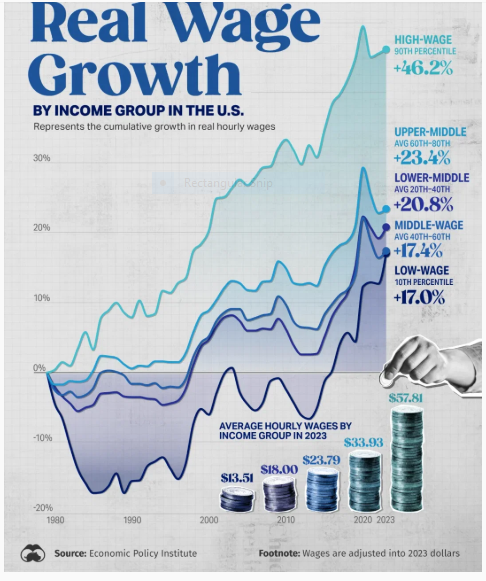
  • Global trade has made us richer.  Real wages are up 74% since the 1970s. In the 1950s, the typical American household spent more than a third of its income on food, clothing, gasoline and basic energy.  By the 1970s it was still more than a quarter.  By the 2000 aughts it was down to 13.5%.  Globalization is a large part of the story.
  • Example. It pays $12 an hour to work in a T-shirt plant in South Carolina. It pays much more to work down the street at Amazon or Costco.  So why not purchase T-shirts from Guatemala where T-shirt manufacturing pays good wages?
  • Manufacturing. The United States today is the second-largest manufacturing nation in the world. But we don’t have a lot of manufacturing workers because our workers are the most productive manufacturing workers in the world.  Since American manufacturing is dependent on open trade, it needs access to lower-cost raw materials and parts.
  • Example: Canada. The U.S. Defense industrial base includes Canada.  To slap tariffs on stuff from Canada doesn’t make sense.
  • Example: Mexico. https://humanprogress.org/scott-lincicome-an-update-on-the-trump-tariffs/ We get food from Mexico.  Does it make sense to tariff these imports and impoverish our own citizens?
  • Example: China. Increased trade with China starting in 1999 caused about a million U.S.manufacturing jobs to be lost. But there were also jobs gained from lower import prices in manufacturing, jobs gained from services, and jobs gained from exports to China.
  • Will tariffs raise a significant sum of revenue?  Imports make up $4 trillion toward our annual consumption of $25 trillion.  This means that tariffs will never be a broad-based consumption tax.  If tariffs are too high, there will be no imports at all.  Tariffs could bring in a maximum of $400 billion a year, whereas individual income taxes bring in $2.5 trillion a year.
  • Recession? Trump’s on-and-off tariff strategy is causing much consternation around the world, especially with our democratic allies.  A recession could result, doing great damage.  A continued decrease in the consumer price index down to the desired level of 2% would be attractive if this can be accomplished without tripping off a full-blown recession.

Conclusion.  Tariffs should only be used sparingly to occasionally protect fragile domestic industries.  If Trump is going to use them as a bargaining tool, he must be very careful not to overplay his hand.  Otherwise, he will do much damage to global trade, greatly impoverishing the whole world, including the U.S.

For my Email Newsletter
Follow me on Facebook
Follow me on Twitter

Cutting Spending in Trump 2.0 II. Will Debt Be Our Ruination?

The last several posts on this blog have discussed the severity of our debt problem and several different ways to address it.  Also addressed is the continuing threat of renewed inflation if annual spending deficits are not significantly reduced. 

Even more details on the severity of the problem are presented in today’s post.  Consider:

  • Hoover Institution scholar, Niall Ferguson, asks the question “Debt has always been the ruination of great powers. Is the U.S. next?”  He points out that last year, the U.S. spent $1.107 trillion on defense and $1.104 trillion on debt service.  He also points out that America’s expensive welfare system will only become more costly as the population ages, making it harder to reduce the national debt.
    |
  • The Wall Street Journal points out that Medicaid was established to help the needy – poor children, pregnant women, the elderly, and the disabled. Democrats have since expanded it by degrees into a far broader entitlement for able-bodied, working-age adults with lower incomes.  Republicans could frame their budget reform as improving the entitlement for the truly vulnerable while putting it on a fiscally sustainable trajectory.  Reforms like state block grants and per-capita caps on spending growth would do his while returning flexibility and political accountability to states for how Medicaid dollars are spent.

  • Wisconsin Senator Ron Johnson says that fiscal sanity is possible this year.  In FY 2019, federal outlays totaled $4.447 trillion.  In FY 2020, federal outlays jumped to $6.554 trillion because of the pandemic.  From March 2020 to March 2022, the federal government spent $5.2 trillion on Covid relief.  There was no justification for maintaining that level of spending once the pandemic was over.  Yet this is what we did, spending $6.6 trillion, $6.8 trillion, $6.3 trillion, $6.1 trillion, and $6.8 trillion in FY 2020, 2021, 2022, 2023, and 2024 respectively.  President Biden’s 2025 budget proposed spending $7.3 trillion, 63.3% higher than 2019 spending.
    Using FY 1998 as a base (the first year since 1969 with a budget surplus), adjusting for inflation and population growth, and using Biden’s 2025 figures for S.S. and Medicare, established a total budget for 2025 of $5.5 trillion, which coincides with Biden’s 2025 revenue projection, thereby producing a balanced budget!

Conclusion.  The above analysis demonstrates that the lack of fiscal restraint could be the ruination of our country.  It also demonstrates how to achieve fiscal restraint by making some common-sense spending reforms.

For my Email Newsletter
Follow me on Facebook
Follow me on Twitter

Cutting Spending in Trump 2.0 II. The Inflation Threat

Several weeks ago, I stated on this blog that Trump’s biggest challenge is to keep inflation under control.  This is an even bigger challenge today.  Consider:

  • As of January 2025, inflation (the consumer price index, CPI) is back up to 3%, way above the Fed’s desired level of 2%. This means that the Fed will not be cutting interest rates any time soon and may even have to raise them again.

  • If such a high inflation rate continues, and maybe even goes higher, Trump won’t keep his current 53% job approval rating for long.  Furthermore, his tariff plans could push inflation higher than it is already.
  • A recent Government Accountability Office (GAO) report states that the Federal Government loses between $233 billion and $521 billion annually to fraud. This is what Elon Musk and his DOGE team are trying to eliminate.

  • House Republicans last week advanced a blueprint that directs committees to find $2 trillion in savings to offset planned $4.5 trillion in tax cuts or new spending. This obligates House Republicans to shrink bloated programs like Medicaid and food stamps so that they can spend more on defense and the border.

Conclusion.  The Fed cannot control inflation by itself, just by raising interest rates.  It needs fiscal restraint from Congress and the President as well.  Congress is doing its part by setting a $2 trillion (ten-year) goal for cutting spending.  The President is doing his part by recruiting Elon Musk and DOGE to eliminate waste, fraud, and inefficiency in government spending.  In other words, the Republicans now in charge of the Federal Government are off to a good start in doing what is necessary to help the Fed bring inflation down to the desired 2% level.  This is critical for the success of President Trump’s second term.

For my Email Newsletter
Follow me on Facebook
Follow me on Twitter

Cutting Spending in Trump 2.0

On this blog, It Does Not Add Up, I discuss various issues such as the strength of U.S. and world democracy, the U.S. economy, and other major concerns.  The biggest problem our country faces by far is our enormous national debt, now exceeding $36 trillion, and our rapidly growing annual spending deficits, most recently $1.85 trillion for FY2024.  In a recent post, I discussed several general ways of reducing the annual deficit, such as closing tax loopholes, requiring able-bodied welfare recipients to work, and encouraging federal employee layoffs.

Now, as Donald Trump begins his second term, the budget situation has become more focused:

  • Even though the unemployment rate has now shrunk to 4.1%, 42.6 million Americans still receive food stamps, similar to January 2021, at the height of Covid. This number is clearly excessive.

  • There are now 84.6 million Americans enrolled in Medicaid, the same number as when President Biden entered office. Simply returning to pre-pandemic Medicaid spending levels would generate a savings of $1.4 trillion over a decade.

  • Both the consumer-price index and the federal debt rose dramatically under President Biden. These are closely related very serious long-term problems.

  • Federal workers have now been ordered to return to the office or accept an eight-month buyout by February 6.  It is estimated that at least 10% of federal employees, approximately 200,000, will accept the buyout.
  • Elon Musk, the head of DOGE (Department of Government Efficiency), says that he can cut $4 billion a day from the federal budget between now and the end of September 2025, and by a total of $1 trillion for FY2026, which begins October 1, 2025.

Conclusion.  Thanks especially to tech entrepreneur Elon Musk, we can look forward to big cuts in federal spending over the next year.  This is critical for getting our national debt under control.  It is also needed to help the Federal Reserve get inflation back down to the desired 2% level. This cannot be done without the major fiscal restraint that Elon Musk is determined to bring about.

For my Email Newsletter
Follow me on Facebook
Follow me on Twitter