The social economist William Galston has a column, in last week’s Wall Street Journal, “Closing the Productivity and Pay Gap”, discussing the large gap between the rising productivity of American workers and the stagnant pay level which has developed since 1973 (see below). He points out that “the erosion of the compensation/productivity link has made it harder to sustain robust domestic demand for goods and services, which constitutes more than two-thirds of our entire economy. As the gap widened, U.S. households responded by sending more women into the workforce, expanding the numbers of hours worked, and taking on a greater burden of debt. These strategies have hit a wall. Unless compensation rises more rapidly, stagnant domestic demand will depress economic growth as far as the eye can see.” In other words, workers are no longer receiving their fair share of the productivity gains. And this retards the increased economic growth which we all desire. Without detracting from the seriousness of Mr. Galston’s argument, I would like to make several observations which are pertinent to the discussion.
 First of all, as pointed out by the Heritage Foundation (in the second chart), wage stagnation since 1973 does not take into account the growth of total compensation including healthcare and other benefits. And since healthcare costs are twice what they are in any other country, this is a huge drag on the growth of worker’s pay. In other words, if the U.S. were able to cut healthcare costs nearly in half, as should be possible with a more efficient system, then the hundreds of billions of dollars saved would give a huge boost to paychecks.
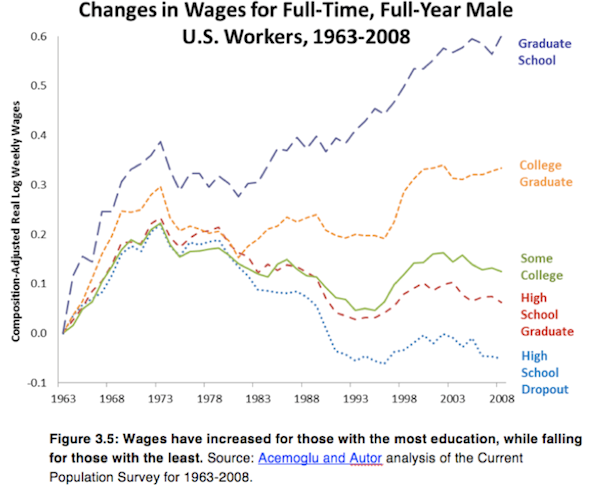
 Secondly (as shown in the last chart), there is a direct correlation between wages and education level for U.S. workers. Of course, boosting educational outcomes is much easier said than done and, in any event, is a long term process. Nevertheless, any highly motivated and ambitious person can increase their earnings prospects by succeeding in school.
 Finally, a combination of minimum wage increases and perhaps an expansion of the Earned Income Tax Credit can help those people at the lowest levels of the income scale earn a living wage as long as they are willing to work.
As Mr. Galston said in an earlier piece, “We need nothing less than a new norm – a revised social contract – that links compensation to productivity. And because we cannot return to the conditions that once sustained that link, we need new policies to bring it about.”
Closing the Productivity and Pay Gap
2