I have discussed global warming on this blog many times, most recently here. Global warming is real and serious but it is not an emergency. We know that the temperature has risen by 2 Fahrenheit since preindustrial times. Arctic sea ice is receding. The ocean is rising at the rate of one foot per century. Miami could, theoretically, be flooded in a hundred years, but it has lots of time to adapt to rising sea levels.

The greatest threat to the decarbonization of energy sources comes from unsustainable energy policies, especially those proposed by the current U.S. administration. America’s announced climate goals seek a transition to 100% clean electricity by 2035 and net-zero carbon emissions by 2050. Such aggressive timelines are at odds with three hard realities: economic, geostrategic, and political.
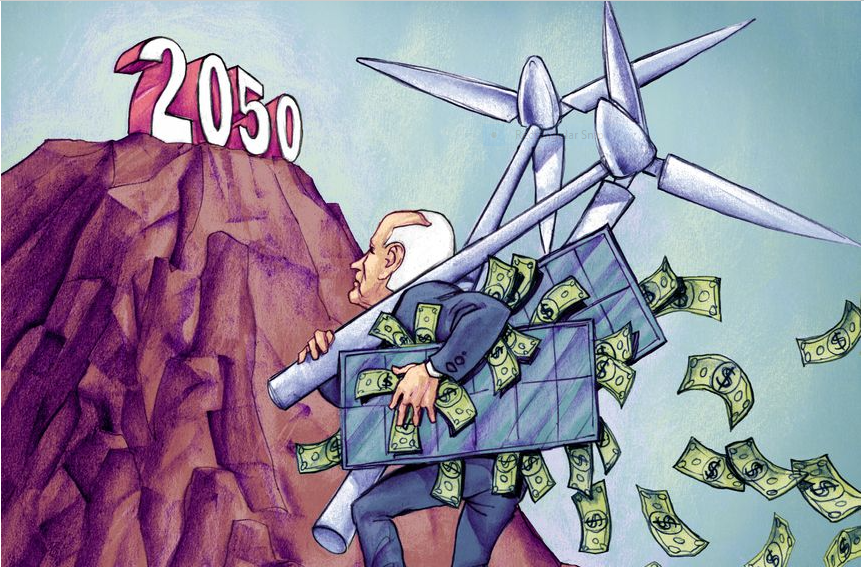
- According to the federal Energy Information Administration, global demand for energy will rise nearly 50% by 2050, with fossil fuels still accounting for roughly 75% of the world supply. A McKinsey & Co. report shows that achieving net-zero carbon emissions globally by 2050 would require $6 trillion in new spending every year for the next 30 years, clearly a practical impossibility.
- It is increasingly clear that both Russia and China view aggressive Western climate commitments as an opportunity to increase their power and influence. We have already witnessed what Europe’s reliance on Russian natural gas has wrought: unacceptable dependence on one of the world’s vilest governments. Meanwhile, China continues to increase its use of fossil fuels as it tries to catch up to and surpass the U.S. as the world’s largest economy.
- Without committed action by the Group of Seven nations – the U.S., Canada, France, Germany, Italy, Japan, and the U.K. – there is little hope for real climate progress in the coming decades. And these are the world’s leading democracies, accountable to their public. The voters in these countries could easily rebel against energy policies that ramp up energy prices, hinder economic growth, and even lead to rationing and blackouts. According to a July NYT/Siena College poll, only 1% of U.S. registered voters rank climate change as the country’s most important issue, far behind inflation and the economy.
The U.S., which sits atop massive natural gas reserves and has the world’s most innovative economy, is perfectly positioned to lead a realistic green transition. The administration should announce that U.S. natural gas will become the world’s vital bridge to an eventual carbon-free future. The U.S. should also strongly support research in carbon capture and storage, the development of lightweight, high-capacity lithium batteries, and next-generation nuclear reactors.
Conclusion. A transition to clean energy will be more effective and happen more quickly if it is based on sustainable policies and makes full use of America’s vast resources and well-known capacity for innovation.
for my Email Newsletter
Follow me on Facebook
Follow me on Twitter