Is “Medicare for All” a Good Idea?

I am not a socialist.  I am not a supporter of Bernie Sanders for President.  But “Medicare for All” has one very attractive feature.  It will substantially lower the cost of healthcare in the U.S.

As I repeat many times on this website, our country’s biggest long term problem by far is the rapidly growing, out-of-control, and unsustainable national debt.  The driving force of our debt problem is the rapidly increasing cost of entitlements.  And the cost of entitlement spending is primarily driven by the cost of healthcare: Medicare, Medicaid and private healthcare in that order (since Social Security insolvency is a conceptually easy fix).

We have excellent healthcare in the U.S. but we pay too much for it, in fact 18% of GDP for all of healthcare, public and private.  This is almost double what any other developed country pays.  The federal government subsidizes the cost of U.S. healthcare (i.e. for Medicare, Medicaid and private) at over $1 trillion per year.  This exceeds even our increasing annual budget deficits.

Capture21

“On average, the government (i.e. Medicare and Medicaid) pays the government 87 cents for every dollar of their costs compared with private insurers that pay $1.45.”   In other words, a government run “Medicare for All” program would force hospitals to operate much more efficiently and thereby lower overall hospital costs by an estimated 40%.  This is the plus side of “Medicare for All.”

The negative side of a single payer system like “Medicare for All” is its likely negative effect on innovation.  According to the economist Tyler Cowan, “The American healthcare system, high expenditures and all, is driving innovation for the entire world.”

Summary.  The sixty four thousand dollar question is: “How do we dramatically lower healthcare costs in the U.S., which are burgeoning out of control, without losing the cutting edge medical advancements produced by the U.S. healthcare system?”

Follow me on Twitter 
Follow me on Facebook 

How to “End Economic Inequality, Grow the Middle Class, and Heal the Nation”

“Solving inequality in earnest will require dramatic changes. … It will take vision, wisdom, creativity, patience, courage, and will to fully change our current inequalities.  But we can start with urgency in the business arena.  We can change the dynamic of our precarious current state.  We can change the dialogue and turn the crisis into a discussion of constructive possibilities.  With caring and compassion our attitudes will shift.  The good people will multiply and their efforts will be transformational.  Progress and success will beget more of the same.” 

These are the closing words of retired CEO Peter Georgescu in his new book, “Capitalists, ARISE: end economic inequality, grow the middle class, heal the nation.”  According to Mr. Georgescu, this can all happen if business CEOs will stop worrying so much about the return on investment to their stockholders and instead give more concern to the welfare of their employees.

Capture20

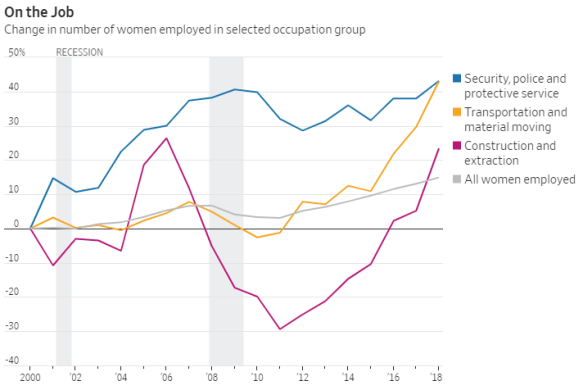
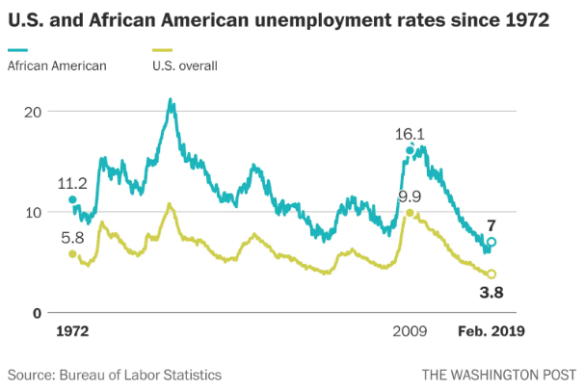
But it is not necessary for CEOs to act altruistically for these good things to happen.  In 2018 our economy grew at a rate of almost 3% and the unemployment rate is now down to 3.8%.  Such a low unemployment rate means we have a nationwide labor shortage!

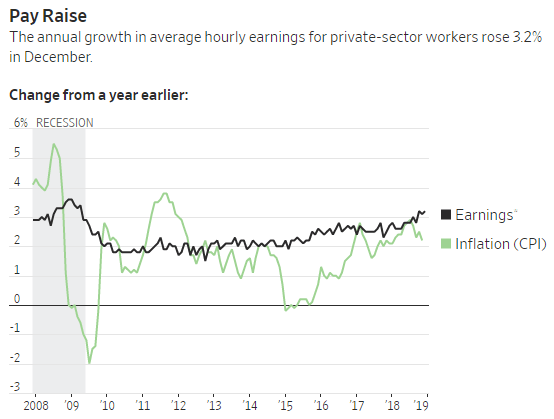
In fact wages are now rising at a fairly rapid clip, faster than 3% per year (see second chart).    Many big companies, such as Amazon, Home Depot and Walmart, are individually raising their minimum wages in order to be able to attract the large numbers of workers they need to operate their businesses.

Capture19

Summary.  In other words, the best way to achieve Mr. Georescu’s laudable goals, is to keep the unemployment rate as low as possible, at least under the 4% benchmark.  This will accomplish far more economic good for the average worker than acts of altruism by individual or groups of CEOs.  And by and large it is faster economic growth which lowers the unemployment rate.

Follow me on Twitter 
Follow me on Facebook 

The Stupidity of Modern Monetary Theory

Modern Monetary Theory says that deficits don’t matter, unless inflation increases a lot, because the U.S. can always just print new money to pay off its debts.  The idea being that if inflation does increase then the Federal Reserve would respond by increasing interest rates which would in turn drive up interest payments on the debt.
Capture16
Another way to say it is that we are okay with huge deficits, adding each year to our already large debt, as long as inflation remains low.  Yes, it is true that that right now, interest rates are so low that our huge almost $22 trillion debt is almost free money, costing us “only” about $300 billion per year in interest payments.

The problem is, of course, that this currently happy low inflation era will eventually end and the Federal Reserve will be forced to raise interest rates, perhaps dramatically.  The longer this takes to occur, the more our debt will have accumulated in the meantime.  Right now debt is 78% of GDP (for the public part on which we pay interest), and is predicted by the Congressional Budget Office to keep growing steadily worse without major changes in policy.

I find it shocking that many financially experienced people take MMT seriously.  They should know better.  The very simple logic that inflation, and therefore interest rates and interest payments on the debt, will significantly increase, sooner or later, should be easy to understand.  The longer this takes to happen, the more severe will be the eventual problem and therefore the more traumatic will be the necessary fiscal adjustments to make at that time.

Summary.   It is depressing to clearly foresee the awful fiscal hole that our nation is gradually sinking into and be unable to do anything to stop it.

Follow me on Twitter 
Follow me on Facebook 

Tax Policy and the Wealthy

Most of the Democratic candidates for President want to raise tax revenue to pay for new programs of various sorts.  Senator Elizabeth Warren of Massachusetts has in fact suggested creating a new wealth tax, 2% annually on wealth over $50 million and an additional 1% on wealth over $1 billion.
Capture15

Is a wealth tax a good idea?

Normally I am skeptical of the economic ideas of Harvard University’s Larry Summers.  He has stated many times that slow economic growth may be the new normal.  He has also said quite recently that we should stop worrying about trillion dollar budget deficits.  These are both very dangerous ideas. (here and here)

But he has two recent columns in the Boston Globe about wealth taxes which make a lot of sense.  First of all, he points out the many problems in trying to tax wealth rather than income.  Secondly, he identifies several ways to broaden the income tax base and close loopholes which would raise significant amounts of new money.
For example:

  • Auditing the tax returns of even just 25% of million dollar earners could greatly increase the compliance rate and likely raise $400 billion over ten years.
  • Closing corporate tax shelters would raise $360 billion over ten years.
  • Closing individual tax shelters would raise $420 billion over ten years.
  • Eliminating the stepped up basis for unrealized capital gains on inheritances would raise $250 billion over ten years.

Just these four tax revenue enhancements alone would more than pay for the $1 trillion cost of the Trump tax cuts passed in December 2017.

Summary.  The Democrats want a variety of new government programs which will have to be paid for.  And the trillion dollar annual deficits already projected for the future are totally unacceptable and need to be greatly decreased.  Broadening the tax base and closing loopholes, as suggested by Larry Summers, will meet both of these needs.

Follow me on Twitter 
Follow me on Facebook 


Two Cheers for the Senate Budget Proposal

My last post has faint praise for the Trump 2020 budget proposal because it makes no effort to control overall federal spending even though it does suggest a few relatively small curtailments in both discretionary and Medicare and Medicaid spending.

Now the Senate Budget Committee has come up with a much better proposal.  It reduces deficits by $538 billion over five years (see first chart) thereby keeping annual deficits under $1 trillion going forward.
Capture13

Under the Senate proposal the federal debt (i.e. the public part on which interest is paid) would still rise to 83% of GDP in 2024 compared to 78% of GDP today (see second chart).  Under the Trump budget, the debt would be 86% of GDP in 2024.
Capture14

I emphasize that the Senate Budget proposal is better than the Trump proposal, not that the Senate plan is really adequate.  As the third chart clearly shows, it is mandatory (entitlement) spending which is the driver of our increasingly serious debt situation.  In fact, it is even more specific than this.  Social Security can be fixed with some relatively small tweaks but Medicare and Medicaid need major changes.

Capture10

The basic problem is that the cost of healthcare in the U.S. is way too high, almost twice as expensive as in all other developed countries.  All three sectors of healthcare are to blame: hospitals, providers (i.e. doctors) and drugs.

Furthermore, it is unlikely that the free market can fix this problem.  Healthcare overall is just too complicated for individual healthcare consumers to understand in sufficient detail to be able to effectively compare prices.  It is likely that strict government controls will be needed.

One specific reform which would help out immensely is to let Medicare negotiate with drug companies over the cost of individual drugs.  Right now this is prohibited by Congress so the law would have to be changed.  Other measures to control the costs of both hospitals and doctors will also be needed.

Summary.  At the present time there is general public awareness that our national debt is out of control but not nearly enough interest by individual members of Congress to seriously address this critical problem.

Follow me on Twitter 
Follow me on Facebook 

One Cheer for the Trump Budget Proposal

As the readers of this blog are well aware, I believe that the rapidly accumulating national debt is by far the biggest long term problem our country faces.  While I am in general optimistic about the future of our country, I am pessimistic that our debt crisis can be solved in a planned and rational manner without going through another huge financial crisis.

Capture10

Simply put, fixing a debt problem requires a bipartisan solution, and, at the present time, our broken political system makes it all but impossible to find any kind of consensus short of having a national crisis.  The only way to fix the debt is to get entitlement spending under control (see the first chart).

Capture11

The Trump budget for 2020 projects a deficit of $1.1 trillion or 4.9% of GDP which is way too large.  Nevertheless it does at least make some attempt to control both Medicare and Medicaid spending as the second chart shows.
The budget also takes a whack at various governmental departments and agencies (see third chart).  Such whacks at discretionary spending do little to reduce the annual deficit (which will still amount to $1.1 trillion) but are beneficial to force the federal government to operate more efficiently.

Capture12

Unfortunately the final budget for 2020, after approval by Congress, is likely to project an even larger deficit than the $1.1 trillion projected by Trump.  This is because Congress is likely to insist on more discretionary spending than Trump proposes.

Summary: The Trump budget proposal at least takes a few small steps towards controlling entitlement spending as well as making cuts in discretionary spending.  Unfortunately even these relatively modest spending curtailments are unlikely to survive Congressional action.

Follow me on Twitter 
Follow me on Facebook 

Why It Will Be So Difficult To Fix Our National Debt

This blog deals primarily with fiscal and economic issues.  Overall I am a political moderate but I am a hardcore conservative on our national debt.  It is in very bad shape as I have said over and over again:

  • First of all, our debt is now at 78% of GDP (for the public part on which we pay interest), the highest it has been since right after WWII and is predicted by the Congressional Budget Office to keep getting worse. Right now interest rates are so low that it is almost free money.  But when interest rates go up, as they will eventually, interest payments on the debt will skyrocket and create a huge fiscal burden for the United States.  The longer this takes to happen, the greater our debt will likely become, and so the eventual interest payment problem will have gotten that much worse in the meantime.
  • The only way to fix the debt is to either raise taxes and/or curtail spending on entitlements, by far the biggest and fastest growing budget item. Either of these approaches requires sacrifice by large numbers of people and therefore is difficult to achieve politically in the best of circumstances.                                  Capture9
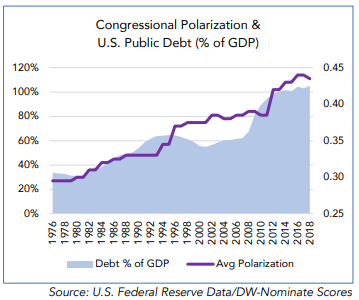
  • And now we have the worst of circumstances! Our political system is deadlocked  with both sides trying to destroy the other side.  Any move by either party to either raise taxes and/or curtail entitlement spending will be strongly attacked by the other side.  The attached graph shows that polarization and debt level go hand in hand.  In other words, our rapidly worsening debt level is a symptom of our ever increasing political polarization.

Summary.  Our large and rapidly growing national debt is a very serious and urgent problem.  It requires a bipartisan solution which will be very hard to achieve in our current deadlocked political system.  It is difficult to be optimistic about addressing this problem effectively in the current environment.

Follow me on Twitter 
Follow me on Facebook 


Why Our Country Is So Starkly Divided

Although Donald Trump’s election as President in 2016 was a fluke in the sense that the three purple states of Wisconsin, Michigan and Pennsylvania barely carried him over the finish line with a total three state margin of just 77,000 votes, it also reveals the stark division of our country into red and blue pieces (see first map):
Capture7

  • As of the November 2018 national elections, 30 states (see second map) now have both legislative chambers controlled by Republicans, 19 states have both controlled by Democrats and only one state – Minnesota – has a split legislature. (Nebraska, the only state with a unicameral legislature, is in the Republican group.)
    Capture8
  • We’ve known for some time that the red–blue divide is to a large extent rural–urban, with minorities, who usually vote Democratic, packed into cities while Republicans are more evenly spread out and thus dominate the rural areas.
  • Would you rather drive a Prius or a pickup truck? Would you rather eat meatloaf and mashed potatoes or chicken curry and vegetable biryani?  According to the authors of Prius or Pickup, how you answer these questions reveals a lot about how you vote!
  • The political analyst, Christopher DeMuth, distinguishes between the elite “anywheres” who are not especially tied down to any one particular geographical location and the less educated “somewheres” who are more likely to live where they grew up. The “anywheres” are well educated, articulate and mobile and well positioned to influence the administrative state and the judiciary.  The “somewheres” are more beholden to their congressional representatives for political support.  As the federal government grows ever bigger and more complicated, and Congress willingly forfeits more of its power to the administrative state, the influence of the elite “anywheres” is strengthened at the expense of the non-elite “somewheres”.

The less educated, more rural “somewheres” are revolting and have, for example, demanded restrictions on immigration and foreign trade which they see as threats to their traditional way of life.  This has turned them into avid supporters of Donald Trump who has adopted their wishes as a major part of his agenda.

Summary.  The nationalism springing up all around the free, democratic world is a natural reaction by the non-elites to the increasing complexity of modern society and the growth of government to deal with this increasing complexity.

Follow me on Twitter 
Follow me on Facebook 

The Jungle Grows Back

Every once in a while I read a book which is so compelling that I want to tell everyone about it.  The last one was “The Hundred-Year Marathon” by Michael Pillsbury which reveals “China’s secret strategy to replace America as the global superpower.”

Now I want to tell you about “The Jungle Grows Back” by Robert Kagan.   It describes the crucial role of America in our imperiled world.

Capture6

Several authors such as Johan Norberg, “Progress“, Steven Pinker, “Enlightenment Now”,  and Matt Ridley, “the Rational Optimist”, describe the steady human progress of the last several hundred years such as the increase of personal freedom, equality, and longevity and the decrease in poverty and violence all around the world.  These remarkable trends are widespread and have made the world a much better place.

Mr. Kagan makes a strong counter-argument that “this story of human progress is a myth.”  He argues that the amazing progress of the past 75 years is the product of a unique set of circumstances.  Namely that “the most powerful nation in the world since 1945 has been a liberal democratic capitalist nation.  The question is not what will bring down the liberal order but what can possibly hold it up?  Today there are signs all around that the jungle is growing back.”

“Prior to WW II democracy was in decline and it had been virtually nonexistent over the preceding five thousand years.”  Since 1945 it is “the growing power and reach of the liberal world order which is unprecedented.”

“We have lived inside the bubble of the liberal world order for so long that we have forgotten what the world ‘as it is’ really looks like.  In the American-led liberal order, Russia has fallen from superpower status but China has risen towards it.  If the United States is strong and determined and the liberal order remains healthy and united, a Chinese challenge could fail.”

But the “liberal world order may no longer be healthy enough and coherent enough to continue containing and discouraging” Chinese ambitions.

The biggest question of all concerns America’s own commitment to the liberal world order.  We have to abandon the post-Cold War myth that liberalism must be the natural end point of human evolution because it triumphed over communism.

“Today the order remains intact despite the hostility of the present administration and the weakness of the last.  It is ultimately the American security guarantee, the ability to deploy hard power to deter and defeat potential aggressors that provides the essential foundation without which the liberal world order could never survive.”

In summary, “the liberal world order is as precarious as it is precious.  It is a garden which needs constant tending lest the jungle grows back and engulfs us all.”

Follow me on Twitter 
Follow me on Facebook 


Prosperity Requires Economic Growth

Many authors have pointed out recently that the world is gradually getting better in the sense that world-wide poverty is steadily decreasing.  The primary cause is the steady economic growth which has taken place ever since the beginning of the industrial revolution in the late 1700’s.

Capture5

Faster economic growth means that more workers are needed to perform the necessary labor to produce the growth.  This in turn means that the unemployment rate goes down and wages go up as employers have to compete more vigorously to hire the available workers.
The eternal debate about the best way to increase growth has flared up again recently as Amazon has decided to back out of its plan to create 25,000 new jobs in New York City because of local opposition.

Capture4

Some people say that the best way to bolster workers and the middle class is to increase minimum wages and to provide free college and federal job guarantees.
The problem is that before jobs can be enhanced with a minimum wage or hiring guarantees, for example, the jobs have to exist in the first place.  It is true that some jobs are created by government investment but this requires spending tax dollars which are usually in short supply and have to be spent carefully and efficiently so that voters won’t object to paying them.
In our free enterprise system most jobs are in the private sector.  This means that the best way to create more jobs and better paying jobs is to encourage entrepreneurs to start new businesses and existing companies to grow and expand.  Let the market determine pay levels and job conditions with minimal government interference.
In turn, the best way to help workers at the lower end of the pay scale is with the already existing Earned Income Tax Credit which provides a wage subsidy for many workers. This government program could easily be expanded to help even more low-income workers.
Summary.  The best way to address income inequality in American society is by encouraging more economic growth in the private sector and then expanding wage subsidies to apply to all workers in the lowest wage categories.

Follow me on Twitter 
Follow me on Facebook