
The Bush Deficits vs the Obama Deficits


As I like to remind readers, I am a fiscal conservative and a social moderate.  I started writing this blog in November 2012, after running unsuccessfully in a Republican congressional primary in May of that year.  I am appalled by our reckless fiscal policies in recent years.  We simply have to get federal spending in much better alignment with tax revenue and do this in a relatively short period of time.
Both political parties are responsible for our current predicament.  Nevertheless, we need to have the best factual information available to help us get back on track.  Today I compare the Bush deficits with the Obama deficits.  The most objective way to do this, in my opinion, is to divide the transition budget years, 2001 and 2009, between the incoming and outgoing presidents.  In other words, October, November and December of the year 2000 are assigned to President Clinton and the last nine months of the 2001 budget year, i.e. January 2001 – September 2001, are assigned to President Bush.  Likewise for the 2009 budget year, when Bush was leaving office and President Obama was coming in.
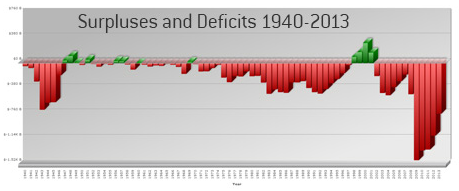
CaptureA good source for such detailed budget information is the website of David Manuel, “an online repository of financial and political information that is often searched for but is generally hard to find.”
Here is what I’ve come up with:

President Bush

  • 2001 budget year (last 9 months)                $129.6 (billion) surplus
  • 2002 budget year                                         $157.8 (billion) deficit
  • 2003 budget year                                         $377.6 (billion) deficit
  • 2004 budget year                                         $413   (billion) deficit
  • 2005 budget year                                         $318   (billion) deficit
  • 2006 budget year                                         $248   (billion) deficit
  • 2007 budget year                                         $161   (billion) deficit
  • 2008 budget year                                         $459   (billion) deficit
  • 2009 budget year (first 3 months)                $332.5 (billion) deficit
  •                                                                   $2,337.3 (billion) deficit TOTAL

President Obama

  • 2009 budget year (last 9 months)               $1080.5 (billion) deficit
  • 2010 budget year                                        $1294  (billion) deficit
  • 2011 budget year                                        $1299  (billion) deficit
  • 2012 budget year                                        $1100  (billion) deficit
  • 2013 budget year                                         $ 683  (billion) deficit
  • 2014 budget year                                         $ 483   (billion) deficit
  • 2015 budget year (CBO estimate)               $ 468   (billion) deficit
  • 2016 budget year (CBO estimate)               $ 467   (billion) deficit
  • 2017 budget year (first 3 months, CBO)      $ 163     (billion) deficit
  •                                                                   $7,037.5   (billion) deficit TOTAL  

These totals represent, of course, the amounts that were added (Bush) or will be added (Obama) to the national debt during their terms of office.  George Bush made little, if any, effort to control deficit spending.  But the Obama debt is three times as bad as the Bush debt.  Getting the debt under control is by far our biggest and most urgent national problem.  By failing to take our debt seriously, both Bush and Obama have been huge failures as president!

Is Universally Free Community College a Good Idea?


President Obama has just proposed that two years of community college be free for all Americans “willing to work for it.”  Forty percent, or about nine million, of today’s college students are enrolled at one of America’s more than 1100 community colleges which have an average annual tuition of $3800.  First estimates are that such a program would cost about $6 billion per year when fully implemented. The advantages of such a program are:
Capture

  • The biggest advantage is to greatly increase college enrollments especially for the low-income, minority and first generation college students who typically attend community colleges.
  • It will make a contribution toward solving the college affordability issue. With tuition averaging $9,139 at public four-year colleges and universities and $31,231 at private institutions, students unsure of their future plans can start out with much lower expenses before deciding if they really want a four year degree. Equally important, it will put pressure on four-year institutions to do a better job of controlling their costs and focusing more strongly on what they do best.
  • Finally, such a plan will put great pressure on expensive for-profit educational institutions, whose primary source of income is from federal student loans, to demonstrate much more clearly their true educational value. Community colleges are likely to expand their course offerings under a big influx of new students and expand into specialized practical subjects where the for-profit institutions now have a virtual monopoly.

There is, of course, one nitty-gritty little thing to be concerned about with such an ambitious new education program.  How is it going to be paid for in our current era of high federal deficits and exploding debt?
I think there are two ways to approach this question.  First of all, the federal education budget is quite large, $141 billion for FY 2014.  We should be able to trim other education programs in order to pay for this new initiative.  This kind of budget discipline, which is absolutely necessary, might require cutting back the President’s proposal in order to reduce its cost.  This is quite appropriate.
There will always be good ideas for new programs which could prove to be quite valuable.  But they will need to be implemented very efficiently!

Barack Obama vs Paul Ryan: Who Is Moving Us in the Right Direction?


“If you give a man a fish you feed him for a day.  If you teach a man to fish you feed him for a lifetime.”
Chinese Proverb

Several weeks ago my post, “How to Improve America’s Welfare System,” described a new proposal from the House Budget Committee (Chair, Paul Ryan) to let selected states experiment in consolidating separate federal programs such as SNAP, TANF, child-care and housing assistance programs, into a new composite Opportunity Grant Program.  The idea is to let participating states choose qualified providers who would then be held accountable for moving people off of assistance, out of poverty and into productive employment.
CaptureA recent report from the Tax Foundation compares what families pay in taxes with what they receive in government benefits.  In 2010, 60% of American families (with incomes up to $86,000) received more in federal benefits than they paid in federal taxes.  However in 2012, this percentage grew to 70% (those families with incomes up to $109,000).  In other words, the trend under Obama is for more people to be net receivers of benefits than net payers of taxes. There are two basic problems with this trend towards more and more benefits for more and more people:

  • As it stands right now, we’re making people more dependent on government programs. Instead we should be helping them become more independent and more capable of supporting themselves on their own. This would improve their quality of life.
  • Our federal government is spending way too much money and not collecting enough tax revenue to pay the bills. According to report after report from the Congressional Budget Office, the trajectory of growing debt is getting much worse and the problem will become harder and harder to rectify as we continue down this path.

My natural inclination is to be optimistic that our political process will respond to this bleak current path we’re on and that things will be turned around before we have another financial crisis.  But it is easy to imagine a course of events where this does not happen.
It’s clear what we need to do but how will this get done?


Bush Was a Disaster; Obama Is Merely Ineffective


As Barack Obama nears the three-quarter’s mark of his presidency, it is natural that he and George W. Bush will be compared to one another.  I consider them both to be disappointing presidents but in very different ways.
CaptureFirst, the sins of George Bush:

  • The Bush Tax Cuts of 2001-2003 lowered tax rates without being offset by closing loopholes and/or shrinking tax deductions. This made his huge budget deficits much worse than they otherwise would have been and without helping the economy.
  • The Iraq War. Regardless of whether or not the U.S. was justified in invading in 2003, the current ISIS uprising of Sunnis is likely to result in a worse outcome than existed before the U.S. invasion. This will come to mean that Iraq was a mistake.
  • Medicare Part D (2003). The Prescription Drug program now costs the federal government about $100 billion per year. It makes the unsustainable cost of Medicare that much worse.
  • The Financial Crisis of 2008. This represents an even bigger stain on his record. He appointed all of the key players such as Ben Bernanke, Tim Geithner and Henry Paulson who failed to see it coming. He also appointed Sheila Bair as head of the FDIC in 2006. She did see it coming but it was too late and she didn’t have enough clout.

Mr. Obama is very bright and articulate.  But he has made many serious mistakes including:

  • His total immediate attention in 2009 should have been on reviving the economy. Instead he and the filibuster-proof Democratic Congress pushed through the Patient Protection and Affordable Care Act. The employer mandate of Obamacare, even though postponed by the administration, has slowed down the economic recovery by making it more expensive for businesses to hire full time employees.
  • For all of his nonpartisan campaign rhetoric about “change we can believe in,” he has been one of the most divisive and partisan presidents in many years. This has created huge animosity and distrust amongst his political opponents which makes it difficult for the two sides to negotiate differences in good faith.
  • The most glaring example of this is the anemic 2.2% annual growth of the economy since the Great Recession ended in June 2009. Many economists agree that cutting both individual and corporate tax rates, offset by closing loopholes and deductions, would be hugely beneficial in boosting the economy. It would put millions of people back to work and shrink our huge deficits. Why isn’t the President talking about this and leading the charge?   But, of course, this was the Romney tax plan in 2012. What’s wrong with the election winner adopting the best parts of the program of the election loser?  Now that would be demonstrating real leadership ability!