The Right Way to Deregulate Wall Street


The economy has been chugging along at about 2% annual GDP growth ever since the end of the Great Recession in June 2009. Unemployment has been steadily dropping and is now a fairly low 4.4%.  Low wage earners are now even beginning to see bigger gains in pay.
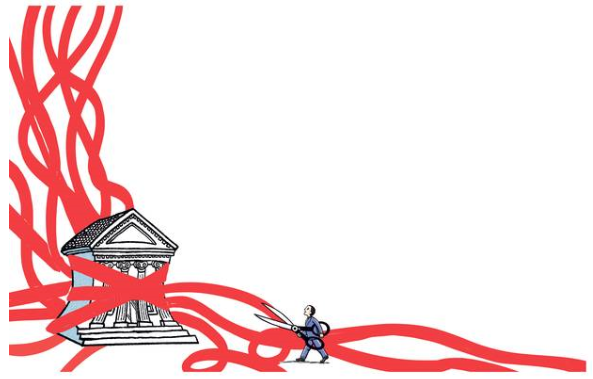
Most people would like to speed up economic growth even more.  Tax reform will help in this regard but so will sensible deregulation.  Barron’s has an excellent article this week about deregulating Wall Street by William D. Cohan.

According to Mr. Cohan:

  • GDP growth is highly correlated with bank lending.
  • The Dodd-Frank Act, passed by Congress in 2010, has disproportionately burdened community banks, despite their having no role in the financial crisis.
  • More than 1700 U.S. banks have disappeared since Dodd-Frank was passed.
  • Senator John Kennedy (R, LA) has introduced a bill which would exempt community banks and credit unions with assets of less than $10 billion from the Dodd-Frank Act.
  • As a result of Dodd-Frank, big banks are now required to have more capital and less leverage. Today a bank’s assets would have to fall about 7% before a bank’s capital would be wiped out, as opposed to only 2% in 2008.  This makes them safer.
  • Prior to 1970 the Wall Street partnership structure ensured that bankers had plenty of skin in the game – essentially their full net worth was on the line every day.
  • Today bankers and traders are rewarded for taking risks with other people’s money. Mr. Cohan recommends that the top 500 traders and executives at every big bank have a significant portion of their net worth on the line.

Conclusion. Mr. Cohan’s program would not only give a big boost to the economy by enabling community banks to lend more freely but would also make our financial system safer by requiring top financiers to have skin in the game.

Follow me on Twitter 
Follow me on Facebook 


Let’s Do Something about Corporate Welfare and Crony Capitalism!


The American Enterprise Institute is one of my favorite Washington think tanks.  It defines its mission as “research and education on issues of government, politics, economics and social welfare.”  I especially like its interest in social welfare which translates for me as being fiscally conservative with a heart.
CaptureThe AEI’s Timothy Carney has just proposed “An anti-corporate welfare, anti-cronyism agenda for the 114th Congress.” Most candidates for Congress condemn crony capitalism and corporate welfare.  This generally means any policies which tilt the playing field, picking winners and losers and rewarding well-connected insiders.  Such actions contribute to the public perception that the “game” is rigged and harm economic growth and innovation.  Here are some prime examples discussed by Mr. Carney:

  • Health Care: repeal Obamacare’s insurer bailout (the “risk corridors”) so that health insurers compete totally on price.
  • Health Care: end the individual mandate which forces people to buy a product from a private industry. An alternative incentive for individuals to remain covered would be limiting enrollment periods, for example, to a brief six-week sign-up period every two years.
  • Energy: end tax breaks and subsidies for both renewable energy (including ethanol) and oil and gas. Make all forms of energy compete in the market.
  • Taxes: make corporate taxes simpler, lower and more neutral. Besides being fairer, such changes will boost the economy.
  • Finance: Rein in Fannie Mae and Freddie Mac by treating them the same as all big banks. This means the same capital requirements, the same tax treatment and the same consumer protection regulation.
  • Finance: Kill Dodd-Frank’s too-big-to-fail designation. It acts as a moat, protecting the big guys from competition.
  • Trade: Kill the Export-Import Bank.
  • Trade: Repeal the Jones Act. It requires all shipping between U.S. ports be done on U.S. flagged vessels.
  • Agriculture: End the Sugar Program which costs consumers $3 billion per year.
  • Agriculture: Reform the Federal Crop Insurance Program by making it self-supporting.

These mostly well-known examples of corporate welfare represent just the tip-of-the-iceberg.  Nevertheless they provide a good place to start in cleaning things up!