A Vivid Example of Fiscal Irresponsibility at the Federal Level


An article in the Friday, August 14 edition of the Omaha World Herald, “Why are the BRT stations so expensive? Officials explain the $260,000 price tag,“ describes a new $30 million bus rapid transit plan for Dodge Street with 27 individual sleek, modern bus stop shelters along the route at a cost of $260,000 each.  Half of the new $30 million plan will be paid for by the city of Omaha and half by the Federal Transit Authority which has an annual budget of $8.6 billion.
Capture1 The issue is not whether Omaha should spend $15 million in local funds to achieve a $30 million bus system upgrade. We can expect city officials to make a responsible decision on this matter. The real issue is why the FTA should have annual budget of $8.6 billion to begin with when it is paying for, and therefore encouraging, extravagantly designed bus transit systems all over the country.
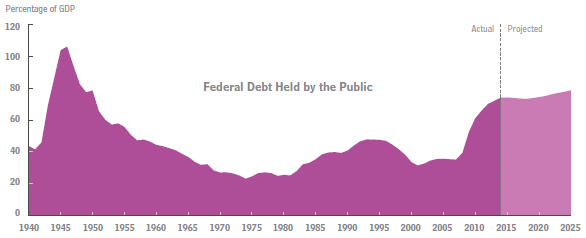
CaptureThe U.S. deficit for the 2015-2016 budget year, ending on September 30, is predicted to be about $450 billion dollars. This adds to the approximately $13 trillion public debt (on which we pay interest) which, at 74% of GDP, is the highest it has been since the end of WWII (see the above chart from the Congressional Budget Office).
It is the responsibility of Congress and the President to figure out how to get the budget under better control. All aspects of federal spending can and should be tightened up, including entitlements (Social Security, Medicare and Medicaid) and discretionary spending (everything else).
The Federal Transit Administration is wasting money on unnecessarily extravagant bus transit systems. Such fiscal irresponsibility means that its budget should be cut significantly. Many other similar examples exist in the federal government. We need people in Congress who can identify these fiscal boondoggles and effectively agitate for needed cutbacks.
How to Avoid a New, and Much Worse, Financial Crisis


Is it possible for the U.S. to effectively address its enormous debt problem in today’s contentious political environment? Two weeks ago I discussed in “America’s Fourth Revolution” why the political scientist James Piereson thinks this is impossible. He is very persuasive but I think he is too pessimistic.
CaptureSince then I have discussed several different things we should do to turn around this perilous situation:

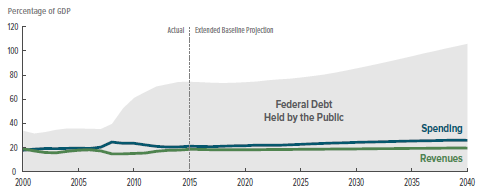
  • If spending for just Medicare and Medicaid (two very expensive entitlement programs) alone fell by 25% over ten years, as a percentage of GDP, and then stayed in line with GDP after that, the U.S. would actually have a budget surplus in 2040.
  • Just recognizing the magnitude of our debt problem would do wonders in public awareness.
  • If the Tea Party were able to grow beyond a protest movement and unite the country behind a majoritarian agenda of work, mobility and opportunity, it would be much more effective in achieving its fiscally conservative goals.
  • Another significant way to save money, and get better results at the same time, is to turn over more and more programs to the states. A good way to do this is with block grants to the states for federal programs in such areas as welfare, education and Medicaid. This would give the states more flexibility to get the job done in an efficient and cost saving manner.

What we need to do to turn our debt situation around is to greatly shrink our annual deficits below their current level of about $450 billion per year. If the debt is growing slower than the economy, then it will shrink as a proportion of the economy. This is what happened after WWII (see above chart) and it needs to happen again now!

The Fiscal Time Bomb Is Still Ticking!


The Congressional Budget Office is by far the most objective source of detailed information about the federal budget, playing a valuable role in the super-charged political atmosphere of Washington D.C.  It has just released a new annual report, “The 2015 Long-Term Budget Outlook,” projecting our fiscal health for the 25 year window, 2015-2040, based on current policy. It is a scary scenario indeed.
CaptureAs shown in the above chart, our public debt (on which we pay interest) has increased from 38% of GDP at the beginning of the Great Recession in 2008 to 74% today.  Although it will remain steady at this high level for about five years, it will then resume a steady increase, reaching a level of about 100% of GDP by 2040.
As many observers, including myself, have pointed out, when interest rates eventually return to their normal historical level of around 5%, interest payments on this huge, and rapidly increasing, debt will double or triple from their current low level, causing a very painful budget shortfall.
Simple prudence suggests that the only responsible course of action is to put our debt on a downward path, as a percentage of GDP, in order to minimize this looming problem to the greatest possible extent.
Capture1CBO gives some useful guidelines for what is required to do this:

  • Just to keep the debt at its current value of 74% of GDP by 2040 would require an annual 6% increase in revenue or a 5½% decrease in spending. This would amount, for example, to a $210 billion spending cut for 2016.
  • To reduce the debt to 38% of GDP by 2040, its average over the past 50 years, would require an annual 14% increase in revenues or a 13% decrease in spending. The spending cut for 2016 would be $480 billion.

These examples show the enormity of the fiscal mess we have gotten ourselves into.  Under current policy it will require a big effort just to stay even with where we are right now, without showing any debt reduction over the next 25 years!
Our only hope is to change current policy.  But how?

Fixing the Debt: Creating a Greater Sense of Urgency


As I have mentioned before, I am a volunteer for the nonpartisan Washington D.C. think tank “Fix the Debt.”  As such I give presentations to civic organizations in the Omaha area about our debt problem and what we can and should do about it.  I have now given four such talks and have another one coming up next week.
Capture
What is most difficult for me is to try to convey a sense of urgency about addressing this problem. Most people deplore deficit spending in a general sense but not nearly enough people think that dealing with it should take priority over current presumably pressing spending needs such as, for example, depletion of the highway trust fund, expanding military spending, or improving early childhood education, just to be specific.
So here is how I am going to try to create a greater sense of urgency.  Several months ago I had a post entitled, “The Slow Growth Fiscal Trap We’re Now In” in which I said (in brief summary) that our current economic condition of

  • slow growth means
  • low inflation which leads to
  • low interest rates which in turn leads to
  • massive debt which eventually leads to a new and much more severe
  • fiscal crisis.

This is the predicament we’re now in.  Do we consciously maintain a slow growth economy, with all the unemployment pain and stagnant wages which this entails, or do we speed things up, enabling more people to go back to work, and also deal with the higher inflation and interest rates which this will entail?
Faster growth may well eventually come on its own anyway and then we’ll be forced to fix our fiscal problems at a time when they’ll be much worse than they are now.
Isn’t it clear that it is much better to act now in a responsible manner rather than to wait and have to react hurridly later on when the problem is much worse?

My Moral, Social and Political Values


About a month ago I wrote a post about a book by Dennis Prager, “Still the Best Hope: why the world needs American values to triumph.”  According to Mr. Prager, there are three ideologies competing for the allegiance of humankind.  They are: Islamism, Leftism and Americanism.  He defines American values as 1) Liberty, 2) In God We Trust and 3) E Pluribus Unum, the three expressions which appear on all American coins.  His trinity of ideologies and values helps me understand my own political framework.
CaptureI consider myself to be a cultural Christian meaning that I identify with Christian values such as practicing the Golden Rule and trying to be a Good Samaritan rather than believing in any particular theological doctrines.
My social values are based on my moral and religious values.  Americans have the good fortune to live in a very prosperous country with much personal liberty.  But along with our freedom and prosperity comes responsibility.  First of all, we are responsible for our own behavior.  If we make bad choices, we have to accept the consequences and try to learn from our mistakes.  We have greatly benefitted from the hard work of our forebears.  In return it is our responsibility to leave the world a better place than we found it.
Just as my social values are consistent with my moral values, so do my social values determine my political values.  I am a fiscal conservative and a social moderate.  I consider it highly irresponsible for my generation to leave a huge, and growing, national debt for future generations.  Either government should cut back on spending or it should raise taxes to pay for what it spends.
But I also consider it to be America’s responsibility, as well as in its own self-interest, to promote freedom and responsibility around the world.  This is demanding,  expensive and sometimes controversial but we need to be willing to do it.  Likewise, we need to provide an adequate safety net for those among us who are truly unable to cope for themselves.
This is my first public attempt to describe the underlying values around which I organize and conduct my life.  It’s a start but I’m pretty sure that I’ll be coming back to this theme again in the future!

The Legacy of Senator Tom Coburn


Oklahoma’s Senator Tom Coburn has just retired from Congress after serving six years in the House of Representatives and ten years in the Senate.  He will be sorely missed because his achievements were legion.
By ridiculing the “Bridge to Nowhere” in Alaska in 2006, he eventually prevailed upon Congress to totally eliminate earmark spending by 2011.
Beginning in 2010 his staff compiled an annual “Wastebook” each year listing numerous examples of wasteful spending by the federal government.  The “2014 Wastebook” gives 100 such examples totally $25 billion ranging from laughing classes for college students to a State Department program to dispel the perception abroad that Americans are fat and rude!
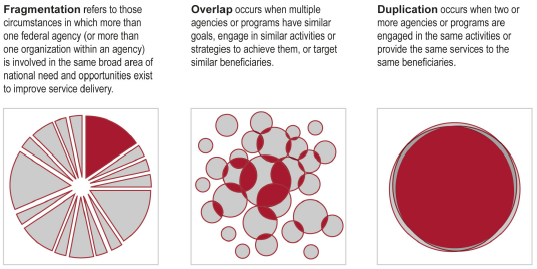
CaptureBeginning in 2011, Senator Coburn has prevailed upon the Government Accounting Office to issue annual reports entitled “Actions Needed to Reduce Fragmentation, Overlap and Duplication and Achieve Other Financial Benefits.”  Now, after four years, a total of 226 specific actions have been recommended by the GAO.  GAO’s Action Tracker shows that the government has addressed about 19% of the efficiency recommendations made by the GAO.  Be thankful for small progress!
His latest, finest and presumably last major effort along these lines is a 320 page report, the “Tax Decoder” which is intended to “decode the tax code for every taxpayer.  It reveals more than 165 tax expenditures costing over $900 billion this year.”  Although more than $1.7 trillion in tax revenue was collected by the government in 2014, the IRS will be unable to collect an additional $500 billion that is owed.  This would have been enough to cover the $483 billion deficit for fiscal year 2014!
As Senator Coburn points out in the introduction to this document, “ideally Congress would throw out the entire tax code and start over.  But at the very least, Congress should make the tax code simpler, fairer and flatter.”
It is rare that a single member of Congress makes such an extraordinary contribution to our country’s welfare!