
Is the American Middle Class in Decline?

Many political commentators have been complaining recently about the financial difficulties of the American middle class.  For example, a recent report from Bill Moyers and Company, “By the Numbers: The Incredibly Shrinking American Middle Class”, has a chart showing that the median middle class salary, adjusted for inflation, is now no better than it was in 1989 and not much higher than in 1979:
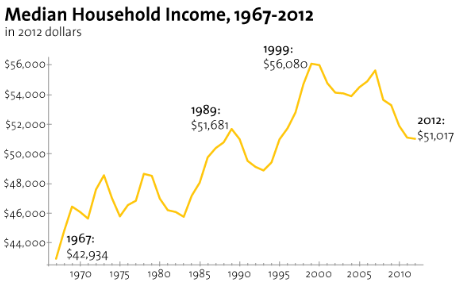
CaptureBut there is another point of view, very well described by the two economists, Donald Boudreaux and Mark Perry, in the Wall Street Journal just about a year ago, “The Myth of a Stagnant Middle Class”.  They make several pertinent points:

  • The Consumer Price Index overestimates inflation by underestimating the value of improvements in product quality and variety.
  • Wage figures ignore the rise over the past few decades in the portion of worker pay taken as (nontaxable) fringe benefits.  Health benefits, pensions, paid leave, etc. now amount to almost 31% of total compensation according to the Bureau of Labor Statistics.
  • The average hourly wage has been held down by the great increase of women and immigrants into the workforce over the past three decades.  Because the economy was (before the Great Recession) so strong, it created millions of jobs for the influx of often lesser skilled workers into the workforce.

Messrs. Boudreaux and Perry point out several other improvements in the quality of life which Americans enjoy:

  • Life expectancy has increased to 79 years for an American born today, five years longer than in 1980.  And the gap in life expectancy between whites and blacks has narrowed.
  • Spending by households on the basics of food, housing, utilities, etc. has shrunk from 53% of income in 1950, to 44% in 1970 to 32% today.
  • Although income inequality is rising when measured in dollars, it is falling when measured in terms of our ability to consume.  For another example, air travel is now as common as was bus travel in an earlier era.  And another: the latest electronic products are available to even middle class teenagers.

Conclusion: We should stop complaining about inequality and thank our lucky stars for the free enterprise system which has been so successful in improving our quality of life.

Can We Solve Our Fiscal Problems by Taxing the Rich? I. The Third Way

“I enjoy your blogs and always look forward to the next one.”
“I am amazed when listening to my liberal friends, who could care less about any of the arguments you are making. Their basic belief is that any deficit can be solved in short order by simply raising taxes on the rich. One of these friends just bought a home in Palm Springs and came back declaring, ” Jerry Brown solved the financial problem in California. He raised taxes on the rich and the deficit is gone. California no longer has a financial problem.” He then went on to say that with 40 million people, California will set a good example for the country. After listening to this, I think you should address the issue of why simply increasing taxes will never work. I would start with Simpson Bowles and then go on to more recent findings. I think this argument has to be made over and over again. There are precious few Democrats who think we have a serious or fundamental financial problem that cannot be solved by simply raising taxes on the rich. I believe Obama is leading the charge.”

One response to this argument is provided by the President, Jon Cowan, and the Senior Vice President for Policy, Jim Kessler, of the Third Way, a center-left think tank, in a June 2013 memo, “The Four Fiscal Fantasies” .

  • Fantasy #1: Taxing the rich solves our problems.

Mr. Cowan and Mr. Kessler look at a plan that “completely soaks the rich.”  They stipulate that the top tax rate increases ten points to 49.6%.  They impose the Buffett Rule requiring all millionaires to pay at least 30% in taxes (after deductions).  They raise the estate tax to allow a $3.5 million exemption with a 45% rate.  “If we leave entitlements on auto-pilot in this scenario, our deficit in 2030 will be close to a stunning $1.3 trillion in 2013 inflation-adjusted dollars.”
The authors then show that to keep our finances even roughly in check, a middle income family with a $65,000 income, for example, would have to pay several thousand dollars a year in new taxes.
Conclusion:  We cannot keep entitlements on auto-pilot.  Something has to give!

What Is the Best Way to Help the Middle Class?


An article in yesterday’s New York Times, “Obama Says Income Gap Is Fraying U.S. Social Fabric”, quotes the President that “If we don’t do anything, then growth will be slower than it should be.  Unemployment will not go down as fast as it should.  Income inequality will continue to rise.  That’s not a future that we should accept.”  He says that “I will seize any opportunity I can to work with Congress to strengthen the middle class, improve their prospects, improve their security.”
A recent editorial in The Wall Street Journal, “The Inequality President”, shows with a chart that median household incomes have fallen from $54,218 in June 2009 as the recession ended to $51,500 in May 2013.  As the WSJ says, “For four and a half years, Mr. Obama has focused his policies  on reducing inequality rather than increasing growth.  The predictable result has been more inequality and less growth. … The rich have done well in the last few years, thanks to a rising stock market, but the middle class and poor have not.”
There are many things that Congress and the President could do to boost the economy if they were willing to work together and compromise.  Obamacare doesn’t need to be repealed, just modified by dropping the employer mandate which is a job killer.  Broad based tax reform, with lower tax rates, paid for by eliminating tax preferences, would be a big boost to investment, risk taking and entrepreneurship.  A reasonable compromise would be to use a part of the revenue raised from eliminating loopholes for deficit reduction.
But little progress will be made unless the President is willing to show leadership by rising above partisanship.  There are all sorts of ways he could do this.  One simple way would be to show that he understands the seriousness of the rapidly growing national debt by supporting some of the many thoughtful proposals for more government efficiency.
A large majority of people want our first African-American President to be successful.  But right now he is not on track to achieve this.