The New Racism


One of the issues I often discuss on this blog is racism, real and perceived, see here   and here.  My basic view is that while there are remnants of our racist past in today’s society, America has made much progress in improving race relations in recent years, and systemic racism no longer exists in our country.

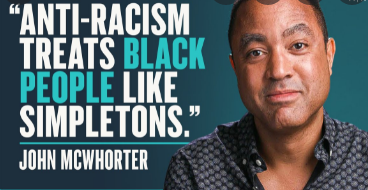
I have just come across the new book, Woke Racism: how a new religion has betrayed black America, by John McWhorter, which adds a new perspective to this controversial issue.  According to Mr. McWhorter:

  • There have been three waves of antiracism historically in our country.
  • First Wave Antiracism battled both slavery and legalized segregation.
  • Second Wave Antiracism, in the 1970s and ‘80s, battled racist attitudes and taught America that being racist is a moral flaw.
  • Third Wave Antiracism, becoming mainstream in the 2010s, teaches that because racism is baked into the structure of society, whites “complicity” in living within it constitutes racism itself, while for black people, grappling with the racism surrounding them is the totality of experience and must condition exquisite sensitivity toward them. . .
  • In other words, Third Wave Antiracism, in its laser focus on an oversimplified sense of what racism is and what one does about it, is content to harm black people in the name of what can only be called dogma. It exploits modern Americans’ fear of being thought racist to promulgate not just antiracism, but an obsessive, self-involved, totalitarian, and utterly unnecessary kind of cultural reprogramming.
  • The author refers to these modern-day antiracists as the Elect. With the rise of third wave antiracism, we are witnessing the birth of a new religion.
  • The Elect have superstition: when Elect white people at protests take a knee for extended periods to indicate general wokeness after George Floyd’s murder, it is a submission to Elect imperatives.
  • The Elect have clergy: they are Ta-Nehisi Coates’ (“The Case for Reparations”), Robin DiAngelo (“White Fragility”), and Ibram Kendi (“How to Be an Antiracist”)
  • The Elect have original sin: “white privilege.” White people are racist, and if they deny it, it proves that they are.
  • The Elect are evangelical: just as fundamentalist Christians are bearers of a “Good News” which, if accepted, would create a perfect world, there is always a flock of unconverted heathen (white people) out there who don’t yet see the light.
  • The Elect are apocalyptic: in 2021 America has become conscious of racism, within just a year, to a degree so extreme and so sincere that history offers no parallel. But to the Elect none of this matters.  The same people are saying the same things that America never “comes to terms” with race.
  • The Elect ban the heretic. Since 2019 the Elect’s behavior has become known as “cancel culture.”  The Elect’s central moral duty is to battle racism and the racist.
  • The Elect supplant older religions. The imperative to “dismantle our white supremacy culture” has virtually taken over the centuries-old now combined Unitarian/Universalist denomination, which happens (what consternation!) to be my own church!

Conclusion.  “America’s sense of what it is to be intellectual, moral or artistic, what it is to educate a child, what it is to foster justice, what it is to express oneself properly, and what it is to be a nation, is being re-founded upon a religion.  This is directly antithetical to the very foundations of the American experiment.”

Sign-up for my Email Newsletter
Follow me on Facebook
Follow me on Twitter
The Critical Importance of Decentralized Government

“The powers not delegated to the United States by the Constitution, nor prohibited by it to the States, are reserved to the States respectively, or to the people.”
10th Amendment to the U.S. Constitution, ratified 1791

Most of the time on this blog I write about major problems facing the United States as a whole such as economic, military, or foreign policy issues.  For example, in my last post, I discussed one of my favorite topics, our very large, and out-of-control, national debt.

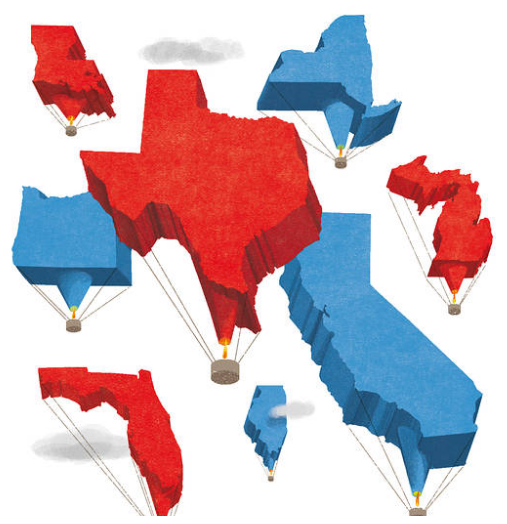
However, one of the most important features of our republican form of government is its fundamentally decentralized nature, as described by the 10th Amendment to the Constitution (see above).  It stipulates that many public issues must be resolved at the state and local levels.  This protects many of our most prized liberties from usurpation by a central authority.  For example:

  • The Electoral College determines who wins a presidential election rather than the national popular vote. This establishes the authority of the states in a fundamental way.  A successful presidential candidate must have majority support in many different states rather than over-relying on huge majorities in just a few large states such as California or New York.
  • Voting procedures are primarily determined at the state level (as guaranteed by the Constitution). Again, this increases the political authority of the states and prevents a federal bureaucrat or Congressional majority from dictating how states should regulate elections.
  • Educational policy is primarily determined by the states with the exception of a few special needs programs such as Title I and Head Start. Likewise, state departments of education often cede policy control over controversial issues to local school boards. This assures that each local community has much authority over how and what its children will be taught in the public K-12 schools.
  • Public health policy is largely under state control. This has been particularly evident during the Covid-19 pandemic where only state governors have the authority to impose state-wide mask mandates and business lockdowns.  The red states have done much better than the blue states in allowing businesses to stay open and thereby preserving more jobs.

  • Other issues. It would make sense to let state governments determine gun control policy and drug law enforcement in their own states.  Such controversial issues as these would be more effectively resolved at the state level.

Conclusion.  The many individual liberties which Americans prize so highly are strongly protected by our decentralized form of government where many powers are given directly to the states (and ultimately to local government).  Such state and local control prevent remote federal Congressional majorities and bureaucracies from dictating how we should live our lives.  Americans often fail to appreciate this essential feature of our constitutional government.

Sign-up for my Email Newsletter
Follow me on Facebook
Follow me on Twitter
Why Americans Should Take Bitcoin Seriously

As readers of this blog well know, I write about what I consider to be the biggest and most serious problems our country faces.  And you probably also know what I consider to be the biggest problem of all:  our national debt.

As bad as our debt problem is, the practical problem is what should we do about it?  Of course, we need to restrain the growth of spending and/or raise taxes.  But what is a reasonable way to get this done?  I used to think that the best solution is to do a better job of controlling the growth of entitlement spending. This would still help a lot, of course, but such a strategy may not be enough because the problem is getting so much worse all the time.  Starting with George W. Bush, the debt problem has accelerated with each successive president: Bush, Obama, Trump, and now Biden.  It is discouraging and demoralizing to think that our debt problem is now so bad that it may be almost insolvable short of a huge crisis.

For all these reasons I am highly intrigued by an article in the current edition of National Affairs by Avik Roy, “Bitcoin and the U.S. Fiscal Reckoning.”  Mr. Roy says that soon “policymakers will face a Solomonic choice: either protect Americans from inflation (by raising interest rates) or protect the government’s ability to engage in deficit spending (by continually printing more money).  It will be impossible to do both.  Over time, this compounding problem will escalate the importance of Bitcoin.”

Here is a brief summary of his argument:

  • When viewed through the lens of human history, free-floating global exchange rates (like we have at present) remain an unprecedented economic experiment – with one fatal flaw. They enable deficit spending.
  • There are several reasons to believe that America’s fiscal profligacy cannot go on forever. Most importantly is the unanimous judgment of history: in every country and in every era, runaway deficits and skyrocketing debt have ended in economic stagnation or ruin.
  • Indications that investors are growing increasingly concerned about the U.S. fiscal and monetary picture – and are in turn assigning more risk to “risk-free” Treasury bonds – are on the rise. Between 2010 and 2020, the share of U.S. securities owned by foreign entities fell from 47% to 32%.  As foreign investors reduce their purchase of U.S. government debt, the Fed is forced to increase its own bond purchases.
  • Until and unless Congress reduces the trajectory of the federal debt, U.S. monetary policy has entered a vicious cycle from which there is no obvious escape.
  • Satoshi Nakamoto, the creator of Bitcoin, wrote in 2009, “the root problem with conventional currency is all the trust that’s required to make it work. The central bank must be trusted not to debase the currency, but the history of fiat currencies is full of breaches of that trust.
  • Bitcoin has the same five important qualities as gold has: it is unforgeable, divisible, durable, fungible, and scarce. Furthermore, bitcoin is rarer, more portable, and more secure than gold.  And it cannot be censored (e.g. by China).
  • Policymakers will be tempted to impose capital controls that restrict the ability of Americans to exchange dollars for bitcoin. This would be a huge mistake by confirming to the world that the United States no longer believes in the competitiveness of its currency.
  • Instead, federal policymakers would do well to embrace the role of bitcoin as a geopolitically neutral reserve asset. In fact, the Treasury Department should consider replacing a fraction of its holdings – say 10% – with bitcoin, sending a positive signal to the innovative blockchain sector.
  • Ideally, the rise of bitcoin will motivate the U.S. to mend its fiscal ways. But even if this doesn’t happen, ordinary Americans will have the opportunity to protect their savings from the federal government’s fiscal mismanagement.

Conclusion.  Bitcoin represents an enormous strategic opportunity for individual Americans and the U.S. as a whole.  The bitcoin currency and its underlying technology could become the next great driver of American growth.  But in order for this to happen, the changeover from the current fiat currency must begin to take place before the economy is decimated by drastic inflation.

Sign-up for my Email Newsletter
Follow me on Facebook
Follow me on Twitter

The Fundamental Question about Joe Biden: is he a Competent President?

In the latest Quinnipiac Poll 38% of Americans rate President Joe Biden as competent and 53% as incompetent.

Here is the evidence so far:

  • The Afghanistan withdrawal was a debacle. The President ignored his top military advisors who urged keeping a small residual force in place. The overall effect of our withdrawal is a boost to terrorism around the world.
  • The disaster at our southern border. The Biden Administration 1) failed to complete border wall construction begun under Trump, 2) immediately canceled the Trump Administration’s Remain in Mexico (while asylum requests are being considered) program, and 3) terminated the Asylum Cooperative Agreements with several Central American countries which requires asylum seekers to request relief from the first safe country able to assist them. The overall effect is that 200,000 illegal immigrants are crossing the border each month and being released into the U.S.  It will be impossible to solve our illegal immigration problem until the southern border is effectively CLOSED to illegal entry.
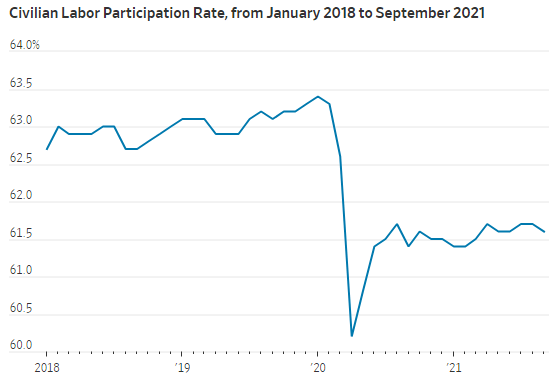
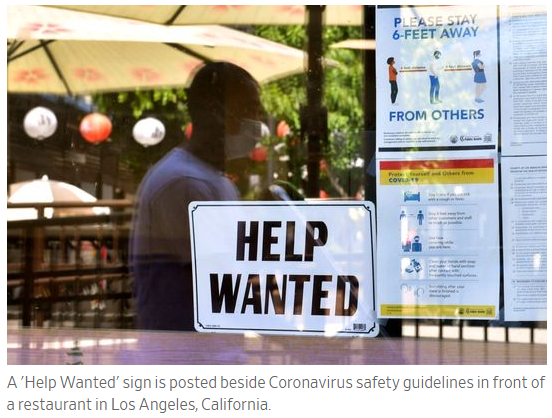
  • Where did all the workers go?  Although the unemployment rate dropped to 4.8% in September, there are still 11 million job openings in the U.S. even though wages are up 7.4% in the last year. The lack of workers has become a drag on the economy contributing to supply-side strains. The problem is caused by an easy monetary policy to boost demand coupled with squeezing the supply side with incentives not to work.


  • The current inflation spike.  Currently, consumer price inflation is rising at over 5% annually with big spikes in food prices, housing costs. and energy prices.  Meantime the Biden Administration is pushing for trillions of dollars in new spending for both infrastructure and social programs which will make inflation even worse if enacted.

Conclusion.  It is not that President Biden is doing everything wrong but that he is making too many big mistakes that are adding up and becoming quite noticeable.  This is the reason for his plunging support in national polls.

Sign-up for my Email Newsletter
Follow me on Facebook
Follow me on Twitter

“Never Bet Against America”

There is currently much pessimism about the strength of American democracy and our status in the world, see here and here.

Furthermore, my most recent posts, here and here, in defense of democracy and freedom, have received lots of negative comments on FaceBook.

But the Oracle of Omaha, Warren Buffett, says to “never bet against America” and I agree with him.

Consider:

  • The Pandemic is largely under control in spite of the Delta variant of the coronavirus. Most of the recent deaths are of people who have not been vaccinated.  The drug company, Merck, has developed a pill that will protect against new high-risk infections.  Covid, in fact, will soon become endemic (i.e. manageable with annual flu shots) rather than epidemic.

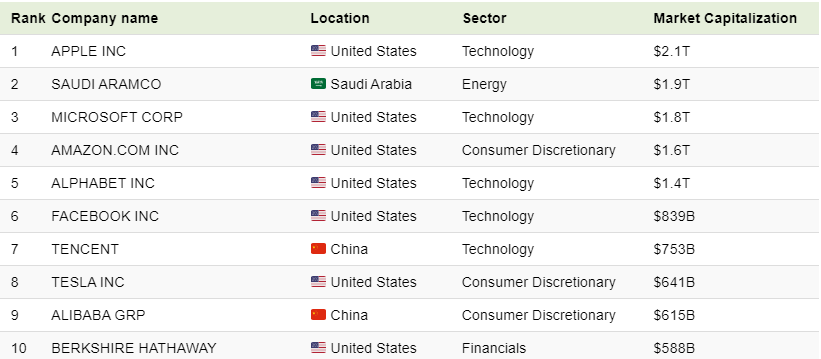
  • Most top world companies are located in the U.S.  It clearly shows that the U.S. dominates world industry, commerce, and innovation. This trend is likely to continue indefinitely because of our superior political and economic systems.

    Stop worrying about the rise of China. The Quad, made up of the Asian powers Australia, India, Japan, and also the U.S., is more than capable of working together to keep Chinese hegemonic ambitions under control.

  • Debt and inflation. Debt is by far our largest problem at the present time and it could soon get much worse with the Biden Administration’s blowout spending plans. But inflation is continuing to rear its ugly head. It is inflation that will directly lead to higher interest rates, which will, in turn, set off our next debt-caused financial crisis.  If we’re lucky, the present rise of inflation will knock some common sense into the big spenders so deeply embedded in national government.

Conclusion.  The U.S. can certainly not afford to be complacent but our great strength, economic and military, as well as our superb democratic form of government, along with our highly prized personal freedoms, will all contribute to help us keep our dominant position among the nations of the world for many years to come.

Sign-up for my Email Newsletter
Follow me on Facebook
Follow me on Twitter
 

Democracy Is Alive and Well in the United States II. We Should be Optimistic about the Future of Our Country

“The land of the free and the home of the brave”                         Francis Scott Key, 1814

I live in (Omaha) Nebraska, home of the “Good Life.”  I am an optimist by nature but also partly because of where I live.  The state unemployment rate is 2.2%, the lowest in the nation.  We have effective and efficient government at both the state and local levels.  The crime rate is low overall.  We do have some problems such as crowded prisons and a poor state foster child program, but they are being addressed in an open and transparent manner.

Perhaps it is partly because of my own secure and pleasant life that I am so optimistic about the future of our country.  My last post discussed the great strength of our country’s democratic traditions.  Today I elaborate on why I believe our country will continue to prosper socially and economically for many years to come.

Consider:

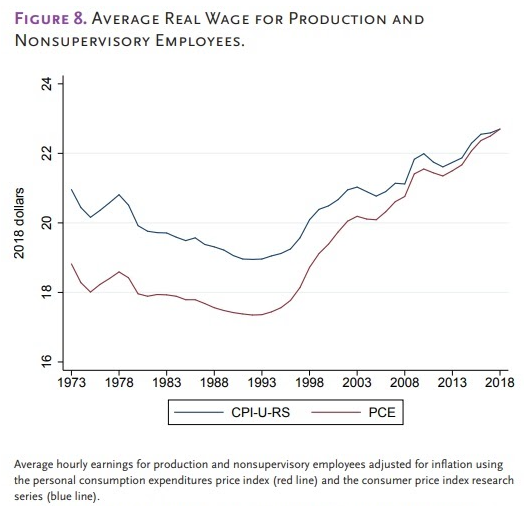
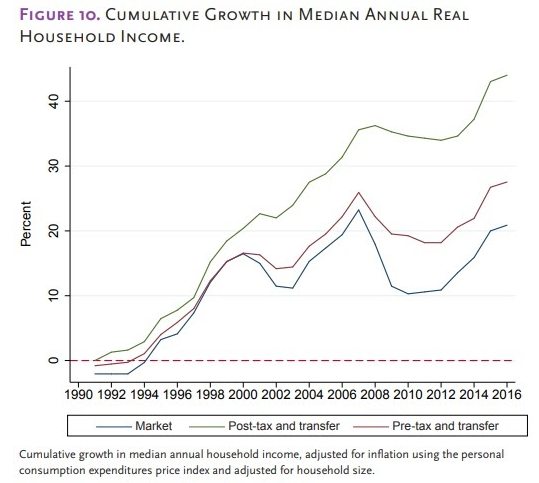
  • The American Dream is alive and well.  Wages for the typical worker have grown (in real terms) by more than 20% in the last three decades. Most Americans in their 40s are doing better than their parents were during their 40s (see attached charts).
  • America should not fear the rise of China. The U.S. rightly helped China emerge from its sluggish past and has recently been making rapid economic progress.  But China has a severe demographic problem.  The UN predicts that the number of working-age Chinese, between now and 2100, will fall by half while the number of working-age Americans will increase by 15%.  This leads to the further prediction that the Chinese economy (GDP), relative to America’s, will peak at 76% by 2040.
  • The world’s largest companies.  Seven of the world’s ten largest companies are American and two are Chinese copycats.  This is a tribute to the initiative, inventiveness, and hard work of individual Americans.  Our immigrant forebears had to take initiative and personal risk to get to America.  We have clearly benefitted greatly from the “can do” spirit of those who came before us.
  • Emphasis on personal freedom. In addition to our strong tradition of democratic government, we have a strong tradition of individual freedom.  Freedom is a tough concept because it means the freedom to fail as well as the freedom to succeed.  But our society strives (even if imperfectly) to provide equal opportunity for all, especially in terms of foundational education and equality under the law.  Ultimately, however, each of us has to take personal advantage of these opportunities in order to succeed in life.

Conclusion.  Of course, the United States should never take its premier world status for granted.  But we are “the land of the free and the home of the brave” for a good reason.  We are the descendants of immigrants and pioneers who wanted personal freedom and were willing to take great risks to obtain it.  Our brilliantly conceived democratic form of government has now lasted for 233 years (the U.S. Constitution was ratified in 1788). All we have to do, so to speak, is to strive to live up to the ideals of our predecessors.

Sign-up for my Email Newsletter
Follow me on Facebook
Follow me on Twitter

Democracy is Alive and Well in the United States

There is a great deal of anxiety in the U.S. these days.  The delta variant pandemic surge, worsening global warming, and the exploding national debt, for example.  All of these are serious problems which need lots of attention.

These real issues have engendered a great deal of pessimism about the capability of our political system to respond adequately to our biggest problems.  Liberal democracy and capitalism are under attack.  On the left, markets generate inequality and democracy works only when it achieves the right outcomes.  On the right, markets destroy traditional moral conventions and individual freedom encourages behavioral deviancies.  In short, the western model of individual liberty and religious neutrality is under political pressure.

But consider:

  • Worldwide, freedom and democracy still strongly predominate.  According to Freedom House, even though there has been some slippage in recent years, the number of free countries greatly exceeds the number of partly free countries which, in turn, exceeds the number of not free countries.
  • U.S. democracy had a huge stress test in Fall 2020 and passed with flying colors. The Trump organization filed more than 63 lawsuits claiming voter fraud in the 2020 Presidential Election and not a single lawsuit prevailed.
  • Are we prepared for future emergencies like the pandemic?  Even though Covid-19 originated in China, China contained the coronavirus very effectively with a centralized and severe lockdown policy.  Our free and decentralized democratic system is unable, by design, to respond in the same way.  But U.S. drug companies produced several effective vaccines in record time and the pandemic is now essentially under control, in spite of the delta variant.  We should have confidence in our incredibly innovative economy to be able to deal with future crises in a similarly effective manner.
  • Political polarization does not represent a breakdown of democracy. It is caused primarily by progressive-left identity politics and the strong reaction to it by the right. Identity politics will gradually fade away as the U.S. population becomes more and more racially amalgamated.

Conclusion.  Yes, the United States has very serious problems to address.  Yes, there are many people who are pessimistic that our democratic form of government, based on our 233-year-old constitution, no longer meets our current needs.  But we are so strong, both economically and militarily, with such vigorous democratic traditions, that we should be optimistic that our long and successful traditions will pull us through not only our current troubles but any new ones which come our way.

Sign-up for my Email Newsletter
Follow me on Facebook
Follow me on Twitter
 

Is There Structural Racism Still Remaining in the U.S.?

“another form of bias: the soft bigotry of low expectations” President George Bush,2000

According to Critical Race Theory, the United States is dominated by white supremacy and systemic racism and CRT is now taught in many public school systems.

On the other hand, the Wall Street Journal columnist, William McGurn, asks “Is it okay that black eighth-graders aren’t proficient in math and reading?”  He examines 27 urban school districts listed in the Trial Urban District Assessment of the National Assessment of Educational Progress for 2019 (before Covid).

The top average reading score, in these 27 urban districts, for black 8th graders, was 20% proficient for Boston MA.  The top average math score was 24% proficient for Charlotte NC.  Many cities had much lower scores.  For example, in Detroit MI, black achievement was an abysmal 4% proficient for math and 5% proficient for reading.  Some of these 27 districts have the highest annual spending per pupil in the country, for example, $28,004 for NYC, $25,653 for Boston, $22,406 for the District of Columbia, and $17,112 for Atlanta.

Let’s agree that Critical Race Theory and Black Lives Matter have increased public awareness of challenges faced by African-Americans in today’s society. There are indeed remnants of the systemic racism which existed before the Civil Rights movement of the 1960s and 1970s.  But their primary challenge today is economic in the sense that average income is significantly less for blacks than for whites.

The best way to meet these challenges is to:

Conclusion.  Basic academic proficiency for African-American children is abysmal in many of our large urban school systems.  This is the worst form of structural racism still existing in the U.S.  It is holding back further black economic and social progress.  This huge problem can be addressed, however, if only national leaders would give it priority attention.

Sign-up for my Email Newsletter
Follow me on Facebook
Follow me on Twitter
What Is Our Country’s Biggest Problem at the Present Time?

It is easy to feel overwhelmed by a constant flow of bad news: the spike in new Covid-19 infections, the botched Afghan withdrawal, tropical storm Ida racing up the East coast, drought and wildfires in the west, etc.  It seems like there is a steady stream of serious problems to deal with.  Here is my Midwestern perspective (I live in Omaha NE).

I maintain that this list overlooks the biggest problem of all.  Consider:

  • The pandemic is basically under control in the U.S.  Nearly 75% of adults have now been vaccinated against Covid.  The spike in new infections, caused by the Delta variant, is mostly affecting the unvaccinated.  In other words, get vaccinated, exercise reasonable precautions, and you have little to worry about.
  • The Afghan withdrawal was handled very poorly and this gives a boost to our many adversaries around the world.  But this is a temporary setback from which we will recover.  Our biggest foreign policy challenge is China which wants to take over Taiwan but is unlikely to risk an outright attack.
  • Global Warming.  Global temperatures have increased by one-degree centigrade since pre-industrial times and sea levels are rising at the rate of one foot per century.  This is serious but not catastrophic.   Carbon emissions are still rising worldwide even though they are now decreasing in the U.S. and many other western countries.  China is by far the world’s worst carbon emitter.  Worldwide carbon emissions will not begin to decline until China gets on board.
  • Political polarization in the U.S.  Polarization is caused primarily by the identity politics practiced by the progressive left and the reaction to it by conservatives.  Polarization will gradually fade away as America continues to become more and more racially assimilated.

These above-listed problems are real but can be managed and adapted to.  But there is a huge problem on the horizon which is steadily getting much worse and will eventually blow up into a new fiscal crisis if it is not taken seriously.  It is the

  • National debt which has grown $5 trillion in the last 18 months, because of the pandemic, and now totals over $28 trillion. When interest rates go up eventually, as they inevitably will, interest payments on the debt will skyrocket and cause a massive new crisis, much worse than the Financial Crisis of 20008.  In this respect, it is heartening to hear that Senator Joe Mansion (D, WV) has announced his opposition to the Democrats’ currently proposed $3.5 trillion spending blowout, see here and here.

Conclusion.  The U.S. has plenty of new (and recurring) problems to deal with all the time such as the pandemic, global warming, foreign policy challenges, and polarization.  But these are routine serious problems compared to the worst problem of all: the national debt.  There is now a good chance that Congress will slow way down in passing giant new spending bills.  Let’s hope that this move towards fiscal restraint holds firm!

Sign-up for my Email Newsletter
Follow me on Facebook
Follow me on Twitter
The Significance of Afghanistan to the U.S. II. What Should We Do Now?

“You were given the choice between war and dishonor.  You chose dishonor and you will have war”
Winston Churchill to Neville Chamberlin, 1938

As the chaotic withdrawal from Kabul continues and the Taliban now control Afghanistan, how should the U.S. respond to its disastrous withdrawal?

Mr. Paul Wolfowitz, a veteran foreign policy and military analyst, offers the following suggestions for how the U.S. can recover from this disaster.  Start out by acknowledging the mistakes that were made:

  • First, acknowledge that the war on terrorism isn’t over and will last for a long time. Decisive victory isn’t necessarily better than “forever war” if a long commitment can keep America safe at a much lower cost in American lives.
  • Second, the rush to get out and the failure to respond to Taliban aggression hastened the collapse of the Afghan army.
  • Third, choosing to avoid “forever war” by abandoning our Afghan allies was both costly and dishonorable. We have now lost the Afghan army which was keeping the Taliban at bay with much reduced costs in American lives and money.
  • Fourth, it was wrong to disparage the bravery of the Afghans, 66,000 of whom have died defending their country. S. fatalities had been averaging about 20 per year since the U.S. switched to a largely advisory role in 2015.  But now the Taliban victory could reverberate far beyond Afghanistan and inspire terrorists around the world.

Then it is necessary to chart a path forward for recovery from this fiasco:

  • First, attend to the safety of Americans, citizens of allied nations, and Afghans now endangered because they assisted in the fight against the Taliban. Do not let the Taliban dictate the terms under which we conduct such a morally and strategically vital mission.
  • Second, there now needs to be more visible action and coordination with Japan and other allies to strengthen deterrence in order to forestall an attack on Taiwan by China.
  • Third, more needs to be done to assure the weaker Persian Gulf countries that the U.S. will protect them against Iran.

Conclusion.  How can a President who is known for his opposition to the 1991 Gulf War, his eagerness to leave both Iraq in 2011 and Afghanistan in 2021, and his opposition to the 2011 raid which killed Osama bin Laden, admit major errors of judgment with regard to the current situation in Afghanistan and propose a sensible road forward?  It won’t be easy, of course, but the success of Biden’s Presidency; and therefore the near-term future of U.S. world-standing and security, depend on his willingness to bite the bullet and be willing to stand up much more firmly against our major adversaries.

Sign-up for my Email Newsletter
Follow me on Facebook
Follow me on Twitter