The Progressive Left Is Becoming Paranoid

Almost the entire issue of the January/February 2022 issue of the Atlantic Magazine  is devoted to anti-Donald Trump trash talk.  Consider the titles of several articles:

  • Imagine The Worst: how to head off the next insurrection
  • January 6 Was Practice
  • The Small Lie: to support the Republican myth that our elections are rife with fraud, someone needs to take the fall
  • I Remember Conservatism: the rich philosophical tradition I fell in love with has been reduced to Fox News and voter suppression

Yes, American democracy had a stress test after the 2020 elections, but it survived brilliantly. The Trump organization filed over 60 lawsuits to overturn election results and not a single one was upheld.  The January 6 Capitol break-in, even though wrongly encouraged by Trump, had no prospect of overturning the results of the 2020 election.

A quick review of Trump’s four years in office:

  • 2017 tax reform lowering the corporate tax rate from 35% to 21%.
  • Putting three highly qualified conservative justices on the Supreme Court.
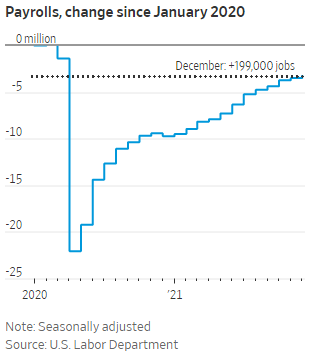
  • Achieving an unemployment rate of 3.5% for the six months preceding the pandemic
  • After the outbreak of Covid-19 in late February 2020, supporting American drug companies in developing effective vaccines at “warp speed”

Compare this record with Joe Biden’s first year in office:

  • A disastrous withdrawal from Afghanistan, leaving over 60,000 U.S. allies at the tender mercies of the Taliban.
  • Our open southern border. Illegal immigrants, with temporary asylum permits, are now pouring into the U.S.
  • Inflation. Because of blowout Congressional spending as well as supply chain bottlenecks caused by millions of absent workers, inflation has now reached an annual rate of 6.8% in November.  Low-income workers are getting hefty pay raises but they are more than eaten away by inflation.

If Trump is a candidate for reelection in 2024, he will surely receive the Republican nomination.  Will he be a viable candidate for reelection?  His poor performance on January 6 is a negative factor.  But Biden’s very poor performance to date, if it doesn’t improve, will give Trump a big boost.  In other words, the outcome of the 2024 presidential election will depend on what happens politically and economically in the U.S. between now and then, not on bogus claims of voter suppression.

Conclusion.  The progressive left should calm down and take more interest in the substance of the Biden presidency rather than Donald Trump’s shenanigans.  This is what will influence the outcome of the 2024 presidential elections.

Sign-up for my Email Newsletter
Follow me on Facebook
Follow me on Twitter


Americans Are Too Pessimistic about the Future

There are lots of serious problems in the U.S., both foreign and domestic, and many Americans are pessimistic about our country’s future.

I am, however, mostly an optimist.  I believe we will weather our many problems and continue to enjoy the benefits of being the world’s leading democracy for many years to come.  Consider:

  • The pandemic is essentially over. Yes, 800,000 Americans have died from Covid-19 and there are active coronavirus variants such as Delta, Omicron, and perhaps more to come.  But three million Americans die every year and so we’ve had an additional 12% deaths for the past two years.  Overall, our own free-enterprise drug companies have rescued us by delivering effective vaccines in less than a year’s time.
  • American democracy is thriving. Our democratic institutions had a major stress test after the 2020 election and survived brilliantly.  There is even a solution on the horizon for polarization and divisiveness.
  • The Chinese threat is overstated. China has many problems and its current leader, Xi Jinping, is making lots of enemies around the world.  It is unlikely that China will try to take Taiwan by force.
  • The American economy and military are very strong. For example, of the ten top companies in the world, seven are American (two are Chinese and one is Saudi Arabian).
  • The American Dream is Alive and Well. Wages for the typical worker have grown by 20% (in real terms) in the past three decades.
  • The American way of life is the envy of the world. Thanks to American leadership, freedom, and democracy are flourishing around the world.  And, yes, America is still the envy of the world.
  • Inflation and Debt. Although I’m an optimist in general, I despair about our debt problem.  It was already very bad before the pandemic and now it is worse.  And, as we know, inflation is heating up (6.8% annual rate in November).  It is precisely inflation that will kick off our coming debt crisis by forcing higher interest rates and therefore much higher interest payments on our accumulated debt.  This whole sequence of events may now happen sooner rather than later, which is a silver lining in disguise!

Conclusion.  Many things are going well in the U.S. today and Americans should generally be optimistic about the future of our country.  Unfortunately, our debt problem is growing steadily worse.  It may well require a huge new crisis for our national leaders to address it seriously.  Our currently worsening inflation could cause this to happen fairly soon.

Sign-up for my Email Newsletter
Follow me on Facebook
Follow me on Twitter

American Life Has Become too Polarized and Divisive. We Need more Pluralism and Decentralization!


My last two posts, here and here, are concerned with one of the most serious problems facing our nation.  It is the rampant polarization and divisiveness affecting both our political institutions and social culture.

George Friedman says that the two dominant cycles in American history, the eighty-year institutional cycle and the fifty-year socio-economic cycle, are both coming to a head and renewing in the mid-to-late 2020s and this will produce a storm before the ensuing calm.

David French says that the quest for moral, cultural and, political domination by either side of our national divide risks splitting the nation asunder.  Both sides must surrender the dream of domination of the other side by embracing increased pluralism which would make our country even more decentralized than it already is.

According to Mr. French:

  • The Republican Party won the Civil War and then dominated American politics for 50 years. Conversely in the 1930s, the Democratic Party won and dominated American politics for roughly the same amount of time.
  • The quest for uniformity is futile, and the restrictions of liberty that are so tempting to those who seek uniformity are far more inflammatory and divisive than they are edifying or unifying.
  • To embrace pluralism, citizens truly need only to embrace two limitations on their quest for ultimate ideological victory. First, if you are a citizen of a liberal republic, you need to defend the rights of others that you would like to exercise yourself.  Second, if you are a citizen of a pluralistic, liberal government, you should defend the rights of communities and associations to govern themselves according to their own values and beliefs.

  • To go forward, we must go back. If the Bill of Rights represents tolerance of individual difference and a diverse civil society, federalism represents tolerance through self-governance and community autonomy.
  • We now have decades of experience with the enormous bloat of federal government. Under healthy federalism, American citizens would enjoy guaranteed civil liberties that don’t waiver or vary from state to state and they would enjoy a much greater degree of local control.  The only downside is that the rebirth of federalism necessitates the death of very particular dreams – the dream of dominance and the dream of utopia.
  • Federalism is simple. It has profound appeals.  Healthy federalism is a system of protected customization.  It lowers the stakes of national politics.  It removes the sense of helplessness and distant alienation that all too many of us feel.
  • Here are two significant possibilities for federalism in action: give blue states more freedom to restrict gun rights; give red states more freedom to restrict abortion rights. If you don’t like what is happening in your own state, then move to another state where you are more comfortable.

Conclusion.  Federalism recognizes that there are fundamental differences between red states and blue states.  It returns power to the states which has been usurped over time by the federal government.  It has the potential to greatly reduce the polarization and divisiveness which is now afflicting our country.

Sign-up for my Email Newsletter
Follow me on Facebook
Follow me on Twitter

How Do We Solve Our Divisiveness Problem? II. What Is Needed Is More Pluralism

America has a highly polarized and divisive political atmosphere at the present time.  Current events, such as the Kyle Rittenhouse trial and acquittal, just seem to make things worse.  How will this contagion hopefully play itself out and eventually end?  None of us know but we can still speculate.

My last post, starts a discussion of this issue by describing a cyclic theory of American history as developed by the geopolitical analyst, George Friedman. Mr. Friedman explains how a repeating 80-year institutional cycle and a likewise repeating  50-year socioeconomic cycle will both be renewing in the mid-to late-2020s and how the resulting clash will likely result in a “storm” before the ensuing “calm.”

The problem of the current institutional cycle, beginning in 1945, is that the federal government has now become too massively incomprehensive and opaque.  This creates distrust on the part of citizens who often feel overwhelmed by policies they disagree with and helpless in trying to overturn them.

The problem of the current Reagan socioeconomic cycle is that capital has successfully expanded but has by now created too much economic inequality.  This is also a cultural issue as the now dominant internet technology has led to an assault on traditional family values.

How will these two cyclic paradigms reinvent themselves simultaneously to address the above problems?  Here I leave Mr. Friedman’s analysis (which becomes vague at this point) and turn to David French. Mr. French starts out by asking the question, “How does a functioning nation manage the challenge of faction?” Response: “James Madison has the answer – pluralism.”

According to Mr. French:

  • One of the core projects of a healthy American constitutional republic is to protect not just individual liberty, but the federalism and freedom of voluntary association that allows a multiplicity of groups and communities to flourish.
  • Pluralism is an essential part of American life and we should seek to foster a political culture that protects the autonomy and dignity of competing American ideological and religious communities.
  • The quest for moral, cultural, and political domination by either side of our national divide risks splitting the nation asunder. To embrace pluralism is to surrender the dream of domination.

Conclusion.  Factionalism is the problem.  Pluralism is the answer.  “To save America, chart James Madison’s course.” Our Republic needs to become even more decentralized than it already is.  Stay tuned for the details!

Sign-up for my Email Newsletter
Follow me on Facebook
Follow me on Twitter
How Will America Solve it’s Divisiveness Problem? I. Background on the Cyclic Nature of American History

Everybody knows how polarized and divisive America now is in both culture and politics.  Is there anything we can do about it?  How will it end?  My next several posts will deal with this hugely serious national problem.

As one glaring example, we all know how polarized Congress is.  But state government is also highly polarized.  In 30 states, Republicans control both legislative chambers (including Nebraska which is unicameral).  In 18 states both chambers are controlled by Democrats.  Only 2 states, Minnesota and Virginia (after the 2021 elections) have divided legislative control.


My views are largely based on two books which I have been reading lately.  One is “The Storm Before the Calm” by the geopolitical analyst, George Friedman.  The other one is “Divided We Fall” by David French, the editor of the newsletter “Dispatch.”

  • Friedman sees American history as described by two different cycles: institutional cycles occurring every eighty years or so and driven so far by the Revolutionary War, the Civil War, and World War II. The next institutional cycle will likely begin in the mid-2020s. There are also socioeconomic cycles that have an approximately fifty-year lifespan.  The first began with George Washington and ended with John Quincy Adams.  The second began with Andrew Jackson and ended with Ulysses S. Grant.  The third began with Rutherford Hayes and ended with Herbert Hoover.  The fourth began with FDR and ended with Jimmy Carter.  The fifth began with Ronald Reagan and may end with the president elected in 1924 or 1928.
  • The institutional cycles describe how the United States shifts the way its political institutions work. The first cycle started with the adoption of the Constitution in 1788 and the Revolutionary War.  It established the federal government but left its relation to the states unclear.  The second cycle emerged from the Civil War and established the authority of the federal government over the states.  The third cycle emerged from WWII and dramatically expanded the authority of the federal government not only over the states but also over the economy and society as a whole.
  • Every fifty years or so America goes through a socioeconomic crisis where previous policies stop working, causing significant harm instead. George Washington got things going with the original 13 colonies.  Andrew Jackson, elected in 1828, was the first president from west of the Appalachians where new lands needed to be settled.  Rutherford Hayes, elected in 1876, presided over the developing Industrial Revolution, and he backed the dollar with gold which led to massive new investment.  FDR, elected in 1932, introduced the new deal which led to our recovery from the depression.  Ronald Reagan solved the problem of capital shortage leftover from the Roosevelt cycle by shifting the tax structure, leading to massive economic growth.
  • For the first time in American history the current eighty-year institutional and fifty- year socioeconomic cycles are both ending at approximately the same time in the mid to late 2020s. “Donald Trump’s election was the first indication that the Reagan cycle is coming to an end. . . . Many see this as a sign that the country is coming apart, but in truth, it is simply evidence of a rapidly evolving country passing through an orderly change. . . . The problem of the third institutional cycle is that the door was opened for massive federal oversight of American life, without defining limits and without establishing an institutional structure capable of managing its vast authority.”  The crisis of the 2020s is the tremendous clash caused by both cycles having to readjust themselves at the same time.

Conclusion.  Mr. George Friedman’s cyclic description of American history is factually well-founded and leads to several predictions as to how our current highly fractured politics will play out in the coming years.  Stay tuned for the next installment!

Sign-up for my Email Newsletter
Follow me on Facebook
Follow me on Twitter

Why Does Racial Inequality Persist?

Let us acknowledge that there are many racial disparities in the United States today, from the academic achievement gap, to incarceration rates, to household incomes.  I personally do not consider racial disparities to be an indication of personal or systemic racism in our society but many people do.

For me, it is far more important for society to figure out how to eliminate, or at least greatly reduce, these major disparities.  In fact, much progress is being made along these lines, even though, of course, much remains to be done.

My last two posts discussed the book “Woke Racism” by John McWhorter, who believes that the antiracism movement has betrayed black America.

Today I discuss an essay, “Why Does Racial Inequality Persist?” by the social scientist, Glenn Loury.  According to Mr. Loury:

  • There are two main narratives about the cause of racial inequality. The bias narrative holds that racism and white supremacy are the culprits and that blacks can’t get ahead until they end.  The development narrative holds that what is most essential is how a person comes to acquire the skills, traits, habits, and orientations that foster successful participation in American society.  This puts the onus of responsibility on African-Americans themselves to develop their own human potential.
  • Some 70% of African-American children are born to a woman without a husband. Is this a good thing?  Is it due to anti-black racism?  It is implausible to imagine how this would be reversed by government policies.
  • Young black men are killing one another at extraordinary rates. The young men taking one another’s lives on the streets of St. Louis, Baltimore and Chicago are exhibiting behavioral pathology.  Is this due to white racism?
  • How about the “mass incarceration” of blacks. Is this due to white racism or because black men more often break the law and therefore violate the basic rules of civility?

  • Of course, if teachers, principals, guidance counselors, and school-based police officers are discriminating by race when they discipline students, the Department of Education and the Department of Justice should get involved. But what if there is a racial disparity in the frequency of disruptive behavior which causes a difference in suspension statistics?  If behavior, not racism, is at the bottom of racially disparate suspension rates, think of all the disservice that is being done by not enforcing the rules.

Conclusion.  You cannot help the hand you were dealt, but you can decide how to play it.  To cast oneself as a helpless victim, to overlook what you have control over, while leaving the outcome to invisible, implacable historical forces: this is a self-defeating posture.
Take the poor central-city dwellers who make up about a quarter of the African-American population.  The dysfunctional behavior of many in this population accounts for much of their failure to progress.
While we cannot ignore the behavioral problems of this so-called black underclass, their fate is a national and not just communal disgrace.  We should discuss and react to these problems as if we were talking about our own children.  Our failure to do so is an American tragedy.  To progress will require adjusting ways of thinking on both sides of the racial divide.

Sign-up for my Email Newsletter
Follow me on Facebook
Follow me on Twitter


The New Racism II. What Does Sensible Progress Against Racism Consist of?

Racism, real and perceived, is one of the most contentious issues in America today.  I have devoted many posts to discussing this problem.  My basic view is that while there are remnants of our racist past in today’s society, America has made much progress in improving race relations in recent years, and systemic racism no longer exists.

Last week I presented John McWhorter’s view that there is now a new form of racism in America which he calls Woke Racism: how a new religion has betrayed black America.  Mr. McWhorter describes in great detail how Woke Racism has many characteristics in common with a religious movement.

Clearly, there are many different ways of discussing racism.  But, whatever it is, how should we be combatting it?  My own view is by achieving better educational outcomes for disadvantaged children and also by creating better job opportunities for them.

Mr. McWhorter is more specific:

  • End the war on drugs. Because drugs are illegal there is a thriving black market for them.  Underserved black men often drift into this market, as an understandable choice when schools have failed them.  Any legal work would be better than selling drugs, which puts people at high risk of being killed or at least going to prison for long stretches.
    I understand what Mr. McWhorter is suggesting and why but I am opposed to drug legalization because this would increase drug use and drugs are unhealthy.  Perhaps there is an intermediate course, for example, decriminalizing drug use without making it legal.  Or perhaps turning over drug use enforcement to the states, so that regional differences are better respected.
  • Teach reading properly. There are two ways of teaching a child to read.  Phonics (sounding out letters) is one way.  The whole word method (approaching words as chunks and guessing at their pronunciation) is the other way.  Since the 1960s, phonics has been unanimously demonstrated to be more effective for teaching poor kids to read.  Generations of black kids, disproportionally poor, have been sideswiped by inadequate reading instruction.  The impact on life trajectory is clear.
    Amen!  I entirely agree with Mr. McWhorter.

  • Get past the idea that everybody must go to a four-year college. America needs to truly value working-class jobs.  We must instill a sense that vocational school – not just four-year college – is a valued option for people who want to get beyond what they grew up in.

Conclusion.  Americans differ strongly on how bad racism really is in America today.  But most of us will agree that society should address it in one way or another, perhaps in many different ways, by helping African/Americans achieve more academic and economic success.  John McWhorter’s new book helps not only to understand what racism is but how to address it most effectively by helping black Americans move up the social and economic ladders.  

Sign-up for my Email Newsletter
Follow me on Facebook
Follow me on Twitter


The New Racism


One of the issues I often discuss on this blog is racism, real and perceived, see here   and here.  My basic view is that while there are remnants of our racist past in today’s society, America has made much progress in improving race relations in recent years, and systemic racism no longer exists in our country.

I have just come across the new book, Woke Racism: how a new religion has betrayed black America, by John McWhorter, which adds a new perspective to this controversial issue.  According to Mr. McWhorter:

  • There have been three waves of antiracism historically in our country.
  • First Wave Antiracism battled both slavery and legalized segregation.
  • Second Wave Antiracism, in the 1970s and ‘80s, battled racist attitudes and taught America that being racist is a moral flaw.
  • Third Wave Antiracism, becoming mainstream in the 2010s, teaches that because racism is baked into the structure of society, whites “complicity” in living within it constitutes racism itself, while for black people, grappling with the racism surrounding them is the totality of experience and must condition exquisite sensitivity toward them. . .
  • In other words, Third Wave Antiracism, in its laser focus on an oversimplified sense of what racism is and what one does about it, is content to harm black people in the name of what can only be called dogma. It exploits modern Americans’ fear of being thought racist to promulgate not just antiracism, but an obsessive, self-involved, totalitarian, and utterly unnecessary kind of cultural reprogramming.
  • The author refers to these modern-day antiracists as the Elect. With the rise of third wave antiracism, we are witnessing the birth of a new religion.
  • The Elect have superstition: when Elect white people at protests take a knee for extended periods to indicate general wokeness after George Floyd’s murder, it is a submission to Elect imperatives.
  • The Elect have clergy: they are Ta-Nehisi Coates’ (“The Case for Reparations”), Robin DiAngelo (“White Fragility”), and Ibram Kendi (“How to Be an Antiracist”)
  • The Elect have original sin: “white privilege.” White people are racist, and if they deny it, it proves that they are.
  • The Elect are evangelical: just as fundamentalist Christians are bearers of a “Good News” which, if accepted, would create a perfect world, there is always a flock of unconverted heathen (white people) out there who don’t yet see the light.
  • The Elect are apocalyptic: in 2021 America has become conscious of racism, within just a year, to a degree so extreme and so sincere that history offers no parallel. But to the Elect none of this matters.  The same people are saying the same things that America never “comes to terms” with race.
  • The Elect ban the heretic. Since 2019 the Elect’s behavior has become known as “cancel culture.”  The Elect’s central moral duty is to battle racism and the racist.
  • The Elect supplant older religions. The imperative to “dismantle our white supremacy culture” has virtually taken over the centuries-old now combined Unitarian/Universalist denomination, which happens (what consternation!) to be my own church!

Conclusion.  “America’s sense of what it is to be intellectual, moral or artistic, what it is to educate a child, what it is to foster justice, what it is to express oneself properly, and what it is to be a nation, is being re-founded upon a religion.  This is directly antithetical to the very foundations of the American experiment.”

Sign-up for my Email Newsletter
Follow me on Facebook
Follow me on Twitter

The Critical Importance of Decentralized Government

“The powers not delegated to the United States by the Constitution, nor prohibited by it to the States, are reserved to the States respectively, or to the people.”
10th Amendment to the U.S. Constitution, ratified 1791

Most of the time on this blog I write about major problems facing the United States as a whole such as economic, military, or foreign policy issues.  For example, in my last post, I discussed one of my favorite topics, our very large, and out-of-control, national debt.

However, one of the most important features of our republican form of government is its fundamentally decentralized nature, as described by the 10th Amendment to the Constitution (see above).  It stipulates that many public issues must be resolved at the state and local levels.  This protects many of our most prized liberties from usurpation by a central authority.  For example:

  • The Electoral College determines who wins a presidential election rather than the national popular vote. This establishes the authority of the states in a fundamental way.  A successful presidential candidate must have majority support in many different states rather than over-relying on huge majorities in just a few large states such as California or New York.
  • Voting procedures are primarily determined at the state level (as guaranteed by the Constitution). Again, this increases the political authority of the states and prevents a federal bureaucrat or Congressional majority from dictating how states should regulate elections.
  • Educational policy is primarily determined by the states with the exception of a few special needs programs such as Title I and Head Start. Likewise, state departments of education often cede policy control over controversial issues to local school boards. This assures that each local community has much authority over how and what its children will be taught in the public K-12 schools.
  • Public health policy is largely under state control. This has been particularly evident during the Covid-19 pandemic where only state governors have the authority to impose state-wide mask mandates and business lockdowns.  The red states have done much better than the blue states in allowing businesses to stay open and thereby preserving more jobs.

  • Other issues. It would make sense to let state governments determine gun control policy and drug law enforcement in their own states.  Such controversial issues as these would be more effectively resolved at the state level.

Conclusion.  The many individual liberties which Americans prize so highly are strongly protected by our decentralized form of government where many powers are given directly to the states (and ultimately to local government).  Such state and local control prevent remote federal Congressional majorities and bureaucracies from dictating how we should live our lives.  Americans often fail to appreciate this essential feature of our constitutional government.

Sign-up for my Email Newsletter
Follow me on Facebook
Follow me on Twitter

Why Americans Should Take Bitcoin Seriously

As readers of this blog well know, I write about what I consider to be the biggest and most serious problems our country faces.  And you probably also know what I consider to be the biggest problem of all:  our national debt.

As bad as our debt problem is, the practical problem is what should we do about it?  Of course, we need to restrain the growth of spending and/or raise taxes.  But what is a reasonable way to get this done?  I used to think that the best solution is to do a better job of controlling the growth of entitlement spending. This would still help a lot, of course, but such a strategy may not be enough because the problem is getting so much worse all the time.  Starting with George W. Bush, the debt problem has accelerated with each successive president: Bush, Obama, Trump, and now Biden.  It is discouraging and demoralizing to think that our debt problem is now so bad that it may be almost insolvable short of a huge crisis.

For all these reasons I am highly intrigued by an article in the current edition of National Affairs by Avik Roy, “Bitcoin and the U.S. Fiscal Reckoning.”  Mr. Roy says that soon “policymakers will face a Solomonic choice: either protect Americans from inflation (by raising interest rates) or protect the government’s ability to engage in deficit spending (by continually printing more money).  It will be impossible to do both.  Over time, this compounding problem will escalate the importance of Bitcoin.”

Here is a brief summary of his argument:

  • When viewed through the lens of human history, free-floating global exchange rates (like we have at present) remain an unprecedented economic experiment – with one fatal flaw. They enable deficit spending.
  • There are several reasons to believe that America’s fiscal profligacy cannot go on forever. Most importantly is the unanimous judgment of history: in every country and in every era, runaway deficits and skyrocketing debt have ended in economic stagnation or ruin.
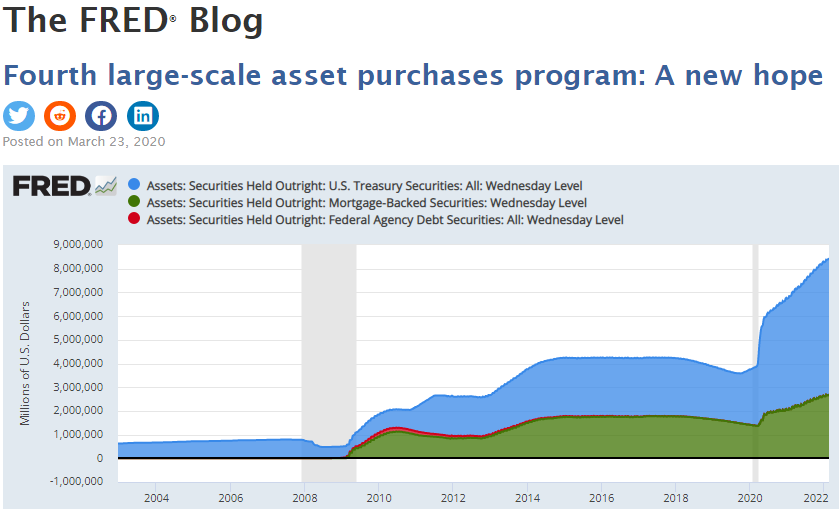
  • Indications that investors are growing increasingly concerned about the U.S. fiscal and monetary picture – and are in turn assigning more risk to “risk-free” Treasury bonds – are on the rise. Between 2010 and 2020, the share of U.S. securities owned by foreign entities fell from 47% to 32%.  As foreign investors reduce their purchase of U.S. government debt, the Fed is forced to increase its own bond purchases.
  • Until and unless Congress reduces the trajectory of the federal debt, U.S. monetary policy has entered a vicious cycle from which there is no obvious escape.
  • Satoshi Nakamoto, the creator of Bitcoin, wrote in 2009, “the root problem with conventional currency is all the trust that’s required to make it work. The central bank must be trusted not to debase the currency, but the history of fiat currencies is full of breaches of that trust.
  • Bitcoin has the same five important qualities as gold has: it is unforgeable, divisible, durable, fungible, and scarce. Furthermore, bitcoin is rarer, more portable, and more secure than gold.  And it cannot be censored (e.g. by China).
  • Policymakers will be tempted to impose capital controls that restrict the ability of Americans to exchange dollars for bitcoin. This would be a huge mistake by confirming to the world that the United States no longer believes in the competitiveness of its currency.
  • Instead, federal policymakers would do well to embrace the role of bitcoin as a geopolitically neutral reserve asset. In fact, the Treasury Department should consider replacing a fraction of its holdings – say 10% – with bitcoin, sending a positive signal to the innovative blockchain sector.
  • Ideally, the rise of bitcoin will motivate the U.S. to mend its fiscal ways. But even if this doesn’t happen, ordinary Americans will have the opportunity to protect their savings from the federal government’s fiscal mismanagement.

Conclusion.  Bitcoin represents an enormous strategic opportunity for individual Americans and the U.S. as a whole.  The bitcoin currency and its underlying technology could become the next great driver of American growth.  But in order for this to happen, the changeover from the current fiat currency must begin to take place before the economy is decimated by drastic inflation.

Sign-up for my Email Newsletter
Follow me on Facebook
Follow me on Twitter