
Is a Balanced Budget Amendment Compatible with Economic Growth?


I have devoted several recent posts to discussing the desirability of a Balanced Budget Amendment to the U.S. Constitution as well as the specifics of how to set it up in an effective yet flexible manner.
CaptureThe Wall Street Journal’s Greg Ip has a pertinent article along this line in today’s paper, “Don’t Celebrate the End of Austerity” in which he argues that the recent congressional deal for the current 2016 budget year, which I and many others have criticized as being fiscally irresponsible, will finally contribute to economic growth after five years of overly “austere” budgets.
This raises the critical question: is it possible to speed up economic growth without the stimulus of deficit spending?  Would a BBA create a stranglehold on spending which would slow down the economy? I feel very strongly that fiscal responsibility and economic growth are compatible and, in fact, contribute to each other in the long run.  Here is what we should do:

  • First of all, either through Congressional action or with a Constitutional Convention, a BBA needs to be proposed, and then ratified, to put our fiscal house in order before our rapidly growing debt rises to ruinous levels. A flexible BBA would include a five year phase in period, after ratification, to give Congress time to prepare for it. There will be some pain in achieving this initial balance but it needs to be done and the sooner the better.
  • Secondly, a flexible BBA would also allow for a 2/3 majority of each House to override strict balance. This feature could be used not only for a wartime emergency, for example, but also for occasional recessionary periods where stimulus is needed.
  • Finally, keep in mind that the real goal is not a BBA per se, but rather to put our debt on a downward path over time as a percentage of GDP. This is what a flexible BBA will accomplish.

Once initial balance is achieved, it will be relatively easy to hold new debt down to manageable levels. Our current fiscal problem will then be largely solved and we can continue building a stronger, freer and more prosperous future for our country.

Follow me on Twitter: https://twitter.com/jack_heidel
Follow me on Facebook: https://www.facebook.com/jack.heidel.3
Setting Up a Balanced Budget Amendment to the U.S. Constitution


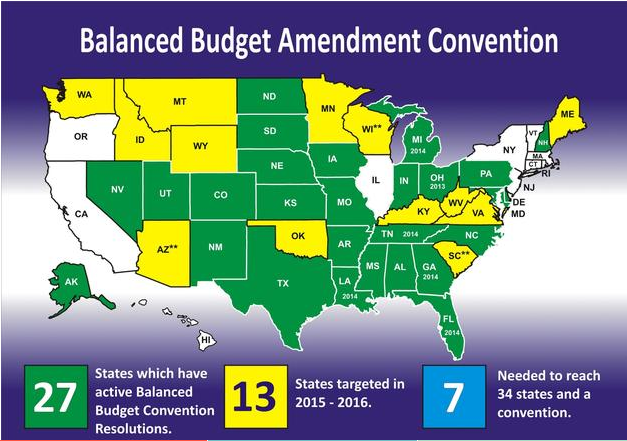
I have made the case in several recent posts, herehere, and here, as to why we need a Balanced Budget Amendment to the U.S. Constitution.  This is a very timely issue since 27 states (out of the 34 required) have now called for a Constitutional Convention to propose such an amendment.
Many people have pointed out the difficulty of creating such an amendment which would be both effective enough to get the job done as well as flexible enough to allow for any emergencies which might arise.
CaptureHere are some suggestions for the main features which are needed:

  • Prior to the beginning of each fiscal year, the President is required to submit a proposed budget for the U.S. Government in which total outlays do not exceed total receipts.
  • Congress need not adopt the President’s proposed budget but is likewise required to adopt a balanced budget for the coming fiscal year.
  • A two-thirds vote of each House of Congress is required to approve an excess of outlays over receipts, either for the entire budget or for supplemental spending once the fiscal year has begun. (Many proposed amendments require only three-fifths majorities for override but I think that this is insufficient.)
  • Congress may pass appropriate legislation to implement and enforce this amendment. For example, official estimates of receipts and outlays could be provided by the Congressional Budget Office.
  • The BBA amendment takes effect beginning with the fifth fiscal year following its ratification. (The idea here is to provide Congress with a sufficient time window to whittle down our current deficit spending, approximately $450 billion, to a more manageable amount, before the strict limits of the BBA take effect.)

Keep in mind that the real purpose of a BBA is not to establish exact numerical balance for the budget but to put our national debt on an overall downward course as a percentage of GDP. Occasional spending overrides during the budget year, as long as they are reasonable, will not detract from this goal.  A two-thirds majority vote for balance overrides should be sufficient to accomplish this.

Follow me on Twitter: https://twitter.com/jack_heidel
Follow me on Facebook: https://www.facebook.com/jack.heidel.3

 

The Wider Value of a Balanced Budget Amendment


Several recent posts, especially here and here, have advocated for a BBA to the U.S. Constitution and pointed out that 27 states (out of a required 34) have now called for a Constitutional Convention to propose a BBA. I pay careful attention to the responses I receive to my posts.  Several folks have said that while they support a balanced budget, there are other higher priorities for them, such as ending wasteful and inefficient programs or focusing more on the needs of people rather than being overly worried about budgetary matters.
CaptureI contend that a carefully formulated BBA would do far more than just solve our debt problem, as important as this is.  For example:

  • An essential component of a BBA would require the President to submit a balanced budget to Congress each year. So it starts out by forcing the Administration to set priorities. If a new program is advocated, fine, but then it has to be offset by cutting back on existing programs, or else raising taxes. Congress need not accept the President’s priorities but then it has to set its own.
  • It would become a huge priority for both Congress and the President to carefully examine all programs to ferret out waste and inefficiency. There would be an incentive for programs to be shifted to the states, with the flexibility to make them more effective, in return for cost savings.
  • The best way to raise stagnant wages for the middle class is to make the economy grow faster. The best way to grow the economy faster is broad-based tax reform, with lower tax rates across the board, paid for by closing loopholes and shrinking deductions. But faster economic growth will also bring in more tax revenue, therefore making it easier to shrink the deficit and balance the budget.

Conclusion: A Balanced Budget Amendment to the U.S. Constitution would have many benefits, beyond “mere” fiscal responsibility. Next question: how should a BBA be formulated to insure that it is both effective and flexible enough to allow response to emergencies?

Follow me on Twitter: https://twitter.com/jack_heidel
Follow me on Facebook: https://www.facebook.com/jack.heidel.3
Good Riddance to 2015


This has been a bad year for the U.S. and the Western World. Peace, prosperity and progress have suffered major setbacks.
CaptureHere are the three worst disasters of 2015:

  • The European refugee crisis. Chaos in the Middle East, especially in Syria, Iraq and Libya, has caused over a million refugees to flee their homelands and overrun Europe. This is not only a humanitarian crisis but also a severe strain on the resources of our friends and allies in the European Union, already weakened by huge debt resulting from the financial crisis.
  • The rise of Donald Trump. He appeals to the worst instincts of many Republican voters: nativist, protectionist and isolationist. Granted he has created more interest in the 2016 presidential campaign but at what cost to future economic and social progress? He is too crude, prejudiced and unprepared to possibly be elected president. His nomination by the Republican Party will lead to electoral disaster and therefore continued economic stagnation and an even faster increase in debt.
  • The collapse of fiscal common sense. The Republican Congress started out 2015 by adopting a ten year plan to achieve a balanced budget by 2025. But this plan fell by the wayside as a 2016 budget was hammered out, leading to an increase in the projected 2016 deficit alone of $158 billion. Such fiscal irresponsibility has created new interest in holding a Constitutional Convention to propose a Balanced Budget Amendment.  Of the 34 states needed to force Congress to call a Con-Con for a BBA, 27 states have already formally applied.

Always the optimist, I have ended on a hopeful note. The world depends on the U.S. for leadership and it isn’t too late for us to get back on track.  But it won’t be easy!

Follow me on Twitter: https://twitter.com/jack_heidel
Follow me on Facebook: https://www.facebook.com/jack.heidel.3

What Lesson Does “The Big Short” Have for Us?


The newly released movie, “The Big Short” based on Michael Lewis’s book of the same name is a fascinating account of several investors who figured out that subprime mortgages would eventually turn bad and made billions of dollars by betting against them.
One of the main characters in The Big Short, the investor Michael Burry, could accurately predict when his credit default swaps would pay off.  Subprime mortgages started out with a low, fixed two-year “teaser” rate and then reset after two years to much higher floating interest rates.  Once the housing market peaked out in 2006 and started to turn down, it became virtually certain that many subprime mortgages would end up in default after the initial two year period because the holders of these mortgages would be unable to refinance in a falling market.
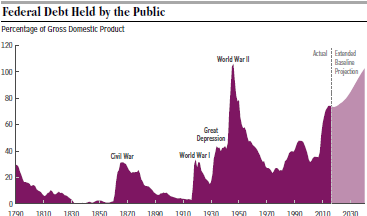
CaptureToday we have a very large debt bubble as illustrated in the above chart from the Congressional Budget Office.   Why is this so serious?

  • Right now our public debt (on which we pay interest) is “only” 74% of GDP but it is likely to keep getting worse in the coming years as clearly indicated by CBO. Congress has the ability to reduce deficit spending and shrink the debt but does it have the will to do so?
  • Right now our debt is almost “free” money because interest rates are so low. But this is already starting to change and we should assume that interest rates will eventually return to normal historical levels of about 5%. When this happens, interest payments on the debt will surge from about $250 billion per year at present to double or triple this amount. This will make our deficits and debt grow even faster.
  • The debt bubble is much more dangerous than the housing bubble from ten years ago because its bursting will affect the whole economy and not just one sector. It is unlikely that anyone will be able to pull a Michael Burry and predict the exact timing of the burst. But this doesn’t mean that no one will try. When China and Japan (our biggest foreign lenders) start shorting U.S. debt, it will serve to hasten the downfall of our whole financial system.

Conclusion. This is an intentionally scary scenario. Things don’t have to happen this way but it’s going to require an enormous effort to turn it around.  Are we capable of doing this?

Follow me on Twitter: https://twitter.com/jack_heidel
Follow me on Facebook: https://www.facebook.com/jack.heidel.3
Passing a Balanced Budget Amendment to the Constitution


My last three posts have discussed the long term damage that will be caused by excessive spending in the recently passed 2016 federal budget and what should be done about it.
CaptureThere is at least one way to force Congress to act in a responsible manner, namely, by putting into effect a Balanced Budget Amendment to the Constitution.  Here is a brief history of recent efforts to do exactly this:

  • In the 1995-96 session of Congress, the House of Representatives passed (by a 2/3 vote) a BBA but it was defeated in the Senate by one vote.
  • Application by 34 states requires Congress to call a Constitutional Convention to propose an amendment. At the end of 2009, 16 states had so applied. Each year since one or more new states have also applied and now there are a total of 27. An additional 13 states are actively considering applications for a BBA at the present time.
  • As the number of applying states gets close to the required 34, it becomes more and more likely that Congress will act on its own in order to preempt a “Con-Con.” This would avoid the messiness and uncertainties of such a convention, none of which have yet occurred in our nation’s history.
  • Once 34 states have applied, however, Congress must call a convention. Any fear of a runaway convention, exceeding a limited mission, should be alleviated by the fact that any proposed amendment(s) have to be ratified by 38 states.
  • In my opinion a proposed amendment should have no restrictions on how a balanced budget will be obtained. There will be far more political pressure to cut spending than to raise taxes. Let Congress hash out the proportion of each.

Fiscal responsibility does not require the budget to be exactly balanced each year. In fact, temporary deficits can be useful as a stimulus in time of recession.  However, deficit spending has gotten so far out of control in recent years that Congress must be forced to modify its behavior.

Follow me on Twitter: https://twitter.com/jack_heidel
Follow me on Facebook: https://www.facebook.com/jack.heidel.3
We Need a Balanced Budget Amendment to the Constitution!


“The Congress, … , on the application of the legislatures of two thirds of the several states, shall call a convention for proposing amendments, which shall be valid to all intents and purposes, as part of this Constitution, when ratified by the legislatures of three fourths of the several states, or by conventions in three fourths thereof  …”
Article V, The U.S. Constitution

As I pointed out in my last post, under the current 2016 federal budget, just adopted by Congress and signed by the President, our public debt (on which we pay interest) is now projected by the Congressional Budget Office to increase from 74% of GDP today to 175% of GDP in 2040, just 25 years from now.
Of course, a new, and more severe, financial crisis is likely to occur long before we hit such a high level of debt but this serves to emphasize the extreme seriousness of our present situation and the need to address it without delay.
The best and simplest way to do this is for Congress to act on its own accord to pass balanced budgets.  In fact, the current Congress passed a multi-year budget plan last Spring which leads to a balanced budget in ten years, by 2025.  But the budget just passed last week for 2016 totally ignores this plan and actually increases the deficit for 2016 by $158 billion.
In other words, Congress on its own accord appears incapable of acting in a fiscally responsible manner.
Capture0As shown above, our founding fathers foresaw the possibility of congressional stalemate and provided for an alternative route to force Congress to act on critical issues.  As reported by the Balanced Budget Amendment Taskforce, 27 states have already called for a Constitutional Convention out of the 34 needed to force congressional action.
In my next post I will discuss in detail the ramifications of holding a constitutional convention, pro and con.
Merry Christmas!

Follow me on Twitter: https://twitter.com/jack_heidel
Follow me on Facebook: https://www.facebook.com/jack.heidel.3

What Defines a (Fiscal) Conservative?


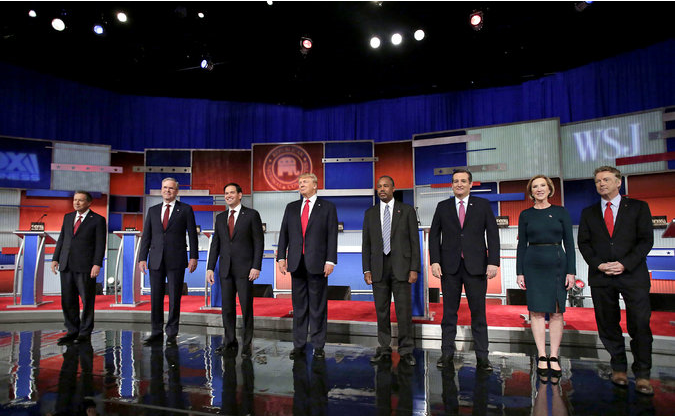
After four debates among the Republican presidential candidates, differences between them are becoming clearer.  The New York Times has an interesting article about this in today’s paper, “G.O.P. Fight Is Now a Battle Over What Defines a Conservative.”
CaptureHere are my views on the four issues discussed:

  • A Wall or a Path? We need to solve our illegal immigration problem and the key is to set up a viable guest worker program. The fact is that our economy needs foreign workers for many jobs which require hard physical labor such as in agriculture, meatpacking and construction trades. If businesses are able to bring in immigrants when sufficient domestic labor is not available, then other issues such as border security and verifying legal status can easily be resolved.
  • The U.S. Place in the World. U.S. leadership makes the world a safer place. This means we need a strong military presence all around the world as well as active alliances, trade and military, with many other countries.
  • Of Banks, Bailouts and Blame. The cause of the financial crisis was the bursting of the housing bubble, in turn caused by an unrealistic government housing policy as well as lax enforcement of existing regulations. Blaming greedy bankers is a copout. The Dodd-Frank Law is overkill which creates a drag on the economy by hampering smaller financial institutions and community banks. The best way to control large banks is to increase their capital requirements.
  • Who Should Get Tax Cuts? The main purpose of tax reform should be to boost the economy without increasing deficit spending. The way to do this is with across the board cuts in tax rates, paid for by closing loopholes and shrinking deductions. Here are some details. The 64% of taxpayers who do not itemize deductions will get an immediate tax cut and income inequality will be greatly reduced.

Getting the answers to these issues correct will have a large effect on the future wellbeing of our country.  The Republican presidential candidates should be commended for grappling with them in a productive manner.


I Am One of Paul Krugman’s “Very Serious People”


There is a stark contrast between the fiscal and economic policies being proposed by the presidential candidates from the two different parties. The Democrats want to tax the rich to reduce income inequality while the Republicans want major tax reform in order to speed up economic growth.
CaptureI favor the latter approach as long as it does not increase deficit spending.  The Keynesian economist Paul Krugman mocks deficit hawks like me as “Very Serious People.”  But in my “serious” view we have a choice between two very different paths for our economic future:

  • Slow Growth. Continue on our present path of slow 2% annual growth. The official unemployment rate has dropped to 5% but slack in the economy caused by the low labor participation rate keeps raises low and millions still unemployed or under-employed. The slow economy also keeps inflation and interest rates low. This permits Congress and the President to shrug off deficit spending and debt accumulation because it’s virtually “free money,” being borrowed at very low interest rates.   Our present course not only prolongs income inequality but also allows the debt to keep ramping up indefinitely. The longer this continues, the greater will be the disruption when inflation and interest rates do eventually return to normal historical levels.
  • Faster Economic Growth.   There are many things we can do to speed up economic growth. Tax reform is first and foremost but deregulation (relax Obamacare and Dodd-Frank), trade expansion (pass TPP) and immigration reform (with an adequate guest worker program) would also help. But, contrary to what the Republican presidential candidates say, tax reform must be revenue neutral to be sustainable. That way the economic growth it produces will lower deficit spending rather than increasing it.  This is critical because economic growth will create new jobs and raise pay for existing jobs, thereby creating inflationary pressure. Inflation will lead to higher interest rates which in turn will make our debt much more expensive than it is now.

Conclusion. We can make our economy grow faster if we simply put our mind to it. But then inflation and interest rates will go up and interest payments on the debt will become an increasing burden on society.  This is why it is so important to put our debt on a downward path as a percentage of GDP.  We can make it happen if we want to.

Austerity’s Grim Legacy?


There is a very important debate going on in the country right now as I have discussed in my last three posts:

  • The Republican presidential candidates are proposing big tax cuts to stimulate the economy but at the cost of huge increases in annual deficits and the accumulated debt.
  • The Democratic candidates want to raise taxes on the wealthy but even raising the top tax rate from 39.6% to 50% would have only a modest effect in lowering income inequality.
  • The Tax Foundation has an excellent plan to lower tax rates for all in a revenue neutral manner by closing loopholes and limiting deductions. Their plan would give the economy a big boost and actually lower deficits by bringing in more tax revenue.

Now comes Paul Krugman in Friday’s New York Times, “Austerity’s Grim Legacy”  saying that “Some of us tried in vain to point out that deficit fetishism was both wrong-headed and destructive, that there was no good evidence that government debt was a problem for major economies, … And we were vindicated by events.  More than four and a half years have passed since Alan Simpson and Erskine Bowles warned of a fiscal crisis within two years; U.S. borrowing costs remain at historic lows.”
Capture12How can such an obviously intelligent and articulate economist miss what is so very, very clear to so many lesser mortals?  Interest rates will not stay low forever!  And when they do go up, interest payments on our rapidly expanding debt will skyrocket! The Congressional Budget Office estimates that the interest payment on our debt will increase from 1.7% of GDP today to 3.6% of GDP in 2025, or $827 billion in 2025 compared with $227 billion in 2015.  Where will the money to pay this new $600 billion expense come from?
It is absolutely crazy not to take our enormous debt seriously.  We simply must put this huge debt on a downward path as a percentage of GDP.  It can be done but it will take a concerted effort by our national leaders to do it.

                                    Follow me on Twitter: https://twitter.com/jack_heidel
                         Follow me on Facebook: https://www.facebook.com/jack.heidel.3