Can the U.S. Economy Do Better VI. Does the President Matter?


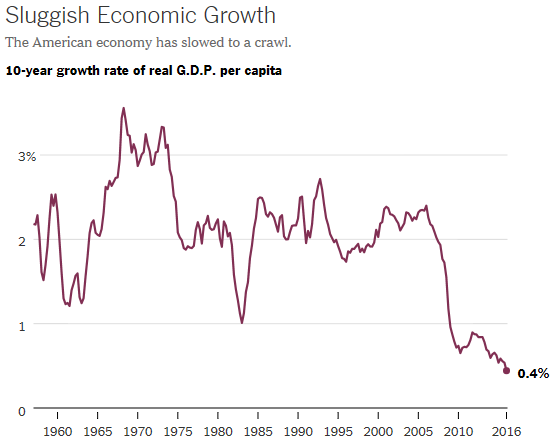
My last five posts have discussed several different aspects of the question, “Can the U.S. Economy Do Better?”  Our economy has been doing especially poorly since the end of the Great Recession seven years ago (see the chart below).  Many people claim that the President doesn’t really have all that much control over the economy.
Capture6 Here is what the2016 presidential candidates are saying on economic policy so far:

  • Hillary Clinton. She wants national paid family leave, a national minimum wage increase and more government spending on infrastructure projects. She would raise taxes by about $100 billion per year to pay for these initiatives. She is opposed to the Trans Pacific Partnership to expand trade with 11 other Pacific Rim countries.
  • Donald Trump. His top priorities are trade and immigration policy. Would he be able to successfully address China’s currency manipulation without starting a trade war? How would he be able to round up and deport millions of illegal immigrants without destroying millions of jobs and thereby crippling many businesses? His plan to slash tax rates would boost the economy but also add trillions of dollars to the debt.

As I have discussed over and over again on this blog, see, for example, here and here,  there are several fundamental policy changes needed to make our economy grow faster and create more and better paying jobs.  We need to:

  • Make it easier to start a small business by simplifying regulations at all levels.
  • Lower tax rates and simplify the tax code, paid for by shrinking deductions and closing loopholes.
  • Respond to globalization and new technology by helping its victims rather than blocking progress.

Our two presidential candidates are appealing to the fears of the voters rather than to their hopes and aspirations. Neither of them is espousing policies which will help the economy really grow in a healthy way.

Follow me on Twitter
Follow me on Facebook

A Guaranteed Income for All: Good Idea or Bad Idea?


The social scientist and American Enterprise Institute scholar, Charles Murray, has an interesting article in yesterday’s Wall Street Journal, “A Guaranteed Income for Every American,” Mr. Murray proposes a Universal Basic Income (UBI) with the following features:
Capture6

  • Every American citizen age 21 and older would get a $13,000 annual grant deposited electronically into a bank account in monthly installments. $3000 would be applied towards health insurance.
  • UBI is financed by eliminating all other welfare programs: Social Security, Medicare, Medicaid, food stamps, housing subsidies, aid for dependent children, etc. as well as agricultural subsidies and corporate welfare.
  • People can make up to $30,000 a year without losing any part of the grant. Above $30,000 in earned income, the grant decreases to $6500 when the income reaches $60,000. The $6500 retained by all compensates for losing Social Security and Medicare.
  • The overall cost of UBI will be $200 billion per year less than the current system. By 2020 UBI would be nearly $1 trillion per year cheaper.

On the other hand, there are at least two possible drawbacks to the Murray plan, as discussed recently by Eduardo Porter in the New York Times:

  • It would probably discourage work. Right now 80% of Americans in their prime working years, 25 – 54, are employed. Work is not just what people do for a living, it organizes people’s lives. Making work more optional would impair this basic social structure.
  • A UBI divorces assistance from need. For example, a housing voucher could lead a family to move to a better neighborhood. A basic monthly income would probably not.
  • More generally, a single parent with several children would be strapped to get by for $10,000 per year without any additional welfare assistance. We can’t let the kids starve.

Conclusion: UBI appears to be an attractive way to simplify our vast welfare system and would save a significant amount of money (always important). But the poor would not be well served.  There are better ways to reform our public assistance programs.

Follow me on Twitter
Follow me on Facebook

Why Is the U.S. Economy Growing So Slowly?


The U.S. economy has only been growing at the rate of 2.1% since the end of the Great Recession in June 2009, almost seven years ago. Such a slow rate of growth means millions of unemployed and underemployed workers and only small salary raises for tens of millions of others.
Capture5The New York Times economic journalist, Eduardo Porter, observes that we have “A Growth Rate Weighted Down by Inaction.”  He points out that:

  • Our economy is adversely affected by the gradual shrinkage of the work force as a share of population as baby boomers retire and the one time surge of women into the workforce in the 20th century has ended.
  • A second factor is a persistent decline in productivity growth over the last dozen years.
  • A pessimistic forecast by the Economic Cycle Research Institute foresees growth of only 1% per year for the next five years. The Congressional Budget Office projects more optimistic productivity growth at 1.5% per year, which added to workforce growth of .5% per year, would amount to total growth of 2% per year for the next ten years.

Mr. Porter goes on to say that there are concrete reasons why productivity growth is so slow:

  • Hiring is growing faster than capital investment. This is because most job growth in the last decade has been in (low productivity) services instead of (high productivity) manufacturing.
  • Too many restrictions on educated immigrants. Relaxing these restrictions would increase entrepreneurship.
  • Too many onerous regulations.
  • Under training of skilled workers. We need more vocational and career education.

Many people, including myself, have pointed out ways to alleviate these problems and speed up economic growth, for example see here. It is most unfortunate that our dysfunctional national leadership cannot figure out how to work together to get this done.

Follow me on Twitter
Follow me on Facebook

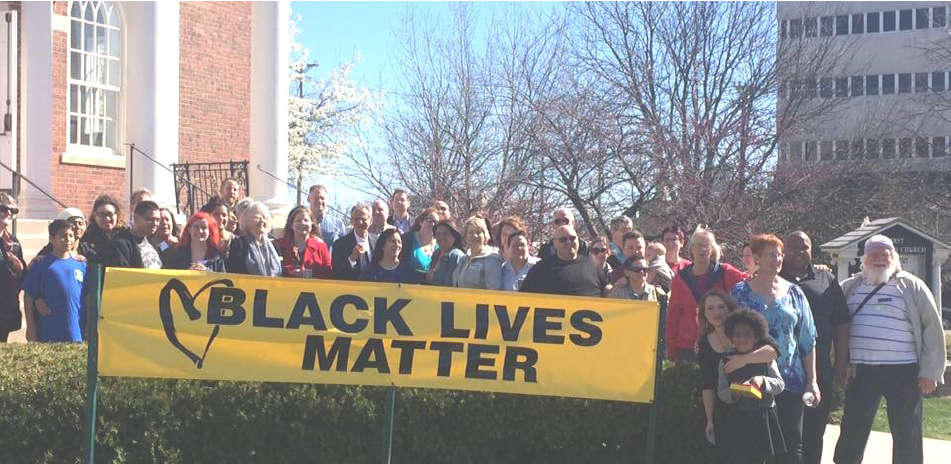
Black Lives Matter


I describe myself as a fiscal conservative with a social conscience. Most of the time I discuss issues like slow economic growth and excessive national debt.  But occasionally, like today, I deal with related issues such as social inequality.
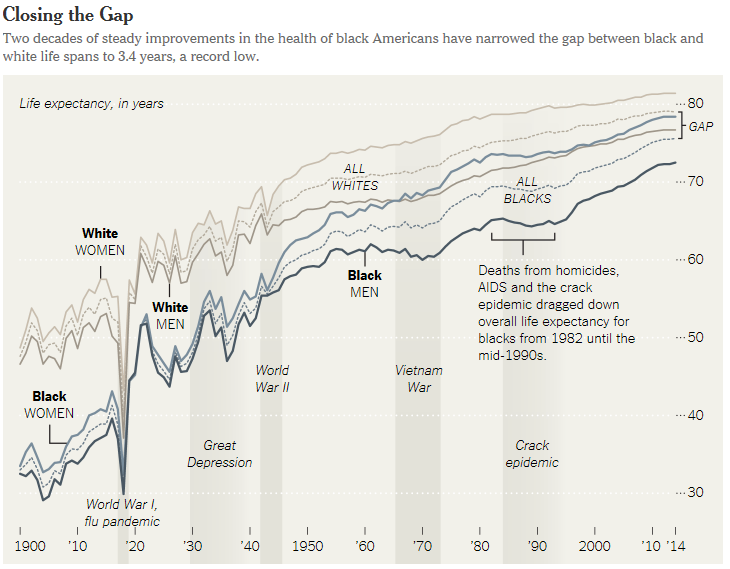
Capture11Last fall I had a post entitled, “Why Racism Exists in America” in which I made the case that it’s not just our different skin color which divides blacks and whites, but also the large degree of social inequality between the two races, such as disparities in family structure and education levels as well as for income levels.
Capture10Today I am pleased to refer to an article in yesterday’s New York Times, “Black Americans See Gains in Life Expectancy.”  In fact, the black-white life expectancy gap has dropped from 7 years in 1990 to 3.4 years today.  This is for a multitude of reasons:

  • The suicide rate for black men has declined from 1999 to 2014, the only racial group to show such a drop.
  • Births to black teenage mothers, who tend to have higher infant mortality rates, have dropped by 64% since 1995, faster than for whites.
  • The rate of deaths by homicide for blacks decreased by 40% from 1995 to 2013, compared with a 28% drop for whites.
  • The death rate from cancer fell by 29% for blacks over the same period, compared with 20% for whites.
  • Smoking has declined faster for blacks than whites and, in fact, blacks now have lower smoking rates than whites.
  • The decline in black deaths from AIDS accounts for a fifth of the narrowing of the mortality gap with whites from 1995 to 2013.

One way that black lives matter is that blacks are living longer! This offers hope that blacks can and will make progress on other fronts as well.

Follow me on Twitter
Follow me on Facebook


Why Faster Economic Growth Is So Important III. Speeding Up Anemic Wage Growth


The U.S. economy is in a peculiar and potentially perilous situation:

  • On the one hand, overall economic growth has averaged only 2.1% since the end of the Great Recession in June 2009.
  • On the other hand, the unemployment rate has dropped from 8% in early 2012 to 5% today.
  • But wages and salaries have grown by only 2% in the past year and near that rate for the past four years.

What explains our relatively low, and steadily dropping, unemployment rate when overall economic growth, and wage growth in particular, are so slow?
Capture2It is low productivity growth as the New York Times’ Neil Irwin, has recently pointed out: here  and here.

  • GDP is up 1.9% in the past year. But the number of hours worked by Americans is also up 1.9% in the past year. This means no increase in labor productivity in the past year.
  • For the past five years labor productivity has only advanced by .4% annually, far below the 2.3% average annual growth since the 1950s.
  • Most job growth in the last decade has been in (low productivity) services rather than (high productivity) manufacturing.

We do not have to accept low productivity growth as immutable. As I have recently discussed here, and here, better government policies can boost labor productivity and therefore boost economic growth as well.  Here is a brief summary of what needs to be done:

  • Decrease regulation: the Dodd-Frank Act and Affordable Care Act, for example, are hampering growth by increasing the inefficiency of the financial and healthcare sectors of the economy.
  • Reform taxation: growth oriented taxation would have the lowest possible rates paid for by shrinking deductions.
  • Reform immigration: giving legal status to millions of illegal immigrants would turn them into far more productive citizens.

In other words, our severe slow growth predicament can be greatly ameliorated if we would adopt more sensible economic policies. It is a shame that this is so hard to do!

Follow me on Twitter
Follow me on Facebook

Why Faster Economic Growth Is So Important II. Replacing Factory Jobs


Populists such as Bernie Sanders and Donald Trump are doing so well in the 2016 presidential primaries because the middle class is suffering from the slow economic growth of the past 15 years.
Capture2My last post is based on the report of a typical victim.   Today’s post is based on an article by Eduardo Porter in yesterday’s New York Times discussing the loss of U.S. manufacturing jobs.  Says Mr. Porter:

  • Fifty years ago, 45,000 workers were employed in California to harvest 2.2 million tons of tomatoes. Now, with mechanization, it only requires 5000 workers to harvest 12 million tons.
  • In 1950, 24% of nonfarm jobs in the U.S. were in manufacturing. Today only 8.5% of nonfarm jobs are in manufacturing.
  • The same thing is true worldwide. Global employment in manufacturing is going down because productivity increases are exceeding increases in demand by significant amounts. The likelihood that we will get a manufacturing recovery is close to nil.
  • The U.S. has a trade surplus in manufacturing with the 20 countries with which it has trade agreements (which does not include China). We have an overall annual trade surplus in services of more than $200 billion.

In other words, an attempt to recover or save manufacturing jobs with smarter trade policies is simply impractical and will likely do more harm than good. What should be done instead is to:

  • Definitely do a better job of helping displaced manufacturing workers with Trade Adjustment Assistance and smarter job retraining programs.
  • Adopt policies to speed up overall economic growth from the anemic 2.1% annual growth rate since the end of the Great Recession in June 2009. Faster growth such as the 3.5% annual average from 1971 – 2001 will do wonders in creating more jobs and better paying jobs. For how to do this see an earlier post.

Our very serious economic problems can be solved if policy makers (and presidential candidates) would only get serious about it!

Follow me on Twitter
Follow me on Facebook

Trade Makes America Great


Two leading presidential candidates, Bernie Sanders and Donald Trump are running against trade expansion because they say it costs American jobs. I pointed out in my last post, that there is a strong correlation between international trade and global GDP growth.
Capture2Today I will focus on the direct benefits to the American economy of expanded international trade.  First of all, I refer to a recent article in the Wall Street Journal by Frederick Smith, the CEO of FedEx Corp.  Says Mr. Smith:

  • From less than $50 billion in total trade in 1966, the U.S. now imports and exports over $4 trillion annually in goods and services, out of a global trade market which exceeds $15 trillion annually.
  • NAFTA has clearly been an economic success. U.S. trade with Mexico and Canada has risen to $1.2 trillion in 2014 from $737 billion twenty years ago.
  • History shows that trade made easy, affordable and fast always begets more trade, more jobs and more prosperity.

The U.S. typically runs a trade deficit of about $500 billion per year. The New York Times journalist, Neil Irwin, explains what this means. Says Mr. Irwin:

  • The dollar is a global reserve currency, meaning that it is used around the world in transactions which have nothing to do with the U.S.
  • This creates upward pressure on the dollar for reasons unrelated to trade flows between the U.S. and its partners. That, in turn, makes the dollar stronger and American exporters less competitive.
  • In other words, trade deficits with other countries serve as their reserve dollars.
  • Maintaining this global reserve currency creates lots of advantages for the U.S., including lower interest rates and higher stock prices.
  • The centrality of the dollar to global finance gives the U.S. power on the global stage which no other country can match.

There certainly are workers who lose their jobs because of trade competition. We can and should do more to help these workers get back on their feet.  This will increase popular support for free trade and allow its growth to continue unimpeded.

Follow me on Twitter: https://twitter.com/jack_heidel
Follow me on Facebook: https://www.facebook.com/jack.heidel.3


Growing Employment, Shrinking Productivity: What Does It Mean?


I know that I occasionally repeat myself, but I can’t help it! In my opinion there are two major problems facing our country:

  • Slow economic growth which has averaged only an anemic 2.1% since the end of the Great Recession seven years ago.
  • Exploding national debt, now the highest it has been since the end of WWII. Unless we can quickly shrink our annual deficits down to zero, and therefore stop adding to the debt, interest payments on the debt will eventually rise to horrendous levels.


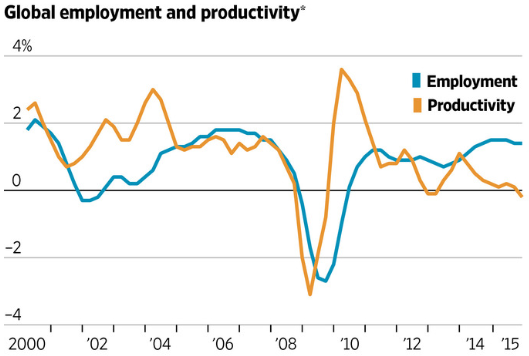
Two recent newspaper articles address the slow growth problem. Greg Ip, writing in the Wall Street Journal, points out that (worldwide) employment growth is up while productivity growth is down (see chart below).
Capture0Neil Irwin, writing in the New York Times, explains this dichotomy by pointing out that most job growth in the last decade has been in (low productivity) services rather than (high productivity) manufacturing. In other words, the U.S. economy is now producing lots of new temporary and contract jobs which do not add very much to the overall economic growth which produces higher wages and overall prosperity.
The economist John Cochrane has clearly described  why productivity growth, and therefore overall economic growth, has stagnated in recent years.  Here is a short summary:

  • Over-regulation. The Dodd-Frank Act and Affordable Care Act, for example, are hampering growth by strangling the financial and healthcare sectors of the economy.
  • Inefficient Taxation. Growth oriented taxation would have the lowest possible marginal rates paid for by shrinking deductions. Taxing consumption rather than income and savings would be even better.
  • Illegal Immigration. Solving our immigration problem would turn millions of illegals into productive citizens. An adequate Guest Worker program and e-Verify enforcement would solve this problem without the need for amnesty.

Conclusion: There are solutions to the severe economic problems facing our country. Does our political system have the flexibility to adopt these workable policies?

Follow me on Twitter: https://twitter.com/jack_heidel
Follow me on Facebook: https://www.facebook.com/jack.heidel.3


The Urgency of Defeating ISIS


After the terrorist attack in Paris I asked, “Does the U.S. Care about Europe?” Now, after the Brussels attack, it is time to repeat this warning. As the New York Time’s Roger Cohen points out:
Capture0

  • Over 1 million refugees entered Europe in 2015 alone. Another 136,000 have arrived so far in 2016. This creates a huge financial burden as well as a cultural challenge for a Europe which is already weakened by huge debt and slow economic growth.
  • It will bolster those campaigning to take Britain out of the European Union in the upcoming June referendum. A British departure from the EU will dramatically weaken it and might encourage other countries to leave as well.
  • Islamic State terror plays into the hands of populist demagogues such as presidential candidate Donald Trump and right wing French leader Marine Le Pen.
  • To allow ISIS to have its own territory, and capital city Raqqa in Syria, is a very high risk strategy. It allows the Islamic State to spread its evil not only around the immediate area but all over the world.
  • The question raised most urgently by the Brussels attacks, so soon after Paris, is whether and why Raqqa can be tolerated when Al Qaeda’s Tora Bora sanctuary in Afghanistan was not. Today, the West’s ponderous wait-them-out approach looks like capitulation.

The fundamental question is whether or not the U.S. can refrain from immersing itself in the crises of the Middle East and still maintain its status as the world’s indispensable super power. “George Bush will be remembered harshly for what he did in the Middle East. Barack Obama is gambling that he will be judged well for the things he didn’t do.”  The stakes are very high indeed for both the United States and our European allies.

Follow me on Twitter: https://twitter.com/jack_heidel
Follow me on Facebook: https://www.facebook.com/jack.heidel.3

Reviving the Working Class Without Building Walls


The strangest aspect of the current presidential campaign is the staying power of the highly unconventional and controversial candidate Donald Trump. There is wide agreement that the secret of his success is his strong appeal to the members of the white working class whose incomes have been in decline for many years.
The plight of the working class is often viewed in the context of the overall increase in income inequality in the U.S.  My last two posts, here and here, are part of that discussion.
Mr. Trump appeals to these disaffected voters by vowing to wall off Mexico and cut back on foreign trade.  But it may be possible to “Revive the Working Class Without Building Walls” as Eduardo Porter suggests in the New York Times.  According to Mr. Porter, what are needed are new government programs such as wage insurance or direct government employment.
CaptureAlternatively we could meet the illegal immigration and trade protectionism problems in a much more growth oriented way as follows:

  • Immigration Reform. Set up an adequate Guest Worker program to serve only those businesses and industries which can demonstrate that they are unable to recruit enough local workers to meet their employment needs. Once the Guest Worker program is functioning properly, eVerify would be enforced to weed out unauthorized illegal workers and deport them back to their home countries. At the same time the number of H1-B visas would be expanded in order to retain more of the highly skilled foreigners getting advanced degrees in the U.S.
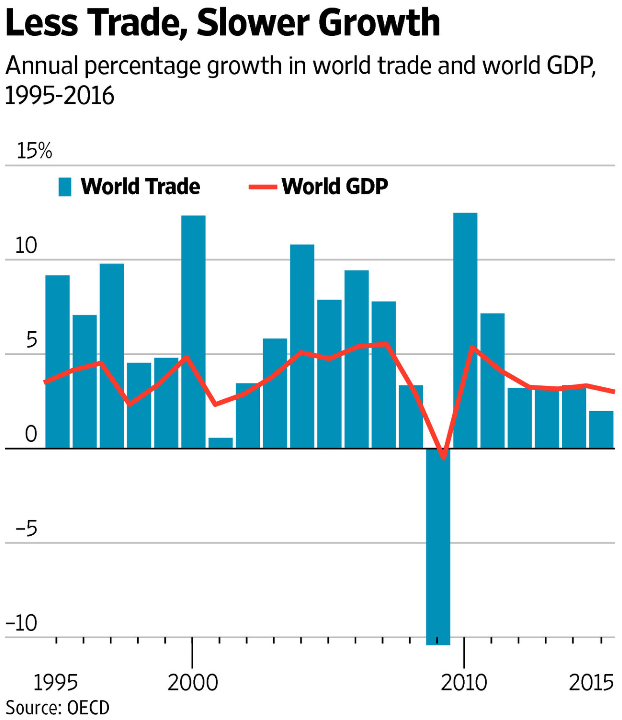
  • Foreign Trade. As the above chart shows, there is a close connection between world trade and world economic growth. And clearly the U.S. economy benefits from world-wide economic growth. The way to balance off job losses caused by foreign trade is with more effective trade-adjustment assistance and job retraining programs.

Whether or not Mr. Trump receives the Republican presidential nomination or is elected to be president in November, we should address the real grievances of his supporters in ways that benefit the entire economy.

Follow me on Twitter: https://twitter.com/jack_heidel
Follow me on Facebook: https://www.facebook.com/jack.heidel.3