
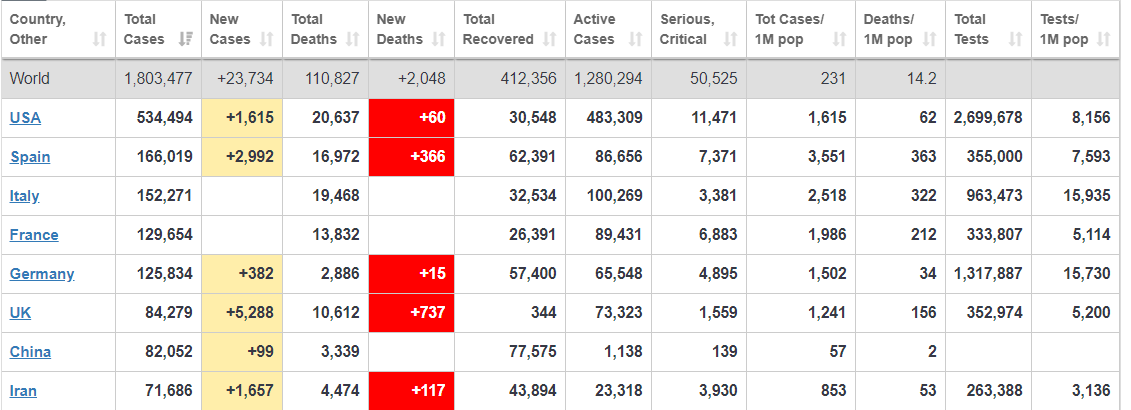
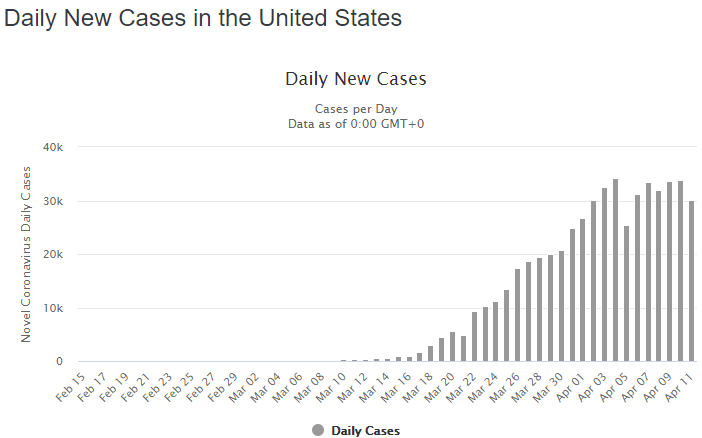
New coronavirus infections in the U.S. have leveled off at about 30,000 per day and we are beginning to turn our focus to the reopening the American economy.

As China increasingly becomes the main challenger to U.S. world leadership, how has the coronavirus pandemic affected the relative standing of these two largest world powers? (see here, here, and here)
Pertinent to this question, Ruchir Sharma, the Chief Global Strategist at Moran Stanley Investment, has a very informative article in the latest edition of Foreign Affairs, “The Comeback Nation.”
Mr. Sharma points out that:
- The U.S. share of world-wide nominal GDP was 25% in 1980 and remained at 25% in 2020. During the same time period, China’s share grew from 2% to 16% and the EU’s share dropped from 35% to 21%.
- 90% of global financial transactions use the dollar. The share of countries which use the dollar as their anchor currency (including China) has risen from 30% in 1950 to 60% today. Because the U.S. Federal Reserve controls the supply of dollars, it is now, more than ever, the world’s central bank. Whether or not global elites trust the current U.S. president, they do trust U.S. institutions, which is why the U.S. is now a financial empire without rivals.

- Signs are that the coronavirus pandemic will even further entrench the dollar at the center of the global financial system.
- Ever since Gallup started asking Americans, in 1979, whether they were satisfied with how their lives were going, the vast majority have said yes. In January 2020, that share hit a record 90%.
- The median household income in 2018, adjusted for inflation, was $63,000, an increase of $15,000 from the early 1970s, and of $7000 since 2013.
- For all the talk of decline and despair, the bigger risk for the future is complacency in the face of growing threats from debt, deficits and demographics.
- U.S. productivity has gotten a boost from investment in technology in recent years, but the most important U.S. advantage has been a relatively high population growth rate, babies and immigrants, not Stanford and Google.
- Unfortunately, major voices in both parties are now making the case that deficits no longer pose a threat to growth – Republicans to defend low taxes and Democrats to defend higher public spending.
- If, into the future, China and the U.S. each maintained their officially reported nominal GDP growth rates, 6% for China and 4% for the U.S., China would not catch up with the U.S. until 2050. If its growth rate slows by one percentage point, China will not catch up with the U.S. until 2090.
- The most important driver of any economy is the working-age population, which is still growing in the U.S. but started shrinking in China five years ago.

Conclusion. Perhaps “the experts may be correct to argue that the United States should modernize its global strategy, restore ties to traditional allies and critical trade partners, rejoin international agreements, and help rebuild the international pillars of the postwar order.” But such moves would be icing on the cake. They are not needed to preserve U.S. leadership because the United States is not in decline.



 It Does Not Add Up