The national debt is now over $23 trillion and growing at the annual rate of $1 trillion per year. This is not only a very serious problem (see chart below), which will eventually cause enormous harm if not corrected, but it is also a very difficult problem to solve politically.

First of all, there are many proposed solutions which simply will not work such as:
- Modern Monetary Theory (ignore the debt until inflation strikes). The problem is that when inflation does take off someday, as it almost assuredly will, then interest rates will rise dramatically, and interest payments on the debt will explode. This will lead to a new financial crisis much worse that the Great Recession of 2008-2009.
- Issuing long term bonds at low interest rates to finance the debt. Of course, we want to pay the lowest possible rate of interest on our debt. But long term, low interest bonds merely postpone the eventual problem of much higher interest payments on the debt. It lulls us into complacency in the meantime while we continue to accumulate massive amounts of new debt.
- Growing our way out of debt. Our current trillion dollar annual deficits are increasing the debt by over 4% per year. Projected annual growth going forward of 2% per year is simply inadequate to reduce the debt as a percentage of GDP and will, in fact, allow it to get progressively worse.
- Cutting military spending. The current military budget is about $750 billion per year. Let’s suppose that 10% is waste which can be eliminated. There are two problems with this approach. It will be very difficult for Congress to agree on how to cut $75 billion from military spending. Furthermore $75 billion is less than 10% of the $1 trillion size of the current deficit and so would be little more than a drop in the bucket towards solving the underlying problem.
- Cutting other discretionary spending such as for education, agriculture, foreign aid, etc. The same problem as above. It would take a huge amount of effort by Congress, largely fruitless, to save only small amounts of money, not nearly enough to shrink the annual deficits significantly.
Secondly, the real problem, entitlement spending, is not sufficiently clearly understood as the real culprit:
- The entitlements Medicare, Social Security and Medicaid all represent big chunks of federal spending (see chart below):

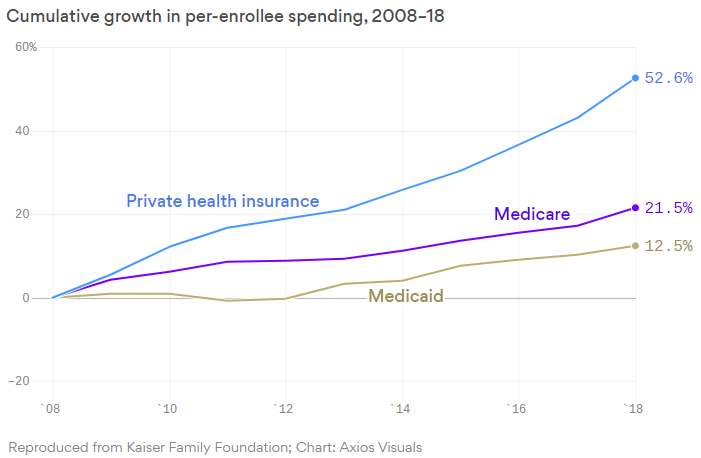
- Entitlement spending (Medicare, Social Security and Medicaid) represents by far the largest growth in federal spending, going forward (see chart below), with Medicare the biggest expense of all:

- The federal government pays 41% of all Medicare costs so that Medicare recipients pay only 59% of the costs (see chart below). Note that the Medicare payroll tax of 2.9% funds Part A (hospitalization) only. The remaining Parts B (doctors), Part C (Medicare Advantage) and Part D (drugs) are paid for from federal government revenues.

- Here is a breakdown of the average federal subsidy to Medicare per individual, based on retirement year. A retiree in 2020, for example, will receive a $400,00 lifetime subsidy from Medicare (see chart below):

- The total annual federal contribution to Medicare is now about $600 billion per year and rising rapidly (see chart below):

Conclusion: Medicare represents by far the biggest single drain on federal revenues for the future. It is therefore a huge threat to the solvency of the federal government. Any serious plan to solve the federal debt problem must start with major reform of Medicare.
Next: how should entitlement spending be controlled?