Corporate Tax Reform and the Border Tax


Most informed observers of the U.S. economy agree that the Corporate Income Tax of 35% is too high and should be lowered to a rate which is more competitive with other developed countries. Republican Congressional leaders and the Trump administration have agreed that a 20% rate is about the right level.
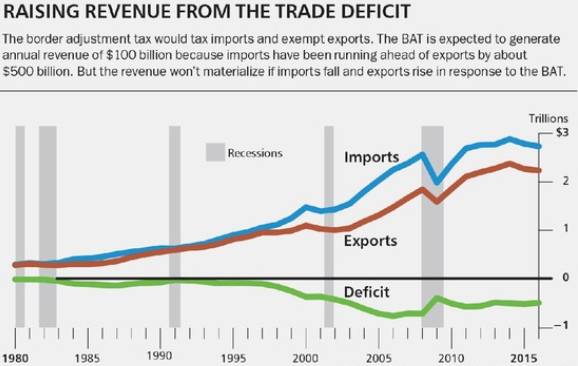
Now the question is how to make up the tax revenue lost to the federal government from a lower tax rate.  One idea is to impose a Border Adjustment Tax on imports into the U.S. but exempting exports from such a tax.  Since the U.S. trade deficit is currently running at about $500 billion per year (see chart), a 20% tax on imports offset by a 20% tax credit for exports would raise the necessary $1 billion per year.

This week’s Barron’s points out several disadvantages of a BAT:

  • Economic theory predicts that a 20% BAT would mean that the dollar would rise in value by 20%, offsetting the higher costs of imports. But if this happens, then other industries, such as U.S. tourism, would take a big hit.
  • Other countries could retaliate in ways that would be unfavorable to us and cause a “Trump slump.”
  • If a BAT leads to an increase in exports and a decrease in imports, the $500 billion trade deficit will shrink and so the BAT will bring in less revenue than the predicted $100 billion per year.

The Barron’s article suggests much better ways to make up the $100 billion in tax revenue (on a static basis) which would be lost to a corporate tax rate cut to 20%. For example:

  • A corporate tax rate cut of this magnitude would be revenue enhancing (on a dynamic basis), easily raising an additional $50 billion in tax revenue.
  • The CATO Institute recently compiled a list of corporate welfare programs in the federal budget totaling $100 billion. Eliminating just half of this would save an additional $50 billion.

Conclusion. Cutting the corporate tax rate to 20% from its current level of 35% will contribute significantly to faster economic growth. It should be quite possible to keep such a tax rate cut revenue neutral by cutting back on crony capitalism.

Follow me on Twitter
Follow me on Facebook

Why Inequality Is Harmful and What to Do About It


I describe this blog as addressing our fiscal and economic problems, meaning deficits and debt on the one hand and slow economic growth on the other.  But these topics, while being of critical importance to our national welfare, are also somewhat on the dry side.  The subject of economic inequality stirs up lots more interest and response. In the Fall of 2012 The Economist declared that “a new form of radical centrist politics is needed to tackle inequality without hurting economic growth.”
CaptureSays The Economist:

  • There’s too much cronyism in the rich world. Banks which are “too big to fail” have an implicit subsidy. From doctors to lawyers, many high paying professions are full of unnecessarily restrictive practices. Social spending often helps the rich more than the poor. For example housing subsidies for the top 20% (mortgage-interest deductions) are four times the amount spent on public housing for the poorest 20%.
  • If income gaps become too wide, they can lead to less equality of opportunity, especially in education. The gap in test scores between rich and poor American children is 30 – 40% wider than it was 25 years ago.
  • If those on the top of the heap resist equalizing changes, it could lead to political pressure which serves nobody’s best interests.

Here are The Economist’s proposals for a True Progressive Agenda to attack inequality:

  • Compete.   A Rooseveltian attack on monopolies and vested interests is needed. School reform is crucial: no Wall Street financier has done as much damage to social mobility as the teacher’s unions have.
  • Target. Government spending need to be focused on the poor and the young. Governments can’t hope to spend less on the elderly but they can reduce the pace of increase.
  • Reform. Eliminate tax deductions which primarily benefit the wealthy such as for mortgage-interest; narrow the gap between tax rates on wages and capital income.

“The right is still not convinced that inequality matters.  The left’s default position is to raise income tax rates for the wealthy and to increase spending still further – unwise when sluggish economies need to attract entrepreneurs and when governments are overburdened with promises of future spending.”
Surely there is a better way!

Let’s Do Something about Corporate Welfare and Crony Capitalism!


The American Enterprise Institute is one of my favorite Washington think tanks.  It defines its mission as “research and education on issues of government, politics, economics and social welfare.”  I especially like its interest in social welfare which translates for me as being fiscally conservative with a heart.
CaptureThe AEI’s Timothy Carney has just proposed “An anti-corporate welfare, anti-cronyism agenda for the 114th Congress.” Most candidates for Congress condemn crony capitalism and corporate welfare.  This generally means any policies which tilt the playing field, picking winners and losers and rewarding well-connected insiders.  Such actions contribute to the public perception that the “game” is rigged and harm economic growth and innovation.  Here are some prime examples discussed by Mr. Carney:

  • Health Care: repeal Obamacare’s insurer bailout (the “risk corridors”) so that health insurers compete totally on price.
  • Health Care: end the individual mandate which forces people to buy a product from a private industry. An alternative incentive for individuals to remain covered would be limiting enrollment periods, for example, to a brief six-week sign-up period every two years.
  • Energy: end tax breaks and subsidies for both renewable energy (including ethanol) and oil and gas. Make all forms of energy compete in the market.
  • Taxes: make corporate taxes simpler, lower and more neutral. Besides being fairer, such changes will boost the economy.
  • Finance: Rein in Fannie Mae and Freddie Mac by treating them the same as all big banks. This means the same capital requirements, the same tax treatment and the same consumer protection regulation.
  • Finance: Kill Dodd-Frank’s too-big-to-fail designation. It acts as a moat, protecting the big guys from competition.
  • Trade: Kill the Export-Import Bank.
  • Trade: Repeal the Jones Act. It requires all shipping between U.S. ports be done on U.S. flagged vessels.
  • Agriculture: End the Sugar Program which costs consumers $3 billion per year.
  • Agriculture: Reform the Federal Crop Insurance Program by making it self-supporting.

These mostly well-known examples of corporate welfare represent just the tip-of-the-iceberg.  Nevertheless they provide a good place to start in cleaning things up!

Crony Capitalism and Economic Growth


“If there is one thing that populists on the left and right can agree upon, it is disdain for crony capitalism.  It is a distaste for the cesspool of Washington influence in which big-business lobbyists canoodle with lawmakers to get their way.  It is anger at corporate welfare enriching America’s biggest companies at the expense of the little guy.”  So says the economics journalist Neil Irwin in today’s New York Times, “Why we’re All Crony Capitalists, Like It or Not”.
Specifically he is talking about the current debate in Congress over whether or not the Export-Import Bank of the United States should be continued.  It mostly helps big corporations like Boeing and General Electric finance sales to other countries.  But there’s a trade off.  If it shuts down, then American corporations will be at a disadvantage compared with international competitors who get help from their own governments.
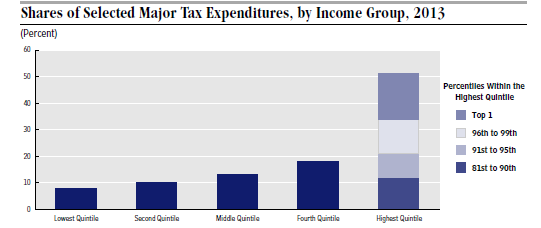
CaptureIn fact, crony capitalism has a much wider scope than this.  Each year deductions and loopholes in the U.S. tax code, referred to euphemistically as tax expenditures, total $1.2 trillion in lost tax revenue.  As the above chart from the Congressional Budget Office shows,  50% of these tax reductions are enjoyed by the highest earning 20% of all U.S. households, with 30% of the benefits going to just the top 5%.
Many experts say that our stagnant economy is caused by a lack of consumer demand, in turn caused by the huge loss of wealth during the Great Recession.  If lower and middle income people had more money, they would surely spend it and our economy would grow faster.  This line of reasoning suggests a way forward!
We should enact fundamental, broad-based tax reform, whereby individual tax rates are lowered across the board, in a revenue neutral way, paid for by greatly shrinking the deductions and loopholes enjoyed by the top 5% of wage earners.  The two-thirds of taxpayers who do not itemize their deductions will receive a correspondingly significant increase in income which they are most likely to spend.
A plan like this would not only boost the economy but also boost public morale by lessening inequality.  A win, win plan!