How To Address Inequality: A Summary


I have had many recent posts addressing the problem of income inequality in the United States and what can and should be done about it.  Below is a chart, from the Congressional Budget office, which also appeared in my December 24, 2013 post.  It shows that all income groups have made gains since 1980 but that higher income groups have gained the most.
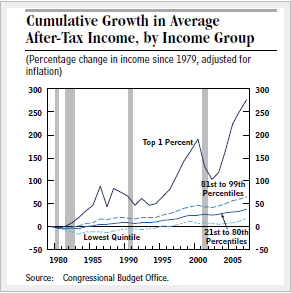
CaptureThis means that income inequality is increasing.  The question is what to do about it.  My own attitude is to try to provide more economic opportunity for low income people.  How do we do this in the most effective way?

  • First and foremost by stimulating the private economy to grow faster and therefore to create more and higher paying jobs.  This can be done with broad based tax reform (lowering tax rates offset by closing loopholes), fiscal stability achieved by eliminating deficit spending, expanded foreign trade for a more efficient global economy, and finally, immigration reform to give legal status to undocumented workers and allow more high skilled foreigners to immigrate to the U.S.  Such measures as these require action by Congress and the President.
  • Secondly, by improving human capital, meaning fixing underperforming schools, improving rundown neighborhoods, combatting inner city crime more effectively, providing at least part-time jobs to young people and combatting teenage pregnancy. Problems such as these are best addressed at the state and local level.
  • Finally, providing more motivation for the unemployed and underemployed to find jobs and hold onto them.  A very effective way to do this is with the federal Earned Income Tax Credit.  It supplements the salary of working adults with children.  New York City is conducting an experiment to see if a similar program will also motivate childless adults to try harder to find work and stay employed.

Conclusion:  the best way to address inequality is to give people the best possible opportunity to obtain full time employment.  This means 1) creating more jobs, 2) providing better qualified workers for all jobs and 3) motivating the unemployed more strongly to find jobs and hold on to them.
Government at all levels can help people find jobs, in one way or another, and therefore become more productive citizens.  This will lead to a happier, healthier, and therefore a stronger society.  All of us will benefit from this happening!

The Link between Education and Prosperity, Part II: Educare

In my previous post, “The Link between Education and Prosperity”, I looked at data from Paul Peterson and Eric Hanushek which show a very close connection between high school academic achievement and rate of economic growth for various countries around the world.  They point out, for example, that only 32% of U.S. high school students are proficient in mathematics, as compared to 49% in Canada, and that closing this achievement gap would boost our rate of GDP growth by almost 1%.  But they also point out that the math proficiency rate for white students in the U.S. is 42% with much lower proficiency rates for both African American and Hispanic students.  In other words, almost 2/3 of the American-Canadian math proficiency gap can be explained by poor performance of American minority students, many of whom grow up in poverty.
In yesterday’s New York Times, James Heckman, a Nobel prize winner in economics, has an article “Lifelines for Poor Children” which points out the importance of investing in effective early childhood development from birth to age 5.  “High-quality early childhood programs are great economic and social equalizers – they supplement the family lives of disadvantaged children by teaching consistent parenting and by giving children the mentoring, encouragement and support available to functioning middle-class families.”
High quality early childhood education is expensive and it is very important for all levels of government, especially at the federal level, to operate more efficiently.  How is it possible to expand early childhood education under such very tight financial constraints?
The key is to build it into our existing Head Start program on which we are currently spending over $8 billion per year.  Many experts acknowledge that academic gains from Head Start are short lived, seldom persisting even into 3rd grade.  But there are existing models for much more effective early childhood education, such as the program run by Educare in Omaha and other cities.
In short there is a cost effective way to provide “lifelines for poor children”, for their own good and also for the benefit of society as a whole, and we should expect our national leaders to move in this direction.

The Link between Education and Prosperity


In Thursday’s Wall Street Journal, two education experts, Paul Peterson and Eric Hanushek, write about “The Vital Link of Education and Prosperity”.  They point out, for example, that only 32% of U.S. high school students are proficient in mathematics based on the National Assessment of Educational Progress test.  Comparable scores for other countries are 45% in Germany and 49% in Canada.
The authors demonstrate a close correlation between academic achievement and economic growth of many countries around the world.  The highest academic achievers, such as South Korea, Taiwan, Singapore and Hong Kong, also have the highest growth rates.
Over the past 50 years, from 1960 – 2009, the U.S. economy has grown 2/3 of a percent faster than would be predicted by our mediocre test scores.  But our relative economic advantages, such as open markets, secure property rights, universal K-12 education and favorable immigration policy, are now declining as other countries adopt these same successful social and economic practices.  In other words, we need to do better if we want to remain on top.
The authors make a good case that America’s GDP growth rate would be boosted by ¾ of a percent per year if we were able to match the educational attainment level of Canadian students (49% math proficiency vs 32%).
In their recent book, “Endangering Prosperity, a Global View of the American School,” the authors break down the overall math proficiency score by racial group:  the white proficiency rate is 41.8%, the African American rate is 11.0% and the Hispanic rate is 15.4%.  In other words, almost 2/3 of the American-Canadian math proficiency gap can be explained by the poor performance of American minority groups.
Conclusion: let’s definitely try to improve American K-12 education overall.  But in working on this difficult problem, we should concentrate on measures which will have the most impact on minority groups where the problem is greatest.  For example, providing early childhood education for all low income families will do more to raise academic achievement overall than adopting the Common Core curriculum (which will mostly benefit already high achieving students).

The College Education Bubble


A recent article in the Wall Street Journal by the expert on the economics of higher education, Richard Vedder, “The Real Reason College Costs So Much”, points out the similarities between the government’s higher education and housing policies.  “In housing we had artificially low interest rates.  The government encouraged people with low qualifications to buy a house.  Today we have low interest rates on student loans.  The government is encouraging kids to go to college who are unqualified just as it encouraged people to buy a house who are unqualified.”
The federal government is now spending $105 billion on student loans each year.  The average student loan debt is $26,000 but goes much higher for millions of students.  The maximum annual Pell Grant (intended for low income students) is now $5350 and 20% of the recipients come from families making over $60,000 per year.
President Obama suggests capping monthly loan repayments at 10% of discretionary income and forgiving outstanding balances after 20 years.  This creates a moral hazard.  It signals to current and future loan borrowers that they don’t have to take loan repayment very seriously.  It encourages students to major in “soft” academic areas which have poorer job prospects rather than “hard” areas like engineering and technology which have good job prospects.
Innovation in higher education is not coming from government programs but from private initiatives such as massively open online courses (MOOCs).  These have the potential to greatly reduce college costs.  Community colleges have rapidly growing enrollments and prepare students for skilled jobs in high demand areas such as truck driving, machine technology and health careers.
The cost of higher education is going up much faster than the rate of inflation and the infusion of federal money is making the situation worse by encouraging students to take on excessive amounts of debt.  A cap should be placed on the amount of government money which can be borrowed by an individual student.  There are plenty of low cost options available for obtaining postsecondary education and government policy should support, rather than subvert, such common sense options.

Education Reform Is Speeding Up


A front page article in yesterday’s Wall Street Journal, “Biggest Changes in a Decade Greet Students in Classroom”, discusses many new and recent developments in K-12 education.  The controversial Common Core, with tougher math and reading standards, has been adopted by 45 states.  A total of 41 states have agreed to link teacher evaluations to test scores or other student achievement measures and 15 states use, or plan to use, an A – F grading scale to rate schools.  Last year there were 5997 charter schools, up from 2559 during the 2002-2003 school year.
What all of this means is that states are hotbeds of educational experimentation.  Meanwhile Congress is trying to figure out how to replace the unpopular No Child Left Behind law which was enacted in 2002 and has been renewed on a year by year basis since it expired in 2007.  Both the Senate and the House are currently considering legislation to give individual states more flexibility in figuring out how to increase educational success.
The fiscal implications of this whole movement of educational reform and decentralization are huge.  The U.S. Department of Education has over 100 separate programs for K-12 education alone, involving massive duplication and inefficiency, with a combined budget of $100 billion per year.  A smaller total amount of money could be given directly to the states in the form of block grants devoted to education.  The states are able to spend the money more effectively than the federal DoE and at less total cost.  Conclusion: better results for significantly less money.
This helps reduce the deficit!

The A+ Method to Reform Federal Education Policy


The Heritage Foundation’s Lindsey Burke has recently described, in “A-Plus: A Conservative Alternative to NCLB”, a new bill, The Academic Partnerships Lead Us to Success Act, recently introduced into both houses of Congress.  A+ would allow states to completely opt out of all programs which fall under No Child Left Behind and send NCLB funding back to the states in the form of block grants to be used for the most pressing educational needs.
Under such an arrangement, states would have to describe how they plan to improve education for disadvantaged students.  Performance data for various student demographic groups would be disaggregated and states would have to demonstrate how they have narrowed achievement gaps.  Many other safeguards would also be in place.
The problems with NCLB are well known.  The Adequate Yearly Progress requirement, that all students be proficient in reading and mathematics by 2014, is unrealistic and has led to the watering-down of proficiency standards.  The Highly Qualified Teacher mandate is too rigid and should be under the purview of local education leaders.  Standards and assessments, such as the Common Core and national tests, would no longer be dictated by the U.S. Secretary of Education.
There are huge budgetary ramifications of A+.  At the present time there are over 80 individual grant programs under NCLB, which have a total annual budget of more than $25 billion.  Consolidating all of these numerous individual programs into a single K-12 block grant to each state would easily allow a 20%, or $5 billion, annual savings to the federal government as well as saving states and local school systems much expense in administering the newly streamlined federal education policy.
Here is an example of a good way of improving one particularly large and expensive federal program.  This sort of retrenchment needs to happen throughout the federal government.  Let’s get started in doing what needs to be done!

Should Nebraska Adopt the Common Core Standards?


Yesterday’s New York Times has an article by Andrew Hacker and Claudia Dreifus “Who’s Minding the Schools?”, which makes a strong case against the so called Common Core education standards already adopted by 45 states.  Their argument is that the standards are a “one-size-fits-all pathway governed by abstract academic content” which will primarily benefit the affluent middle class students who have strong parental support and who will go on to attend selective colleges.
About a year ago Mr. Hacker wrote another NYT article “Is Algebra Necessary?”, pointing out all the grief resulting from requiring high school students to learn algebra.  The Common Core standards have a strong algebra component and so they will tend to solidify the expectation that all high school students study algebra and learn it well.  This is an especially big challenge for low income and minority students who have the least academic success in high school and are the most likely to drop out before graduation.
Both the U.S. Senate and the House are currently considering legislation to renew No Child Left Behind by giving states more flexibility in figuring out how to increase educational success for their own students.  This makes a lot of sense and should make it possible to cut back substantially on the approximately $100 billion per year spent by the federal Department of Education on grants to the various states.  In other words, for various reasons there is currently taking place a shift in educational policy to give more control and responsibility back to the states.  The Common Core standards are attempting to move things towards more federal control and therefore are likely to face very strong headwinds.

After the Crisis: The Power Inversion and What It Means


In today’s New York Times David Brooks has a column “The Power Inversion”  describing a shift of economic and political power from the federal government to municipal governments.  Of course, the rural to urban population migration has been taking place for many years.  But now the financial crisis and resulting political stalemate in Washington is causing civic leaders to take more initiative in addressing economic problems.  The Brooking Institution’s Bruce Katz gives many specific examples of such initiatives in a recent speech “After the Crisis: The Metropolitan Revolution”.
This shift of power away from Washington and back to local government could have big ramifications for the federal budget which, as almost everyone knows, is currently running huge deficits.  Here is a good example to start with.  The U.S. Senate is about to take up revision of the No Child Left Behind law which expired several years ago.  A bill, Strengthening America’s Schools, has been introduced by the Democratic majority for this purpose.  It allows states to create their own education reform plans and sets testing and performance standards for all states to follow.  It is much more flexible than NCLB.
Congress should take this opportunity to reorganize the federal Department of Education by greatly consolidating its huge number of individual programs (over 100 separate programs in K-12 education alone).  Support for state education programs could be given in much larger chunks thereby giving states and school districts more leeway in figuring out the best way to divide up and allocate their education dollars.  The total federal budget for education could be significantly reduced in this way and the states will, at the same time, be able to do a better job with fewer dollars because there will be fewer strings attached.
This is a smart way to shrink the federal deficit and we should take advantage of it!