“A Better Way” for Donald Trump to Make His Case


In my last post, “Donald Trump’s Best Chance to Win in November,” I said that the best way for Mr. Trump to broaden his appeal beyond working-class whites and to have any chance of winning the presidential election is for him to endorse the reform plan, “A Better Way,”  recently developed by the Republican House of Representatives.
Capture9Here is a brief and positive summary of the Trump platform so far:


  • His tax plan is highly pro-growth and will not cost nearly as much as the previously advertised $10 trillion over a decade.
  • He supports legal immigration and simply wants to solve the illegal immigration problem, one way or another.
  • He is not opposed to foreign trade per se but wants to negotiate, from a position of strength, with countries that manipulate their currencies, steal intellectual property or compel companies to disclose trade secrets as a condition of entering their markets.

His policy proposals so described are completely compatible with the House’s “A Better Way” reform plan whose planks are:


  • Poverty. Reward work. Tailor benefits to people’s needs. Improve skills and schools. Demand results.
  • National Security. Defeat the terrorists. Protect the homeland. Defend freedom.
  • The economy. Regulate smarter. End bailouts and cronyism. Put students and workers first.
  • The constitution. Make government more accountable and more representative. Restore constitutional checks on spending.
  • Health Care. More choices and lower costs. Real protections and peace of mind. Cutting edge cures and treatments. A stronger Medicare.
  • Tax reform. Simplicity and fairness. Jobs and growth.


These guiding principles are being fleshed out into complete policy documents. They do indeed represent a better way forward for our national government.  Donald Trump could do far worse than to endorse this comprehensive reform plan developed by the House Republicans.  It would show that he is serious about “Making America Great Again.”

Follow me on Twitter
Follow me on Facebook

 

What Should Brexit Mean for the U.S.?


My two main sources of information for this blog are the New York Times and the Wall Street Journal. In particular I am always eager to read Eduardo Porter’s weekly column, Economic Scene, in the NYT.  He frames the issues very well, even though I often disagree with him on the details.
Capture17Yesterday’s column, “In Brexit and Trump, a Populist Farewell to Laissez-Faire Capitalism,” points out the similarities in the white working class support for both Brexit and for Donald Trump.  It then goes on to advocate for what the economist Larry Summers refers to vaguely as “responsible nationalism.”
I couldn’t agree more with Mr. Porter and Mr. Summers that we need policies to boost the fortunes of blue collar workers, and here are some good ways to do it:

  • Tax reform to put more disposable income in the pockets of middle- and lower-income workers, to support job creators, and to provide a big incentive for American multinational companies to bring their earnings back home for reinvestment.
  • Immigration Reform. The key here is a rigorous Guest Worker Visa program to provide immigrant employees for businesses who are unable to hire enough qualified domestic workers. At the same time, a strict eVerify enforcement system would also be established to catch illegal immigrants and deport them.
  • Free and Fair Trade. Free trade among nations has lifted hundreds of millions of people out of poverty worldwide, as well as benefitting all Americans with lower prices. What we have failed to do is to adequately help displaced workers retrain for the millions of high skilled jobs available in the U.S. which go unfilled for lack of qualified applicants.

Conclusion. Our country faces severe problems. If we don’t get deficit spending under greater control, we risk a new and more severe financial crisis.  If we can’t create more and better paying jobs for the modestly educated, we will be faced with Trump-like demagogic candidates for president every four years. It will be a huge challenge for us to extricate ourselves from this mess in a peaceful manner.

Follow me on Twitter
Follow me on Facebook
Can the U.S. Economy Do Better VI. Does the President Matter?


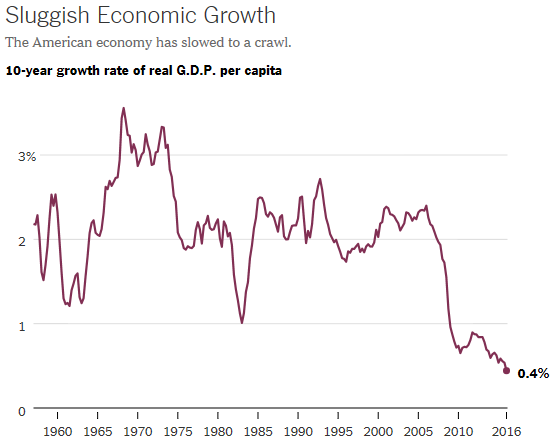
My last five posts have discussed several different aspects of the question, “Can the U.S. Economy Do Better?”  Our economy has been doing especially poorly since the end of the Great Recession seven years ago (see the chart below).  Many people claim that the President doesn’t really have all that much control over the economy.
Capture6 Here is what the2016 presidential candidates are saying on economic policy so far:

  • Hillary Clinton. She wants national paid family leave, a national minimum wage increase and more government spending on infrastructure projects. She would raise taxes by about $100 billion per year to pay for these initiatives. She is opposed to the Trans Pacific Partnership to expand trade with 11 other Pacific Rim countries.
  • Donald Trump. His top priorities are trade and immigration policy. Would he be able to successfully address China’s currency manipulation without starting a trade war? How would he be able to round up and deport millions of illegal immigrants without destroying millions of jobs and thereby crippling many businesses? His plan to slash tax rates would boost the economy but also add trillions of dollars to the debt.

As I have discussed over and over again on this blog, see, for example, here and here,  there are several fundamental policy changes needed to make our economy grow faster and create more and better paying jobs.  We need to:

  • Make it easier to start a small business by simplifying regulations at all levels.
  • Lower tax rates and simplify the tax code, paid for by shrinking deductions and closing loopholes.
  • Respond to globalization and new technology by helping its victims rather than blocking progress.

Our two presidential candidates are appealing to the fears of the voters rather than to their hopes and aspirations. Neither of them is espousing policies which will help the economy really grow in a healthy way.

Follow me on Twitter
Follow me on Facebook
Growing Employment, Shrinking Productivity: What Does It Mean?


I know that I occasionally repeat myself, but I can’t help it! In my opinion there are two major problems facing our country:

  • Slow economic growth which has averaged only an anemic 2.1% since the end of the Great Recession seven years ago.
  • Exploding national debt, now the highest it has been since the end of WWII. Unless we can quickly shrink our annual deficits down to zero, and therefore stop adding to the debt, interest payments on the debt will eventually rise to horrendous levels.


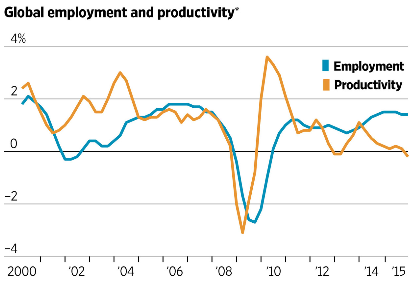
Two recent newspaper articles address the slow growth problem. Greg Ip, writing in the Wall Street Journal, points out that (worldwide) employment growth is up while productivity growth is down (see chart below).
Capture0Neil Irwin, writing in the New York Times, explains this dichotomy by pointing out that most job growth in the last decade has been in (low productivity) services rather than (high productivity) manufacturing. In other words, the U.S. economy is now producing lots of new temporary and contract jobs which do not add very much to the overall economic growth which produces higher wages and overall prosperity.
The economist John Cochrane has clearly described  why productivity growth, and therefore overall economic growth, has stagnated in recent years.  Here is a short summary:

  • Over-regulation. The Dodd-Frank Act and Affordable Care Act, for example, are hampering growth by strangling the financial and healthcare sectors of the economy.
  • Inefficient Taxation. Growth oriented taxation would have the lowest possible marginal rates paid for by shrinking deductions. Taxing consumption rather than income and savings would be even better.
  • Illegal Immigration. Solving our immigration problem would turn millions of illegals into productive citizens. An adequate Guest Worker program and e-Verify enforcement would solve this problem without the need for amnesty.

Conclusion: There are solutions to the severe economic problems facing our country. Does our political system have the flexibility to adopt these workable policies?

Follow me on Twitter: https://twitter.com/jack_heidel
Follow me on Facebook: https://www.facebook.com/jack.heidel.3


Reviving the Working Class Without Building Walls


The strangest aspect of the current presidential campaign is the staying power of the highly unconventional and controversial candidate Donald Trump. There is wide agreement that the secret of his success is his strong appeal to the members of the white working class whose incomes have been in decline for many years.
The plight of the working class is often viewed in the context of the overall increase in income inequality in the U.S.  My last two posts, here and here, are part of that discussion.
Mr. Trump appeals to these disaffected voters by vowing to wall off Mexico and cut back on foreign trade.  But it may be possible to “Revive the Working Class Without Building Walls” as Eduardo Porter suggests in the New York Times.  According to Mr. Porter, what are needed are new government programs such as wage insurance or direct government employment.
CaptureAlternatively we could meet the illegal immigration and trade protectionism problems in a much more growth oriented way as follows:

  • Immigration Reform. Set up an adequate Guest Worker program to serve only those businesses and industries which can demonstrate that they are unable to recruit enough local workers to meet their employment needs. Once the Guest Worker program is functioning properly, eVerify would be enforced to weed out unauthorized illegal workers and deport them back to their home countries. At the same time the number of H1-B visas would be expanded in order to retain more of the highly skilled foreigners getting advanced degrees in the U.S.
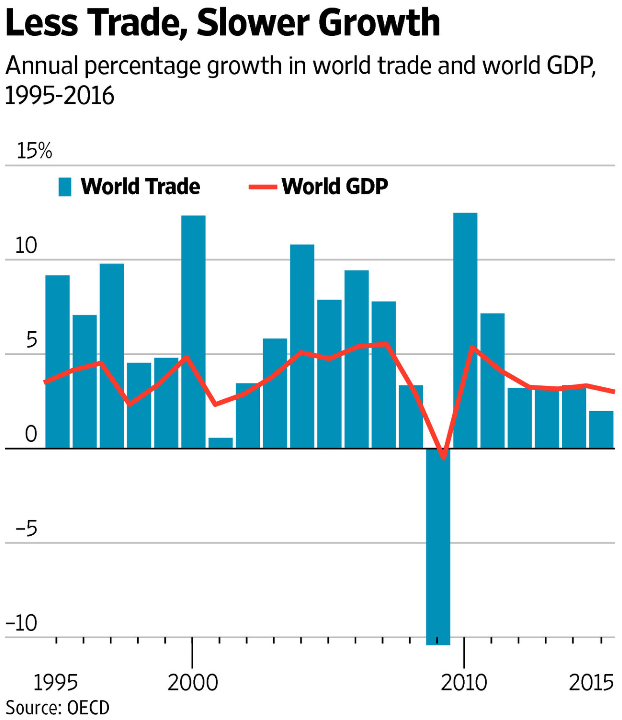
  • Foreign Trade. As the above chart shows, there is a close connection between world trade and world economic growth. And clearly the U.S. economy benefits from world-wide economic growth. The way to balance off job losses caused by foreign trade is with more effective trade-adjustment assistance and job retraining programs.

Whether or not Mr. Trump receives the Republican presidential nomination or is elected to be president in November, we should address the real grievances of his supporters in ways that benefit the entire economy.

Follow me on Twitter: https://twitter.com/jack_heidel
Follow me on Facebook: https://www.facebook.com/jack.heidel.3


What Defines a (Fiscal) Conservative?


After four debates among the Republican presidential candidates, differences between them are becoming clearer.  The New York Times has an interesting article about this in today’s paper, “G.O.P. Fight Is Now a Battle Over What Defines a Conservative.”
CaptureHere are my views on the four issues discussed:

  • A Wall or a Path? We need to solve our illegal immigration problem and the key is to set up a viable guest worker program. The fact is that our economy needs foreign workers for many jobs which require hard physical labor such as in agriculture, meatpacking and construction trades. If businesses are able to bring in immigrants when sufficient domestic labor is not available, then other issues such as border security and verifying legal status can easily be resolved.
  • The U.S. Place in the World. U.S. leadership makes the world a safer place. This means we need a strong military presence all around the world as well as active alliances, trade and military, with many other countries.
  • Of Banks, Bailouts and Blame. The cause of the financial crisis was the bursting of the housing bubble, in turn caused by an unrealistic government housing policy as well as lax enforcement of existing regulations. Blaming greedy bankers is a copout. The Dodd-Frank Law is overkill which creates a drag on the economy by hampering smaller financial institutions and community banks. The best way to control large banks is to increase their capital requirements.
  • Who Should Get Tax Cuts? The main purpose of tax reform should be to boost the economy without increasing deficit spending. The way to do this is with across the board cuts in tax rates, paid for by closing loopholes and shrinking deductions. Here are some details. The 64% of taxpayers who do not itemize deductions will get an immediate tax cut and income inequality will be greatly reduced.

Getting the answers to these issues correct will have a large effect on the future wellbeing of our country.  The Republican presidential candidates should be commended for grappling with them in a productive manner.


Omaha: What Happens When There’s a Labor Shortage?


The unemployment rate in Nebraska is now down to 2.9% and even in Omaha, a relatively large metropolitan area of 850,000, it is only 3.2%.  As reported by the Omaha World Herald today, such a low unemployment rate creates big problems for employers at all levels.
CaptureFor example:

  • In fast foods, beginning salaries are up to $10 or more per hour, well above Nebraska’s new minimum wage of $8 per hour, and raises for responsible employees are frequent. Manager’s salaries are increasing rapidly. Benefits are being expanded into such areas as tuition reimbursement.
  • For the predominantly minority residential area of North Omaha, with a traditional unemployment rate of up to 20%, local manufacturers are beginning to provide transportation vans to pick up and drop off workers.
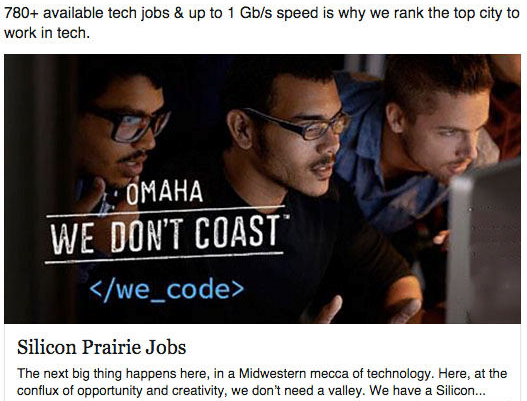
  • The Omaha Chamber of Commerce is running an ad campaign in Seattle to appeal to soon-to-be-laid-off Microsoft workers, because there are lots of vacant tech positions in Omaha.
  • Both the Greater Omaha Chamber of Commerce and the Lincoln Chamber of Commerce have endorsed LB 586 in the Nebraska Legislature to ban discrimination in the workplace based on sexual orientation and gender identity. The purpose, as expressed by both chambers of commerce, is to create a more attractive work environment in order to attract more workers from other states. The neighboring states of Iowa and Colorado have passed such laws.

What more can be done?  The welcoming labor market should provide a bigger incentive for both high school and college students to finish their studies and graduate.  Jobs will be waiting for them!  The labor shortage should also help create more interest in immigration reform.  This would insure that Nebraska has an adequate number of legal guest workers to meet the needs of the agricultural and meatpacking industries.

Nebraska Will Benefit From Immigration Reform


Several months ago the Omaha World Herald reported that Nebraska has approximately 45,000 illegal immigrants, or about 2.5% of the state’s population.  Nebraska’s unemployment rate has now dropped to 3.4%, the third lowest in the nation behind only North Dakota and South Dakota.  Such a low unemployment rate represents a labor shortage.  There simply aren’t enough Nebraskans to perform all of the physically demanding, low skill work needed in the agriculture, meatpacking and construction industries.  It is this labor shortage which is attracting such a large number of illegal immigrants to Nebraska.
CaptureAccording to the New York Times, the Tea Party has recently changed its focus from “curtailing the reach of the federal government, cutting the deficit and countering the Wall Street wing of the Republican Party to becoming largely an anti-immigration overhaul movement.”  This is a very unfortunate development.
Why would it be so difficult to solve our illegal immigration problem in the following manner:

  • Give all businesses a limited period of time, perhaps six months, to present a list of current employees who are illegal. Everyone on this list without a criminal record would receive a guest worker visa.
  • Going forward, businesses would be authorized to hire additional foreign workers as needed with guest worker visas issued in their home country. This would eliminate the need for illegal entry into the U.S.
  • As of a certain date in the near future, all businesses would be required to periodically demonstrate the legal status of all workers on their payroll.
  • Guest workers would be eligible to apply for citizenship after a lengthy period of time, perhaps ten years.

Once an adequate guest worker visa program has been set up and is operating efficiently, security on our southern border with Mexico would hardly be more of a problem than is security on our northern border with Canada. Illegal immigration should be considered as an economic problem, not a law-enforcement problem.
If it were handled correctly in this way, the problem would disappear in short order!

Now Is the Time to Solve Our Illegal Immigration Problem!


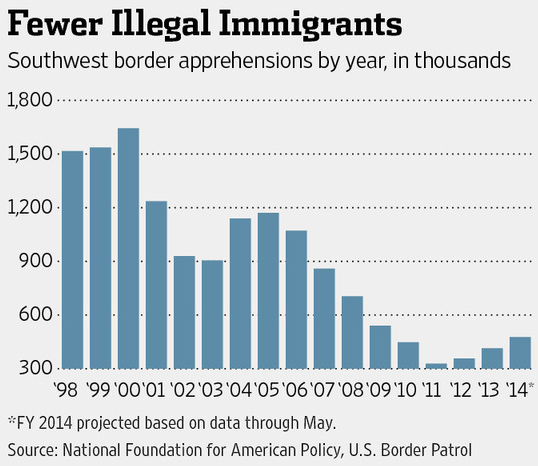
The sight of thousands of children from Central America sitting in camps at the U.S. border should knock some sense into those members of Congress who are dragging their feet on comprehensive immigration reform.  Overall, illegal border crossings are at their lowest level in many years (see chart below).  Now is the time to get things straightened out before the illegal traffic starts building up again.
CaptureWhen the New York Times, “The Border Crisis,” and the Wall Street Journal, “A Better Border Solution,” agree on an issue, I tend to agree with them.  Both newspapers say that the current crisis is the result of illegal immigrants in the U.S. trying to rescue their children from deplorable conditions back home.  If they had legal status they would go home themselves and bring their children back to the U.S. but they can’t risk doing this without a visa.
As I pointed out in a recent blog, “Immigration Reform Will Benefit Nebraska,” it shouldn’t be that hard to achieve a comprehensive solution as follows:

  • All businesses would compile a list of their current employees who are illegal. Everyone on this list, without a criminal record, would receive a guest worker visa as of a certain date. Visas would be transferable from one employer to another.
  • Companies would be authorized to hire additional foreign workers in their home countries who would then receive a guest worker visa to enter the U.S.
  • Once the system was set up and operational, all businesses would be required to periodically demonstrate the legal status of all workers.
  • Guest workers would be eligible to apply for citizenship after a relatively lengthy period of time.

America needs immigrant labor to do the hard low skilled physical work such as in agriculture, meatpacking, and construction, which most Americans don’t want to do.  An adequate guest worker system would virtually eliminate illegal immigration, thereby solving a huge current law enforcement problem.  It would also give the U.S. economy a big boost by providing all businesses with an adequate source of labor.
We have got to get beyond our hang-up about amnesty to solve this incredibly serious problem!

Immigration Reform Will Benefit Nebraska


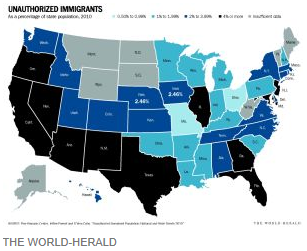
Today’s Omaha World Herald has an excellent article, “A Window on Immigration.”  It points out that 2.46% of Nebraska residents as of the 2010 census were illegal immigrants.  This works out to about 45,000 illegal immigrants in Nebraska today compared to just 3,000 as recently as 1980.  This is really a shocking figure.  It is roughly the same as the population of Nebraska’s fourth largest city (Grand Island) or Nebraska’s fifth largest county (Buffalo).  Nebraska’s unemployment rate of 3.9% is really a labor shortage.  It needs these 45,000 illegal immigrant workers!
CaptureWhy is it so difficult for our national leaders to solve this problem?  It’s crazy to think that we are going to round up 11 million illegals throughout the country and dump them into Mexico unless they are willing to “self-deport.”  Amnesty and citizenship are bogus side issues.  Here is the outline of a simple plan which would solve the problem:

  • Give all businesses a limited time period, perhaps six months or a year, to present a list of their current employees who are illegal. Everyone on this list without a criminal record would receive a guest worker visa along with all necessary legal papers. These papers would belong to the individual worker who could use them to change employment from one business to another.
  • Going forward, businesses would be authorized to hire additional foreign workers as needed who would automatically qualify for guest worker visas. Such visas would be granted in the country of origin thereby avoiding the need for illegal entry into the U.S.
  • As of a certain date in the near future, all businesses would be required to periodically demonstrate the legal status of all workers on their payroll. Penalties for non-compliance would be severe.
  • Guest workers would be eligible to apply for citizenship after a relatively lengthy period of time, perhaps five years or ten years.

Once an adequate guest worker visa program has been set up and is operating efficiently, allowing all businesses to hire as many foreign workers as they need, security on our southern border with Mexico would be no more of a problem than is security on our northern border with Canada.
In other words, illegal immigration is an economic problem, not a law enforcement problem.  The way to solve this problem is to address it correctly!