What Is Slowing Down Today’s Economy? II. Three Culprits


My last post, “What Is Slowing Down the U.S. Economy,” reports on an interesting analysis by the Gallup economist, Jonathan Rothwell, making an excellent case that three of the biggest drags on the U.S. economy are the costs of:

capture93

  • Healthcare. By far the biggest drag, healthcare costs have increased from 9% of GDP in 1980 to 18% in 2015. Mr. Rothwell notes that the average U.S. physician spends $83,000 per year to process claims and interact with insurance companies compared to $22,000 in Canada which has a single payer system. The solution, in my opinion, is to change the tax treatment of employer provided health insurance (to cover catastrophic coverage only) in order to give individuals more “skin in the game.”
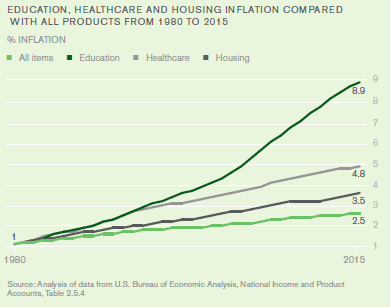
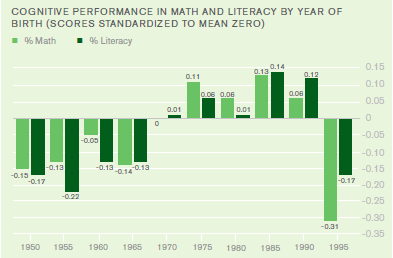
  • Education. Although education costs have risen only from 6% to 7% of GDP over the past 35 years, education overall is 8.9% more expensive in 2015 than in 1980 and higher education is 11.1 times more expensive. Considering the ever increasing need for highly trained workers in today’s high-tech and globally competitive economy, such rapidly increasing cost presents a huge impediment to progress. Foundational K-12 education is also failing to close the achievement gap between low-income minority students and middle-class students. Such disparity in educational outcomes bodes ill for future social harmony. Even overall cognitive performance in math and literacy is now declining (see chart). These are tough problems to solve.

    capture95

  • Housing. Again, only a 1% increase (from 11% to 12%) in GDP from 1980 to 2015 but this translates into a rental cost increase of 19% of GDP in 1980 to 28% of GDP in 2015. Also mortgage payment costs increased from 12% of GDP in 1980 to 16% of GDP today. Mr. Rothwell attributes these increases to a tightening of local zoning restrictions. There does not appear to be any general policy solution to such a problem.
Conclusion. The costs of healthcare, education and housing are eating up greater and greater amounts of family income and therefore are retarding economic growth and social progress. What can be done about these problems?  Stay tuned!
Follow me on Twitter
Follow me on Facebook

What Is Slowing Down Today’s Economy?


We will soon have a new President and, even though his election was somewhat of a fluke, he will obviously want to help the blue-collar workers who elected him.  The best way to do this is to make the economy grow faster.
The Gallup economist, Jonathan Rothwell, has just issued an excellent analysis of some of the major reasons for our current slow economy, “No Recovery: an analysis of long-term U.S. productivity decline.”

capture91
Says Mr. Rothwell:

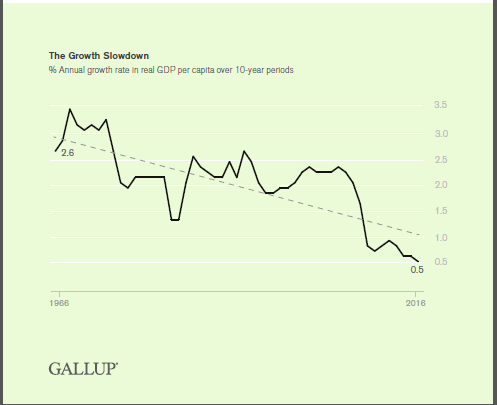
  • The problem is severe. U.S. GDP growth per capita has declined from 2.6% in 1966 to .5% today. Small differences expand into vast gaps in potential living standards. 1% growth for the next 35 years would expand household income from $56,000 in 2015 to $79,000 in 2050 (inflation adjusted), whereas 1.7% growth would raise household income to $101,000 in 2050.
  • Changes in living standards are fundamentally linked to changes of how the quantity of goods and services relate to their cost. Deterioration in the quality-to-cost ratio for healthcare, housing and education is dragging down economic growth. These three sectors alone have increased from 25% of GDP in 1980 to 36% of GDP in 2015.capture92
  • The cost of healthcare is 4.8 times as high today as in 1980, the cost of education is 8.9 times as high today as in 1980 and the cost of housing is 3.5 times as high today as in 1980. These compare to an overall cost increase of all items of 2.5 times today compared to 1980.
  • These three sectors have all gotten more expensive (without getting more productive), thereby absorbing more of families’ incomes, making it harder to satisfy other wants.

Conclusion.  We all want schools that work, adequate housing, and quality healthcare.  The problem is how to achieve these ends in a much more affordable manner.  Stay tuned!

Follow me on Twitter
Follow me on Facebook

The Meaning of 2016


For my last blog post of each year I briefly summarize the main events of the preceding year and then try to evaluate their significance. Last year I was badly off in one respect. I said that the rise of Donald Trump was a disaster for the Republican Party because he could not possibly be elected president!  I badly underestimated the force of populism sweeping the country.
Here are the main events of 2016:

  • Brexit. On June 23 Great Britain voted 52% – 48% to leave the European Union. Elite opinion advocated staying in and the polls predicted majority support for staying. The world was shocked when the vote went the other way.
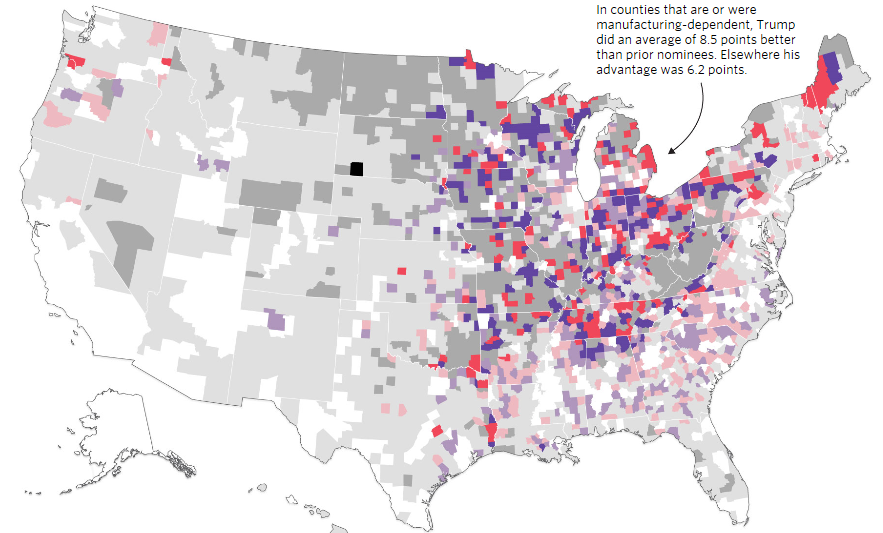
  • Donald Trump was elected the next U.S. President on November 8. The polls predicted a Hillary Clinton victory and she in face won the popular vote by a 3,000,000 vote margin. But Trump squeaked by in the Electoral College by winning the rust belt battleground states of Michigan, Pennsylvania and Wisconsin by a combined total of 100,000 votes (see attached map to understand the Trump electoral vote margin).capture17
  • The Mid-East Refugee Crisis, Terrorism and Russia’s Vladimir Putin were even bigger problems in 2016 than in 2015 and will present huge challenges to Donald Trump when he becomes President on January 20.

Granted that Trump was elected by a slim electoral vote margin and a smarter campaign by Clinton could have led to a different outcome, nevertheless for such a sleazy, non-politically correct candidate to have done so well, has huge significance. It constitutes a major slap down of elitism:

  • Consider where our most recent presidents went to college: Reagan (Eureka College), George H.W. Bush (Yale), Bill Clinton (Yale Law), George W. Bush (Yale), Barack Obama (Harvard Law) and Donald Trump (Fordham). In other words, Trump will be the only president since Reagan not to have graduated from Harvard or Yale.
  • Consider that since John Paul Stevens (Northwestern Law) retired from the Supreme Court in 2010, every current Supreme Court Justice has graduated from an Ivy League Law School.
  • Consider that most nationally prominent Republicans, including members of Congress, shunned Donald Trump on the campaign trail even as his poll numbers steadily increased. In other words he was elected largely without the help of the Republican establishment.

Conclusion. The American voters have decided to take a big chance on a nontraditional presidential candidate. Are the voters collectively smarter than the elites to whom they usually turn for leadership?  I am optimistic that the answer will turn out to be yes!

Follow me on Twitter
Follow me on Facebook


The Obama Legacy II. In the tender hands of Donald Trump


A year ago, I examined “The Obama Legacy” from a general point of view. I simply looked at his record after seven years in office:

capture16

  • Stagnant Economy, growing at an anemic 2.1% annual rate ever since the end of the Great Recession in June 2009.
  • Massive Debt, at 74% of GDP (now 76%), the highest since the end of WWII.
  • Chaotic Middle East, the rise of ISIS in Syria, Iraq and North Africa and the resulting refugee crisis in Europe is the result of weak U.S. leadership.
  • Hyper-partisan Political Atmosphere, especially because of the above failures, leading to the rise of populist political candidates such as Bernie Sanders and Donald Trump.

Now, a year later, as he prepares to leave office, all of the above conditions are still true. The only major change is that the conservative, not the liberal, populist, Donald Trump, will succeed him in office.  Admittedly, the election outcome was a fluke.  Trump’s electoral margin was provided by a slim popular vote victory of 100,000 votes combined in the battleground states of Michigan, Pennsylvania and Wisconsin.  Such an outcome was totally unpredicted and represents a miscalculation by the Clinton campaign.
In other words, the election easily could have gone the other way, in which case the Obama legacy would have had a four year period of protection by a Hillary Clinton presidency. Nevertheless, according to the Democratic pollster, Stanley Greenberg, the Obama presidency was deficient in several fundamentally crucial ways:

  • More than 1000 state and national Democrats lost their elections during his two terms. Republicans now have total (legislative and governor’s office) control in 25 states.
  • The economic recovery from the Great Recession morphed into bailouts – bank bailouts, auto bailouts, insurance bailouts, rather than directly addressing the continuing economic struggles experienced by a majority of Americans.
  • Approximately 40% of the Democratic base of minority, unmarried female and millennial voters disapproved of how President Obama was handling his job in 2010 and 2014, and many of these voters stayed home during the 2016 election as well.

Conclusion. The fate of Mr. Obama’s major achievements of the Affordable Care Act, the Iran nuclear agreement and committing the nation to address climate change are all now at risk of being overturned by the new presidential administration.

Follow me on Twitter
Follow me on Facebook

Understanding the Trump Agenda


From a reader of my blog:

“I continue to enjoy your blog. A word of warning.  Trump is not a normal person and he is extremely self-centered (narcissistic).  He has never thought of anyone other than himself (& his family).  I believe that will not change.  He lies all the time so can only be judged by his actions, not his words.  He admires Putin.  I think he would like to be an autocrat who rules without any dissent.  I do not think he cares about the constitution.  Not for a minute.”

capture91
I understand that many people feel this way about Donald Trump and I can’t argue with such an analysis. But he is also a change agent and, now that he has been elected President, I am hopeful that he will make good choices for our country.  For example:

  • The Economy. His appointments of Mnunchin for Treasury, Price for HHS, Pruit for EPA, for example, are excellent. People like these will work closely with the Republican Congress on the tax reform, regulatory reform, financial reform, etc. measures which are needed to get our economy growing faster. Boosting growth to 3% per annum as opposed to our current anemic 2% rate, which is entirely possible, will do wonders to create more jobs and better paying jobs, and therefore restore a stronger spirit of optimism to our national mood.
  • Education. DeVos for Education is also an excellent choice. Our K-12 public education system is not working for low-income, minority kids in big cities. We also need far more emphasis on career and vocational education for those unlikely to go to college.   In other words, we need big changes in education policy and DeVos is a reformer.
  • National Security. Both terrorism and Russia’s Vladimir Putin represent huge threats to the western world. General Jim “Mad Dog” Mattis is highly qualified to lead our defense in such a dangerous environment. The big question remaining at this point is whether Trump will be able to stand up to and outfox Russia’s Putin.

Conclusion. Mr. Trump is making some very good appointments for the people who will lead major governmental agencies. In this respect his presidency is off to a good start.

Follow me on Twitter
Follow me on Facebook

How to Confront Vladimir Putin


My last post expressed my biggest worry about Donald Trump: that he won’t be sufficiently firm with Vladimir Putin to persuade him to stop his aggression in Eastern Europe. The American Enterprise Institute’s Leon Aron has an excellent analysis of the Putin problem, “Changing Putin’s Mind.”  Says Mr. Aron:

  • Vladimir Putin has called the demise of the Soviet Union “the greatest geopolitical tragedy of the 20th century.” The overarching objective of Putin’s policies, both domestic and external, is to recover and repossess the political, economic and geostrategic assets lost by the Soviet state when it fell apart in the 1990s.
  • In Putin’s first two terms as Russian President, from 2000 – 2008, he focused on restoring the economy. But by 2012, when Putin returned to power, the domestic investment climate had slowed to a crawl with low oil prices causing a severe recession. Putin shifted the foundation of his regime’s legitimacy from economic expansion to patriotic mobilization.

    capture91

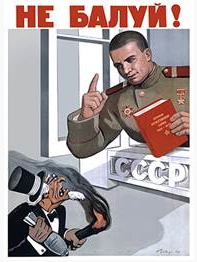
  • The reason for the annexation of Crimea, war on Ukraine and intervention in Syria is that restoring Russia’s superpower pride is essential to his regime’s legitimacy. This is the point of a classic Soviet poster (attached) with a Russian soldier admonishing Uncle Sam, “Don’t you fool around!”
  • In Syria, Putin’s goal is to help Bashar al Assad, not defeat ISIS, and so Assad must not be restored. This could be accomplished by grounding the Syrian air force, enforcing no-fly zones, etc. and forcing Putin to distance himself from Damascus.
  • In Ukraine, Putin will not stop unless battlefield dynamics begin to change by, for example, sending Ukraine defensive anti-tank and anti-aircraft weapons, radars to pinpoint Russian positions, etc. Putin must be forced to make a choice between increasing Russian deployment and thus casualties or seeking a genuine peace agreement.

Conclusion.  The choice is between two admittedly risky and unpleasant options: confronting Putin now or see him emboldened to the point where he attempts to destabilize a member state on NATO’s eastern flank.

Follow me on Twitter
Follow me on Facebook

My Biggest Reservation about Donald Trump


“Freedom is never more than one generation away from extinction”
Ronald Reagan, 1911 – 2004

I am now cautiously optimistic about President-elect Donald Trump. He was not my first choice among the Republican Primary candidates nor did I even vote for him on November 8th.  However he is a change agent and our country badly needs change.  A big problem is that he praises Russian President Vladimir Putin and says that NATO is “obsolete.” I have learned not to take Mr. Trump literally but, nevertheless, I am still concerned.
capture90I have long been a fan of the Russian native and former world chess champion, Garry Kasparov, who is now the Chairman of the Human Rights Foundation in New York.  He is the author recently of “Winter is Coming: why Vladimir Putin and the enemies of the free world must be stopped.”
Here is an outline of Mr. Kasparov’s recommendations for confronting Mr. Putin:

  • Isolate dictatorships that exploit engagement to support oppression of their own people.
  • Keep human rights and the value of human life as the backbone of foreign policy.
  • Defend Ukraine as if it shares a border with every free nation in the world. It is easier to take a stand now over Ukraine than to let it go and then have to worry constantly about our commitment to the Baltics and Poland who are NATO members.
  • Europe gets a third of its energy from Russia but Europe buys 80% of Russia’s energy exports. This provides the NATO Allies with great leverage especially considering the export potential for U.S. oil and gas.
  • Maintaining a robust American security umbrella is much safer than encouraging military proliferation by shrinking that umbrella.
  • Appeasement reflects the overall climate not just the personal weakness of specific leaders.

Conclusion. Russian aggression under Vladimir Putin is now the biggest threat to world peace. It is critical for incoming President Trump to act firmly with Mr. Putin.

Follow me on Twitter
Follow me on Facebook

Trump’s Economic Challenge


As I like to remind my readers from time to time, I am a non-ideological fiscal conservative. I simply want to solve our two most fundamental fiscal and economic problems:

  • Slow economic growth, averaging just 2.1% since the end of the Great Recession in June 2009,
  • Massive debt, now at 76% of GDP (for the public part on which we pay interest), the highest since the end of WWII,

by whatever means it takes.
Donald Trump won the presidential election contest because he convinced blue-collar white voters that he would do something about their declining economic prospects.  But can he actually deliver for them?
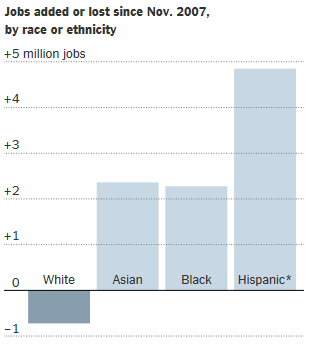
capture87Yesterday’s New York Times has an excellent analysis of this problem by the economic journalist, Eduardo Porter, “Where were Trump’s votes?  Where the jobs weren’t.”  Mr. Porter points out that, in fact, Hispanic, Black and Asian workers have all done much better than white workers since November 2007 (see above chart).
capture88He also points out that all three of these minority groups live primarily in metropolitan areas where jobs have been growing much faster than in nonmetropolitan areas (see above chart).
He further points out that while the number of manufacturing jobs has been flat since 1978, the number of service jobs has been increasing rapidly and that most of these new service jobs are in the cities where minorities are clustered (see below).
capture89The question then is what Mr. Trump (or anyone else!) can do to help his largely rural blue-collar constituency?  Mr. Porter recognizes that faster economic growth will have to come from investments in technology and human capital.  But he thinks that this will happen mostly in the cities and thus help minorities proportionally more than whites. Conclusion. Helping blue-collar whites is Mr. Trump’s fundamental economic problem.  Faster overall economic growth will help to some extent.  Trade restrictions will not help.  Immigration restrictions might help but could also hurt the overall economy if employers can’t hire enough workers. Better education and vocational training will help in the long run but not immediately.  This is a very tough problem to solve!

Follow me on Twitter
Follow me on Facebook

Do Charter Schools Improve K-12 Education?


President-elect Donald Trump has nominated a charter school advocate from Michigan, Betsy DeVos, to be his Secretary of Education. This raises the obvious question, do charter schools improve K-12 education? A recent study by Stanford University’s Center for Research on Education Outcomes (CREDO) suggests that they do in general, although very unevenly.

capture86
As summarized and elaborated upon by the Economist, here are the results:

  • Charter schools work well for low-income children in cities. In 41 urban areas (see map), students learned 40 more days of math and 28 more days of reading every year on average. Black and Hispanic children performed especially well. Where they have worked well such as in Boston, New York City and Washington D.C., students make gains up to 100 days per year.
  • One lesson learned is that autonomy needs to be coupled with accountability. When charter schools expand with little oversight, as in Arizona, results can be worse than in regular schools.
  • A second lesson is that leadership matters. Business practices such as performance tracking and incentives achieve better test scores. A successful charter organization such as KIPP (Knowledge is Power Program) opens new school only when it spots a leader capable of running it.
  • A third lesson is how to scale up the type of education provided by the best charters. These have five qualities: frequent feedback for teachers, tutoring, longer school days and terms, effective use of data to track student progress, and a relentless focus on academic achievement.

Conclusion. Charter schools are a valuable state and local educational option. Many charters are succeeding very well and the factors which lead to success are increasingly well understood. At the very least the competition created by charter schools leads to better performance by public schools. The answer to the question in the title is yes!

Follow me on Twitter
Follow me on Facebook

Trump’s Cabinet Choices Bode Well for the Economy


President-elect Donald Trump made faster economic growth one of his major campaign themes and the direction of Trumponomics is already beginning to take shape.  His major cabinet choices so far auger well for the fundamental changes which are needed to speed up economic growth:
capture64

  • Steven Mnuchin for Treasury. Mr. Mnuchin says that “the number one problem with Dodd-Frank is that it is way too complicated and cuts back lending.” Making loans is “the engine of growth to small- and medium-sized businesses.”  He also believes that 3% – 4% GDP growth is possible with tax and regulatory reform.
  • Tom Price for Health and Human Services. Mr. Price has some excellent ideas for getting American healthcare straightened out, in order to make it more consumer-oriented as well as less costly for individuals, businesses and the government (i.e. the taxpayers).
  • Scott Pruitt for the Environmental Protection Agency. Mr. Pruitt is a lawyer who has fought EPA overreach as the Attorney General of Oklahoma. Mr. Pruitt will end up improving the environment because “he will make sure that the rules issued by the EPA are rooted in law and thus won’t be overturned in court.”
  • Betsy DeVos for Education. Ms. DeVos, a school reformer from Michigan, is a strong supporter of vouchers and charter schools. K-12 school reform is absolutely essential to better prepare low-income and minority students for the high tech and global economy which awaits them after graduation.
  • General James Mattis for Defense and Senator Jeff Sessions for Attorney General are also excellent choices for strengthening America’s national security and moral fabric.

Conclusion. I have been advocating fundamental changes in fiscal and economic policy for years now and, thanks to the election of Donald Trump, things are moving rapidly in this direction. It is a good time to be optimistic about the future of our country.

Follow me on Twitter
Follow me on Facebook