Should We Raise Taxes or Cut Spending?


Tax Day is a good time to remind ourselves about our perilous fiscal situation.  With a public debt (on which we pay interest) of $13 trillion and with annual deficits of just under $500 billion adding to the debt each year, we have a huge problem which is not being adequately addressed by Congress.  The solution is to either raise taxes or cut spending or do a combination of both.
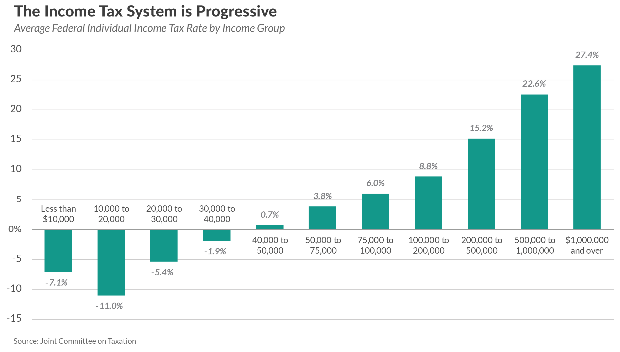
CaptureIs it feasible to raise taxes, presumably on the rich?  The problem in doing this is that our tax code is already very progressive as indicated by the above chart. The top 20% already pay 84% of all income taxes.  It’s just not feasible to expect to be able to raise their taxes by a very large amount.  In addition, Middle- and lower-income people are in a tight fiscal situation, because of the slow economy, and can hardly be expected to see their own taxes increase.
Capture1The alternative to raising taxes is to cut spending and there are many opportunities to do this.  The organization Citizens Against Government Waste has just identified a collection of government programs whose elimination would save $639 billion in the first year alone.  Taxpayers for Common Sense has a long list of potential spending cuts which would save $267 billion in the first year.
Amazingly, neither of these lists of possible cuts includes any mention of entitlement programs.  Before very long, major savings in entitlement programs must certainly be achieved in order to put the federal government on a sustainable fiscal course.
In fact, spending should be trimmed all across the board, wherever possible, in order to get our annual deficits on a steadily downward course.  It is critical for this process to get under way as soon as possible and to continue until fiscal balance is achieved by entirely eliminating deficit spending altogether.

Can We Solve All Our Fiscal and Economic Problems at the Same Time?


This website, It Does Not Add Up, is devoted to discussing our country’s most serious economic and fiscal problems.  They are:

  • Stagnant Economy. Since the end of the Great Recession in June 2009, the economy has been growing on average at the historically slow rate of about 2.3%. Slow growth means higher unemployment, stagnant wages and less tax revenue.
  • Massive Debt. U.S. public (on which we pay interest) debt is now 74% of GDP (highest since WW II) and projected by CBO to grow rapidly unless strong measures are taken to reduce it. This puts our country’s future wellbeing and prosperity at great risk.
  • Increasing Income Inequality. Incomes for the high-skilled and well-educated are increasing much faster than for the low-skilled and less-educated workers.

The new Republican majorities in Congress are stirring the waters by proposing a ten year plan to shrink the deficit down to zero, i.e. to balance the budget by 2025.  The opposition claims that this would “sharply cut the scale of domestic spending, which would mostly fall on the poor.”
Capture1But the American Enterprise Institute’s James Pethokoukis points out that social spending in the U.S., both public and private, is very generous and second only to France in the entire OECD. So here is how we could proceed to address our basic problems in a unified manner:

  • Balance the Budget by a combination of Republican spending cuts and cutting back on two major tax deductions: Employer-sponsored Health Insurance (cost: $250 billion per year) and Mortgage Interest (cost: $70 billion per year).
  • Boost Economic Growth by expanding the Earned Income Tax Credit to encourage more people to accept low paying, entry level jobs. Increase the Social Security eligibility age from 67 to 70, thereby keeping near retirees in the workforce for three additional years (this will also extend the solvency of the Social Security Trust Fund).
  • Decrease Income Inequality. Cutting back on tax deductions, in part to pay for expansion of the EITC, lessens income inequality as well as shrinking the deficit. A faster growing economy also lessens inequality by providing more opportunities for upward mobility.

In other words, addressing each of these fundamental problems in an intelligent manner contributes to solving the remaining problems as well.  This creates a virtuous circle for economic progress!

The President’s Budget: Stabilization of the Debt Is Not Enough!


President Obama has proposed a $3.99 trillion budget for next year, a $340 billion increase from the current 2015 budget year.  As shown in the charts below, it projects deficits of about 2.6% over the next ten years equal to its (optimistic in comparison to the CBO) growth projections for GDP.  This means that the debt would stabilize at about 73% of GDP.  And, of course, achieving his predicted stabilization of debt will require big tax increases over this ten year period.
CaptureHere are the major weaknesses in the budget:

  • Sequestration. The President declares that “I’m not going to accept a budget that locks in sequestration going forward.” Everyone deplores the mindlessness of sequestration but the only responsible alternative is to make targeted cuts throughout the budget. The President makes no attempt to do this. And he wants to add spending for various new education and research initiatives, as well as an expanded Earned Income Tax Credit for low-income workers.
  • Infrastructure. Spending over the next six years would increase by $238 billion to be raised from a 14% repatriation tax on the $2 trillion in foreign earnings held overseas by American multinational corporations. The problem is that any repatriation tax should be tied in with overall corporate and business tax reform, exchanging lower tax rates in return for closing loopholes and deductions, in order to make U.S. business taxes competitive with those of other countries. Fundamental tax reform is the key to getting our economy growing faster.
  • Entitlements. The President’s budget does not even mention the biggest threat to long-term fiscal sustainability, namely the rapidly increasing spending for Social Security, Medicare and Medicaid. It will be very difficult to make progress on this critical issue without presidential leadership.
  • Stabilization of the Debt. The President’s budget, with quite optimistic revenue and growth projections, stabilizes the debt over ten years. But this is not nearly good enough. To be satisfied with a public debt of 73% of GDP indefinitely into the future is simply too risky. What’s going to happen when we have another financial crisis, as we surely will? How are we going to cope with our growing rivalry with China with very little budget flexibility? And one can imagine any number of other possible emergencies which might occur. Putting the debt on a clear downward trajectory is the only prudent thing to do!

What Will It Take to ‘Fix the Debt’?


I have recently become a volunteer for the national bipartisan organization, Fix the Debt. It is the outreach arm for the Washington think tank, Committee for a Responsible Federal Budget, which is an offshoot of the Simpson-Bowles Commission from several years ago.
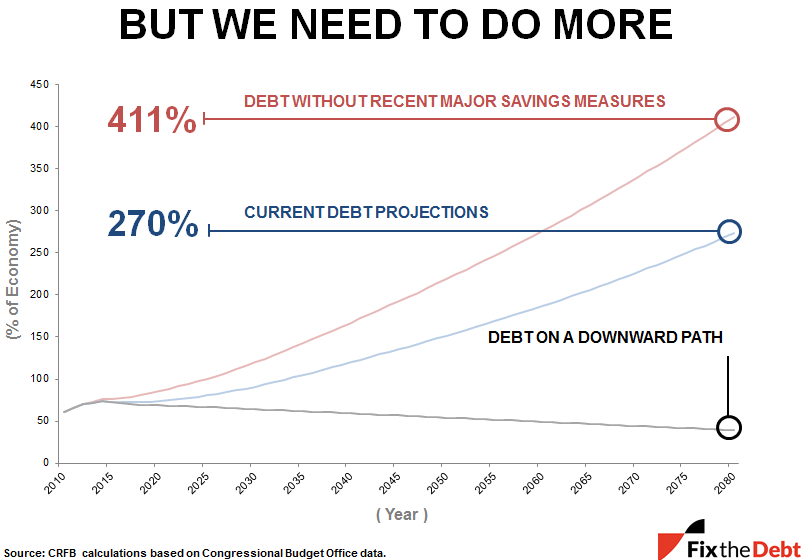
As such, I give presentations to local civic organizations about our national debt and what needs to be done to get it under control. Typically the audience will readily appreciate the seriousness of our debt problem.  What they want to talk about are practical ways to address it.  They have their own ideas and want to know what I think as well.  My first message is that we don’t have to pay off the debt or even balance the budget going forward.  Realistically we need to shrink our annual deficits in order to put the debt on a downward course as a percent of our growing economy,  as shown in the chart just below.

Capture It will be a huge challenge to accomplish even this!  Here are my ideas, in very general outline, on how to get this done:

  • Entitlements (Social Security, Medicare and Medicaid) are the biggest single problem because our population is aging so fast. Furthermore, in order to control the growth of Medicare and Medicaid, we have to do a much better job of controlling the overall cost of healthcare in the U.S. For example, even though healthcare costs slowed down to an increase of only 4.1% in 2014, this is still more than twice the rate of inflation!
  • The second thing we need to do is to make our economy grow faster than the roughly 2.3% growth we have achieved since the end of the Great Recession. The main way to get this done is through broad-based (and revenue neutral) tax reform at both the individual and corporate levels, by reducing tax rates, paid for by closing loopholes and limiting deductions.
  • Finally, there is enormous waste and inefficiency in the federal budget, with huge redundancy and overlap of programs between different federal departments. Responsibility for such programs as education, community development, transportation and social welfare, for example, should be returned to the states with block-grant funding to replace rigid federal control.

I have discussed each of these major reform ideas in much detail in previous blog posts and will continue to do so.  As large as our fiscal problems are, I remain optimistic that they can and will be successfully addressed.

Fix the Debt


Recently I have had several posts about our national debt, for example, “Why the National Debt Is Such a Threat to the U.S.,” showing graphically that our current public debt at 74% of GDP is very high by historical standards and rising rapidly under current fiscal policies.
CaptureYesterday I attended a workshop in Washington D.C. put on by Fix the Debt.  All expenses were paid and, in return, the attendees agree to make at least three presentations to local community groups during the following year.  This means that I will soon be sending out a letter to such groups as Kiwanis and Rotary Clubs around the Omaha area where I live, offering my services as a speaker at one of their meetings.  The purpose is to build more public awareness of the threat of a huge and growing national debt to the long-term welfare of our country. Here is a summary of talking points from the workshop:

  • The deficit for the 2013-2014 fiscal year is almost $500 billion.
  • Under current fiscal policies the debt will increase to 270% of GDP by 2080.
  • Reasons for our debt problem:
  1. An aging population which means expanded Social Security spending
  2. Healthcare costs are growing for both Medicare and Medicaid
  3. Interest costs will grow rapidly as the economy recovers and interest rates rise
  • All bipartisan reform plans call for both spending cuts and revenue increases.
  • The benefits of taking action are:
  1. Increased budget flexibility
  2. Lower exposure to changes in interest rates
  3. Reduced risk of another financial crisis
  • The longer we wait:
  1. The older our population gets
  2. The higher the debt will rise
  3. The less time we have to phase in changes
  4. The slower our economy will grow
  5. The fewer tools we will have to fix it
  • How do we bring debt under control?
  1. Enact policies that grow the economy
  2. Health care cost containment
  3. Spending cuts
  4. Tax reform and tax expenditure cuts

Let me know if you’d like a speaker on this topic at your club!

Which Nebraska Senate Candidate Is Most Serious about the National Debt?


“The single biggest threat to our national security is our debt”
Admiral Mike Mullen, former Chairman of the Joint Chiefs of Staff

My last blog, “Why the National Debt Is Such a Threat to the U.S.” observes that our debt is very large by historical standards and will just keep getting worse under current policies now in effect.  This has many severe consequences for the well-being of our country.
What do we do about it?  We have to shrink the size of our annual deficits which are continuing to make the debt bigger and bigger.  The deficit for the 2014-2015 budget year just ended is $483 billion which is 2.8% of GDP.  Since our economy has been growing at a rate of only 2.2% for the past five years, this means that the debt is still growing faster than the economy.  We have to do better than this.
CaptureThe above chart from the Congressional Budget Office shows that the main contributors to the deficit, and therefore also the debt, over the next 20 years, will be entitlements (Social Security, Medicare and Medicaid) and interest payments on the debt.  All other programs, i.e. almost all of traditional federal spending, will decrease as a percentage of GDP.
This means that there are just two basic ways to solve our debt problem: trim entitlement spending and/or increase government revenue.  We’ll need to do both.  Furthermore, it is unrealistic to expect middle-income and lower-income people to pay higher taxes when their wages have been stagnant for many years.  New tax revenue will have to come from the wealthy including upper-income wage earners.  The best way to do this is by cutting back on the annual $1.2 trillion in loopholes and deductions built into the tax code.
CaptureOnly one Senate candidate from Nebraska is willing to both trim entitlement spending and raise additional tax revenue: Jim Jenkins, a registered independent from Calloway.  The Democratic candidate, David Domina, will not support any significant reining in of entitlement spending.  The Republican candidate, Ben Sasse, is too beholden to wealthy contributors to be willing to raise their taxes by cutting back on their tax deductions.
We badly need elected representatives in Washington who will make it their top priority to “fix the debt.”  Jim Jenkins is such a person.  I hope you will vote for him!