Redesigning the American Health Care System to Lower its Cost II. Medicare


By far the biggest problem our country faces is long term debt. The public debt (on which we pay interest) is now 77% of GDP, the highest since the end of WWII, and steadily growing worse.  The fundamental driver of our debt problem is the cost of healthcare, public and private.
My last post describes two major reforms which are needed to get the cost of healthcare under control. The first, and most important, is to replace the tax exemption for employer provided care by a universal tax credit limited to the cost of catastrophic health insurance (with a high deductible).  This fundamental change would be accompanied by allowing tax preferred Health Savings Accounts for use in paying routine medical expenses.  The purpose here is to make all of us more responsible for the cost of our own healthcare.

The second big change which is needed is a

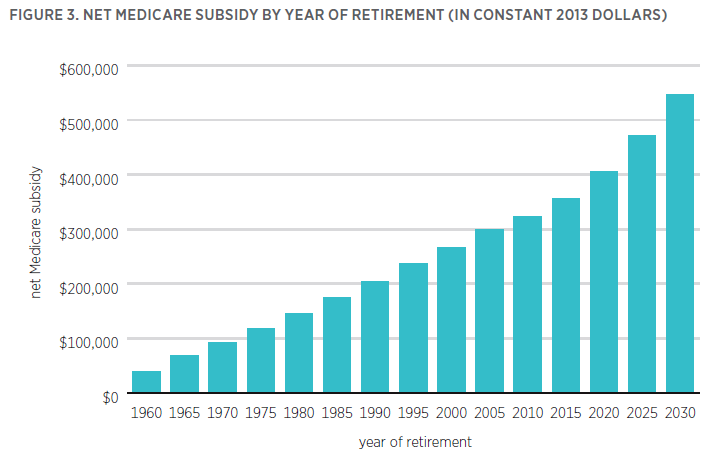
  • Redesign of Medicare. Medicare is currently being subsidized by the federal government at a net cost (after FICA taxes and premiums paid) of over $400 billion per year, and this cost will continue to increase rapidly without a change in policy.

The best way to reform Medicare is to first modify the tax exemption for employer provided care, as mentioned above, and then gradually migrate Medicare onto this new system.  However, in the meantime there are more direct ways to make Medicare less expensive:

  • Community-rated premiums. Medicare premiums should not vary based on age or health status but they should vary based on an enrollee’s income.
  • Defined contributions and beneficiary choice. Enrollees would apply the government contribution to their choice among competing options for Medicare coverage.
  • Facilitating healthcare savings. Tax-preferred Health Savings Accounts would be made available to Medicare enrollees to pay for routine medical expenses up to a deductible amount.

Conclusion. The current Medicare program is rapidly becoming too expensive for the federal government to fund with general tax revenues. A few simple and sensible changes will put Medicare on a sustainable course.

Follow me on Twitter 
Follow me on Facebook 


Maybe the GOP Really Is the Stupid Party


The Nobel prize-winning economist, Paul Krugman, more recently turned partisan flack for the New York Times, has occasionally referred to Republicans as “the stupid party.” After the debacle with the House’s American Health Care Act, maybe he is right.  This bill is far from perfect but is a step in the right direction.  Its major virtue is a serious attempt to get Medicaid spending under control.
According to an astute analysis by the Wall Street Journal:

  • The AHCA would put Medicaid on a budget for the first time since its creation in 1965.
  • Medicaid insures more than 72 million people, or one in every five Americans.
  • Medicaid is now the third largest, and fastest growing, program in the federal budget. Federal outlays are now $360 billion per year, more than three times as much as in 2000.
  • The federal government matches between 50% and 74% of state costs for Medicaid recipients, which means that the states have little incentive to control spending by allocating resources toward high quality care for the most vulnerable.
  • A 2013 study by the New England Journal of Medicine found that “Medicaid generated no significant health improvements,” compared to the uninsured.
  • The AHCA would transition federal funding to a per-capita block grant that would grow with an index of medical inflation. In exchange, governors would gain reform flexibility over the current rigid rules.

Conclusion. It is completely nonsensical for the House Freedom Caucus to oppose such an attractive reform plan just because it isn’t perfect. The members of the Freedom Caucus claim to be fiscal conservatives and to support balanced budgets.  And yet they refused to take a simple, practical step to work toward that goal.

Follow me on Twitter
Follow me on Facebook

The Meaning of 2016


For my last blog post of each year I briefly summarize the main events of the preceding year and then try to evaluate their significance. Last year I was badly off in one respect. I said that the rise of Donald Trump was a disaster for the Republican Party because he could not possibly be elected president!  I badly underestimated the force of populism sweeping the country.
Here are the main events of 2016:

  • Brexit. On June 23 Great Britain voted 52% – 48% to leave the European Union. Elite opinion advocated staying in and the polls predicted majority support for staying. The world was shocked when the vote went the other way.
  • Donald Trump was elected the next U.S. President on November 8. The polls predicted a Hillary Clinton victory and she in face won the popular vote by a 3,000,000 vote margin. But Trump squeaked by in the Electoral College by winning the rust belt battleground states of Michigan, Pennsylvania and Wisconsin by a combined total of 100,000 votes (see attached map to understand the Trump electoral vote margin).capture17
  • The Mid-East Refugee Crisis, Terrorism and Russia’s Vladimir Putin were even bigger problems in 2016 than in 2015 and will present huge challenges to Donald Trump when he becomes President on January 20.

Granted that Trump was elected by a slim electoral vote margin and a smarter campaign by Clinton could have led to a different outcome, nevertheless for such a sleazy, non-politically correct candidate to have done so well, has huge significance. It constitutes a major slap down of elitism:

  • Consider where our most recent presidents went to college: Reagan (Eureka College), George H.W. Bush (Yale), Bill Clinton (Yale Law), George W. Bush (Yale), Barack Obama (Harvard Law) and Donald Trump (Fordham). In other words, Trump will be the only president since Reagan not to have graduated from Harvard or Yale.
  • Consider that since John Paul Stevens (Northwestern Law) retired from the Supreme Court in 2010, every current Supreme Court Justice has graduated from an Ivy League Law School.
  • Consider that most nationally prominent Republicans, including members of Congress, shunned Donald Trump on the campaign trail even as his poll numbers steadily increased. In other words he was elected largely without the help of the Republican establishment.

Conclusion. The American voters have decided to take a big chance on a nontraditional presidential candidate. Are the voters collectively smarter than the elites to whom they usually turn for leadership?  I am optimistic that the answer will turn out to be yes!

Follow me on Twitter
Follow me on Facebook

 

The Remarkable Human Progress of the Last 200 Years


About a month ago I had a post, “Optimism or Pessimism for the Future: Which is More Justified?” in which I referred to the book, “The Rational Optimist,” by Matt Ridley to point out all of the positive trends in present day society. I come back to this topic today because of another remarkable new book, “Progress: ten reasons to look forward to the future,” by the Swedish economic historian, Johan Norberg. The following brief illustrated comments give the flavor of Mr. Norberg’s book:

  • The Good Old Days Are Now, referring to the rapid rise in global wealth starting in about the year 1800.capture43
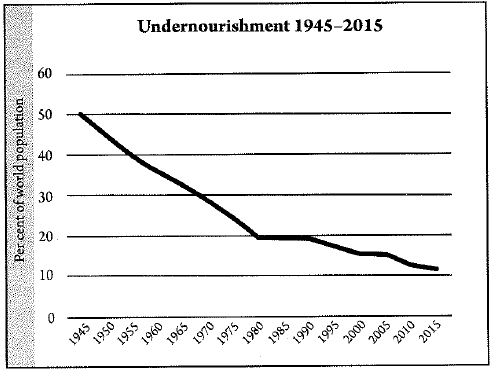
  • Food. In 1968 Paul Ehrlich wrote in The Population Bomb that “in the 1970s, the world will undergo famines and hundreds of millions of people are going to starve to death.” Yet just the opposite happened.capture44
  • Sanitation. Consider that in 1980 only 24% of the world’s population had access to proper sanitation and today this has increased to 68%.capture48
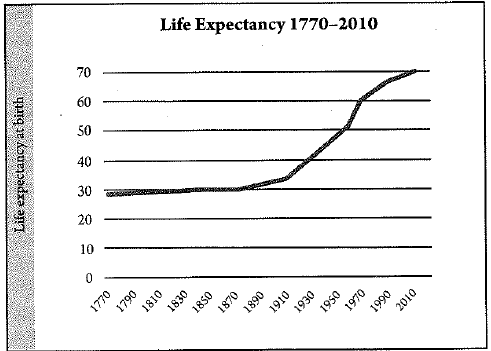
  • Life Expectancy. Consider that smallpox was totally eradicated in 1980 and that the number of annual cases of polio has been reduced from 350,000 in 1988 to just 416 today.capture49
  • Poverty. Between 1981 and 2015 the proportion of the developing world population living in extreme poverty (less than $2 per day) fell from 54% to 12%.capture50
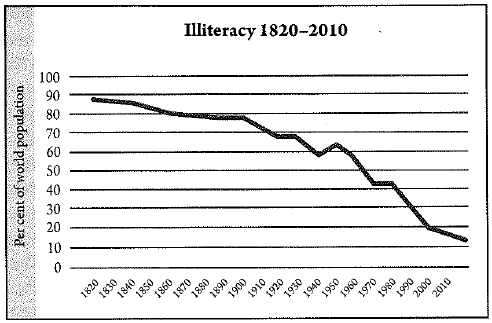
  • Literacy. The global ratio of female literacy to male literacy increased from 59% to 91% between 1970 and 2010.capture45
  • Freedom. In 1950 31% of the world population lived in democracies, increasing to 58% in the year 2000. Today that number has increased to 64%.capture46
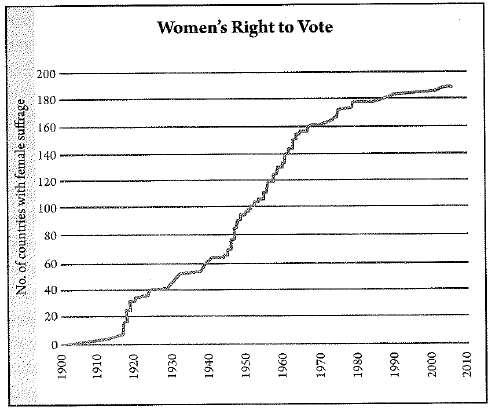
  • Equality. Minority rights, women’s rights and gay rights have all increased enormously during the last 100 years.capture51

The author concludes, “Even though wealth and human lives can be destroyed, knowledge rarely disappears. It keeps on growing.  Therefore any kind of backlash is unlikely to ruin human progress entirely.  But progress is not automatic.  It is the result of hard-working people and brave individuals. If progress is to continue, you and I will have to carry the torch.”

Follow me on Twitter
Follow me on Facebook

Real Financial Sector Reform


My blog, It Does Not Add Up, addresses fiscal and economic issues facing the United States at the present time.  I am concerned about our slow economic growth which deprives many middle- and lower-income workers of their proper share of our nation’s increasing prosperity.  I am also concerned about our large and rapidly increasing national debt which will create a huge cost burden on society when interest rates resume their normal historical levels.
Capture11Another critical problem, left over from the Great Recession of 2008 – 2009, is how to properly reform our financial system to avoid another meltdown as occurred in 2007 – 2008.  To me this is a more complex issue than slow growth and huge debt and therefore harder to figure out what to do about it.  I am always looking for new sources of information on this topic and feel that I have just discovered a good one.  It is a new book, “Five Easy Theses”, by James Stone, the founder and CEO of the Plymouth Rock Insurance Group and former chairman of the U.S. Commodity Futures Trading Commission (1979 – 1983).
According to Mr. Stone the Dodd-Frank Act of 2010 is too weak in certain respects and three additional reforms are badly needed to avoid a new crisis:

  • The scale and risk profile of large banks should be reduced by having the Federal Reserve impose progressively steeper capital requirements as they grow larger.
  • Hedge funds should be regulated like mutual funds under the Investment Company Act of 1940.
  • The leverage of derivative markets should be reduced decisively with meaningful reserve requirements (which do not net opposite positions to zero).

Mr. Stone emphasizes that he is offering “best” solutions, not constrained by political reality. The financial sector’s share of GDP is now at an all-time high of about 8%.  The enormous wealth enjoyed by those at the pinnacle of finance will make them powerful opponents of meaningful reform.
But it always helps to know in what direction we need to go.

Follow me on Twitter
Follow me on Facebook
 

Why Faster Economic Growth Is So Important II. Replacing Factory Jobs


Populists such as Bernie Sanders and Donald Trump are doing so well in the 2016 presidential primaries because the middle class is suffering from the slow economic growth of the past 15 years.
Capture2My last post is based on the report of a typical victim.   Today’s post is based on an article by Eduardo Porter in yesterday’s New York Times discussing the loss of U.S. manufacturing jobs.  Says Mr. Porter:

  • Fifty years ago, 45,000 workers were employed in California to harvest 2.2 million tons of tomatoes. Now, with mechanization, it only requires 5000 workers to harvest 12 million tons.
  • In 1950, 24% of nonfarm jobs in the U.S. were in manufacturing. Today only 8.5% of nonfarm jobs are in manufacturing.
  • The same thing is true worldwide. Global employment in manufacturing is going down because productivity increases are exceeding increases in demand by significant amounts. The likelihood that we will get a manufacturing recovery is close to nil.
  • The U.S. has a trade surplus in manufacturing with the 20 countries with which it has trade agreements (which does not include China). We have an overall annual trade surplus in services of more than $200 billion.

In other words, an attempt to recover or save manufacturing jobs with smarter trade policies is simply impractical and will likely do more harm than good. What should be done instead is to:

  • Definitely do a better job of helping displaced manufacturing workers with Trade Adjustment Assistance and smarter job retraining programs.
  • Adopt policies to speed up overall economic growth from the anemic 2.1% annual growth rate since the end of the Great Recession in June 2009. Faster growth such as the 3.5% annual average from 1971 – 2001 will do wonders in creating more jobs and better paying jobs. For how to do this see an earlier post.

Our very serious economic problems can be solved if policy makers (and presidential candidates) would only get serious about it!

Follow me on Twitter
Follow me on Facebook

Are Democratic Presidents Better for the Economy than Republicans?


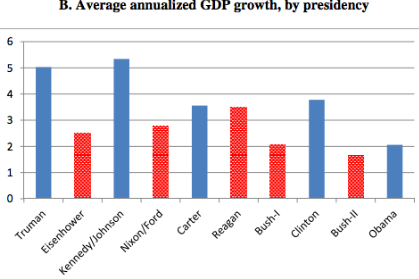
In his usual provocative manner, Paul Krugman reminded us yesterday that, according to a recent study by Alan Blinder and Mark Watson, ever since President Truman the economy has grown faster under Democratic presidents than under Republican presidents.  There are a lot of different explanations for this, not necessarily demonstrating better economic policies by Democratic presidents.  Nevertheless, it is a noteworthy finding which fiscally conservative, fix-the-economy types, need to be aware of.
CaptureAmong other things, Republican presidential candidates must become more credible about their economic policies than they have been so far.  They have all proposed big cuts in tax rates to stimulate the economy. But their plans lose trillions of dollars in tax revenue.  At a time of huge deficits and a rapidly growing national debt this is simply unacceptable.
In today’s Omaha World Herald, the economics journalist, Robert Samuelson, reports on a new Brookings Institute study about the effect of raising the top individual tax rate from 39.6% to 50%.  Such a tax hike would raise as much as $100 billion per year.

  • However, if used to lower deficit spending, it would cover less than ¼ of current deficit spending ($439 billion in 2015, for example).
  • If used to reduce income inequality for the poorest 1/5 of Americans, it would give such households an average of $2,650, and the overall effect on income inequality would be very modest.

The point is that neither costly tax cuts to boost economic growth nor a sizable tax increase on the wealthiest Americans represents a viable program to straighten out our economic problems. What we need to grow the economy is:

  • Revenue neutral tax reform, lowering rates across the board, paid for by closing loopholes and shrinking deductions.
  • Lightening the regulatory burden at least on small and mid-size businesses in order to speed up business growth and entrepreneurship.
  • Trade expansion and immigration reform to increase productivity.

Fiscal conservatives are badly needed to implement such policies effectively but neither party can get the job done alone. It will take both parties working together to make progress.

                                Follow me on Twitter: https://twitter.com/jack_heidel
                      Follow me on Facebook: https://www.facebook.com/jack.heidel.3

Higher Ed: Higher Costs, More Inequality. What to do?


Several months ago I discussed “How the American Education System Contributes to Inequality.” It so happens that students from high-income families graduate from college in much greater numbers and also with much less debt, compared with students from low-income families.
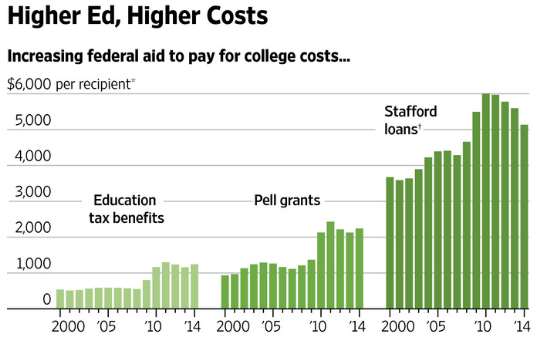
CaptureA new study from the New York Federal Reserve has found a connection between a rapid increase in student aid in recent years and the rapid increase in college costs. In particular:

  • A $1 increase in the subsidized loan cap leads to a tuition increase of 65 cents, and
  • A $1 increase in the Pell Grant limit leads to a tuition increase of 55 cents.
  • Furthermore, private schools, both nonprofit and for-profit, are bigger offenders than public schools, even though declining state subsidies for higher education primarily affect public universities.
  • At the present time undergraduates can borrow a maximum of $57,500 from the federal government.
  • Under the decade-old Grad Plus program, graduate students can borrow any amount their school charges. In the seven years before Grad Plus, undergraduate tuition was rising faster than grad school costs. In the seven years after, the reverse occurred.
    Capture1Clearly this is an untenable situation. The solution, in my opinion, is to strictly limit the total amount of federal loans for both undergraduate and graduate students and force schools to compete on price. For example:
  • Limit the total amount borrowable by an undergraduate, from the federal government, to $30,000, the average amount borrowed today, and then let it adjust it each year for inflation.
  • Limit the total amount borrowable by a graduate student to $60,000, the average amount borrowed today, adjustable each year by inflation.
  • Students who want to borrow additional funds may do so on the private market, with no subsidies or guarantees provided by the federal government.

Such a program would provide much needed financial discipline to colleges and universities and reduce and stabilize ballooning student loan costs for the federal government.

Fix It Now: the Political Philosophy of Chip Maxwell


I have just recently come across the book, “Fix It Now: Rediscover the Constitution and Get America Out of Its Fiscal Death Spiral” by Chip Maxwell, a candidate for Congress in Nebraska’s Second District May 2016 Republican Primary.
Chip lays out his political philosophy very clearly.  It is to:

  • Adopt a Balanced Budget Amendment to the U.S. Constitution, phased-in over ten years.
  • Phase out Social Security and Medicare for those under age 55.
  • Dismantle over the next decade the rest of the federal welfare/entitlement system.
  • Provide social services at the state or local level.
  • Launch a national effort to build a majority in Congress of crusaders for limited government.
    Capture1There are some attractive features to Chip’s program but overall I think it is too radical to have much chance at implementation.
    I am very much in favor of a balanced budget amendment and a ten year phase-in period is quite reasonable. Furthermore, providing social services at the state and local level would be much more efficient than what we are currently doing and, even with federal support, would be a big help in balancing the budget.
    Social Security and Medicare are lifelines for tens of millions of people. We can and should strengthen these programs in order to make them more financially viable for future retirees. They are now part of our national fabric and are here to stay.
    Chip’s last principle, promoting limited government, has much appeal but I think is not practical in this day and age. From my perspective, simply passing a Balanced Budget Amendment is sufficient to do what is needed. A BBA will force Congress to set spending priorities and eliminate inferior programs.
    Chip Maxwell is to be commended in running for Congress. If elected, he would move the needle in the right direction, even though some of his ideas wont work.

The Great Decoupling

In the great debate over slow economic growth and falling incomes of the middle class, the usual culprits are globalization, growth of technology and income inequality.
Capture
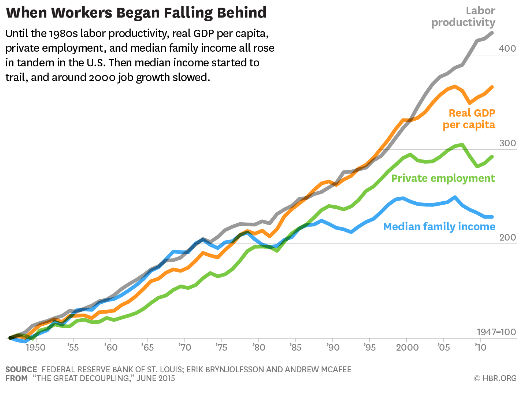
Just published in the latest issue of the Harvard Business Review, “The Great Decoupling: an interview with Erik Brynjolfsson and Andrew McAfee” is a more focused analysis of what is happening. These two technology experts note that both labor productivity and GDP are growing much faster than the growth in the number of jobs as well as median family income.  This is what they refer to as the great decoupling.  They are careful to point out that the same trends are happening in other developed countries such as Finland, Germany and Sweden.
They emphasize that the best response to this decoupling is to create an economic environment that’s conducive to innovation, new business formation, and economic growth.  In their opinion this means to focus on five things:

  • Education. Primary and secondary education systems should spend more time on things that computers are not good at such as creativity, interpersonal skills and problem solving.
  • Infrastructure. World-class roads, airports and networks are the foundations of growth.
  • More entrepreneurship. Most industries and regions are seeing fewer new companies than in recent decades.
  • Immigration reform. The U.S. needs to attract more of the world’s most talented people. Immigrant-founded companies have been great job-creation engines.
  • Basic Research. Since companies concentrate on applied research, the government needs to step up support for basic research. Both total and nondefense federal R&D spending, as percentages of GDP, have declined by more than a third since 1980.

The recommendations of Messrs. Brynjolfsson and McAfee are quite sensible.  But they will be hard to implement overall.  More federal funding for both infrastructure and basic research will be very difficult in an era of tight budgets.
This is the challenge of our time.  We must become better prepared to prosper in an era of increasing global competition and rapidly expanding technology.  And do this in a tight fiscal environment.
A very big challenge indeed!