How to Speed Up Wage Growth in the U.S.


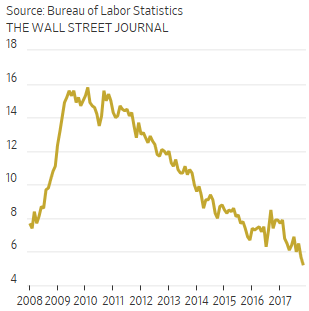
Donald Trump was elected President a year ago because the white working class is angry about a lot of things, including slow wage growth. The tax burden in the U.S. is lower than in other developed countries and wages are higher in the U.S. even if they are not rising fast enough. The Brookings Institute has carefully analyzed the wage growth issue, here and here, and has delineated several reasons for wage stagnation:

  • Compensation has lagged behind productivity growth. This is largely due to globalization and technology which has put upward pressure on skills and downward pressure on wages.
  • Benefits have grown faster than wages, thus holding down wages. The skyrocketing cost of healthcare is mostly responsible for this.
  • Labor’s share of income, compared to capital’s, has been shrinking. Technology needs less low skill labor. Also, market concentration, i.e. monopoly power, has been increasing, which increases profits and therefore return on capital.
  • Wage gains have been higher in the higher wage quintiles. This is explained by the increasing wage benefit of more education and higher skill levels.
  • Manufacturing output is up and employment is down. High technology needs fewer low skill workers and high skill workers are in short supply.
  • Entrepreneurship, i.e. new business formation, has declined over the past several decades. This is caused by increased business consolidation and would also be relieved by more immigration of high skilled workers.
  • Labor market slack has declined since the Great Recession. This bodes well for wage increases which are now starting to occur.

  • Labor productivity growth since the Great Recession has been especially slow. What is needed is increased business investment which is the justification for the current push for lower corporate and business tax rates.

Conclusion. In short, what is needed to boost wages is better education and skills, more business investment, control of the surging cost of healthcare, better trust busting to break up monopolies, and more high level immigration.

Follow me on Twitter 
Follow me on Facebook 

Why Wage Growth Has Been So Slow in Recent Years


My last post pointed out that there appears to be an inverse correlation between tax rates and economic growth in developed countries.  In particular:

  • Tax levels in the U.S. have stayed relatively constant since 1965 while they have grown significantly in other O.E.C.D. countries.
  • GDP, on the contrary, has been growing faster in the U.S. than it has in these same countries.
  • Median wages, while growing more slowly in the U.S., are still much higher than in the other major O.E.C.D. countries.

A new report from the Brookings Institute analyzes the factors which have contributed to relatively slow wage growth in the U.S.


For example:

  • Labor productivity has been growing faster than hourly compensation since the mid-1970s.

  • Benefits have grown much faster than wages in recent years.

  • Labor’s share of income, compared to capital’s share, has been dropping in recent years.

  • Wage gains have been greater in the higher wage quintiles.

  • Domestic manufacturing output has increased even as manufacturing employment has decreased.

  • Entrepreneurship (i.e. new business formation) has declined in recent years even though it may now be starting to pick up.

  • Labor market slack has declined since the Great Recession though some still remains (measured as the share of the work force that works part time for economic reasons).

  • Recent labor productivity growth has been especially slow, restraining wage growth.

Conclusion. As everyone knows, slow wage growth is a highly contentious issue in the U.S. In addition to being a fundamental measure of a society’s wellbeing, it played a central role in the outcome of the 2016 Presidential election.
What can and should be done to speed up wage growth in the U.S.?  Stay tuned!

Follow me on Twitter 
Follow me on Facebook 

The Connection between Taxes and Growth


One of my favorite economic journalists is Eduardo Porter of the New York Times who writes the weekly column Economic Scene. In his latest column.  He points out that taxes (federal, state and local) for the U.S. and the O.E.C.D. average were about the same 27% of GDP in 1969.  But now, almost 50 years later, the U.S. tax level has stayed the same while the O.E.C.D. average has grown by 7% (see chart below).


Mr. Porter says that according to Wagner’s Law “government spending as a share of the economy will increase as nations get richer and their citizens demand more and better public services.”
Americans may be receiving fewer public services than citizens of the OECD countries but we are also enjoying faster economic growth as pointed out by the AEI scholar James Pethokoukis using data from the International Monetary Fund (see chart below).


According to the Pew Research Center our median family wage is also one of the highest in the world (see chart below).


As pointed out by Mr. Pethokoulis, lower taxes are a fundamental reason for the superior performance of the U.S. economy.  Other (tax-related) reasons are:

  • The most competitive large economy as ranked by the World Economic Forum.
  • An entrepreneurial culture fueled by a willingness to take risks.
  • Labor markets which generally link workers and jobs unimpeded by excessively restrictive labor regulations.
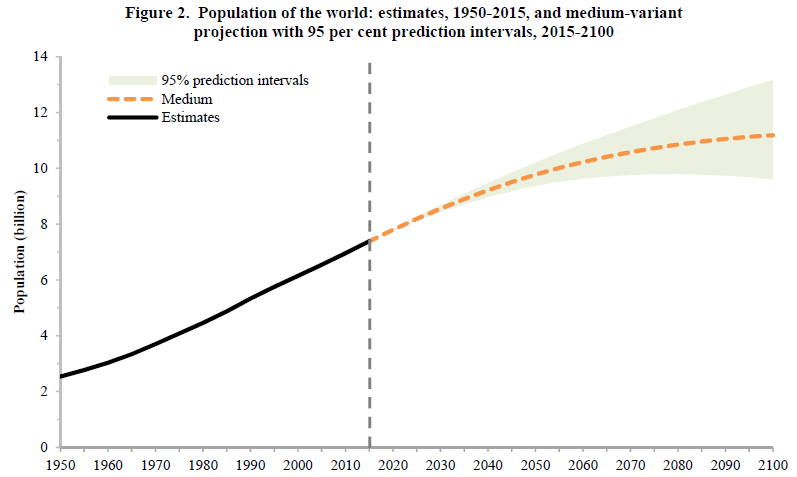
  • A growing population fueled by immigration based on economic opportunity.
  • A culture and tax-transfer system that encourages hard work and long hours.
  • A favorable regulatory environment, relatively speaking.
  • A decentralized political system in which states compete both tax-wise and by other means.

Conclusion. Americans pay lower taxes than other developed countries and also enjoy faster economic growth and higher median wages than most. There appears to be a strong connection between these three fundamental measures of economic wellbeing.

Follow me on Twitter 
Follow me on Facebook 

Improving the Republican Tax Plan


The Republican tax plan has many good features and is now moving along in Congress. The best feature of all is reducing the top corporate rate from 35% to 20%.  This will make the U.S. internationally competitive and create a strong incentive for all multinational companies to conduct more business in the U.S. and for U.S. multinationals to bring their profits back home for reinvestment.
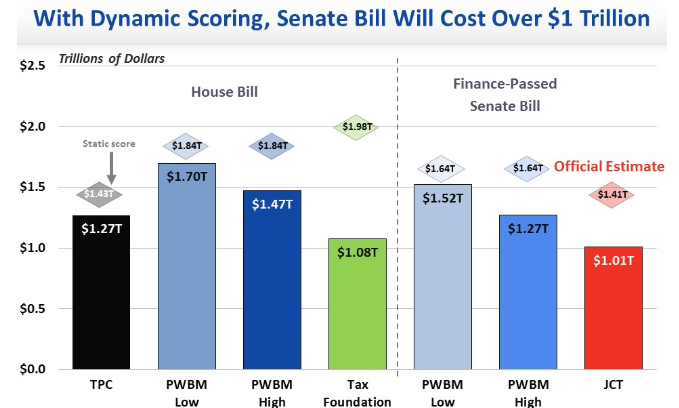
The Tax Foundation estimates that the Senate version of the Plan will lead to the creation of 925,000 new jobs and an after tax income gain of $2,598 for a middle-income family over a ten year period.
But there are several parts of the plan which could be significantly improved.  For example:

  • Revenue neutrality, at least on a dynamic basis (taking growth into account) is essential. Our national debt is way too large to ignore.

  • Shrinking more deductions, to achieve revenue neutrality. The mortgage interest deduction should be eliminated completely, not just limited to $500,000 mortgages. Same for the state and local tax deduction.
  • More progressivity. Keep the estate tax to bring in more tax revenue. Scrap the lower 25% rate for a pass-through business tax because it will be too easy to abuse.  The Congressional Budget Office has estimated that eliminating the individual mandate for the ACA will save $338 billion over ten years.  It will also save millions of Americans from having to pay a tax penalty of $695 or more for not having health insurance.
  • Emphasis on growth. Make expensing (i.e. immediate write-off) for new investment a permanent feature rather than limited to five years only.

Conclusion. There are lots of good features in the Tax Reform Plan. Several changes would make it even better.  As soon as it achieves stability in the legislative process, the CBO will analyze its fiscal and economic effects.  At this point revenue neutrality will be essential for achieving broad support.

Follow me on Twitter 
Follow me on Facebook 

Donald Trump and Isolationism, Protectionism and Nativism


Most of the time on this blog I write about the pros and cons of various policy measures, independently of which individuals or parties are supporting them. But, of course, the U.S. President is the most important single actor on the political stage so it does matter immensely what the President thinks on any particular issue.


The three biggest quagmires for Republican presidents are nativism, protectionism and isolationism. Where does President Trump come down on these major policy threads?

  • Isolationism. Mr. Trump is not an isolationist.  He is working with China and other Asian countries to contain North Korea. He is working with several Mideast powers to defeat ISIS. We have beefed up forces in Afghanistan to neutralize the Taliban. He has clearly backed down on his threat to withdraw from NATO.
  • Protectionism. Unfortunately, Mr. Trump is too much of a protectionist. He is not against trade per se but he wants to replace broad multilateral trade agreements with separate bilateral trade agreements with lots of different countries. This will simply create an “insanely complicated mishmash of rules.”  Instead he should focus on bargaining with China to get much better access for American products into Chinese markets.
  • Nativism. Again, Mr. Trump (and many of his supporters) apparently doesn’t appreciate the enormous contributions which immigrants make to the U.S. economy at both the high end (skilled workers and entrepreneurs) and the low end (willingness to provide hard physical labor in agriculture, meatpacking, construction and personal care). Especially with our currently low unemployment rate of 4.1% we should take the opportunity to solve our illegal immigration problem by expanding our guest worker visa program.

Conclusion. President Trump is clearly not an isolationist but smarter trade and immigration policies would help to speed up economic growth and create more jobs and higher wages for the blue-collar workers who are Mr. Trump’s main base of support.

Follow me on Twitter 
Follow me on Facebook 

How to Make America Stronger


Americans are very fortunate indeed to live in such a strong, prosperous and free society.  But not all of us share in this good fortune.  How can we help the less fortunate among us have a better chance to succeed in life?

Here are several things we can do, in rough order of importance:

  • Grow the economy faster than the 2.1% growth rate which has prevailed since the end of the Great Recession in June 2009. Faster growth means more new jobs are created and higher wages are paid for existing jobs. Success in life for most people includes earning an adequate income to live comfortably without major wants. Appropriate deregulation and tax reform are the best ways to speed up growth.
  • Improve basic education so that more people can qualify for rewarding jobs. Right now too many kids from minority and other low-income families are not graduating from high school with the skills they need to succeed in life. Two promising solutions to this problem are more charter schools and expanded early childhood education, both targeted at kids from low-income families.
  • Alleviate poverty in a productive manner by emphasizing work requirements for most, if not all, welfare programs. Higher work force participation and lower poverty rates are strongly correlated. Work not only provides income but also provides dignity and purpose in life.
  • Promote two parent families. Two parent families are much less likely to be poor than single parent families and also more likely to be supportive of their children’s education. Federal tax policy should always encourage child raising by two parent families for this reason.

Conclusion. America will become an even stronger country than it already is if more people, especially from low-income and minority families, have the education, work training and personal qualities to make a positive contribution to society.

Follow me on Twitter 
Follow me on Facebook 

Why Americans Are So Fortunate


Most of the time on this blog I discuss somewhat humdrum issues such as:

  • Slow economic growth, averaging just 2% since the end of the Great Recession in June 2009. Slowly our unemployment rate has shrunk to its current low level of 4.1% and finally median wages are beginning to rise. But faster growth would give a badly needed boost to millions of the unemployed and underemployed.
  • Massive debt, now 77% of GDP (for the public debt on which we pay interest), the highest since the end of WWII, and predicted by the Congressional Budget Office to keep getting steadily worse without major changes in spending policies. When interest rates rise, as they surely will before long, interest payments on our accumulated debt will skyrocket and cause huge pain.

These are serious and urgent problems upon which America’s national leaders need to focus. But my last few posts, here and here, discuss our great strengths as a nation and how to maintain them:

  • Being a free democratic society, is our greatest strength of all, because it allows most of us to reach our own maximum potential. Furthermore other democratic countries are our best friends and their number is increasing around the world.

    Capture173

  • America is a prosperous country which means that most Americans grow up in a loving and supportive environment which is critical for getting a good start in life.
  • America has an outstanding educational system, on the whole, which well serves most of us. Especially in today’s globally complex and highly competitive market place, the ability to adapt to new trends and developments is very important.

Conclusion. America has huge strengths which well serve most, but not all of us. One of our country’s great challenges going forward is to reach out to those members of society who have been left behind and help them share more fully in our prosperous society.  Stay tuned!

Follow me on Twitter 
Follow me on Facebook 

Walmart Saves You Money; Amazon Saves You Time


Like most Americans I am fascinated by modern technology as exemplified by the big five American technology companies: Amazon, Apple, Facebook, Google and Microsoft.
The allure of Apple (a telephone merged with a pocket-sized computer), Facebook (a vast social network) and Microsoft (windows operating system and the personal computer) are easy to understand.  Google has accomplished the amazing feat of organizing all human knowledge with its search engine.


Amazon is the most humdrum of the five giants.  It primarily does online retail.  But ecommerce is revolutionizing much of the business world and therefore all aspects of our lives.
Consider:

  • Retail in America accounts for one in nine jobs.
  • Total retail employment in the U.S. is growing since ecommerce has added far more jobs in the last two years than brick-and-mortar jobs have been lost. Furthermore, fulfillment center wages are 31% higher than for traditional retail in the same geographical area.
  • In 2016 Amazon accounted for more than half of the growth in online spending.
  • More than 1/3 of American households now pay $99 per year for Amazon Prime which provides free two day shipping on all orders.
  • Amazon’s own inventory now accounts for less than half of the sales on its site, i.e. ever more independent retailers use its giant warehouses.
  • Amazon earns more than 1/3 of its revenue from ecommerce outside of North America (but not much in China where Alibaba is king).
  • Amazon now pays sales taxes in every American state which has such a tax.

Conclusion. The giant retailer, Walmart, which has brought Americans low-cost goods from around the world, is now struggling to compete with online retailer Amazon. Walmart saves us money but Amazon saves us time as well as money.  Only a free market system like ours, which goes all out to encourage innovation, could lead to such progress.

Follow me on Twitter 
Follow me on Facebook 

Responding to Economic Trends


In my most recent posts I have been making the case that

  • The American economy is in basically good shape with a low unemployment rate of 4.2% and the likelihood of somewhat faster growth in the near future.
  • Income inequality and poverty are real problems, see here and here, but there are reasonable and effective ways to address them.
  • Rapidly accumulating debt is by far our most critical unsolved problem which is all the more frightening because our polarized political system does not seem capable of addressing it.

The Bureau of Labor Statistics has just released its projections of what the U.S. economy will look like in 2026.


The highlights are:

  • More dominated by the service sector amid the continuing erosion of manufacturing jobs (see two charts below).

  • More polarized in both earnings and geography (see top and bottom charts).

  • More tilted towards jobs which require at least a bachelor’s degree (see bottom chart).

The BLS report has several ramifications for public policy as follows:

  • Improved educational outcomes are needed all along the line: K-12 basic and vocational, training programs for the many skilled jobs going begging and also more low-cost college programs.
  • More low-skill immigrants, not fewer, are needed to take on the expanding number of low-wage jobs, such as caring for the growing numbers of elderly, which Americans are not willing to do.

Conclusion. These economic trends towards more earnings and geographical polarization could easily make our current political polarization even worse than it already is. This means it is all the more important to make sure that we keep speeding up economic growth, better address income inequality and poverty and get our gargantuan debt problem under control.

Follow me on Twitter 
Follow me on Facebook 


Addressing Poverty in a Free and Dynamic Society


With an unemployment rate now down to 4.2% and the average wage rising 3.1% in the past year, the U.S. is finally recovering from the Great Recession which ended in June 2009. My last several posts have described an optimistic scenario for the U.S. economy going forward.

  • The American idea is thriving.  The U.S. is the world’s most competitive large economy. Amazon, Apple, Facebook and Google are in the process of revolutionizing all aspects of life, all over the world. Productivity growth in the digital industries has grown at the annual rate of 2.7%, much faster than for physical industries. Democracy is mostly flourishing around the world.
  • Ecommerce is one example of a thriving industry.   Fulfillment center weekly wages are 31% higher on average than for brick and mortar retail in the same area. Total ecommerce related jobs have increased much faster in the last two years than have traditional retail jobs been lost.
  • Income inequality can be addressed effectively by speeding up economic growth (with tax and regulatory reform), improving educational (especially with early childhood) opportunities and with better training programs for the unemployed and underemployed to qualify them for the millions of skilled jobs going begging for lack of qualified applicants.

One additional feature needed is “A balanced and sensible anti-poverty program,”  to help many of the down and out get back on their feet.


The way to accomplish this is with:

  • Work requirements as a condition of public assistance. The work first approach has been shown to have better outcomes with regard to attachment to the labor force (see above chart) than even approaches which focus on training and education.

Conclusion. The U.S. economy is basically sound. We lead the world in many industries and especially in digital technology.  There are lots of good jobs going begging for lack of qualified applicants.  The best anti-poverty program is job training.

Follow me on Twitter 
Follow me on Facebook