Income Inequality in a Dynamic Economy


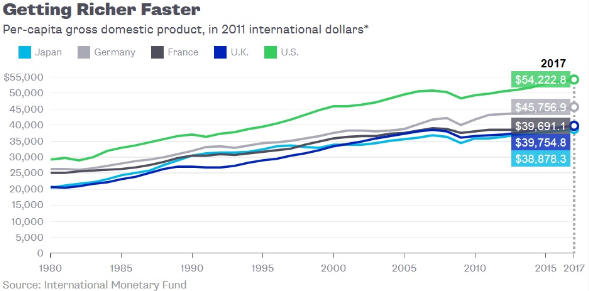
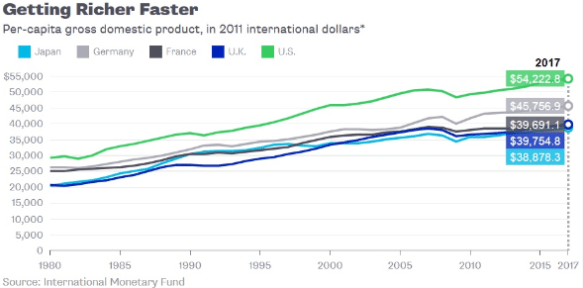
I have pointed out in a recent post that, not only is the U.S. the world’s most competitive large economy, but also that our per-capita GDP is growing faster than for our nearest rivals.
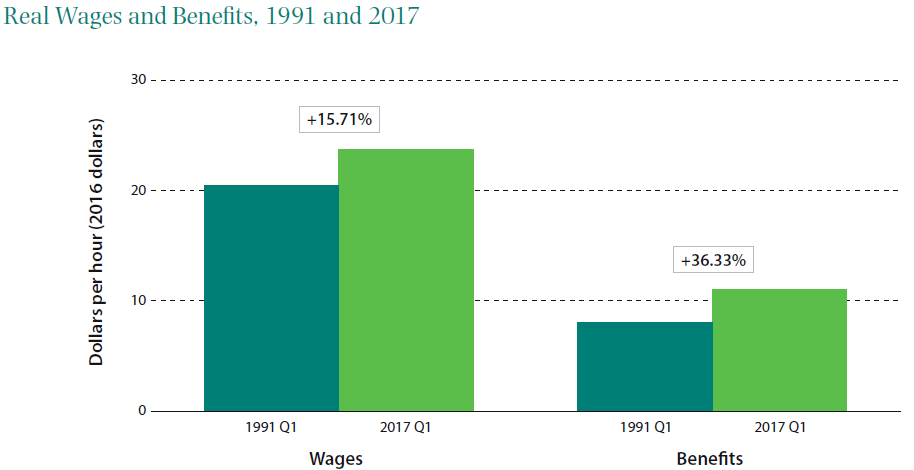
A particularly vivid example of this dynamism is ecommerce where both the adjusted (gains minus losses) size of the workforce and the average wage are increasing rapidly.
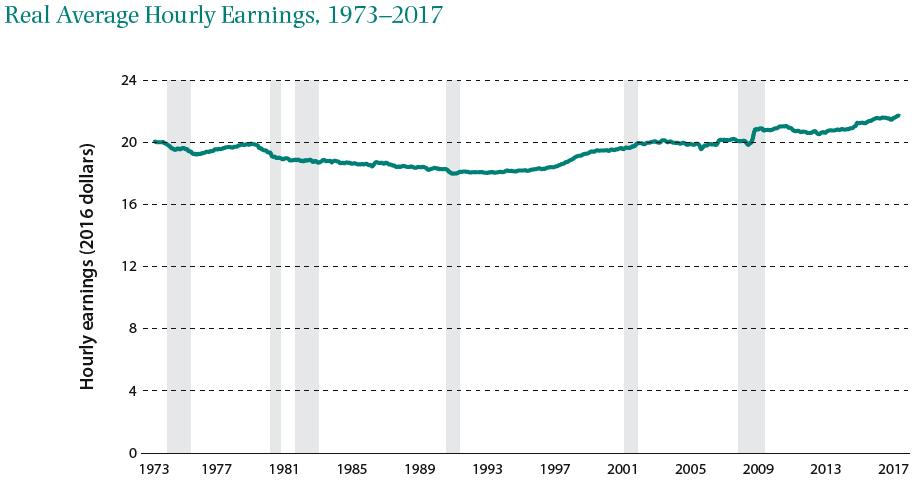
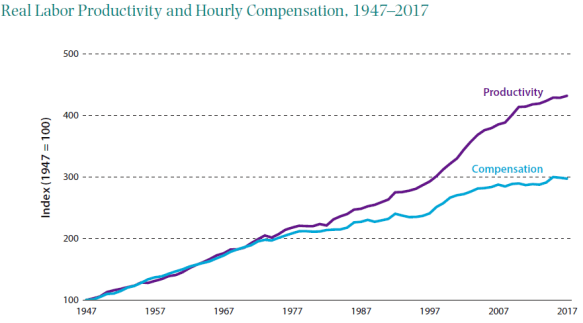
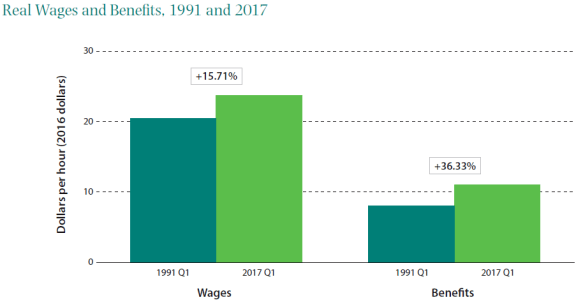
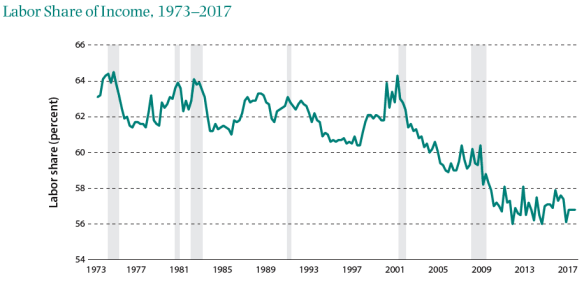
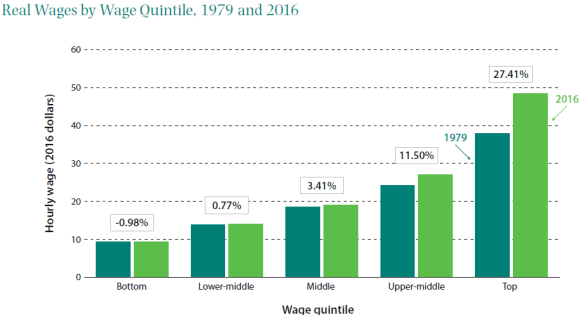
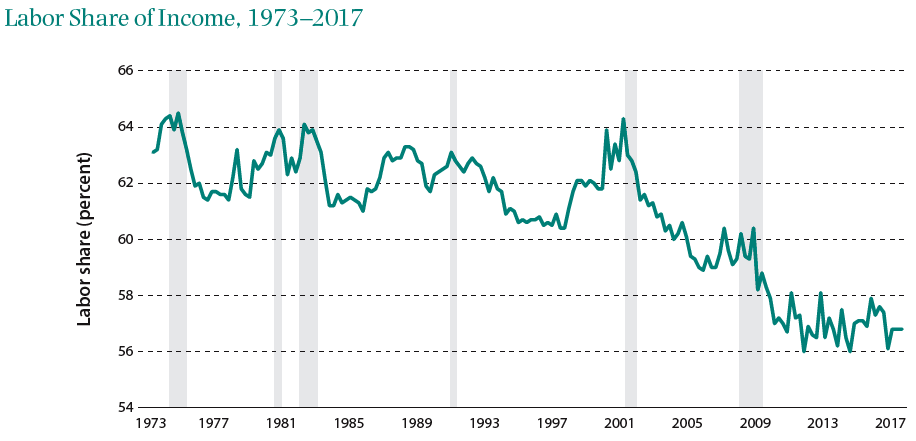
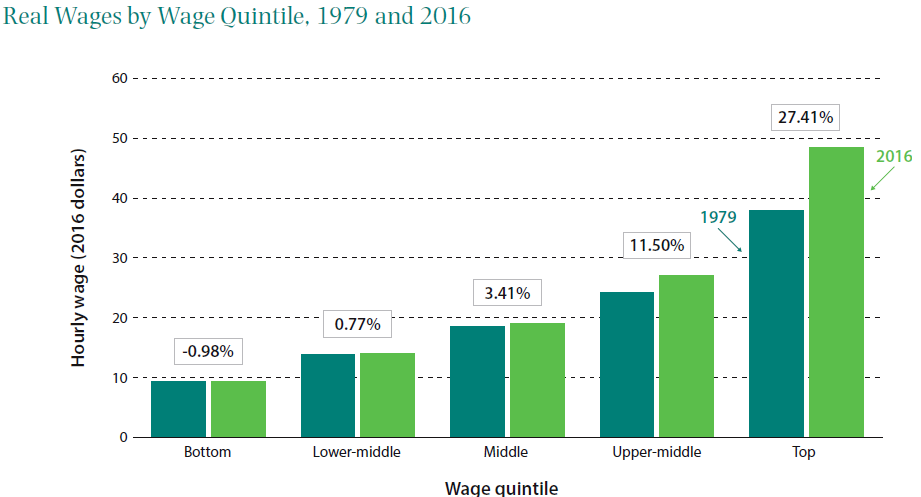
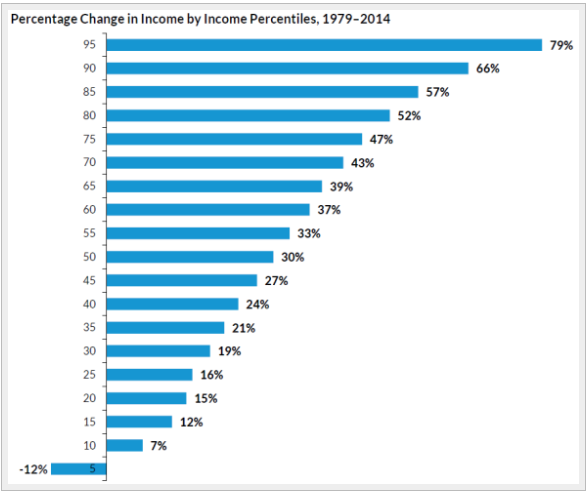
We also know that incomes in the U.S. are rising faster at the high end rather than further down (see chart below).  What to do about this has become a major political issue.


Here are my ideas (in rough order of importance):

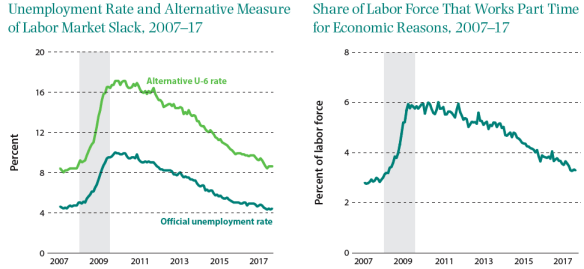
  • Economic growth is too slow, averaging just 2% per year since the end of the Great Recession in June 2009. It is reasonable to expect that the regulatory reform already underway and the tax reform under consideration in Congress can increase growth to 2.5% per year.  Together with our low unemployment rate of 4.2%, this is already leading to more and better paying jobs.
  • Improve educational opportunities by, for example, making early childhood education widely available to low-income families and attracting the best teachers to the poorest performing schools with targeted bonus pay.
  • Better vocational and retraining programs to prepare the unemployed and underemployed for the millions of skilled jobs now going begging for a lack of qualified applicants.
  • Attempt to address the social inequality associated with income inequality, see here.  Marriage rates, civic involvement and public trust have all declined significantly in recent years for the lower class. A very difficult problem to solve!

Conclusion.   In a free society like the U.S., providing self-help opportunities for advancement is the natural and preferred way of lifting up people who need assistance. The U.S. does a okay job in this respect but there is plenty of room for improvement.

Follow me on Twitter 
Follow me on Facebook 


Why Entitlement Spending Is So Difficult to Control


The readers of this blog know that my favorite topic is our very large national debt, now 77% of GDP (for the public part on which we pay interest) and predicted by the Congressional Budget Office to keep steadily getting worse, without major changes in current policy.


It is also well documented (see chart)  that our entitlement programs of Social Security, Medicare and Medicaid are the drivers of the huge annual budget deficits which make the accumulated debt so much worse and worse.
The economist John Cogan has an informative interview in yesterday’s Wall Street Journal explaining why entitlement spending is so difficult to control. First of all, according to Mr. Cogan, only three modern presidents have made any effort to control entitlement spending:

  • FDR who persuaded Congress to repeal unjustified disability entitlements to 400,000 WWI, Philippine War and Boxer Rebellion veterans.
  • Ronald Reagan “slowed the growth of entitlements like no other president ever had.”
  • Bill Clinton’s welfare-reform plan not only reduced welfare’s burden on taxpayers but also benefitted the recipients, whom the old program had been harming.


Mr. Cogan identified three necessary political conditions for any entitlement reform. They are:

  • Presidential leadership “without which there has never been a significant reduction in an entitlement.”
  • Significant agreement among the general public and the elected representatives that there’s a problem.
  • Bipartisan consensus on the solution for correcting the problem.

Conclusion.  Think about it.  This is a quite a gloomy assessment.  Nothing will get done on the primary reason for our huge debt problem without both presidential leadership and bipartisan political support. When is this going to happen?

Follow me on Twitter 
Follow me on Facebook 

Donald Trump and American Progress


I am a non-ideological (registered independent) fiscal conservative and social moderate. I was not very excited about either presidential candidate last fall but finally decided to vote for Clinton because of Trump’s sleaziness.
As it turned out Mr.Trump was elected because of his strong support from the white working class, especially in the upper Midwestern states of Wisconsin, Michigan and Pennsylvania.  Interestingly, the Democrats are responding by proposing legislation to try to appeal more strongly to blue-collar workers.
Of course I disapprove of Donald Trump’s poor handling of the Charlottesville tragedy but I try to avoid being distracted by all of the drama and rather stay focused on his policies and actions.  In this respect there are both plusses and minuses.


On the positive side:

  • North Korea. He is handling this crisis well simply by working through the UN to condemn North Korea’s provocative testing of ballistic missiles. Also his Administration has clearly stated that the goal of U.S. policy is to denuclearize the Korean peninsula, not to achieve regime change in North Korea.
  • The economy is still chugging along at 2% annual growth. On the deregulation front, the annualized pace of new regulations for 2017 is 61,000 pages, down from 97,000 in 2016. This is the lowest level since the 1970s and has the potential to speed up growth.

On the negative side:

  • NAFTA renegotiation is just getting started. Any shrinkage of U.S. exports will badly hurt the economy, especially in states like Nebraska which depend so much on agricultural exports.
  • Immigration. Mr. Trump proposes to dramatically decrease annual legal immigration quotas, especially for low-skilled workers. This is a very poor idea  which will hurt the economy, especially in states like Nebraska which have low unemployment rates.

Conclusion. President Trump’s record at this point is mixed, all the more so since the two very important issues of the 2018 budget and tax reform have yet to be resolved in Congress. Mr. Trump’s election may or may not be good for progress in America.  We simply don’t know yet.

Follow me on Twitter 
Follow me on Facebook 

The Major Challenges Facing the U. S. II. National Debt


My last post, “The Major Challenges Facing the United States,” came to the conclusion that, while the U.S. has many big problems to address, our national debt is the biggest problem of all, because it will be so hard to deal with through the political process.
Our total national debt is now $19.9 trillion. The so-called public debt, on which we pay interest, is $15 trillion, or 77% of GDP, the highest it has been since right after WWII.  Furthermore it is predicted by the Congressional Budget Office to keep getting steadily worse, reaching 90% of GDP by 2025 and 150% of GDP by 2047 unless current policy is substantially changed.
Right now our debt is almost “free” money since interest rates are so low.  But when interest rates return to more normal levels, interest payments on the debt will skyrocket by hundreds of billions of dollars per year, likely leading to a new fiscal crisis, much worse than the Financial Crisis of 2008.
The only sane solution to this humongous problem is to start shrinking our annual deficits, this year at about $685 billion, down close to zero over a period of several years.  This will require a painful combination of spending curtailments and perhaps some tax increases as well.


One possible way to accomplish this herculean task has been laid out by Barron’s economic journalist Gene Epstein, see here and here.  Mr. Epstein’s plan would balance the budget in ten years by decreasing projected spending by $8.6 trillion, with 60% of spending curtailments coming from the entitlement programs of Social Security, Medicare and Medicaid and the rest from both military and domestic discretionary programs.
It needs to be strongly emphasized that under the Epstein plan spending would not actually decrease from one year to the next, but would rather grow at a slower rate, from $3.9 trillion in 2016 to $4.7 trillion in 2026.  His plan would decrease the public debt from 77% of GDP today to 58% in 2026.

Conclusion. The U.S. faces the very unpleasant problem of excessive debt which will just keep getting worse and worse without making some relatively unpleasant adjustments in the way that the federal government spends money. The sooner we get started in this process the better off we will be.

Follow me on Twitter 
Follow me on Facebook 

We Need More Low-Skilled Immigrant Labor, Not Less


Our economy is chugging along at 2% annual growth of GDP, not spectacular but not awful either. The unemployment rate has dropped to 4.3%, and low-wage earners are beginning to see decent pay raises. Furthermore there are good indications that GDP growth may rise in the near future to at least 2.5%, see here and here.
As growth increases, unemployment continues to drop, and wages increase more quickly, severe labor shortages in certain job categories are likely to develop.  As the New York Times economics reporter, Eduardo Porter, points out, “The Danger from Low-Skilled Immigrants: Not Having Them.”


Consider:

  • Eight of the fifteen occupations expected to experience the fastest growth – personal care and home health aides, food preparation workers, janitors and the like – require no schooling at all.
  • Low-skilled immigration does not just knock less-educated Americans out of their jobs, it often leads to the creation of new jobs – at better wages.
  • The strawberry crop in California owes its existence to cheap immigrant pickers. They are sustaining better paid American workers in the strawberry patch to market chain who would have to find other employment if the U.S. imported the strawberries directly from Mexico.

  • The benefits of immigration come from occupational specialization. Immigrants concentrated in more manual jobs free up natives to specialize in more communication-intensive (English speaking) jobs.
  • The average American worker is more likely to lose than to gain from immigration restrictions. Halting immigration completely would reduce annual economic growth by .3%.
  • The Pew Research Center estimates that about 30,000 unauthorized immigrants work in Nebraska, 3.2% of Nebraska’s total labor force. They are heavily represented in a handful of industries, making up 18% of Nebraska’s construction workers, 9% of production workers, and 5% of farm laborers.  With an unemployment rate hovering around 3%, the Nebraska economy would be severely stressed without these immigrant workers.

Conclusion. Both in Nebraska and nationwide, the U.S. economy has a strong need for immigrant workers. An adequate guest worker visa program is badly needed to provide legal status to these workers who are so critical to the success of the U.S. economy.

Follow me on Twitter 
Follow me on Facebook 


Time to Start Over on Healthcare Reform


The Affordable Care Act, established in 2010, greatly expanded access to healthcare in the U.S. However, in spite of its name, it has done nothing to control the rapidly increasing cost of healthcare which is the core of our debt problem.


The new Senate plan, struggling to gain enough support to pass, puts Medicaid on a budget but doesn’t even attempt to address wider aspects of the healthcare cost problem.
A wider approach is the best way to proceed and perhaps now it is the only way to succeed in getting something done. Mr. Peter Suderman, who writes for Reason magazine, proposes several principles for a new approach:

  • Work for broader coverage but not necessarily universal coverage. This allows focusing on other important features such as:
  • Unification, not fragmentation, is what should be emphasized. Medicare and Medicaid are paid for directly by the government. Employer provided coverage, subsidized through the tax code and costing $250 billion per year, is the biggest problem in the U.S. healthcare system. It incentivizes employers to provide ever more generous insurance while insulating individuals from the true cost of care. It discourages job switching and entrepreneurship. Medicare ends up paying out far more than individuals have paid in.
  • Health insurance coverage is not the same as healthcare. For non-catastrophic, non-emergency expenses, affordability should be emphasized, rather than subsidies. Health savings accounts are a good way to accomplish this.
  • Focus on government assistance for the poorest and sickest. This means upgrading Medicaid, and coverage for pre-existing conditions, at the same time as putting Medicaid, Medicare and employer provided care all on a fixed, but reasonable, budget.

Conclusion. The cost of American healthcare is a huge problem. Hopefully the Senate will begin to address this fundamental problem as it struggles to pass a healthcare reform bill.

Follow me on Twitter 
Follow me on Facebook 


Redesigning the American Health Care System to Lower its Cost II. Medicare


By far the biggest problem our country faces is long term debt. The public debt (on which we pay interest) is now 77% of GDP, the highest since the end of WWII, and steadily growing worse.  The fundamental driver of our debt problem is the cost of healthcare, public and private.
My last post describes two major reforms which are needed to get the cost of healthcare under control. The first, and most important, is to replace the tax exemption for employer provided care by a universal tax credit limited to the cost of catastrophic health insurance (with a high deductible).  This fundamental change would be accompanied by allowing tax preferred Health Savings Accounts for use in paying routine medical expenses.  The purpose here is to make all of us more responsible for the cost of our own healthcare.


The second big change which is needed is a

  • Redesign of Medicare. Medicare is currently being subsidized by the federal government at a net cost (after FICA taxes and premiums paid) of over $400 billion per year, and this cost will continue to increase rapidly without a change in policy.

The best way to reform Medicare is to first modify the tax exemption for employer provided care, as mentioned above, and then gradually migrate Medicare onto this new system.  However, in the meantime there are more direct ways to make Medicare less expensive:

  • Community-rated premiums. Medicare premiums should not vary based on age or health status but they should vary based on an enrollee’s income.
  • Defined contributions and beneficiary choice. Enrollees would apply the government contribution to their choice among competing options for Medicare coverage.
  • Facilitating healthcare savings. Tax-preferred Health Savings Accounts would be made available to Medicare enrollees to pay for routine medical expenses up to a deductible amount.

Conclusion. The current Medicare program is rapidly becoming too expensive for the federal government to fund with general tax revenues. A few simple and sensible changes will put Medicare on a sustainable course.

Follow me on Twitter 
Follow me on Facebook 


Maybe the GOP Really Is the Stupid Party


The Nobel prize-winning economist, Paul Krugman, more recently turned partisan flack for the New York Times, has occasionally referred to Republicans as “the stupid party.” After the debacle with the House’s American Health Care Act, maybe he is right.  This bill is far from perfect but is a step in the right direction.  Its major virtue is a serious attempt to get Medicaid spending under control.
According to an astute analysis by the Wall Street Journal:

  • The AHCA would put Medicaid on a budget for the first time since its creation in 1965.
  • Medicaid insures more than 72 million people, or one in every five Americans.
  • Medicaid is now the third largest, and fastest growing, program in the federal budget. Federal outlays are now $360 billion per year, more than three times as much as in 2000.
  • The federal government matches between 50% and 74% of state costs for Medicaid recipients, which means that the states have little incentive to control spending by allocating resources toward high quality care for the most vulnerable.
  • A 2013 study by the New England Journal of Medicine found that “Medicaid generated no significant health improvements,” compared to the uninsured.
  • The AHCA would transition federal funding to a per-capita block grant that would grow with an index of medical inflation. In exchange, governors would gain reform flexibility over the current rigid rules.

Conclusion. It is completely nonsensical for the House Freedom Caucus to oppose such an attractive reform plan just because it isn’t perfect. The members of the Freedom Caucus claim to be fiscal conservatives and to support balanced budgets.  And yet they refused to take a simple, practical step to work toward that goal.

Follow me on Twitter
Follow me on Facebook

The Meaning of 2016


For my last blog post of each year I briefly summarize the main events of the preceding year and then try to evaluate their significance. Last year I was badly off in one respect. I said that the rise of Donald Trump was a disaster for the Republican Party because he could not possibly be elected president!  I badly underestimated the force of populism sweeping the country.
Here are the main events of 2016:

  • Brexit. On June 23 Great Britain voted 52% – 48% to leave the European Union. Elite opinion advocated staying in and the polls predicted majority support for staying. The world was shocked when the vote went the other way.
  • Donald Trump was elected the next U.S. President on November 8. The polls predicted a Hillary Clinton victory and she in face won the popular vote by a 3,000,000 vote margin. But Trump squeaked by in the Electoral College by winning the rust belt battleground states of Michigan, Pennsylvania and Wisconsin by a combined total of 100,000 votes (see attached map to understand the Trump electoral vote margin).capture17
  • The Mid-East Refugee Crisis, Terrorism and Russia’s Vladimir Putin were even bigger problems in 2016 than in 2015 and will present huge challenges to Donald Trump when he becomes President on January 20.

Granted that Trump was elected by a slim electoral vote margin and a smarter campaign by Clinton could have led to a different outcome, nevertheless for such a sleazy, non-politically correct candidate to have done so well, has huge significance. It constitutes a major slap down of elitism:

  • Consider where our most recent presidents went to college: Reagan (Eureka College), George H.W. Bush (Yale), Bill Clinton (Yale Law), George W. Bush (Yale), Barack Obama (Harvard Law) and Donald Trump (Fordham). In other words, Trump will be the only president since Reagan not to have graduated from Harvard or Yale.
  • Consider that since John Paul Stevens (Northwestern Law) retired from the Supreme Court in 2010, every current Supreme Court Justice has graduated from an Ivy League Law School.
  • Consider that most nationally prominent Republicans, including members of Congress, shunned Donald Trump on the campaign trail even as his poll numbers steadily increased. In other words he was elected largely without the help of the Republican establishment.

Conclusion. The American voters have decided to take a big chance on a nontraditional presidential candidate. Are the voters collectively smarter than the elites to whom they usually turn for leadership?  I am optimistic that the answer will turn out to be yes!

Follow me on Twitter
Follow me on Facebook


The Remarkable Human Progress of the Last 200 Years


About a month ago I had a post, “Optimism or Pessimism for the Future: Which is More Justified?” in which I referred to the book, “The Rational Optimist,” by Matt Ridley to point out all of the positive trends in present day society. I come back to this topic today because of another remarkable new book, “Progress: ten reasons to look forward to the future,” by the Swedish economic historian, Johan Norberg. The following brief illustrated comments give the flavor of Mr. Norberg’s book:

  • The Good Old Days Are Now, referring to the rapid rise in global wealth starting in about the year 1800.capture43
  • Food. In 1968 Paul Ehrlich wrote in The Population Bomb that “in the 1970s, the world will undergo famines and hundreds of millions of people are going to starve to death.” Yet just the opposite happened.capture44
  • Sanitation. Consider that in 1980 only 24% of the world’s population had access to proper sanitation and today this has increased to 68%.capture48
  • Life Expectancy. Consider that smallpox was totally eradicated in 1980 and that the number of annual cases of polio has been reduced from 350,000 in 1988 to just 416 today.capture49
  • Poverty. Between 1981 and 2015 the proportion of the developing world population living in extreme poverty (less than $2 per day) fell from 54% to 12%.capture50
  • Literacy. The global ratio of female literacy to male literacy increased from 59% to 91% between 1970 and 2010.capture45
  • Freedom. In 1950 31% of the world population lived in democracies, increasing to 58% in the year 2000. Today that number has increased to 64%.capture46
  • Equality. Minority rights, women’s rights and gay rights have all increased enormously during the last 100 years.capture51

The author concludes, “Even though wealth and human lives can be destroyed, knowledge rarely disappears. It keeps on growing.  Therefore any kind of backlash is unlikely to ruin human progress entirely.  But progress is not automatic.  It is the result of hard-working people and brave individuals. If progress is to continue, you and I will have to carry the torch.”

Follow me on Twitter
Follow me on Facebook