What Will Trump Do?


I did not vote for Donald Trump because of his often crude remarks and sleazy behavior. But I am now cautiously optimistic about the prospects for his presidency based on the quality of his nominees for important government posts.  Like many of his voters, I “take him seriously but not literally.”

capture97
Here is what I think he will do:

  • Economic Policy. He will try to speed up economic growth, well above the average 2.1% annual GDP growth of the past 7½ years. This can be accomplished with tax reform (lowering tax rates paid for by shrinking deductions), regulatory reform (including paring back Dodd-Frank and the ACA), immigration reform and tougher trade policies. Faster growth benefits the whole country and especially the blue-collar workers who voted for him.
  • Improving life in the inner cities. K-12 education is a disaster in many inner cities and Betsy DeVos will be a reformer in the Education Department. Ben Carson grew up in public housing and is an excellent choice for HUD.
  • Foreign Policy. Mr. Trump wants changes from China on currency and trade practices. He also wants more cooperation from Russia in fighting terrorism. He wants our NATO partners to bear a bigger share of their own defense. His Secretary of State designee, Rex Tillerson, supports arming Ukraine against Russia and also supports the TPP trade agreement with Asia. This all sounds good to me.
  • Fiscal Policy. My biggest concern at this point is our national debt, now 76% of GDP (for the public part on which we pay interest) which is historically high and steadily getting worse. The House Republicans are serious about shrinking deficit spending and hopefully Mr. Trump will support their efforts.

Conclusion. Donald Trump has a highly unconventional (but very effective) style of communication. If it leads to progress in addressing our biggest problems as above, then he’ll have a very successful presidency.

Follow me on Twitter
Follow me on Facebook

Trump Could Become a Transformational President


According to the historian John Steele Gordon, “Trump May Herald a New Political Order,” there have been just four transformational presidencies so far in U.S. history:

  • Andrew Jackson in 1828 moved the locus of political power sharply down the socioeconomic scale.

    capture97

  • Abraham Lincoln in 1860 preserved the Union, freed the slaves and turned the South into essentially a third world country for the next 100 years.
  • William McKinley in 1896 ushered in an era of almost unbroken Republican dominance which lasted until the 1930s.
  • Franklin Roosevelt in 1932 who overcame the Great Depression and greatly expanded the reach and power of the federal government.

Ronald Reagan in 1980, constrained by a solidly Democratic House, was less transformational than the four presidents above, even though he ushered in the era of Great Moderation which lasted until the Great Recession hit in 2007-2008.
Barack Obama in 2008 took office with strong Democratic majorities.  However the last eight years have proved a disaster for the Democratic Party.  They lost the House in 2010, the Senate in 2014, and Republicans now control most governorships and state legislatures as well.
Now consider Donald Trump’s strong political position as he takes office:

  • The Republicans hold a big majority in the House and a small majority in the Senate. And ten Democratic Senators in states carried by Mr. Trump are up for re-election in 2018.
  • He was elected to change the self-serving ways of Washington and owes little to the political establishment.
  • His cabinet picks, many with excellent qualifications, signal profound changes in government policy, especially lower tax rates and a regulatory environment more friendly to business.

Conclusion. Mr. Trump has excellent prospects for achieving faster economic growth and therefore rising incomes for the blue-collar workers who provided his victory margin. If he can also improve life in the inner cities, as he has promised to do, he and the Republican Party will be unbeatable for many years to come.

Follow me on Twitter
Follow me on Facebook

The Obama Legacy: Personal Popularity Coupled with Poor Judgement


As President Obama prepares to leave office many observers are weighing in on his accomplishments, as I have already done myself, see here and here.

capture97

Today let’s evaluate his major achievements:

  • Reviving the economy after the Great Recession. This was done but the recovery has been unnecessarily slow with annual growth averaging just 2% of GDP ever since June 2009. In fact, stagnant middle-class and especially blue-collar incomes are the reason Donald Trump eked out a victory over Hillary Clinton.
  • A giant step towards national healthcare. Even if the Affordable Care Act is repealed, its replacement will be much more universal than before. Unfortunately, however, the ACA increases access but does nothing to control the cost of healthcare (now 18% of GDP) which continues its steady rise. This is what has to change.
  • A global pact to combat climate change. Global warming is real but our response should be more circumspect. China has only pledged to reduce carbon emissions after 2030. India has 300 million people off the electric grid. It also has an abundant supply of coal. Heroic efforts by the developed world alone will have little effect on worldwide C02 levels.
  • A rash of new financial and environmental regulations. Both Dodd-Frank and new EPA regulations have contributed significantly to the economic slowdown which is why they are likely to be modified by the Trump Administration and Congress.
  • The Iran nuclear deal. The problem here is what will happen when the 10 – 15 year deal expires. Iran then will have a green light to develop nuclear weapons unless China and Russia agree to new sanctions which is unlikely.
  • American retreat from superpower status. Obama deposed a dictator in Libya but walked away from the aftermath. His premature decision to leave Iraq allowed ISIS to spring up. He let the civil war in Syria run out of control. A “reset” with Russia did nothing to prevent Putin from invading Ukraine and annexing Crimea.

Conclusion. As the first African-American President, Barack Obama is certainly a historical figure. But “a presidency of great promise is now ending in rancor and disappointment.”

Follow me on Twitter
Follow me on Facebook


Globalization without Globalism


Ever since the November election, when Donald Trump eked out a victory in the Electoral College, I have been trying to understand the significance of his win. Of course it has a lot to do with populism and anti-elitism as I have said previously.

capture97
In yesterday’s Wall Street Journal the economics journalist, Gregg Ip, makes a strong argument that what is happening has more to do with globalism than with globalization:

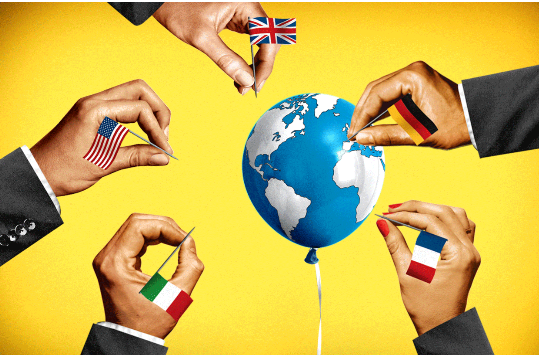
  • Globalization refers to people, capital and goods moving ever more freely across borders. Globalism is the ideology that globalization should lead to global governance over national sovereignty. This refers to such global structures as the European Union, the World Trade Organization, NATO, the United Nations and the North American Free Trade Agreement.
  • The problem is not globalization itself, which just means specialization and trade across borders, but rather the damage which breakneck globalization has inflicted on ordinary workers. Since China joined the WTO in 2000 a wave of Chinese imports wiped out 2 million American jobs, with no equivalent boom in the U.S. from exports to China.
  • Globalists have been blind to the nationalist backlash because their world – entrepreneurial, university-educated, ethnically diverse, urban and coastal – has thrived as the whiter, less-educated hinterlands have stagnated.
  • Globalists should not equate concern for cultural norms and national borders with xenophobia. Large majorities of Americans welcome immigrants so long as they adopt American values, learn English, bring useful skills and wait their turn. Opposition to open borders does not imply racism.

Conclusion. Says Avik Roy, President of the Foundation for Research on Equal Opportunity, “There is a middle ground between a nationalist and globalist approach.”  This is what we should be looking for.

Follow me on Twitter
Follow me on Facebook

The Meaning of 2016


For my last blog post of each year I briefly summarize the main events of the preceding year and then try to evaluate their significance. Last year I was badly off in one respect. I said that the rise of Donald Trump was a disaster for the Republican Party because he could not possibly be elected president!  I badly underestimated the force of populism sweeping the country.
Here are the main events of 2016:

  • Brexit. On June 23 Great Britain voted 52% – 48% to leave the European Union. Elite opinion advocated staying in and the polls predicted majority support for staying. The world was shocked when the vote went the other way.
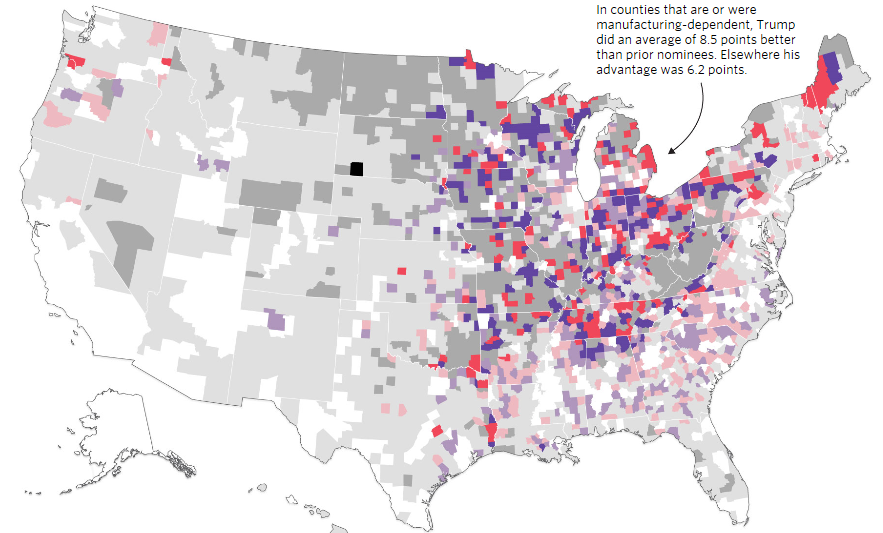
  • Donald Trump was elected the next U.S. President on November 8. The polls predicted a Hillary Clinton victory and she in face won the popular vote by a 3,000,000 vote margin. But Trump squeaked by in the Electoral College by winning the rust belt battleground states of Michigan, Pennsylvania and Wisconsin by a combined total of 100,000 votes (see attached map to understand the Trump electoral vote margin).capture17
  • The Mid-East Refugee Crisis, Terrorism and Russia’s Vladimir Putin were even bigger problems in 2016 than in 2015 and will present huge challenges to Donald Trump when he becomes President on January 20.

Granted that Trump was elected by a slim electoral vote margin and a smarter campaign by Clinton could have led to a different outcome, nevertheless for such a sleazy, non-politically correct candidate to have done so well, has huge significance. It constitutes a major slap down of elitism:

  • Consider where our most recent presidents went to college: Reagan (Eureka College), George H.W. Bush (Yale), Bill Clinton (Yale Law), George W. Bush (Yale), Barack Obama (Harvard Law) and Donald Trump (Fordham). In other words, Trump will be the only president since Reagan not to have graduated from Harvard or Yale.
  • Consider that since John Paul Stevens (Northwestern Law) retired from the Supreme Court in 2010, every current Supreme Court Justice has graduated from an Ivy League Law School.
  • Consider that most nationally prominent Republicans, including members of Congress, shunned Donald Trump on the campaign trail even as his poll numbers steadily increased. In other words he was elected largely without the help of the Republican establishment.

Conclusion. The American voters have decided to take a big chance on a nontraditional presidential candidate. Are the voters collectively smarter than the elites to whom they usually turn for leadership?  I am optimistic that the answer will turn out to be yes!

Follow me on Twitter
Follow me on Facebook


Bush Failures Led to Obama and Obama Failures Led to Trump


As I have previously stated, I voted for Hillary Clinton because Donald Trump is so crude and sleazy even though our country will now greatly benefit from the change which Mr. Trump represents.  This is the way the political process often works.

capture79 Consider that after eight years of George Bush we had:

  • Ongoing war in Iraq and Afghanistan, of which the Iraq war was an unnecessary mistake.
  • $2.5 trillion of additional debt, even after Mr. Bush started out with a budget surplus, compliments of Bill Clinton.
  • An expensive new Medicare Part D prescription drug plan which just makes overall Medicare even less affordable than it already is.
  • The Financial Crisis of 2007-2008 which the Bush Administration could have seen coming if they had been more vigilant.


Under such political circumstances, the 2008 election of the Democratic nominee, Barack Obama, over the Republican nominee, John McCain, was almost inevitable. But then in the next eight years we have experienced:

  • Slow economic growth averaging only 2% per year, ever since the end of the Great Recession in June 2009. The unemployment rate has fallen to 4.9% but there is still a lot of slack in the labor market which holds wages down. This is the main reason for the huge support Mr. Trump had from white blue-collar workers in the election.
  • Massive debt, now 76% of GDP (for the public debt on which we pay interest), the highest since right after WWII and double the debt in January 2009 when Mr. Obama entered office. Such a high debt level means greatly increased interest payments as soon as interest rates go up which they are likely to do anytime. The high annual deficits contributing to the debt mean little budget flexibility for new programs.

Conclusion. Democrats like to say that slow economic growth is “the new normal” which can only be overturned with budget busting new fiscal stimulus. This is a pessimistic point of view which refuses to consider other alternatives.  This is what led to Ms. Clinton’s defeat on November 8.

Follow me on Twitter
Follow me on Facebook

Election Day 2016: The Fourth Anniversary of this Blog


I have now been writing this blog for four years, beginning right after the presidential election of 2012. I was a candidate in the May 2012 Republican Primary for the 2nd Congressional District of Nebraska.  I campaigned on the platform to “eliminate the deficit.”  I lost to the incumbent Lee Terry who was in turn replaced in office by the Democrat Brad Ashford in 2014.

capture79
The overriding theme of my blog is “how to restore fiscal responsibility to our national government.”   I discuss two fundamental and related issues:

  • Massive Debt now 75% of GDP, the highest level since right after WWII, and predicted by the Congressional Budget Office to keep rising steadily under current policies.
  • Slow Economic Growth averaging just barely 2% per year since the end of the Great Recession in June 2009. Although the unemployment rate is down to a respectable 4.9%, the labor participation rate is also lower than usual. Faster growth would mean more jobs and better paying jobs. It would also mean more tax revenue to shrink our annual deficits.

How should these problems be addressed?  In briefest outline:

  • Balanced Budget Amendment to the Constitution. This is a drastic measure but I see no other way to get the job done. The pressure on Congress is always to create new programs and spend more money, not less. A BBA could be designed in a flexible manner to allow emergency overrides. It could also be phased in by, for example, having an effective date three years after ratification. It so happens that 28 states (out of 34 needed) have now called for a Constitutional Convention to propose such an amendment. (http://bba4usa.org/)
  • Tax Reform, lowering rates for individuals and corporations, paid for by shrinking deductions, would do wonders for encouraging business investment and entrepreneurship, as well as encouraging American multinational companies to bring their foreign earnings back home for reinvestment.

Conclusion. Much more can be done but this would be a very good start.

Follow me on Twitter
Follow me on Facebook

Clinton Is Not As Bad As Trump


I’ve been saying for several months that I would endorse one of the two main presidential candidates before the election and that “Donald Trump Should Withdraw from the Presidential Race” because of his personal sleaziness and that, in any case, I could not vote for him.
But it is worse than this.  As the Wall Street Journal stated recently, “Mr. Trump would start out with more than half of the country disliking him, and most of his advisors lack governmental experience.  Too many blunders or an early recession (especially one caused by trade restrictions) could cause voters to sweep out the GOP Congress in 2018, setting up a return to an all-progressive government in 2020.” In other words the disaster of 2009-2010, when President Obama had a filibuster-proof Congress, could easily happen all over again.

capture79
Mrs. Clinton has said that she wants, ”higher taxes, more spending on entitlements, more subsidies and price controls in ObamaCare, more regulations on business, more limits on political speech, and more enforcement of liberal cultural values on schools and churches.”  The likely result of such an agenda would be more lost years of slow economic growth.  And “the costs of slow growth are corrosive.  Flat incomes lead to more social tension and political enmity.  The fight to divide a smaller pie would get uglier in a country that once was accustomed to rising possibilities.”  This is a highly conceivable result of four years of a Clinton presidency.
Conclusion. I am not exactly enthusiastic about Mrs. Clinton.  But she is predictable and much less risky than Mr. Trump.  As long as the House of Representatives remains under Republican control, which is very likely, Mrs. Clinton will have to negotiate with it to implement much of her agenda.  This could conceivably lead to bipartisan progress on such major issues as tax reform and entitlement cost control.

Follow me on Twitter
Follow me on Facebook


The Political Predicament We Are In


I am an optimist by nature. I am used to having things go well.  If they’re not quite right, I try to imagine how they can get straightened out.  I’m also a realist.  As long as things are moving in the right direction, I am satisfied with the status quo.
Although my optimism is natural and intuitive, I find an intellectual justification for it in, for example, the work of Matt Ridley: “The Rational Optimist: how prosperity evolves.”  He makes a persuasive argument that not only has the humane race made huge strides in recent times but that this progress is intrinsic to evolved human nature and is likely to continue indefinitely.
The British historian, Andrew Roberts, has a cogent essay in yesterday’s Wall Street Journal, “1776: Would You Like to Reconsider?”, expressing consternation about the horrible choice we have for president this year between vulgarity and corruption.

capture77
Mr. Roberts admonishes Republicans to:

  • Somehow find party leaders and candidates who confront people like Mr. Trump seriously from the start and do not coddle him in the vain hope that he’ll collapse.
  • Avoid having debates controlled by TV channels who want the GOP to split and the Democrats to win.
  • Avoid talking down America, even in an election year, which is likely to be misinterpreted abroad.
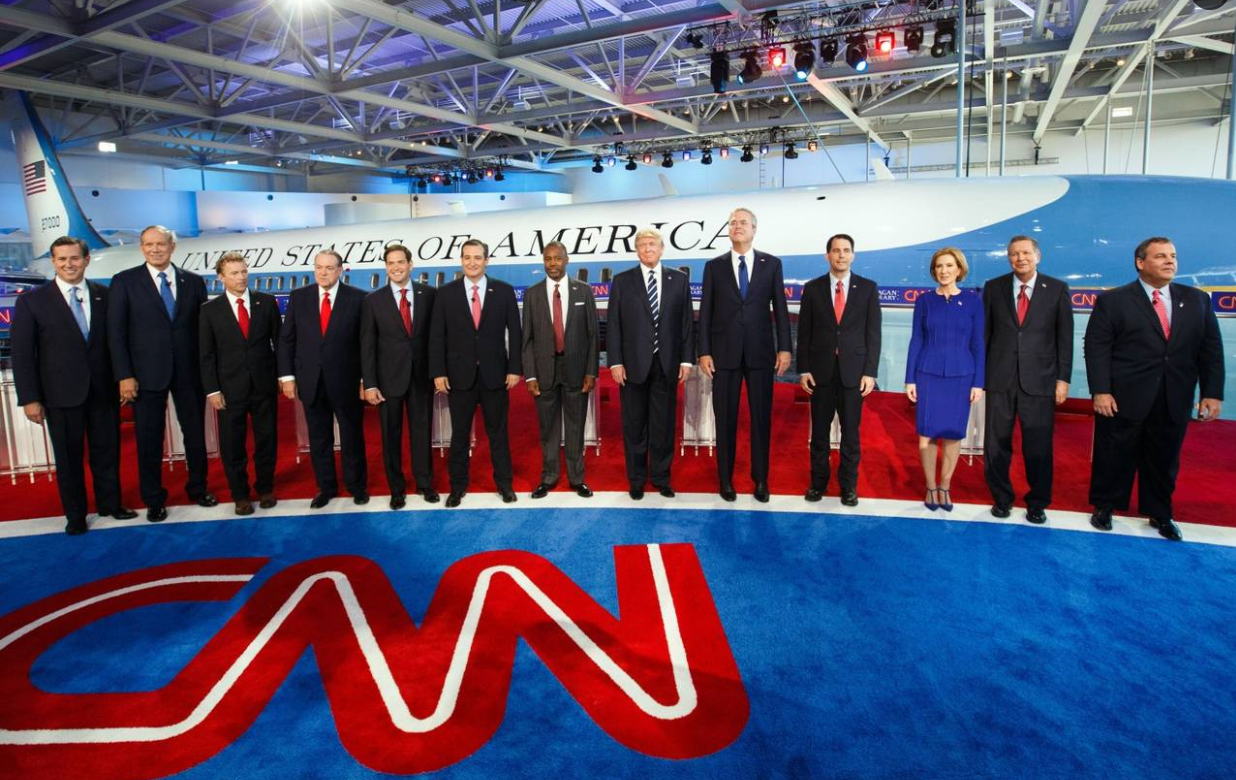
  • Drastically raise the percentages of support that guarantee a candidate a place in the debate in order to avoid too many candidates and moronically low standards of debate.
  • Figure out how to exclude candidates who have neither held public office nor held any previous significant (appointed) public position.
  • The Republican Party machine should have the last say on who is or is not a Republican and who can therefore stand under the Republican banner.

Of course, Mr. Robert’s suggestions are impractical because they are not sufficiently democratic! But he is pointing to a huge problem which must be addressed:  Right now democracy, as a political system, is on trial and is “losing out to the ideas of totalitarian state directed corporatism that seems to be delivering much higher growth and much better leaders.”
Question. Can democracy be saved with democratic methods?

Follow me on Twitter
Follow me on Facebook


The Grand New Party


With the presidential election tightening and Hillary Clinton still the favorite to win, more and more attention is being devoted to trying to figure out what will happen to the GOP after Donald Trump. William Galston from the Brookings Institute sees a three-headed Republican party:

  • Wall Street i.e. establishment (fiscal) conservatives.
  • Main Street i.e. small government conservatives who think that government is the main obstacle to growth.
  • Populists i.e. non-ideological working class people who feel left behind by the modern world.

The Wall Street Journal is analyzing the Trump phenomenon with a series of articles, “The Great Unraveling” based on an underperforming U.S. economy:

  • Technology has not led to broadly shared prosperity.
  • The Federal Reserve did not foresee the financial crisis and hasn’t delivered adequate growth.
  • Trade with China has put millions of Americans out of work.

Today’s WSJ, “Republicans Rode Waves of Populism until They Crashed the Party,”  describes the transformation of the Republican party all the way from Richard Nixon’s southern strategy, Pat Buchanan’s anti-immigration appeal in 1992, the Tea Party uprising in 2009 and 2010 until today’s populist rebellion against the establishment.

capture76The map above shows the huge political realignment which has taken shape between 1996 and 2012 and is undoubtedly even more pronounced in 2016. The main question for me is whether and to what extent the three main Republican factions can come together on important policy issues such as immigration and trade:

  • Immigration. In the last debate Mr. Trump said that after the border is secured, and the “bad guys” are deported, then we’ll figure out what to do with the rest of the undocumented immigrants. This suggests a workable approach to the illegal immigration problem.
  • Trade. The challenge is to figure out how to make the proposed Trans Pacific Partnership trade agreement compatible with the interests of working Americans.

Conclusion. Regardless of the outcome of the November 8th election, Donald Trump has had a huge effect on American politics.  Whichever party is most successful in appealing to the core working-class Trump voters will have a huge advantage in the 2020 elections.

Follow me on Twitter
Follow me on Facebook