Concrete Actions Which Can Be Taken to Fix the Debt

My last post, “Why It Is So Difficult to Fix Our Debt Problem” made the case (I hope!) that there is really only one practical way to fix our debt problem.  It is to control the cost of healthcare spending in the U.S. and especially the cost of entitlement healthcare spending such as for the programs Medicare and Medicaid.  In fact, Medicare by itself is the biggest part of this problem.

Consider that:

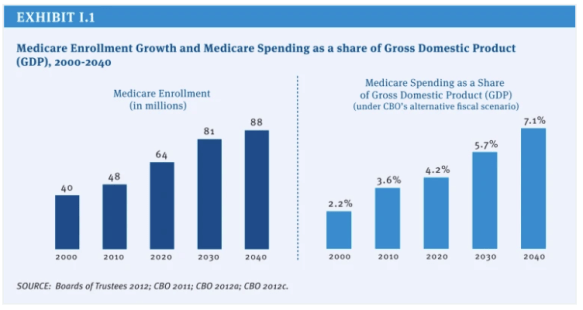
  • In 2018 there were 60 million Medicare recipients and this number is projected to reach 81 million by 2030, just ten years away (see chart):Capture92
  • Medicare spending, 4.2% of GDP in 2020, is projected to reach 7.1% of GDP by 2040.  Again, as pointed out in the previous post, Medicare is the fastest growing single government program in our entire country.

    This means that strong action needs to be taken to control the rise of Medicare costs as well as other public healthcare programs such as Medicaid.  For example:

  • Let Medicare negotiate drug prices with pharmaceutical companies. This is currently banned under the ACA and so will require congressional action.  It would have the effect of lowering drug prices for all Americans.
  • Require Medicare recipients to pay more than the 59% of the cost of their healthcare benefits which they now pay.  This could be done on a means-adjusted basis so that the affluent, at least, would pay the full cost of their own healthcare and with even middle-class recipients paying more, say 50% of parts B and D, than they pay at present.
  • Put Medicaid on a block-grant financial basis so that the federal government pays only a fixed amount to each state (increasing with inflation) rather than a fixed percentage of the expenses of each state. This will not only control the federal cost but also give the states a greater incentive to control their own Medicaid expenses.
  • (blunderbuss last resort) Medicare prices for all. Note that I did not say “Medicare for All” as has been proposed by several Democratic presidential candidates.  Medicare has a reasonable price control system which could be used for all of U.S. healthcare.  All of the world’s other advanced economies have both universal healthcare coverage and price controls of some sort for all medical expenses.
  • The CEO, Michael Hansen, of the Columbus (NE) Community Hospital has figured out to prosper financially with Medicare and Medicaid payment rates for most of his patients. This is reported (pages 66 – 69) in the book “The Price We Pay” by Marty Makary, MD

Conclusion.  The U.S. national debt is a very serious problem which must be addressed by our national representatives in the very near future.  Controlling the cost of the healthcare entitlement programs, Medicare and Medicaid is by far the best way to make significant progress on this huge problem.

Follow me on Twitter 
Follow me on Facebook 

Why It Is So Difficult To Fix Our Debt Problem

The national debt is now over $23 trillion and growing at the annual rate of $1 trillion per year.  This is not only a very serious problem (see chart below), which will eventually cause enormous harm if not corrected, but it is also a very difficult problem to solve politically.

Capture91

First of all, there are many proposed solutions which simply will not work such as:

  • Modern Monetary Theory (ignore the debt until inflation strikes). The problem is that when inflation does take off someday, as it almost assuredly will, then interest rates will rise dramatically, and interest payments on the debt will explode.  This will lead to a  new financial crisis much worse that the Great Recession of 2008-2009.
  • Issuing long term bonds at low interest rates to finance the debt. Of course, we want to pay the lowest possible rate of interest on our debt.  But long term, low interest bonds merely postpone the eventual problem of much higher interest payments on the debt.  It lulls us into complacency in the meantime while we continue to accumulate massive amounts of new debt.
  • Growing our way out of debt. Our current trillion dollar annual deficits are increasing the debt by over 4% per year.  Projected annual growth going forward of 2% per year is simply inadequate to reduce the debt as a percentage of GDP and will, in fact, allow it to get progressively worse.
  • Cutting military spending. The current military budget is about $750 billion per year.  Let’s suppose that 10% is waste which can be eliminated.  There are two problems with this approach.  It will be very difficult for Congress to agree on how to cut $75 billion from military spending.  Furthermore $75 billion is less than 10% of the $1 trillion size of the current deficit and so would be little more than a drop in the bucket towards solving the underlying problem.
  • Cutting other discretionary spending such as for education, agriculture, foreign aid, etc. The same problem as above.  It would take a huge amount of effort by Congress, largely fruitless, to save only small amounts of money, not nearly enough to shrink the annual deficits significantly.

Secondly, the real problem, entitlement spending, is not sufficiently clearly understood as the real culprit:

  • The entitlements Medicare, Social Security and Medicaid all represent big chunks of federal spending (see chart below):

    Capture43

  • Entitlement spending (Medicare, Social Security and Medicaid) represents by far the largest growth in federal spending, going forward (see chart below), with Medicare the biggest expense of all:

    Capture4

  • The federal government pays 41% of all Medicare costs so that Medicare recipients pay only 59% of the costs (see chart below). Note that the Medicare payroll tax of 2.9% funds Part A (hospitalization) only.  The remaining Parts B (doctors), Part C (Medicare Advantage) and Part D (drugs) are paid for from federal government revenues.

    Capture45

  • Here is a breakdown of the average federal subsidy to Medicare per individual, based on retirement year. A retiree in 2020, for example, will receive a $400,00 lifetime subsidy from Medicare (see chart below):

    Capture232

  • The total annual federal contribution to Medicare is now about $600 billion per year and rising rapidly (see chart below):

    Capture44

Conclusion:  Medicare represents by far the biggest single drain on federal revenues for the future.  It is therefore a huge threat to the solvency of the federal government.  Any serious plan to solve the federal debt problem must start with major reform of Medicare.

Next:  how should entitlement spending be controlled?

Follow me on Twitter
Follow me on Facebook 

In Spite of Our Problems, America is Thriving!

It is common these days for commentators to declare that America is in decline. For sure we have problems which are quite visible, such as:

Polarized politics and impeachment.  President Trump has been impeached by the House of Representatives but is almost certain to be acquitted by the Senate.  Congress still functions in the meantime and passes essential legislation such as annual budgets.  The polarization is a result of the increasingly nationalistic views held by workers who feel deserted by the elite establishment.  Global expansion of trade will continue but at a slower pace while adjustments are made to help displaced workers catch up.

Homelessness.  Los Angeles has an estimated 44,000 homeless people living on its streets. Homelessness is worsened by the rapid influx of high paid tech workers into our largest cities which results in a huge housing shortage. See picture below:


Opioid crisis.  Approximately 45,000 Americans die each year from opioid overdoses, about the same number as are killed by guns. The answer here is for tighter control of opioid prescriptions by physicians which is beginning to happen.

The high cost of healthcare.  American’s pay far too much for healthcare, compared with the rest of the world. See here and here. Solving this difficult problem is the only way to get our national debt under control.

But now contrast these serious but solvable problems with progress now occurring in the U.S. and around the world:

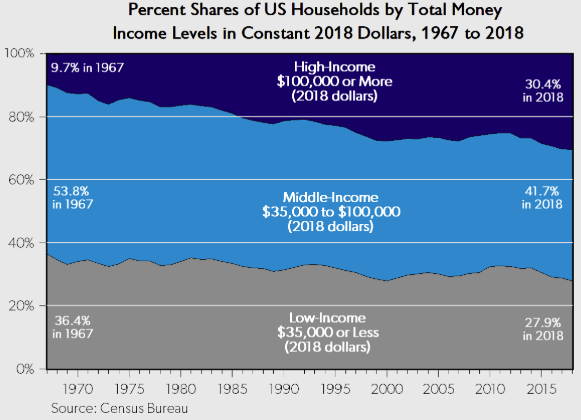
 The rapidly growing middle class.  Since 1967, there are fewer and fewer and fewer low-income households and a concomitant expansion of middle-income and higher income households.  See chart below:

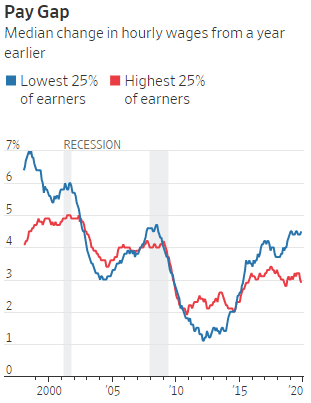
Low wage workers are finally getting the biggest raises.  In the last few years the wages of the lowest paid workers are finally beginning to increase significantly. This is because the unemployment rate, under 4% (3.5% in November 2019) for almost two years, has created a major labor shortage. See graph below:

The advance of technology.  The top five public companies in the world, by market value, are American technology companies.  Our domination of technology world-wide vividly illustrates the overwhelming superiority of our free enterprise economic system.

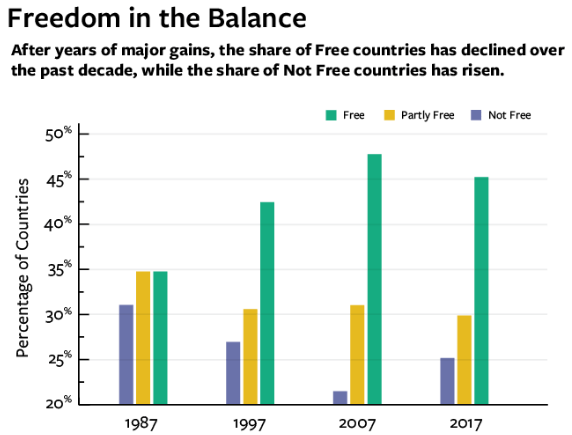
Freedom and democracy around the world.  Freedom House rates democracy around the world as very strong even if there are several instances of nationalistic retrenchment.  See chart below:

The world is getting better overall.  In 2019 illiteracy and poverty fell around the world. Access to electricity and piped water rose. 

Conclusion.  The U.S. is very strong, both economically and militarily. Our immediate, pressing problems are minor compared to our great strengths.  The outbreaks of nationalism around the world are being addressed through democratic processes and represent no serious threat to the continued increase of freedom and prosperity in the U.S. and elsewhere.

Follow me on Twitter
Follow me on Facebook

Controlling Healthcare Costs II. Private vs Public Costs

I have recently discussed in detail the rapidly increasing costs of American healthcare.

I have suggested ways in which the costs of our public healthcare programs, Medicare and Medicaid, can be controlled.

But the cost of private healthcare is increasing even faster than for the public programs.  For example, the cost of Medicare has increased by 21.5% in the last ten years, the cost of Medicaid has increased by 12.5% while the cost of private insurance has increased by 52.6%.

Capture85

The International Federation of Health Plans (iFHP) has clearly described the high costs of American healthcare compared to other countries.  For example:

  • Bypass surgery was less than half the price for the U.S. in all the other countries included in the study (see below).

    Capture86

  • The average cost of bypass surgery in the U.S. is $78,000 while the second highest cost (New Zealand) is $37,800 (see below).

    Capture88

  • Drug prices for most countries were less than half the U.S. price for almost all of the administered and prescription drugs included in the study (see below).

    Capture87

How are these exorbitant prices for private American healthcare being paid?  It turns out that individual company employees are paying gradually increasing out-of-pocket costs (premiums and deductibles).  But primarily it is employers who are paying the major share of the increased costs.  Of course, this means that base employee salaries and wages are substantially less as a result (see below). 

Conclusion.  The cost of American healthcare is much too high for both individuals and the government. The rapidly increasing federal government costs are the primary cause of our rapidly increasing annual deficits and therefore to our out-of-control national debt.  Private healthcare cost increases are largely paid for by employers which means less pay for employees.
So far only Medicare and Medicaid have been able to exert any meaningful cost control and this has been done with strict price controls.  It is unlikely that private companies will be able to develop the clout to limit their healthcare costs in any significant way.  This means that overall strict price controls for all of U.S. healthcare are almost inevitable.

Follow me on Twitter 
Follow me on Facebook 

Controlling Healthcare Costs. What Are the Options?

In my last post  I summarized the latest data showing how high and out-of-control American healthcare costs have become, both for individuals (and families) and government.

Capture

For example, the cost of health insurance for the average American family is now $20,576 per year.  Many people without adequate insurance are being forced into bankruptcy.

Even though Medicare recipients pay 60% of their healthcare costs, the remaining 40% paid for by the federal government was $591 billion in 2017.  This enormous federal expense is increasing rapidly and is one of the main drivers of our out-of-control national debt which is now increasing (through annual deficits) at the rate of $1 trillion per year.

Drastic action is needed.  Here are some possible initial steps:

  • Let Medicare negotiate drug prices with pharmaceutical companies. This is currently banned under the ACA and so will require congressional action.  It would have the effect of lowering drug prices for all Americans. Nebraska Representative Fortenberry supports doing this.
  • Require Medicare recipients to pay more than 60% of the cost of their healthcare benefits. This can be done on a means-adjusted basis so that the affluent, at least, pay the full cost of their own healthcare with even middle class Medicare recipients paying more than at present.
  • Put Medicaid on a block-grant financial basis so that the federal government pays only a fixed amount to each state (increasing with inflation) rather than a fixed percentage of the expenses for each state. This will not only limit the federal cost but also give the states a much greater incentive to control their own Medicaid expenses.

The blunderbuss approach if nothing else gets the job done:

Capture41

  • Medicare prices for all. Note I did not say “Medicare for All” as is popular amongst the Democratic presidential candidates.  Medicare has a reasonable price control system which could be used for all of American healthcare.  All of the world’s other advanced economies have both universal healthcare coverage and price controls of some sort for all medical expenses.

Summary.  Healthcare costs in the U.S. are out of control and drastic action is needed to rein them in.  If moderate initial steps are not effective in getting the job done, then overall price controls, along the lines of what Medicare does already, will be necessary.  Americans, take heed of this urgent problem!

Follow me on Twitter 
Follow me on Facebook 

The Rapidly Increasing Costs of American Health Care

I keep close track of health care costs on this blog because the cost of public health care (Medicare, Medicaid, and the tax exemption for employer provided care) is the major driver of our national debt which is totally out of control.

Healthcare costs are also an increasing economic burden for families and individuals.  Here is the latest bad news on this serious problem:

  • Total health care spending in the U.S. increased 4.6% in 2018 to reach $3.6 trillion or $11,172 per person, with 33% going to hospitals care, 20% to doctors and clinical services and 9% to retail prescription drugs. For the federal government, spending growth on health care accelerated in 2018 by 5.6%, compared to an increase of 2.7% in 2017.
  • The average annual premiums for employer-sponsored health insurance in 2019 are $7188 for single coverage and $20, 576 for family coverage. The average premium for family coverage has increased 22% over the last five years and 54% over the last ten years, significantly more than either worker’s wages or inflation (see chart).
    Capture83
  • The average employee premium contribution and deductible as a percent of median household income has gradually increased from 2008 to 2018 (see chart).
    Capture81
  • It is very informative to look at American income growth when taxes and all cash and in-kind transfers are taken into account including Medicare, Medicaid and Employer Sponsored Insurance (see chart).  Looking at it this way, the bottom quintile of income distribution has the greatest percentage gain since 1959 and the other quintiles show only small differences in growth.  It is clear from this diagram that the common media story of stagnant incomes is untrue especially when costly health care benefits are taken into account.
    See also here.Capture82
  • Where the Frauds are all legal.” One of my favorite experts on the problems with American health care is Elizabeth Rosenthal, who is both a physician and a medical journalist for Kaiser Permanente.  Read her devastating report on hospital billing procedures.

Conclusion.  The cost of American health care is growing rapidly and is a huge drain on society, both for workers with employer provided insurance (which greatly reduces their net income) and also for the government which pays for all of Medicaid and much of Medicare expenses.  It is vital to the future prosperity and well being of our country to rein in the cost of health care.

Next: what are our options for doing this?

Follow me on Twitter 
Follow me on Facebook

Jack Heidel’s Overall Political Outlook

I have been writing this blog, It Does Not Add Up, for seven years now, beginning in November 2012, right after Barack Obama was reelected to a second four year term as President.

I am a non-ideological (registered independent) economic conservative and social moderate.  I have definite opinions about many aspects of American public policy, which I believe are supported by careful reasoning and analysis of current events as well as ordinary common sense.

Capture80

Every now and then I pause to summarize my most basic public policy views which will usually determine how I come down on specific issues:

  • The overwhelming economic and military strength of the U.S. is responsible for the relative peace and stability which the world has enjoyed ever since the end of WWII.
  • The biggest challenge to U.S. world dominance going forward is the rise of China. It would be dangerous and foolhardy to assume that China will become less autocratic in the future (as much as we hope this will happen).
  • As China’s strength continues to grow, our biggest advantage in the coming bipolar world is the great appeal of democracy. Democracies rarely go to war with each other.  We should continue to support the growth of democracy around the world as much as we reasonably can without getting bogged down in local disputes.
  • Domestically our high degree of political polarization is caused by the populist revolt to the inexorable rise of globalization and technology. The biggest unknown is what will happen after President Trump leaves office in either January 2021 or 2025.  A Democrat will almost surely follow him as President.  The big question is how the Republican Party will reconstruct itself to provide effective opposition.
  • The best way to combat populism is with faster economic growth, especially focused on maintaining a low unemployment rate (under 4%). This is the single best way to provide more and better paying jobs for those on the bottom of the economic ladder.
  • Our biggest domestic problem by far is the rapidly growing and out-of-control national debt, now sitting at 79% of GDP (for the public part on which we pay interest). It is currently being ignored by most national leaders and many economists because interest rates, and therefore interest payments on the debt, are so low.  But interest rates will inevitably rise in the future, and the longer it takes for this to happen, the greater will be the eventual new fiscal crisis, much worse than the Great Recession of 2008-2009.  It is the rapid rise of entitlement and especially healthcare spending which makes this such a difficult political issue.
  • Man-made global warming is a serious and immediate environmental threat. But public awareness about it is so large (70% in the U.S. and growing), that strong measures are already being taken both in the U.S. and around the world to combat it.

Conclusion.  The U.S. has been the leading superpower in the world since 1945 and is in a good position to continue to dominate world affairs indefinitely, if it can just exercise reasonably good judgement.  As the world better adjusts to globalization and the rise of technology, political polarization will  begin to wane and more conventional political norms will again prevail.

Follow me on Twitter 
Follow me on Facebook 

Income Inequality in the U.S. III. Are Billionaires a Problem?

My last two posts, here and here, demonstrate that income inequality in the U.S. is really fairly mild, after taxes (state, local and federal) and government transfers are taken into account.  In fact, the average disposable household income of the bottom quintile is a surprisingly high $50,901. 

I also discuss several ideas for helping those in the lower echelons increase their chances of moving up to a higher level.  Equality of opportunity is an important American ideal and we can certainly do a lot better in trying to meet that ideal.

Are billionaires a problem because they create more inequality?  There are about 600 of them in the U.S. today.  But consider:

  • Innovators such as Jeff Bezos, Bill Gates or J.K. Rowling capture only about 2% of the economic value they create. The rest of it accrues to consumers.
  • The U.S. ranks 13th in the so-called Human Development Index which measures qualities of life such as longevity, amount of education and income levels for 189 different countries around the world.

    Capture79

  • The countries ranking ahead of the U.S. for HDI are mostly European and especially Scandinavian.
  • Believe it or not, ten of these high HDI countries have more billionaires per capita than the U.S! including the supposedly socialistic Sweden which ranks 6th in billionaires per capita.
  • The high ranking HDI “liberal-democratic welfare-state capitalist” countries are the most desirable countries in which to live and they all have lots of billionaires.

Conclusion.  Income inequality is simply not a significant problem in the U.S. and is blown way out of proportion by the media.  Even though billionaires are sometimes viewed as the public image of rampant inequality, in reality they are the highly visible sign of a successful society.

Follow me on Twitter 
Follow me on Facebook 

Income Inequality in the U.S. II. How Do We Alleviate It?

My last post points out that there is a relatively small degree of income inequality in the U.S., not nearly as bad as is commonly portrayed by the media, after taxes and government transfers are taken into account.  Nevertheless, it would represent progress if low-income people could earn higher salaries and not have to depend so much on government welfare programs to boost their disposable incomes.

How can this be accomplished?  A new book, “Unbound” by Heather Boushey makes a number of practical suggestions:

  • Increase early childhood education opportunities. “Children’s test scores at age seven can explain 4 percent to 5 percent of the variation in employment at age thirty-three.”
    Capture78
  • Increase social mobility. A child is better off in an environment “less segregated by race and income, with a strong middle class, better schools, better test scores, and with fewer single parent families.”
  • Maintain full employment. “One of the best ways to create opportunity is full employment.”  This, of course, is exactly what the Trump economy has accomplished.
  • High degree of market concentration. “One metric of the effects of high market concentration on innovation is the reduction in the number of startups.”  Interestingly, another new book, “The Great Reversal: how America gave up on free markets” by the economic conservative Thomas Philipon, makes the very same case.
  • The economic cycle. “We’re learning from evidence that broad prosperity for those on the bottom and middle rungs of the economic ladder not only reduce inequality but also can create better economic outcomes.”  This is precisely what our currently generous government transfer programs and low unemployment rates are already accomplishing.

Conclusion.  It would be much better to decrease income inequality by increasing market incomes of those on the bottom rather than doing it primarily with government transfer programs. Ms. Boushey has some good ideas for accomplishing this goal, several of which are already being implemented.

Follow me on Twitter 
Follow me on Facebook 

Income Inequality in the U.S. I. How Bad Is It?

Income inequality is a hot political issue in the U.S.  The 400 wealthiest Americans are each worth more than $2 billion.  The top 1% of American families have an annual household income of $422,000 or more.

Capture76

But let’s look at income inequality from a different perspective (see chart):

  • The average bottom quintile household earns only $4,908 while the average top quintile household earns $295,904 or 60 times as much. This is a huge difference but it is before taxes and government transfers.
  • The bottom quintile receives $45,389 in government transfers and $3,313 in private and charitable sources. They also pay an average of $2709 in taxes, mostly sales, property and excise, for a net household income of $50, 901.
  • The average top quintile household pays an average of $109,125 in taxes and is left, after taxes and transfer payments, with an income of $194,106.
  • This works out to a net income ratio of 3.8 as opposed to the above gross income ratio of 60. This is, of course, an enormous difference.
  • More generally, there is an annual $1.9 trillion in transfer payments to American households coming from 95 different federal programs such as Medicare, Medicaid and food stamps and dozens of state and local programs.
  • Government transfers make up 89% of resources available to the bottom quintile of households and more than 50% of resources available to the second quintile.
  • More than 80% of all taxes are paid by the top two quintiles. More than 70% of all government transfers go to the bottom two quintiles.

Conclusion.  “Antipoverty spending in the past 50 years has raised most of the households in the bottom quintile into the middle class.  … Any debate about further redistribution of resources needs to be tethered to these facts.”  Next: what more should we do to lessen income inequality?

Follow me on Twitter
Follow me on Facebook